This study was released in NEJM without much fanfare at the fag end of the last century, (rather the millennium) in 1999. Dr. Bertram Pitt and his team scripted this from the Department of Medicine, University of Michigan School of Medicine, Ann Arbor, USA. One can’t expect even in your dreams a study like this would be be done in the future.
This study tested PTCA vs with a single lipid lowering drug in terms of plaque regression. This conclusion is explicitly illustrated here, and the dramatically dissociated Kaplan and Myers would tell the whole story.
Can you name this trial that can withstand any period of time?
One clue : We do prescribe this drug every day and it beats angioplasty. Some of you may have got it right. Yes, It is the AVERT study: Atorvastatin versus revascularization treatment.(Ref 1) that dare to compare PTCA with a humble statin one to one, and we found the winner long long ago. This study also defined the bench mark for dosage of high intensity Atrovastatin at 80mg/per day.
Final message
I am sure, many of the current generation cardiologists may not know about this study and the conclusion might amuse them as well . The truth is , It deserves a 25-year anniversary celebration. Wishes and congratulations to Dr. Bertram Pitt.
A simple question with mammoth repercussions in the revascularization world.
How was the question ? Was it difficult ?
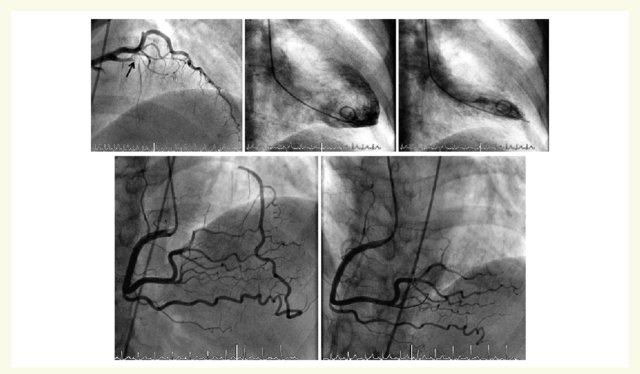
Don’t worry, it wouldn’t be the same even for elite cardiology experts worldwide. It is not a Himalayan task, though, to find an answer. All it requires is a simple FFR run through pre and post PCI (Now RFR, iFR, QFR). Surprisingly, very few inquisitive minds wanted to do this. I can find 5 related papers. The fifth one is very specific: REPEAT-FFR study. Go through at least that one paper and find the answer yourself.
Cardiology fellows it is worth reading about this important study , might be asked in exams.
Final message
The conclusions from these studies are not really baffling, but demand a lot of academic cleansing of our understanding about the relationship between epicardial patency and microvascular flow.”It is obvious from these studies that epicardial PCI never guarantees good revascularization with a FFR backing “
Every cardiologist should ask this question before they scrub, whether the PCI, they are going to do today, would improve the net-myocardial flow, LV function or symptoms . Are we doing justice to our patient (or blindly practicing science) who is quietly lying on the table, with a mix of anxiety and trust, with a complete belief that what they are undergoing is a life-changing or life-saving procedure.
Further, it is our duty to restore the lost glory to the defamed , stigmatised medical management of CAD & Impress our patients that “All that, doesn’t glitter could be pure gold as well”
There are a whole lot of scientists trying to jailbreak and expose the limitations of the hugely popular ISCHEMIA trial which put the emergency breaks in the way we used to practice cardiology. Not everyone is happy. While few are ready to apply the brake, many continue to love the accelerator.
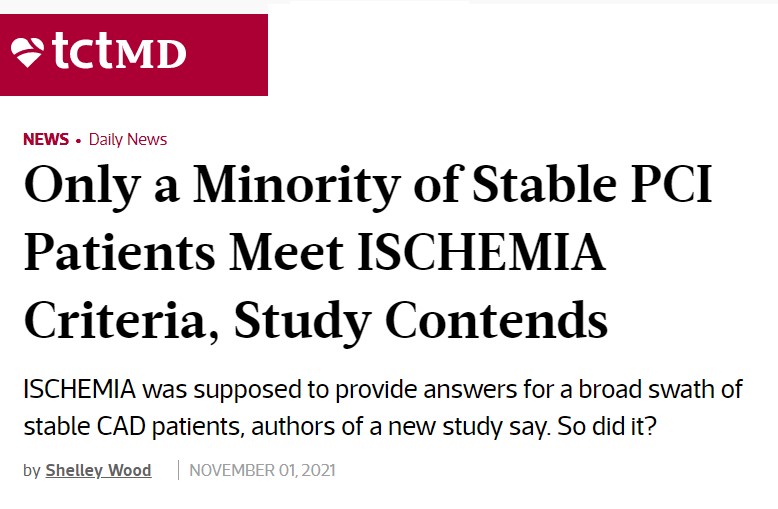
This study (Ref 1) talks about an important issue. How much of the CAD populations in the real world will match the ISCHEMIA trial population? It concludes it is just 32%. It suggests caution to the cardiologists to understand this trial from a proper perspective. Don’t give too much importance, lest we may end up with Inappropriate non-intervention.
The authors of ISCHEMIA have countered this claim. (Ref 2)If we include all mild and moderate symptom cohort Ischemia study population is very much relevant in the true world and, actually constitutes about 68 % .
Final message
Clinical trials are the greatest gift of science and EBM. But why is that …it never fails to confuse us at each and every step, while we accumulate tons and tons of evidence.
I wish someone do a mega four-limbed study on what really our patients are getting in the overall CAD care.
Inappropriate non-intervention
Appropriate Interventions
Inappropriate interventions
Appropriate non-Intervention.
I could easily guess the winning theme of this hypothetical trial. (That’s not good news though) However, response 4 If practiced in the right spirits would have the maximum impact on global cardiovascular health in terms of both healing and saving.
Why ISCHEMIA trial conclusions often make us nervous?
Because, we know we can’t follow the lessons from it with true intent, as many of us are near slaves to Invisible Interventional forces in some form or other.
I would think, ISCHEMIA trial in one sense was a wasted effort. We always knew OMT is superior to any sort of PCI in stable CAD (Backed up with COURAGE /BARI 2D/and of course the deadly exposure by ORBITA )
Anyway, we did ISCHEMIA for the sake of deniers, with huge public funding to prove the truth as truth.
Still, I am sure ISCHEMIA will be looked down, by most elite Intervenionlists. For the rest, it becomes a tough fight with their conscience.
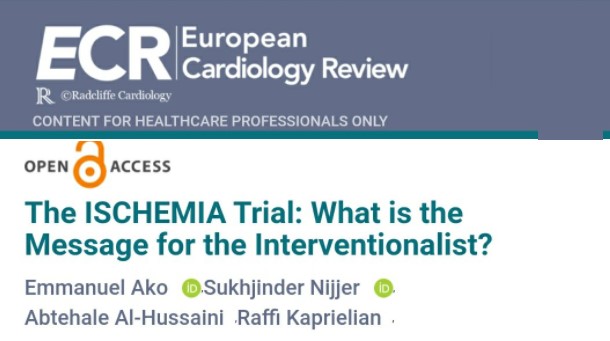
A recent review on European cardiology review
Final message
I don’t know, how many more trials would be required to tell us the same story all over again. Hope we grow enough COURAGE to follow the ISCHEMIA lessons. Let us (try to ) make a full stop on this issue.
Just roll over the virtual marker along the coronary lesion to get the underlying flow ratio. Blue is an absolute normal segment. Green is ok, orange and red slow-moving coronary traffic jam zones. it’s just like drawing a google map showing life traffic. No wire, no adenosine FFR comes inbuilt in every angio shot. Looks great Isn’t it? This is called QFR. Quantitative flow ratio derived from routine coronary angiograms. It can also guide us to find the optimal sites of both proximal and distal stent landing zone in the best physiological manner.
Which company makes this ?
Any studies done with QFR ?
FAVOR 2 study was reported in TCT. This modality is expected to evolve.
Final message
Whenever possible every anatomical lesion in the coronary should be substantiated by physiological parameter and possibly coronary Imaging to know plaque morphology and vulnerability. Though it is wishful thinking, still for all logistic reasons, most of the real world stenting will be based only on the blind anatomical luminogram.
At this point, please let me utter a non-academic hyperbole. Even a casual query to your beloved patients about their true symptoms and exercise capacity shall make these ultra-modern coronary physiology studies redundant in many. A well-performed and well-interpreted stress test is a good, objective, non-invasive indicator of coronary flow across lesions. It is wise to keep this as a basic clinical foundation in the evaluation of CAD,even as we continue to learn and forget half evolved modalities with rapid expiry dates like FFR, IFR, CT-FFR. QFR shows some promise though. Please watch for next in line coronary physiology – OFR, Optical flow ratio from OCT run through.
Practice of cardiology is simple as long we don’t dwell deep into coronary physiology.
One of my patients asked, why he was told his total occlusion in LAD appears safer now, which was subtotal a few months ago.I told him, it is indeed true. It is the fear of subtotal disease that’s prone to a fresh coronary event. In total occlusion, chances of that happening are less or nil.
How can you say 100% block is safe? Is that always true?
No, it’s not always true. He was surprised when I said it is not 100 %, even 90% lesion can be safe if it’s not causing significant angina and responding to OMT. Of course, It is the morphology and stability of the lesion that will dictate* the outcome in the subtotal occlusion. If the lesion is stable, FFR is good >.8 (TMT is poor man’s FFR equivalent ) you can leave it as it is. Doing OCT /Virtual histology /NIR spectroscopy to define the vulnerability of plaque is neither practical nor desirable (Extreme academics is injurious to health)
So it is not the degree of the block that’s going to matter, but the effects of that block on distal circulation that will decide the rules of the myocardial revascularisation game. But unfortunately, both you, (the patients) we (the cardiologist) are finding it so difficult to come to terms with this basic truth in spite of multiple guidelines.
Meanwhile, CTO however makes it much easier to make a decision. One need not bother the content of CTO unless you plan an Intervention. I guess there is no FFR for CTO. Are we aware of any studies that have quantified antegrade flow across a 10% patent LAD and compare it with the Collateral flow in LAD in 100% CTO?
We have long glorified a concept of the open artery hypothesis. (Mainly in Post STEMI though) No one has dared to test and compare a hypothesis that a closed artery might still score over the open in at least some of the subsets of stable CAD. Such a study can never be ethically forbidden after all its a well-observed truth in the real world.
Reference
Trials on CTO revascularisation DECISION CT (Not useful ) EURO-CTO (May be useful)
After three decades into cardiology profession, one thing is very clear. We work so hard to create pseudo-knowledge and struggle with it for so long and feel awkward and guilty to come out of the mess. But we have to . . . in the overall interest of mankind, isn’t?
We aptly call the whole process as continuing medical education, but in the melee, often we ditch some of the precious gems as obsolete. (This tempts me to suggest discontinuing false education is also an option for medical knowledge seekers !)
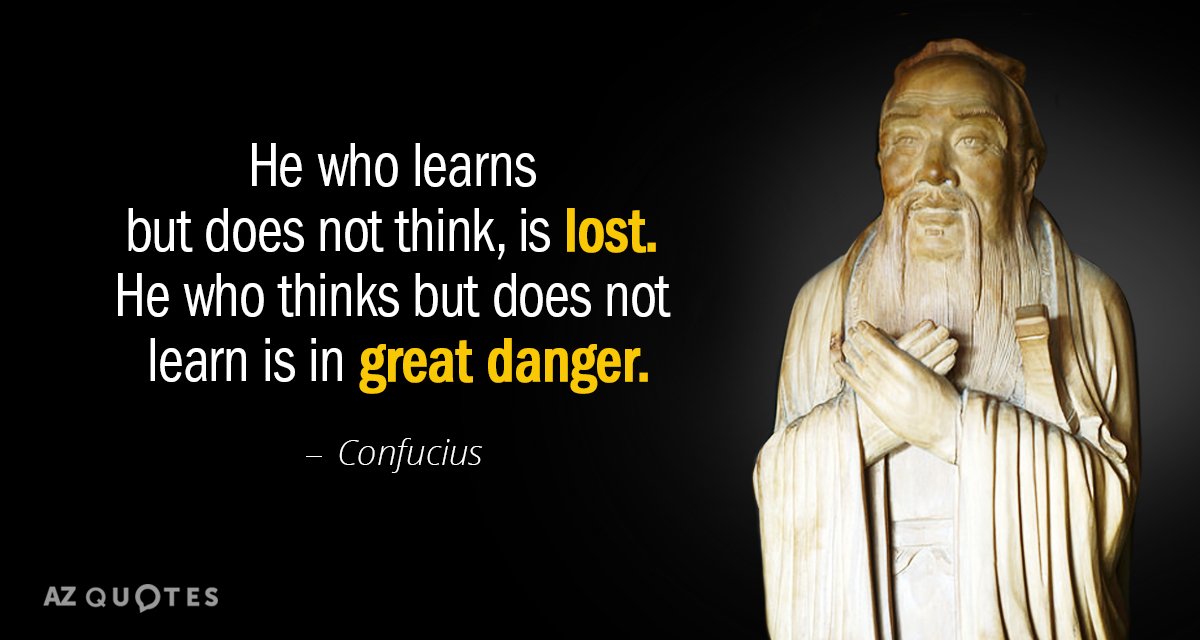
Confucius has something to say about this issue , which appears more relevant to the medical profession in current times.
The contents of the this blog is being published as Kindle E book , as per the request of many of the readers. Every article will continue to be open source in this site. Again I shall reiterate the book format is not aimed at any commercial intent. It is only to facilitate learning in a single book format Here is the link to book https://amzn.in/d/euhL5vu
Click below to see who is watching this website live !
This site will never aim for profit. Still ,this donation link is added at the request of few visitors who wanted to contribute and of-course that will help make it sustainable .
Please Note
The author acknowledges all the queries posted by the readers and wishes to answer them .Due to logistic reasons only few could be responded. Inconvenience caused is regretted.






 Dr.S.Venkatesan MD