We know human heart contracts and relaxes in an active manner .Systole happens when calcium is pumped from the cytoplasm into the actin myosin complex and diastole occur when the calcium is returnded back into the sarcoplasmic reticulam .The rate of calcium reuptake is detemined by the molecules calmodulin , phospholamban and it’s functional status .
When the heart fails acutely , as in asystolic cardiac arrest , does it fail in systole or diastole ?
The seemingly simple question can never be answered dogmatically.
Pathological studies of post moretm specimens suggest contraction band necrosis is a feature of systolic cardiac arrest .We are not yet sure yet . . . How a heart will appear when it stops in diastole .In fact , if a heart gets struck in systole it means systole has actually occured and because it fails to relax it assumes a stone like contracture state .
While the molecular basis are pretty much confusing , what is clear is we do get number of clinical situations where a acute diastolic dysfunction may occur.
Flash pulmonary edema
- Acute hypertensive LVF ( Especailly with renal HT )
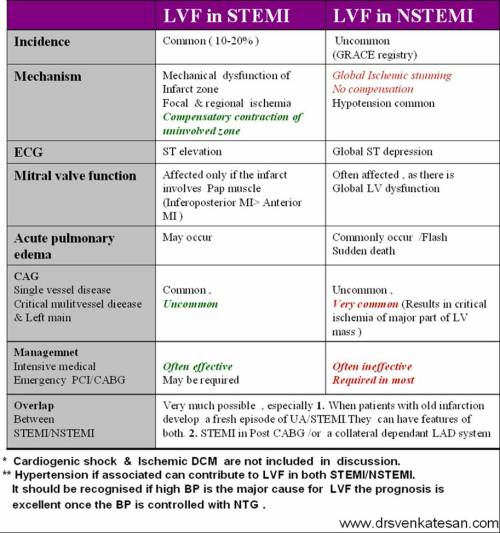
- Ischemic cardiogenic shock as in global ischemia and unstable angina .
- Raynaud’s phenomenon of heart * Diffuse coronary spasm induced acute relaxation failure .
The mechanism in the former could be sudden afterload mediated mechanical stunning while in the later ischemia mediated acute contractile and diastolic dysfunction.
In both situations there is severe pulmonary venous HT and class 4 pulmonary edema. The credance to concept of acute diastolic dysfunction came to light , when we noticed many of these patient with acute LVF had preserved EF % and absence of MR to explain acute pulmonary edema .
*Coronary vasospasm–induced acute diastolic dysfunction in a patient with Raynaud’s phenomenon http://www.springerlink.com/content/g1774g34544q2482/



 Dr.S.Venkatesan MD