PH is an important clinical cardio-pulmonary entity , which we confront day to day. Though the prevalence of PH in a community is just 1 % (25 times less than systemic hypertension) it deserves a special place as the diagnosis is more complex and outcome is often adverse.
The defining criteria , the classification, and grading of PH has always been a difficult and dynamic academic task .Right from WHO’s 1974 definition, we have 7 global symposiums , last one happened few months ago, in July 2024 in Barcelona.
We have made rapid strides in all aspects of PH right from molecular , genetic , imaging and therpeutics. Still, there is one important issue that has been overlooked for quiet some long. The concept of fitting PH in 5 groups based on etiology, though appear to simplify things, there is a significant flaw.
The overlaps in etiology
1.The group 1 contains the famous , (now obsolete entity of primary pulmonary hypertension) Idiopathic PH , meaning that we don’t know the cause of it or we have excluded all known causes. Meanwhile, group 5 also has set of conditions of PH of unknown or unclear etiology. So, a IPH of group one can migrate to either group 4 or group 5 or vice versa.
2.PH due to congenital heart disease can be in both Group 1 and 3
3.If you take PH due to some of the connective tissue order, I am sure, it can fall into any of the 5 groups

Suggestions for the next PH working group
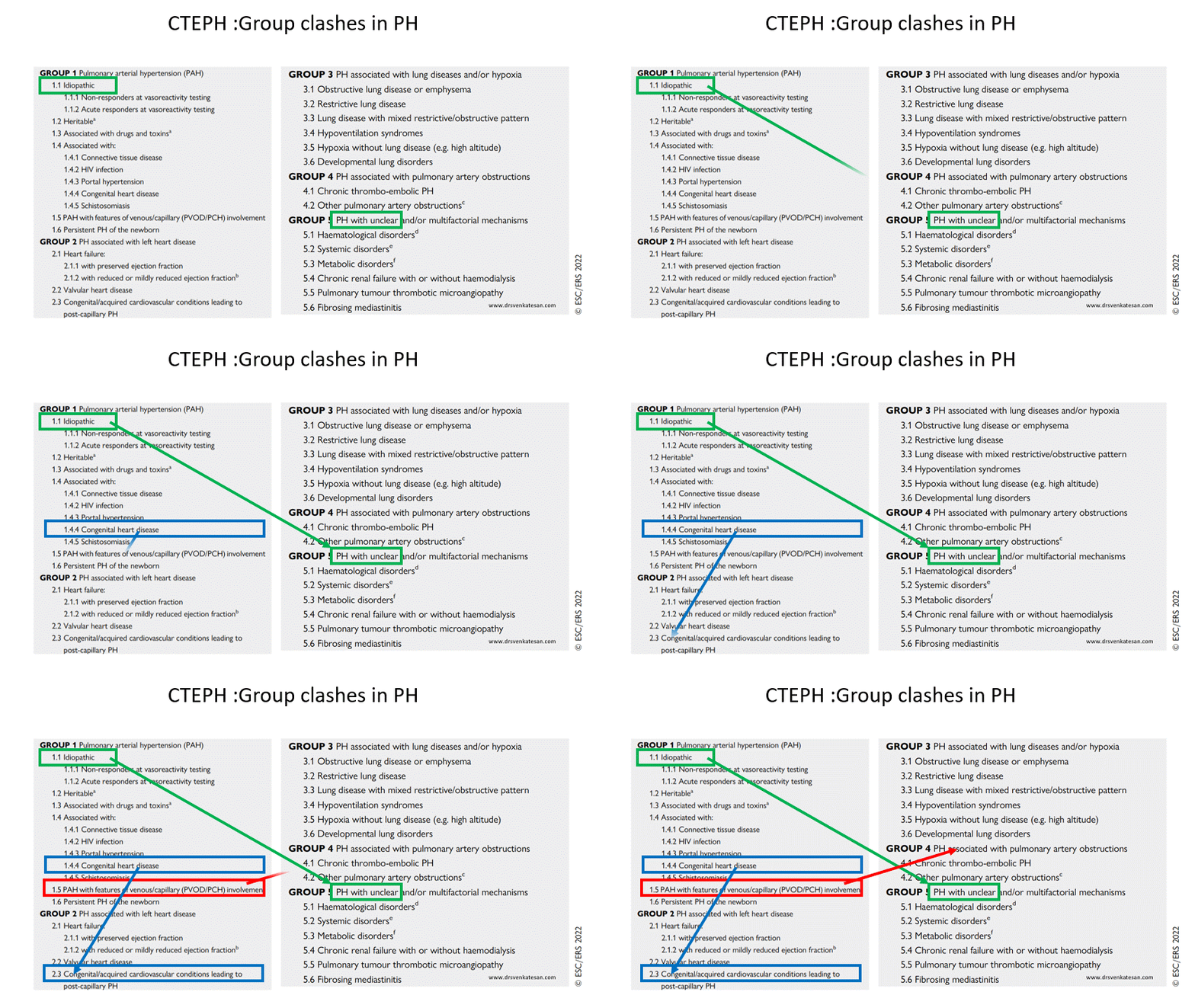
It is desirable that the next working group should acknowledge existence of inter and intra group overlaps of PH in a more clear manner. Either we should take away the groupism or the current definition of group 5 need to be more elaborate . It says multi-factorial. Instead we can try to find what are the groups it is likely to have an overlap. Should we need another a sixth group ? GO-PH (Group overlapping PH)
There can also be a place for combined etiological-hemodyanmic classification . (Example : Group 1 .Pre capillary .Group 1 Intra-capillary as in PVOD) . CTEPH though essentially is a precap PH, the risk factors of CTEPH and HFpEF can be shared one, making it combined pre and post cap PH a distinct possibility. )
Final message
While the problem of groupism in PH exists, the issue of highest importance in PH is something different. This is more philosophical . We need to be very clear what we mean by Idiopathic. As physicians, we must realize how relative this terminology is . What is idiopathic in your hospital, (However big you are) may turn out to be a missed case of mixed connective tissue disorder or silent CTEPH detected only by V/Q scan or a dual energy CT or a rare case of PVOD by judiciously reading a pulmonary angiogram in a dedicated PH center.
*Also we must recall, statistically up to 80% of PH is due to left heart (This HFpEF stuff has jacked this incidence still more ) and lung disease. Our efforts and resources should be used judiciously for optimal diagnosis and management of common conditions first.




 Dr.S.Venkatesan MD