Feeds:
Posts
Comments

Archive for March 18th, 2011

For  a police officer who visits a crime site  every one looks like   a culprit. For a cardiologist  sitting in coronary  care unit  all chest pain  will have to look like  an infarct  !  Then only he is a cardiologist !

A rare , but costly mistake occasionally  happens . When a  patient with severe chest pain in the  retro sternal region with ST elevation in ECG , enters the ER  there is little  reason to suspect any condition other than STEMI !

This is how medical  errors takes place

Medicine is an art , we can not take it as granted .Acute MI can present with normal ECG and a dramatic ST elevation need not be MI

Here  was  a patient who presented with this ECG and one our fellows correctly diagnosed the condition .

Most  physicians would have thromolysed this patient or  might have wheeled into cath lab.  We have such events reported from primary  PCI registry .

Key differentiating points

  • Diffuse ST elevation not confining to a arterial territory
  • Absence of reciprocal changes
  • ST  segment with concavity upwards.
  • Echocardiogram and enzymes will be useful

iFAQs  in pericarditis

What is the mechanism of ST elevation  pericarditis ?

It is actually a zone of epicardial or Sub epicardial injury.

What will be the ECG finding if STEMI is associated with fibrinous pericarditis ?

Double dose of ST elevation .Mimics  a re infarction.

What are the dangers of thrombolysing a patient with diffuse pericarditis ?

It can bleed into pericardial  space

What happens

What will be the ECG finding in localised pericarditis ?
Read Full Post »

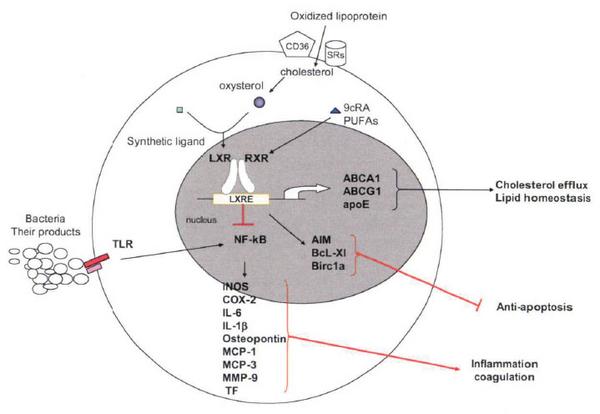
LXR are a unique group of nuclear receptor proteins located in liver as well many body tissues where lipid metabolism is active. They are first identified in liver with apparently no ligands ,  they are  hence referred to as  X (Also called orphan receptors ) .Later  these receptors can be termed as a target receptors for cholesterol metabolites like oxysterols .


How this nuclear receptors modify  the subsequent events could ultimately determine the toxic effects of cholesterol in human body.

An update in NEJM appeared in 2007

The the science of lipidology  is  confronted by  with  suspicious  ,  false targets .We are  biochemically still pitch blind  beyond a point . . . after cholesterol enters  the cell .

We have been targeting cholesterol synthesis by blocking HMGCOA.

Statins though claimed to be the God sent molecule , genuine researchers would agree statins  have a   huge  limitation  and it  is a  hyped up drug in controlling atherosclerosis. In fact ,  it is  believed  (In private ) nearly 50% of people who take statin  atherosclerosis goes  unabated.

Can we modify how  LDL  cholesterol is going to be utilised inside the cell ?

LXR family of proteins along with  RXR are expected to  break  the  barrier.In knock out mice models  LXR agonists are  able to control  and prevent LDL propagation within vascular cells .

The research is ongoing. Let us believe  the right target  has been identified . Nothing is guaranteed as of now . . . but out journey should continue .

http://en.wikipedia.org/wiki/Liver_X_receptor

http://www.nejm.org/doi/pdf/10.1056/NEJMcibr075951

Read Full Post »
