Cardiogenic shock occurs in 5% to 10% of all STEMI cases. The prefix “cardio” bothers us for all the wrong reasons. Though the shock component is initially triggered by primary cardiac pump failure, it soon spirals downward into a tissue level shock threatening the body’s 30 trillion cells. As cardiologists, we repeatedly fail to comprehend this. Instead, we aggressively attempt to revascularise the myocardium using multi-vessel PCI, IABP, ECMO, and LVADs. Yet, nothing seems to work. When tissues are irreversibly damaged a non-stop lactate ooze begins to ring a final pre death biochemical SOS call.
What is the Time Window for Tissue Perfusion?
For myocardial cell death, we have a defined therapeutic window of 12 hours, with under 6 hours being ideal. In cardiogenic shock, however, we face an unknown time window. During this uncertain period, cells within vital organs like the kidneys, liver, and lungs lose their structural integrity and face irreversible injury.
As far as I know, there is no defined timeline for intervention in cardiogenic shock. The inflection point between reversible and irreversible shock varies individually because it is a complex, systemic spiral. But, one thing we must be clear. The clock does not start at the moment of infarct-related artery (IRA) occlusion. Rather, it starts when cardiac index drops below critical threshold required to sustain cellular respiration. Note the emphasis on flow. Beyond a certain point, blood pressures have nothing to do with actual flow. This explains why systolic and mean arterial pressures do not correlate well with the severity of shock. We must never forget the concept of nomotensive shock .
Current Criteria to Diagnose Cardiogenic Shock
We have known this for a long time. To establish a diagnosis of cardiogenic shock, a patient must meet a triad of criteria:
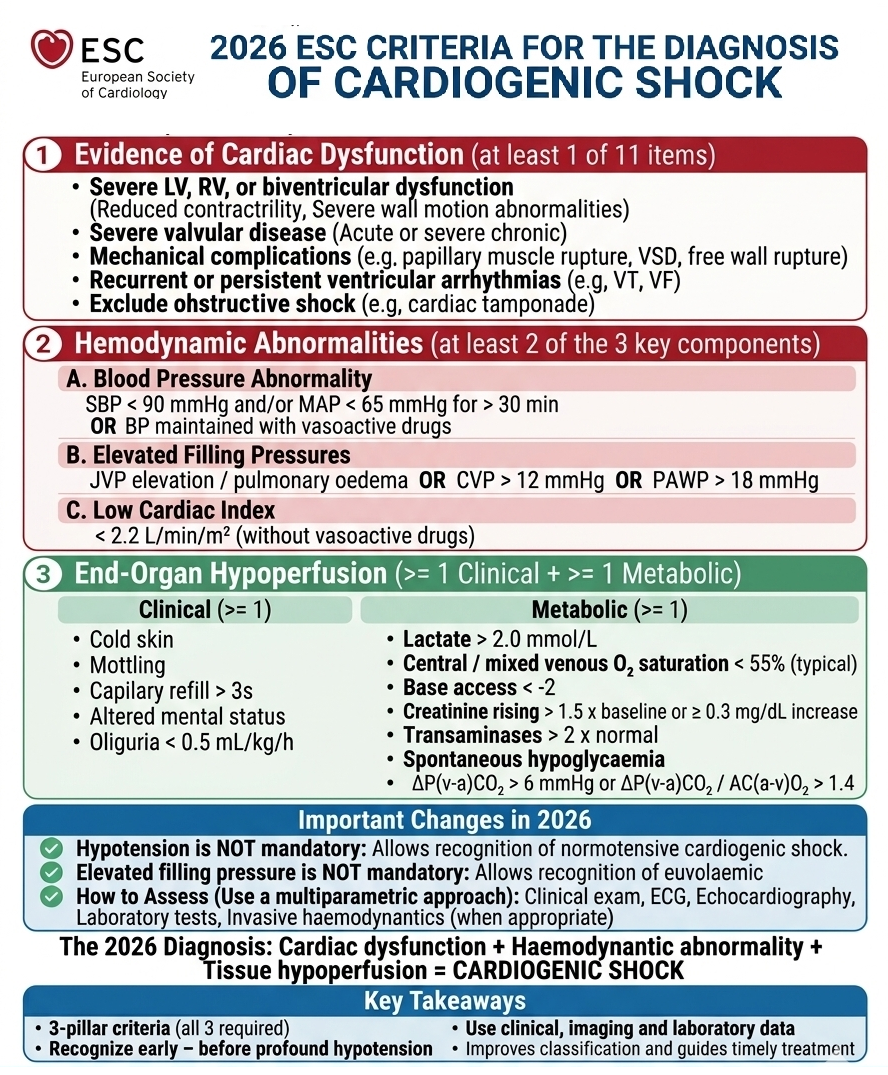
Note the dramatic (& ironic)changes in the current guidelines : Neither the blood presure not the filling pressure matters in the diagnosis of cardiogenic shock
Myocardial No-Reflow vs. Tissue level No-Reflow
This concept has some evidence back up. Even if you somehow manage to revive the heart In CS, it does not guarantee full systemic tissue recovery. This failure of organ perfusion at the systemic level behaves exactly like the no-reflow phenomenon we witness at the myocardial microvascular bed.
So, what shall we do to tame this dreaded condition ?
We really don’t know. Preventing the onset seems to be the most effective Intervention.
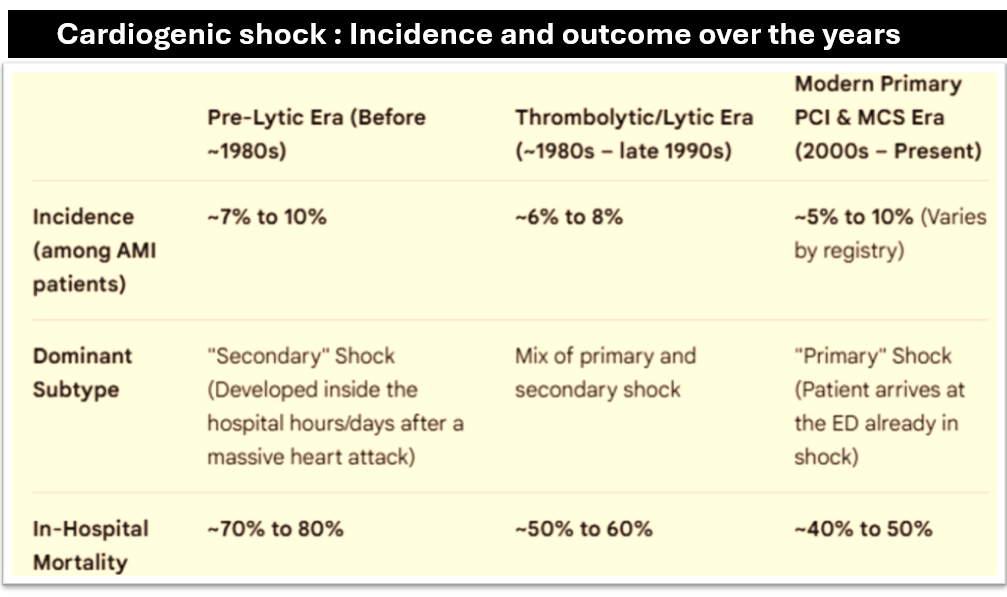
How to prevent?
Have a close look at the table to gain some insights. Focus the third and last column. Ask this question. Why the incidence remains high even in the modern Interventional era,with little improvements in outcomes ?
It is prudent, we make every attempt to revive the heart, paradoxically, we must realise healing can still take place without myocardial excesses*Some times, attempting a cure , will interfere with prevention of the event, we aim to cure.
Final Message
The cardiac component in cardiogenic shock becomes less relevant when vascular and tissue-level shock sets in, making PCIs or MCS devices almost redundant. I think , in the overall interest of the patients , It is advisable for cardiologists to transfer them early to an intensivist or anesthetist, as they are better equipped to manage shock syndromes including the cardiogenic ones.
*Postamble: The missing link in the SHOCK trial
When we look back at the landmark 1999 SHOCK Trial, we find an quixotic truth to ponder over.Nearly 34% of the patients randomized to the medical arm survived to one year without any emergency revascularisation.If cardiogenic shock were purely a mechanical problem that survival rate should have been zero. This study throws two facts, many of us will be reluctant to accept.
- Cellular Resilience: The human cells do possess ancient survival mechanisms. When the coronary flow crtically drops, some individuals have the microvascular mechanism to tolerate severe ischemia and “hibernate” until the native heart recovers.
- The harm of hyper-Intervention could be real . Every extra wire, balloon, and large bore mechanical device we insert brings its own dose of strqin, vascular trauma, and reperfusion injury. The reason for the lucky 30% who survived in SHOCK trial, may simply because they were spared from the toxicity of excess Intervention.




