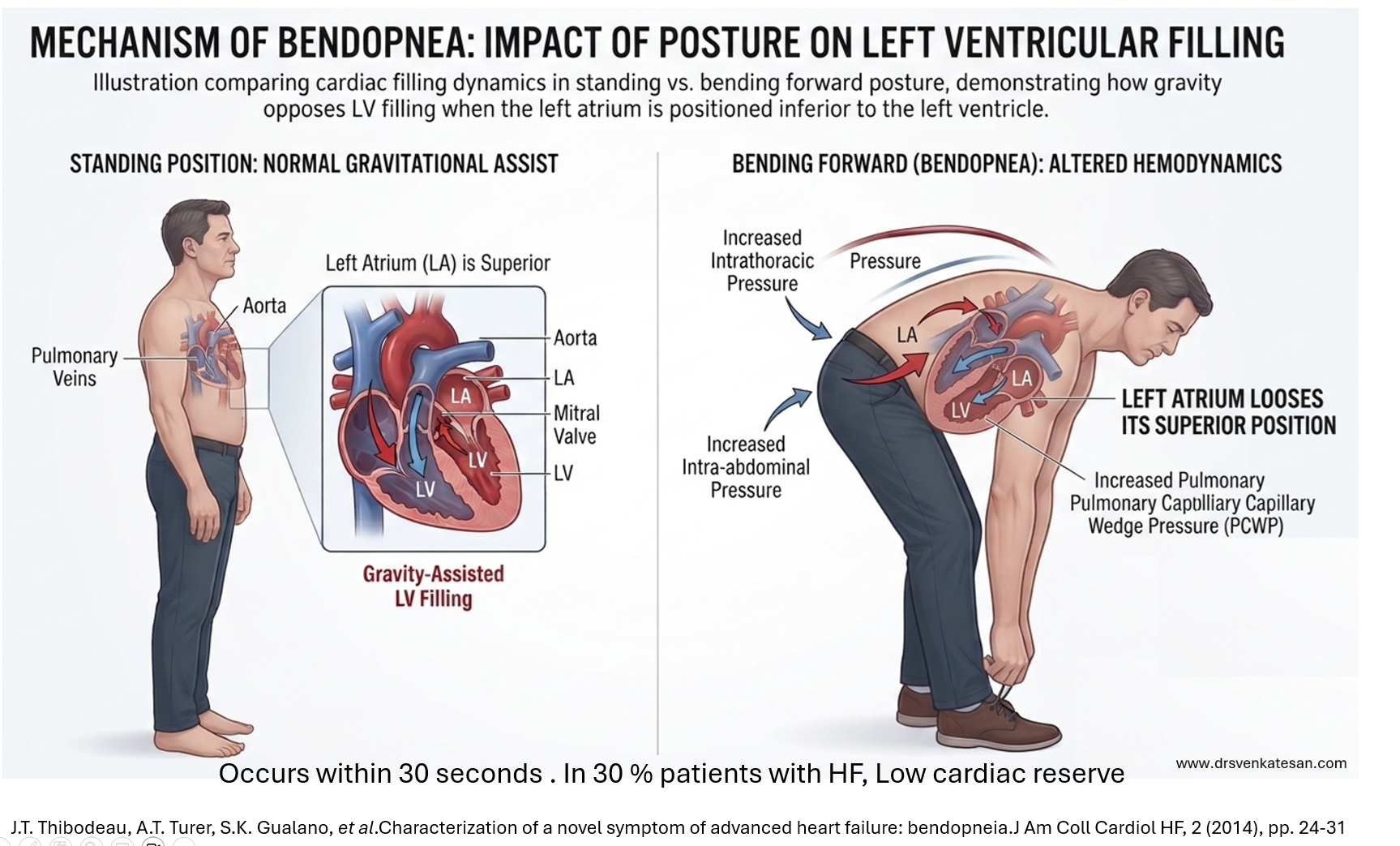
Bendopnea is a newer addition to the special forms of dyspnea, such as platypnea and trepnea.( Not exactly new .It was first reported by Jennifer T. Thibodeau from Texas in 2014 ) Though it initially appeared to be an inconsequential symptom, subsequent observations from many patients with heart failure have made this symptom highly significant. It seems to be a marker of high risk for decompensation. It occurs within 30 seconds of bending. In a patient with an already elevated left ventricular (LV) filling pressure, the act of sudden bending adds more stress by increasing the mean left atrial (LA) pressure further. A precise mechanical explanation for this phenomenon is not available.
The current literature attributes bendopnea to increased intra-abdominal pressure from bending forward, which pushes the diaphragm upward and forces congested splanchnic blood into the chest, causing a sudden surge in central venous return and pulmonary capillary wedge pressure. However, this fluid-shift mechanism does not explain why bendopnea correlates poorly with body mass index or abdominal girth.(Ref 1 the original paper do have BMI data)
The Proposed Mechanism of Bendopnea
The left atrium is the superior-most chamber of the heart in an erect posture, maintaining a strict superior-inferior relationship relative to the left ventricle.
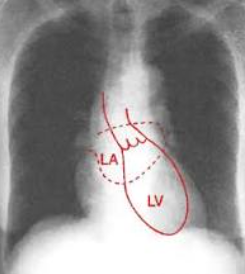
Please realise this subtle relationship of LA to LV . LV may be the most crucial chamber of heart, but LV remains anatomically Inferior , that confers the humble LA, with some commanding powers over LV especially in patients in LV compromised states.
In this upright position, LV filling is naturally assisted by gravity.When a patient bends forward more than 90 degrees, the LA-LV spatial relationship shifts from a vertical orientation to an almost horizontal one. Because of this shift, LA filling loses its gravitational advantage. The pressure must momentarily rise higher to compensate, resulting in acute stretch of the LA, pulmonary veins (PV), and J-receptors causes immediate dyspnea.
Clinical Implications
Though bendopnea is reproducible in many individuals, some patients can become accustomed to the sensation over time. Numerous papers also suggest that bendopnea serves as an excellent clinical marker for HFpEF, RV dysfunction, or pulmonary hypertension.
Final Message
Bendopnea is interesting new symptom . It is clear it can have multiple mechanisms. Posture-induced alteration in the LA-LV axis and the sudden elimination of gravity assistance can be an important factor in triggering dyspnea on bending. This can easily manifest in patients with advanced heart failure who have already exhausted all of their cardiac reserve mechanisms.
Reference
1.Thibodeau JT, Turer AT, Gualano SK, Ayers CR, Velez-Martinez M, Mishkin JD, Patel PC, Mammen PP, Markham DW, Levine BD, Drazner MH. Characterization of a novel symptom of advanced heart failure: bendopnea. JACC Heart Fail. 2014 Feb;2(1):24-31. doi: 10.1016/j.jchf.2013.07.009. Epub 2014 Jan 8. PMID: 24622115.
2.Karauzum K, Karauzum I, Kilic T, Sahin T, Baydemir C, Baris Argun S, Celikyurt U, Bildirici U, Agir A. Bendopnea and Its Clinical Importance in Outpatient Patients with Pulmonary Arterial Hypertension. Acta Cardiol Sin. 2018 Nov;34(6):518-525. doi: 10.6515/ACS.201811_34(6).20180528A. PMID: 30449993; PMCID: PMC6236562.
Postamble
Can bendopnea occur in a patient with a normal heart and normal LV function?
Yes, and here begins the problem. Many deconditioned, sedentary individuals do develop bendopnea. This is due to signals from the peripheral muscle spindle reflex. This condition is largely benign, but it implies that the person needs to improve their physical conditioning.




