Feeds:
Posts
Comments

Archive for the ‘Cardiology -Therapeutic dilemma’ Category

Pharmaco Invasive approach (PIA)  is the new mantra in the management of ACS.It simply means the intention to do PCI   should always  be the  driving force in every STEMI patient , whether the Initial lysis is successful or failed .

This concept is exclusively created  for centers where there is no cath lab (This would include  hospitals  with  inactive labs ,  cardiologist  team  who lack required expertise !)

What to do after lysis ?

  • If  the initial lysis has failed  “Rush” them  for an emergency  PCI.
  • If  Initial lysis is successful  “Send”  them for PCI in a  less emergent manner.

Generally the  time window for PIA is 3-24 hours.  In failed lysis  technically it could be as early as 1 hour as that is the time to assess the efficacy of initial lysis. (Of-course the theoretical transfer  time to be added )

Why the 3 hour period for PIA ?

We know routine   facilitated-PCI(f-PCI)  with various combinations of  fibrinolytics  and 2b -3a antagonists is a failed concept. (FINNESS )

One of  the primary reason for f-PCI to fail is , the  very narrow time window  between drug and balloon which somehow  end up in more hazard  (Needle -Balloon window)  .

If they are very close the harm is likely to be more ,still they have to be closer if lysis has failed .(This is the reason many old studies had depressing results with even with the  concept  of rescue PCI !)

Lytic agents and PCI  even though we assume to compliment each other real world evidence indicate they share a love hate relationship .


Beware, PIA is one form of facilitated  PCI.

If we agree routine  f-PCI is a failed concept we are in for real trouble. PIA indeed may  masquerade as f-PCI  if  you combine lytic and PCI in sequential fashion in a hurry !

My point of view is is a  successfully lysed STEMI should not be rushed to cath lab .If  he  some how reach the  cath lab ultra fast manner , it behaves like a  f-PCI and he is going  to harmed more !  by the current evidence base  isn’t ?

If the  inital lysis was successful , with a  less complex anatomy, it is  possible your PCI  that is going make the lesion more vulnerable.

(The other  issue is tied with flawed human instinct. One can’t stop with CAG in a PIA* .Interventional  cardiologists rarely have the courage to leave a well recannalised IRA  without PCI.)

**Still , you need to facilitate the PCI in complex intervention in  true rescue situation.That’s were we require the collective wisdom.

Assumptions galore in ACS

We have difficulty in  identifying true success and failure of lysis .Vagueness with which we make decisions  in CCUs and cath labs  , is exemplified by the following facts. Post thrombolysis , 40%  patients with persistent ST elevation are asymptomatic and 30 % of all those with complete  ST regression , still have occluded IRA.

We are also uncertain when do  the muscle  truly  die after a STEMI ! It is 6 hours in some, 12 in many, 24h  in few , 36 h in a lucky ones .The role  of collaterals, intermittent patency , individual variation  resistance to myocardial hypoxia injury cannot be  be quantified .

Final message

  • The importance of Needle to Balloon  time (NBT) time in PIA  is to be strongly emphasized.
  • This time can vary between 1-24 hours .But practically it will start from 3 hours .
  • The irony is , we have conflicting  engagement with time in PIA. We have to  strive for both narrowing as well as intentionally  prolonging this time window .
  • It has to be narrowed in true rescue situations and   optimally prolonged (Or is it indefinitely ! ) in non rescue situations !

After thought

Can we do pharmaco-Invasive approach(PIA)  in PCI capable center ?

  • Even in PCI capable centre one may get struck in proceeding with anticipated primary PCI for various reasons . If delay is anticipated we  have to fall back on thrombolysis .This we call as  unscheduled  or bail out  phamaco Invasive strategy .
  • Intentional PIA   in a PCI capable hospital for all low risk MI is also a viable and option .Never think  primary lysis   for STEMI  even if we  have lab ready is serious medial crime . After all , pPCI has a very  marginal benefits in if any in all low risk STEMI!

Read Full Post »

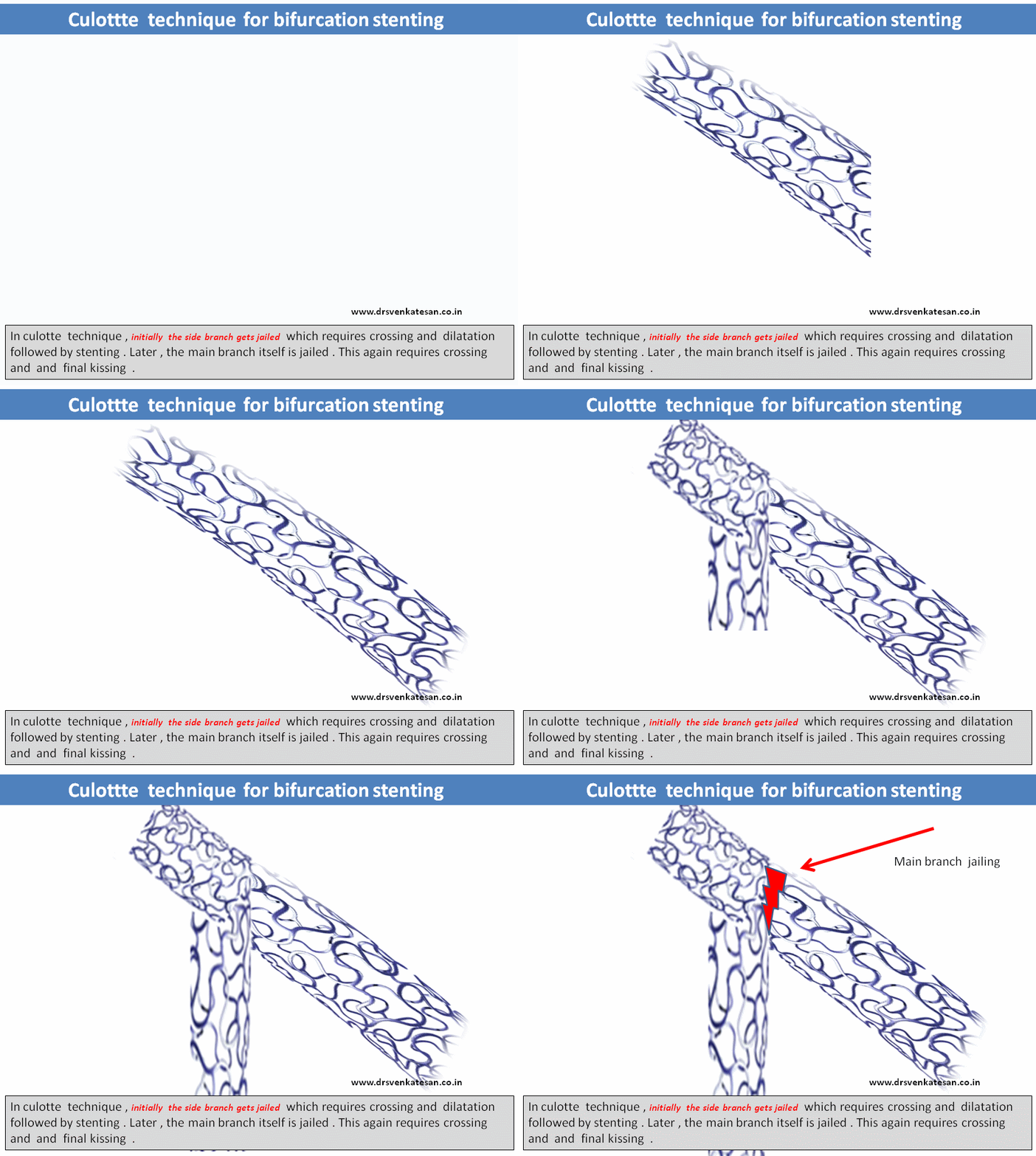
Cullotte is a trouser worn by 18th century French aristocrats.Now,in 21st century French interventional  cardiologists  found a striking similarity  of cullotte with  two stent strategy in bifurcation lesion .

Though this technique is in vogue for more than a decade , it has not been popular due to  perceived complexity .

It is making a come back in recent years , as we begin to negotiate bifurcation lesions with better expertise and hardware.

7  steps  in Culotte technique (From NORDIC study )

  1. Wiring  both main and side branch .

  2. Pre-dilatation of  main branch  and/or side branch,( Optional)

  3. Stenting of main branch

  4. Rewiring  side branch  through main branch stent strut,

  5. Stenting of side branch  through  main branch stent,(Now main branch is jailed by side branch stent

  6. Recross main branch  through struts of SB.

  7. Procedure completed with  final kissing balloon dilatation

culotte technique  stenting ptca pci 004

culotte technique  stenting ptca pci

culotte technique  stenting ptca pci 002

Reference

http://heart.bmj.com/content/90/6/713.full.pdf+html

NORDIC CULOTTE TECHNIQUE FOR BIFURCATION STENTING

Read Full Post »

Any new ST depression occurring during  EST is sine qua non for inducible ischemia.But,this rule does not uni-formally apply  in all 12 leads .ST depression occurring is certain leads is more important. While severe global ischemia can depress  ST segment  in most leads ,factually  only the leads V 5 and V6  predict true Ischemia.This because , bulk of LV muscle mass faces these two leads.

Isolated ST depression in inferior leads  during exercise

  • Is a frequent issue occurring at the peak exercise.
  • Is least predictive of significant CAD.
  • The exact mechanism is not clear.
  • Some continue to  believe it is indeed significant .
  • We have  observed  isolated  ST  depression > 2mm in inferior leads with significant CAD.
  • What really matters is the quantum of ST depression , symptoms, and exercise time and preexisting CAD .

Probable mechanism

  • Apart from true ischemia ,ST depression may indicate relative sub endocardial strain rather than ischemia.(By the way can simple stretch can cause ST depression ?)
  • The Infero posterior surface of heart represent  right ventricle .RV volume overlooked peaks exercise.Some think it represents acute raise in RV load during peak exercise.

How to report such EST ?

You can report it as such,  what you have observed.

  • ST depression noted in Inferior leads at peak exercise.
  • Mention whether it was angina free,
  • At what METS,
  • Total exercise time .

If you are statistically inclined  you can also mention the likely hood of CAD by positive predictive value (PPV) of the test (Low with isolated Inferior ST depression )

If you are really confused , and do not want to scratch your brain we have the most convenient terminology  invented by cardiac physicians ie Borderline EST, or Mildly positive EST “

Should we do Angiogram for such patients ?

In this era of catching normal people  who attend master health check ups  for a day care CAG  . . . it is not all  a crime to do angiogram in a  patient who shows suspicious  ST depression in three of his leads (2,3,AVF) especially if he also complains of vague chest pain.

Alternate investigation

Of course , we  always have the luxury of using  MDCT  that can stunningly  photograph the coronary arteries.

It is a mystery investigation, if it comes entirely normal every one is happy.Even slightest  defects in the photography  has a potential to confuse both physician and the patient .

What I do ?

I hesitate to  do routine CAG  if ST depression occur exclusively at  peak exercise beyond 10-12  METS , which disappear fast.(Many times we can apply this rule  to classical ischemic ST depression of lead V4 as well !)

ST  depression  in any leads (with any degree) following an episode of  ACS seems to be important.

Related topic

Read Full Post »

Oral anticoagulant usage has been steadily increasing for variety of  indications.Dengue fever is also  appearing in different avatars with  low platelet counts  and bleeding being a primary risk.

I was recently contacted by a physician , regarding a therapeutic dilemma .A young lady with mitral prosthetic valve and a febrile illness diagnosed as dengue . She has a platelet  count of 100,000 .She is on regular warfarin and aspirin .The physician  wanted to know , should he stop the OAC and aspirin ?

What are the options ?

  • Confirm if it is really dengue.
  • Look for clinical bleeding.INR, platelet function tests are not helpful.
  • Continue OAC.You can do that in most situations.
  • Stop OAC only if there is clinical bleeding  episode.
  • Anti-platelet drug usage  is more tricky .One may stop it if the trend of falling platelet is steep by at least two serial measurement.(or 50% fall from baseline)
  • Fresh blood and platelet infusions should be ready .
  • Finally and most importantly , Inform the patient and family about the difficult decision we are making.

*Is  OAC  safer than aspirin and clopidogrel in dengue ?

It is believed OAC has no major  Impact on platelet function .It may not  pose a threat of excess bleeding in the setting of  falling platelet levels .(*Evidence base -nil )

Another potential situation : DES and dengue

The number of DES in developing countries are increasing  where Dengue is endemic . It is not a surprising  to expect  both to  occur together.

Anti-platelet agents  can be problematic .It is better to withhold it during the active phase of dengue.(If the  stent has recently  been deployed you have no option !)

Final message

1.  Prosthetic valve , Warfarin Dengue .

2. DES, Dual antiplatelet agents ,Dengue.

They  extraordinary events  throw a complex therapeutic task .There are only two options .Continue or discontinue ! Whichever way you do , you explain to your clients (patients!)  the (un)reality games we play.

My personal option would be , with hold all hematological drugs during the active phase of dengue .

It is better to believe in the  natural thrombus fighting force . Leave the job of anti-platelet action  to the dengue virus for a week or two and give oral anticoagulants and dual anti-platelet agents a holiday

It may be foolish to rely on the dengue virus to guard against  prosthetic  valve  and DES thrombus , In reality we have to do that !

Reference

No reference exists.It is a statistical mind game.Individual assessment  should prevail. Either way, if something adverse happens court of law should protect us !

Read Full Post »

« Newer Posts