Feeds:
Posts
Comments

Archive for the ‘Uncategorized’ Category

There can be no debate to call diabetes as major cardiac risk factor . But , how about calling all diabetics to be deemed (Rather doomed ) to suffer from CAD and label them  with a fanciful terminology as CAD equivalent ?

This is what happened few years ago.From the beginging it was a controversial concept. The argument in favour of it was , many diabetics will have micro or macro vascular disease  process in coronary or peripheral disease which are sub-clinical .One major   study from Fiinish population  in (NEJM 1998 ;Ref 1 ) suggested this possibility and was dissiminated without proper scrutinty . The same Finnish group ( I need to confirm this as few authors are same in both studies !)  has comeout with 18 year old data (1998-2016 ) and conclude their earlier conclusion could be wrong after all (Reference 3 )

Premature conceptualisation can be rampant and crucial time is wasted in unlearning. This emphasizes an important aspect of medical learning what I call as “discontinuing medical education” (DME) that would make sense in the future for sure !

Read Full Post »

This happened  recently in one of my private ER visits. When I asked my fellow to lyse a patient with STEMI who arrived within 20 minutes after the onset of chest pain to our CCU.

He was reluctant and surprised, seemed to suggest  thrombolysis is a banished indication.

I asked him , whether he is aware of any study  that showed early , fast pre-hospital thrombolysis is as good as primary PCI ?

Yes sir. . but these studies clearly say it is useful only if its done prehospitally sir, not inside the hospital or coronary care units. 

I told him to think CCU as an ambualnce ,consider the patient is  in transit and  lyse him.

He was amused , as it looked  a comical concept and an unscientific uttering from a professor !

Still, he was courteous enough to follow my advice.The  patient stabilised within 6 hours and the ST segment  resoluted to near 100 % , No LV dysfunction.Discharged in 48 hours.

Final message

I realised in a harsh way , modern day scientists driven by evidence would struggle to regain the lost common sense ! There is a real risk for  irreversible damage to our faculty of wisdom !

STREAM trial nejm


http://www.nejm.org/doi/full/10.1056/NEJMoa1301092


Read Full Post »

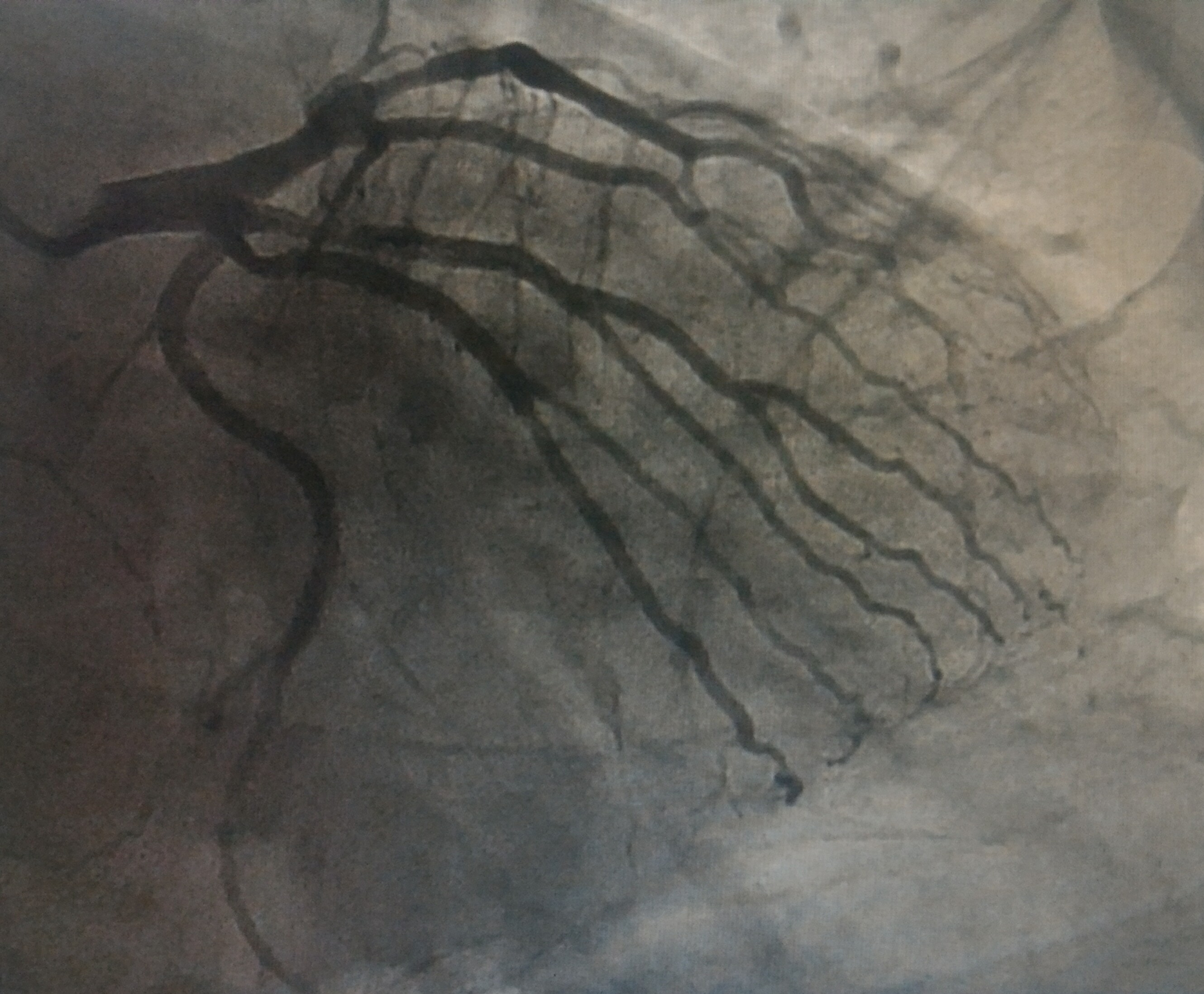
It is believed coronary artery branching pattern is as unique as our finger prints.Left main coronary artery usually bifurcates .Uncommonly it may trifurcate or rarely quadrificates.

When it gives a cluster of branches like in this patient , the left ventricle is richly supplied with multiple pathways .

p_20160421_181013_1.jpg

These are the patients who are protected well during a coronary event as any one of these branches can back up.However, if leftmain is involved one can guess the consequences !

Read Full Post »

I don’t know the answer, rather I am afraid to answer that question.

Read this article , that may  help find answer to this forbidden question.

medical ethics inappropriate medical care

Read Full Post »

medical education critics cardiology evdnce based medicine growth ethics

Read Full Post »

On this special day , wishing all the readers and followers of this blog  an energetic, creative , insightful and  of-course a happy new year 2016 !

Just wanted to share the 2015 annual report of this site with the readers.

wordpress annual report dr venkatesan

Read Full Post »

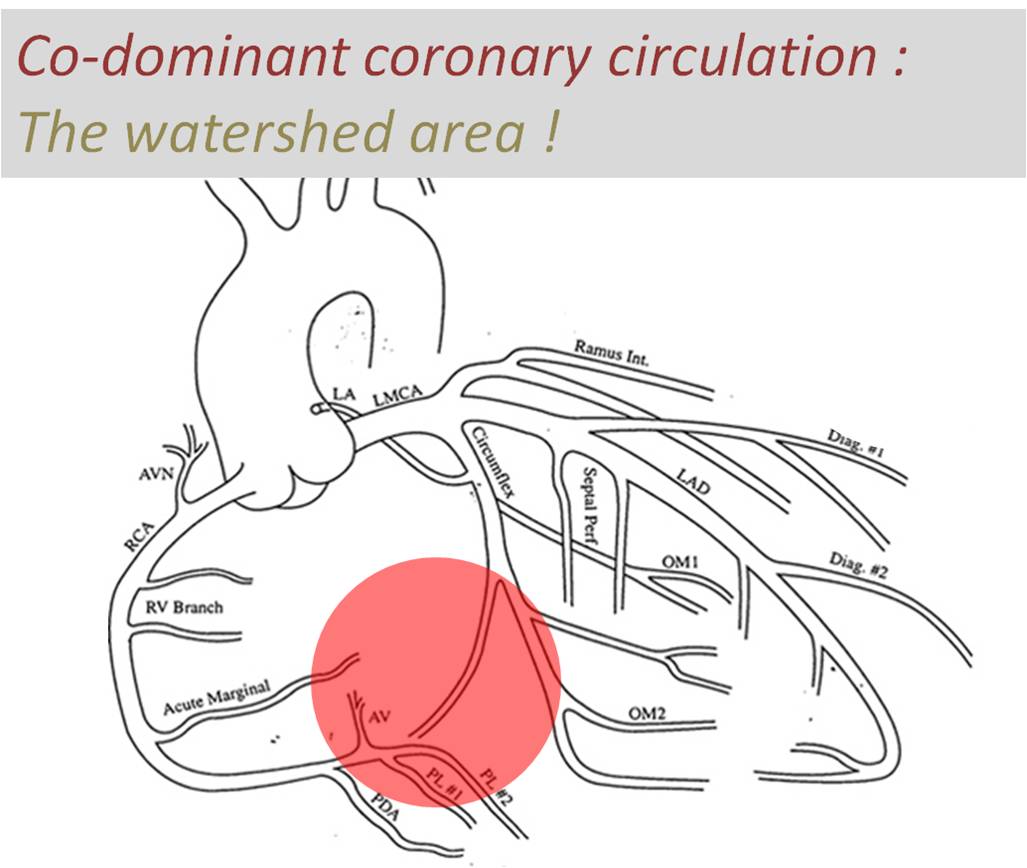
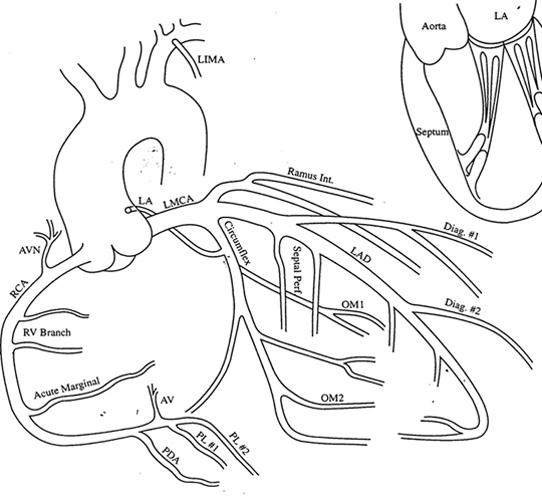
Co-dominant coronary  circulation is defined as , when  posterior crux of the heart receives twigs from both right and left system making this water shed area with advantage of twin innervation.They essentially supply  inferior and posterior aspect of both left and right ventricle including the posterior aspect of interventricular septum.

Traditionally inferior and basal aspects of heart are perceived (wrong tough !) as less important  than anterior  surface of heart.Infero posterior MI can be extensive and cause significant LV dysfunction and poor outcome. Longitudinal function (AV grooval velocity) and Mitral valve function  is critically  dependent on  posterior circulation.

Is there an advantage for co-dominant circulation  with reference to ischemic mitral regurgitation ?

Obviously ,one would expect there is some advantage in co-dominant circulation when ACS occurs  either LCX or RCA.It could theoretically  protect against development of MR as posterior  papillary muscles could receive supportive twigs from its companion.

However , there is a caveat .The antero-lateral papillary muscle normally has twin blood  supply from LAD(Diagonal ) and LCX (OM) . But in co-dominant circulation this pap muscle is  at risk of becoming single blood supply as the dominant RCA has a trade off with OM with its large PLV branch. It is likely in   co-dominant circulations if LAD is the culprit outcomes are likely to be worse.

Final message

A rare  study involving  more than 200,000 patients which specifically addressed this issue  of dominance and outcome , threw some surprising  findings. In concluded  PCI outcomes  with left or co-dominance has a worse outcome than Right dominant system.

Reference

1.Left and Codominant Coronary Artery Circulations Are Associated With Higher In-Hospital Mortality Among Patients Undergoing Percutaneous Coronary Intervention for Acute Coronary Syndromes . Report From the National Cardiovascular Database Cath Percutaneous Coronary Intervention (CathPCI) Registry  Nisha I. ParikhEmily F. HoneycuttMatthew T. Roe, Circulation: Cardiovascular Quality and Outcomes. 2012; 5: 775-782  2012; 5: 775-782

2.Papillary Muscle Perfusion Pattern A Hypothesis for Ischemic Papillary Muscle DysfunctioPaolo Voci, Federico Bilotta, Quintilio Caretta,Circulation. 1995; 91: 1714-1718

Read Full Post »


Verdict ?

Only complicated or high risk  STEMI,  would require immediate anatomy based management. Please note, this population at worst is never beyond 20 % of all STEMI. Hence more than majority of  patients  can be managed effectively without CAG.

My reasoning tells me,though knowing the  coronary anatomy appear vital  , it is rather the physiological impact of those  anatomical lesions  that will determine the outcome. So,post STEMI, if at all , we need to investigate, it should be about the  adequacy of the over all blood supply to left ventricle.This is done by a pre or post discharge sub maximal stress /nuclear test .If it’s negative with a good exercise tolerance  CAG will never be required as any critical flow limiting lesion ( that would require intervention  )is excluded with near 100% surety.

Postamble :Try asking  any neurologist , how often they demand to know cerebral arterial  anatomy for managing stroke  ? You will get a real surprise answer !

Read Full Post »

Holter monitoring is the Initial test for all those with documented  syncope (or Pre syncope ) with suspected cardiac arrhythmia .It is a 24 hour ambulatory  ECG monitoring , expected to pick up any electrical abnormality and its correlation with the resultant symptom if any. Though the test looks  attractive , the diagnostic yield is far less. (About 10%) .The reason being the episodes can be rare  to be  missed by 24hr sample time. We have extended Holter (48hr) , Event monitors , Loop recorders and implantable devices that can record ECG for extended periods.(18 Months ,Reveal Plus Medtronic)  that improve the yield  up to 45%.

One common issue that often confuse us  while reporting  Holter is, the  pauses that occur during day / night .

What is the significance of these pauses * ?  Nocturnal vs Daytime

Pauses are obviously significant when the patient is awake . It is generally accepted pauses more than 3 seconds during day time  (ie Heart rate of < 20/mt ) is significant . This is logical , as pauses more than that,  is expected to cause syncope ( or atleast pre-syncope ).The problem comes when you document pauses more than 3 seconds without any symptoms . Then this  difficult  question comes up ,At what degree of pause syncope occurs ? How is that some persons mange  even prolonged pauses with just giddiness.(Good overall vascular integrity and tone ! )

We know such pauses are  especially  common during sleep. How does the brain react when pauses occur  during sleep ? as there is no question of fall as such and loss of muscle tone is non existing.

*Please note ,when we say pause we mean only Sinus pause , Pauses due to AV blocks are very significant
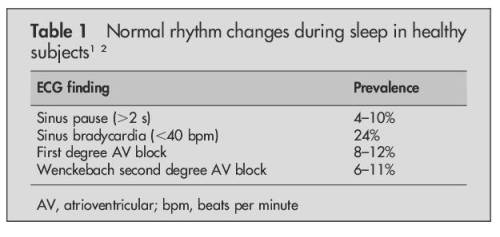
nocturnal pauses during sleep holter

Source : Brodsky M, Wu D, Denes P,et al.Am J Cardiol 1977; .

Dramatic  pauses during sleep do occur

There has been prolonged pauses reported  during sleep without fatality . A 35 second nocturnal pause resulting in seizures has been documented by implantable  recorders.(Mairesse 2003)

Causes for prolonged pauses

  • Sinus node dysfunction
  • Obstructive sleep apnea
  • High dose beta blockers therapy

Final message

 Most bradycardic episodes during sleep are benign.This is due to depressed autonomic control during sleep. Holter interpretation is primarily done with  awake rhythm data in most individuals .So, empirically shall we fix a  5 second pause as significant during sleep ? We don’t know.While this may seem applicable even with structural heart disease , one may be vigilant while interpreting the nocturnal pauses in this population .

Caution

** Please note,  all these rhythm monitoring extravaganza is meant for people  with equivocal symptoms .Patients  with well documented syncope with ECG features suggestive of  cardiac rhythm disorders would never require these tests and go for pacemaker straightaway.

Reference

4.Arrhythmias documented by 24 hour continuous electrocardiographic monitoring in 50 male medical students without apparent heart disease. Brodsky M, Wu D, Denes P,et al.Am J Cardiol 1977;39:390–5.
For Advanced readers
guidelines for syncope nocturnal pause holter

Read Full Post »

Effect of PCI on Long-Term Survival in Patients with Stable Ischemic Heart Disease are just out in NEJM.

The results are as expected !

“Let us get more Courage , to say no when we want to say no !”

Reference

http://www.nejm.org/doi/full/10.1056/NEJMoa1505532?query=TOC

Read Full Post »

« Newer Posts - Older Posts »