Feeds:
Posts
Comments

Archive for the ‘Uncategorized’ Category

Have you felt like this query any time in your office ?

If “Yes” is your answer, then you are not alone .There was a unique  conference  that  took place  in 2010 to answer the same query in Rome , Italy on behalf of Italian cardiology society  , where this entity is researched more than any other place.Its worth going through this.

Reference

Read Full Post »

During exercise stress test , systolic pressures should raise at least by 20-40mmhg.(Max 60 mm from baseline )  Diastolic BP will remain at baseline or show a marginal elevation or even a  miniscule fall.This is primarily due to increased cardiac out-put , mediated by demand and dilatation of musculature  in exercising muscle.

If the systolic BP falls or does not raise during exercise , it implies either poor LV function , vascular insufficiency or autonomic dysfunction.

If there is a fall of > 20mm , even in the first stage,  accompanied by  chest discomfort or giddiness with ECG changes ,it could be an  ominous sign of serious left main or a tight proximal LAD disease and test should be terminated immediately.

Paradoxically , If BP raises more then 200 at any time we call it hypertensive response and may be a risk factor for future onset systemic HT or even a stroke. ( Stress test not only help us  detect ischemia of heart ,it also can reveal  how the vascular system would handle  and adopt to increased cardiac output at time of  hemodynamic demands)

Physical de-conditioning is an important cause for hypertensive response , as the entire vascular system lacks dynamism (Vascular tone ) ,  a  precursor for  hypertension, endothelial  dysfunction and cardio vascular events..

Read Full Post »

We have been taught right from first year cardiology residency  how to trouble shoot a pacemaker .It has been a real complex thing for us. Now looking  back ,all the troubles we took to understand seems to be redundant.Here is a summary of my thought process on the issue. It can be approached  with reference  to time, symptoms and ECG features.  With due respects to all those brainy hardworking   EP experts  , I have taken few academic liberties!
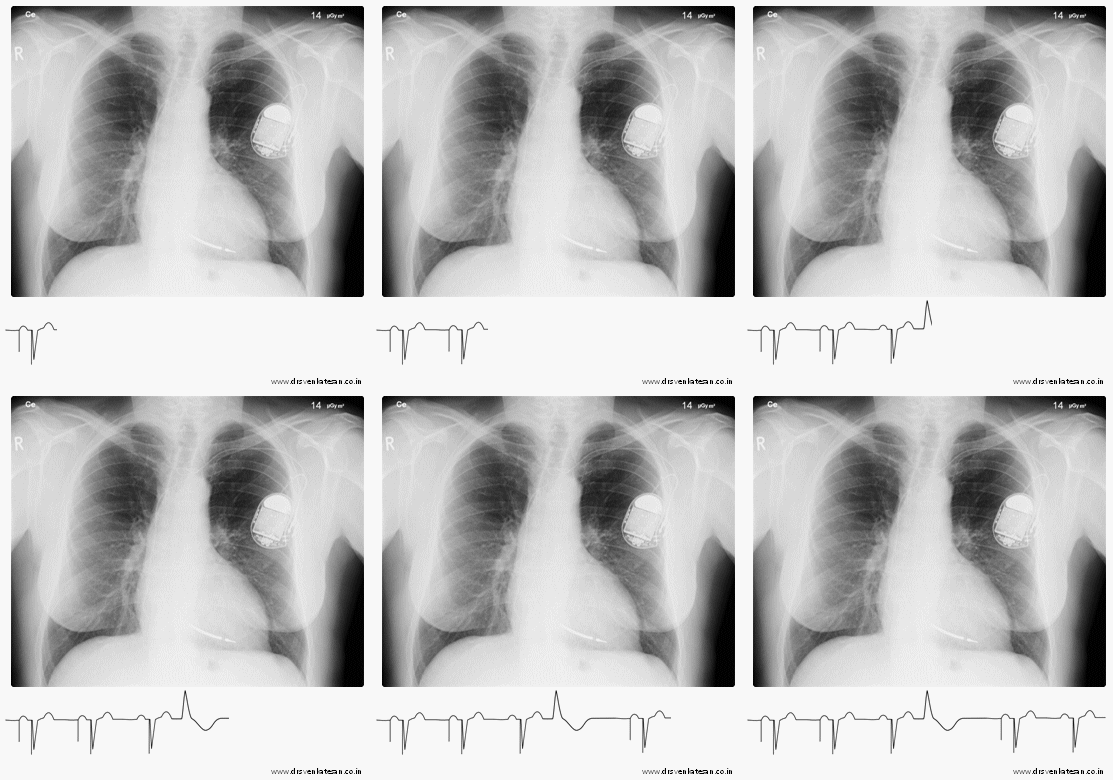
pacemaker trouble shooting

Timing

  • Within 24 hours -100% technical or procedural Issues , like lead dislodgement/Screws and nuts.
  • Within 1-2 week – Again technical , Pocket issues , Infections.
  • Within 6 months – Benign pacemaker syndrome ,Threshold settings, Scars
  • After  first year – Generally Issues are rare , Lead issues , Associate disease progression.
  • Beyond 8-10  years /Near end of life – 95% Energy depletion leads issues .( Please note , pacemakers do not stop all of a sudden it has a intrinsic end of life indicators .We have to look for it. May be ,we can expect a  warning siren in the future ? )

Symptoms

  • Vague dizziness – Pacemaker syndrome ? Anxiety ?
  • Near syncope – Show some concern (For many , Impending true syncope is a non existent entity )
  • True syncope  – Real emergency*

* Syncope can be unrelated to pacemaker but always consider  them electrical  unless proved otherwise . Few patients  may continue to have significant symptoms  in-spite of   normal pacemaker parameters. This would  mean , the original symptom for which  pacemaker was put is not related to the Brady-arrhythmia .It could   suggest alternative hemodynamic explanation  like vaso-depressive component of vagal syncope ,autonomic dysfunction , orthostatic intolerance or  a coexisting neurological /systemic condition.

**Never forget syncope is not an exclusive symptom of bradycardia .A new onset  tachycardia  , which is either a part of  brady- tachy syndrome or separate arrhythmia can continue to provoke the symptom.

Gross ECG findings

Bradycardia /Often implies back to original rhythm –  Indicates real trouble . Since ,in a paced patient HR cannot be less than programmed rate of 70.

Tachycardia -No spike.( Not to worry ?) A common  situation if the original indication was  sinus node dysfunction . Many of them are  in own sinus rhythm or AF . Just ensure spikes reappear when the rate falls below 70 . If the rate never goes down , what to do ? Try a carotid massage or observe a nocturnal ECG  or call analyst and increase the rate to document pacing . (In DDD mode we have a rare PM mediated re-entrant tachycardia , which is mainly used to grill cardiology fellows in their board exams with all those PVARP stuff !)

Simple pauses – Any pause more than the pacing interval is a definite concern .

Spikes more than QRS  – Indicate capture failure.

No spikes (Can be so benign  to ultimate danger )

  • No spikes , but  excellent own rhythm – Good  functional  SA node
  • Regular  spikes ,but intermittent own rhythm or only random spikes with good own rhythm – Needs bedside hairsplitting and  EP assistance !
  • “No spikes -No Own rhythm” -Most dangerous .Sudden lead issues or hyper sensing .(Emergency  switch off  by magnet  application before inserting temporary pacing advised )

* Anatomical issues like lead dislodgement , fracture , compression ,  perforation are to be ruled out in every pateitn with intermittent capture or failure .This is done by combinations of imaging as well physiological assessment.Dislodgement must be visualized .The term micro dislodgement may not exist.

Other Investigations

  • X ray
  • Echo for any new structural lesion (RA,RV dilatation , TR RV clots or vegetation )
  • Holter
  • Event monitors ,Loop recorders.

Pacemaker analysis

  • Battery life ( Very important parameter .Usually around 10 -12 years.Unexpected early drain can occur.)
  • Threshold (Most failure to capture associated with high threshold Note :Threshold will be normal in battery depletion Acute threshold can increase marginally .Should be reasonable other wise battery will drain.New protocols like auto capture and managed pacing will help optimal threshold
  • Impedance – Normal in battery depletion , dislodgement and exit block,  Increased in lead fracture and loose screws.Decreased or lost in insulation failure.

Management

The principle of management are simple. Few logical questions ,

  • Is the pacemaker generator is alive and has has enough energy ?
  • Are the  leads okay ?
  • The problem is in the settings ? can it be rectifies by the programmer
  • Or should we replace the pacemaker ?

Technical jargon like  under sensing , over sensing or no sensing  , fusion beats , micro dis-lodgement  etc are important for  academic reasons . We may talk any thing , realistically , what  the ventricle want  is a non stop heart beat  every second or so !

Emergency

Bradycardia – Insert a temporary pacemaker /Call the analyst  /Inform the  electrophysiologist /Senior cardiologists /(Please realise ,  some fellows  can be better than the personnel mentioned above in tackling emergencies !)

Tachycardia : Native or machine induced ?

Native – Mostly safe ,  Ignore  or treat with drugs.

Machine induced :(very rare) Switch of the pacemaker . No off switch available as in a mobile phone ? *What to do ? if unclear about the  whereabouts  tachycardia origin . If hemodynamically unstable no harm in shocking .Nothing will happen .Call the EP  guys on hot line and decide.

Elective symptom guided.

  • Asymptomatic -Normal ECG : Reassure and send home.
  • Vague symptoms   -Do Holter and Observe
  • Syncope -Normal ECG needs extensive all system investigation.
  • Syncope -With pauses /Bradycardia /Asystole  – Ironically ,decision  making is easier. Temporary pacing is the  ultimate savior. Later , check the lead,  generator .One may need to change  either one or both of of them.

** While the above principles apply  for both single  and dual chamber pacemakers , the later doubles our thinking burden . While atrial tracking is a great technological advancement , what to  do with those sensed event can be really  tricky .The response of  ventricles and the AV intervals  can be tentative at times. Cross talks from unexpected atrial and ventricular arrhythmia can occur.  Further , mechanical atrial lead  issues are far  more common . When confronted with recurrent atrial lead related  problems , one  simple solution is  silently convert the mode to  single chamber VVI mode.

Final message

Pacemaker trouble shooting appears complex at the first look .It’s all common sense.Thinking with simple state of mind and  being clear about the intended  goal is vital. Electrical intricacies are tough to understand  but most situations do not require them. However ,If the initial indication was for complete heart block one has  to be very alert.

Principles of medicine argue us to make an exact diagnosis before treating . But,realise  this is rarely  possible or even desirable in emergency .Curiously , most pacemaker troubles can be solved successfully without making a proper trouble shoot !

If  we can summarize in one line  , a prompt emergency  back up temporary pacemaker insertion  is key to  management most of the serious  pacemaker related problems.It ,not only tackles the emergency ,  buys time till we decode the real problem . . .  if we wish to !

Related article.

Role of magnet application in pacemaker trouble shoot


Read Full Post »
We know , any wide QRS tachycardia  would argue us to make a default diagnosis of VT.But,  one has to be extremely cautious to apply this rule if  wide QRS  tachycardia shows  significant irregularity in RR interval .

All classical VTs are fairly regular tachycardia (Note the  key words , fair and regular) . Small cycle length variations are observed in VT,  but they are usually not discernible in surface ECG.

There are no practical rules .A well  appreciable  irregularity in RR interval will seriously  question the diagnosis of classical VT. To make an another statement, most of the  irregular wide QRS tachycardias infact turns out to be  atrial fibrillation with some form distal widening mechanism .(Preexisting blocks, or rate dependent  or antidromic conduction through accessory  pathways)

However , irregularity  is still possible during VT .(May be less than 10% of times)

When can VT can be irregular ?

  1. Irregularity is observed  immediately at the onset of VT as the re- entrant circuit warms up and tries tosettle down
  2. AV dissociation  can make the VT irregular but it is subtle .(This AV dissociation is absent if retrograde VA conduction is intact)
  3. Multiple reentry circuits with two morphological VTs dissociating themselves
  4. VT with multiple exit points and epicardial breakthroughs
  5. A drugged VT.Amiodarone modified VT can be irregular as it can variably lengthens  the re-entrant  circuits and inducing VA block and precipitating AV dissociation.
  6. Multi- focal VT  (We have MAT in atria do we really have MVT ? (Why not , are we missing it ?)

Final message

Statistically , as well as realistically  , the commonest cause for  any highly irregular tachycardia turns out to be AF , whether  QRS is wide or narrow !

Read Full Post »

ICDs are primarily life saving devices.Whether single or dual chamber  it does this function  effectively.They will also  take care of  bradycardia by  default  back up pacing .For most indications single chamber ICDs are good enough.

My professor used to tell us , dual lead  means ,  dual expertise , dual cost , dual caution and  dual set of complication . One should avoid it whenever possible. Make things as simple as  it could be , without compromising the main goal (Here prevention of SCD) . The incidence of inappropriate shocks being lesser with dual chamber ICD  has not been truly  realised in real world scenario.

Recent studies  tend to give  credence to this  perception .(Peterson JAMA 2013)

Dual  Chamber ICDs  may have an edge only in few situations .

  • When there are both indication for pacing as well as ICD like heart block and LV dysfunction.
  • In extreme LV dysfunction were benefits of dual chamber pacing may have advantage.(If CRT is not an option )

Reference.

1 .Peterson PN, Varosy PD, Heidenreich PA, et al. Association of single- vs dual-chamber ICDs with mortality, readmissions, and complications among patients receiving an ICD for primary prevention. JAMA 2013; 309:2025-2034.

2.Medscape review


single vs dual chamber pacing indication


Read Full Post »

In the last few decades  we have  understood a major concept in the genesis of cardiac arrhythmia.Slowing in the propagation of cardiac impulse is a key  trigger to precipitate a reentry circuit and initiate a tachy- arrhythmia.Still , many conditions like first degree AV block, chronic RBBB or even LBBB are  benign entities  as along as the heart is structurally normal .They seem never increase the incidence or life time risk of  cardiac arrhythmia . Longevity is unaffected.( Or do we assume many things ?)

How is this possible ? or is the theory of slow conduction triggering reentry is flawed ?

Think again . . . if these patients who later on develop a structural heart disease , with an episode of ACS , myocardial or valvular disease,  the original slow conduction substrates these people were harboring ,  will it become important ?

Surprisingly , we have no answers in literature.When Haissaguerre et al found preexisting ERS pattern could be a trigger for primary  VF in case they develop ACS  , he opened up a huge debate as it involved converting  a vast number of normal population electrically anxious.

Now ,is it possible the so called  benign  blocks of heart like first degree AV blocks , RBBB , LAHBa , would be important  at times of ACS  and possibly make them prone for for primary ischemic arrhythmia .

Is bundle branch re-entry possible in structurally normal heart ?

We need answers. Some one , (Any EP fellow) somewhere  could take up the issue and enlighten us !

Read Full Post »

ICDs are one of revolutionary devices , invented last century  that can defy “death & fate”  in high risk cardiac patients who are threatened with ventricular tachycardia or fibrillation .A decade long hard work by  Mirowski  and team from John Hopkins culminated in the dramatic  the first AICD implant in 198o. ( In my opinion, this medical invention can be compared to an event of such  significance as moon landing by Armstrong and team ! ) Ironically , in the last decade such a revolutionary device was sort of misused and thousands of devices were explanted for inappropriate indications.

Fortunately , better sense prevailed recently .The indications are getting  refined. I am sure ICD will go a long way in prevention of  both expected and unexpected sudden  electrical deaths .We are into  the 4th decade of its evolution.While the electrical circuitry has been mastered , power supply remains an issue as they require continuous power supply like a mobile phone. Current technology allows about 6-8 years of battery life.

EL-ICD boston scientific longest life icd smallest profiale dynagen inogen madit indication for icd

Now , Boston scientific  has come out with new technology which make its  battery life extend  by 100%  to 12 years.  It is a major break through , expected to evolve  further  until probably we have rechargeable  batteries or biological power sources .Stretching a wild thought , the days couldn’t be far off  when the smart phones which are omnipresent in every human-being  , could not only power the ICD  remotely and control it too !


Indications (ESC/AHA 2012)

CAD

  •  Post MI* /LV dysfunction  ≤ 35% /NYHA   class II or III  (*  > 40 days)
  •  Post MI* /LV dysfunction ≤ 30% /NYHA Class I (* > 40 days )
  •  With non-sustained VT due to prior MI, LVEF < 40%, and inducible VF or sustained VT at  EP study

Non ischemic structural disease ( Idiopathic DCM, ARVD etc)

  • With structural heart disease and spontaneous sustained VT, whether hemodynamically stable or unstable.

Primary electrical disease

  • With syncope of undetermined origin with clinically relevant, hemodynamically significant sustained VT or VF induced at electrophysiological study


Reference

Link to Product manual form Boston scientific.

Boston scientific


Read Full Post »

A short systolic murmur over pulmonary area (ie Left second inter coastal space ) is listed among 6 other auscultatory  feature  of pulmonary arterial hypertension.Though it is an accepted sign  many would question  the existence of such a murmur or its relevance in PHT.

Why does it occur  ?

Acoustics  principle  tells us whenever  velocity of blood  flow exceeds a critical point(Raynolds number*) in a specific anatomical territory , a  turbulent zone is created  and  a murmur could be generated .This is why many physiological situations like pregnancy, anemia, and some benign outflow murmurs occur.


In pulmonary hypertension , three things are thought to contribute for the murmur generation

  1. Dilated pulmonary artery  promotes Raynauld turbulence
  2. Increased flow velocity (This is correlated with pulmonary artery acceleration time in Doppler)
  3. RV contractility  (A normally functioning   RV is required to generate the murmur .Once RV dysfunction sets the  murmur of pulmonary hypertension usually disappear , of course a TR murmur may appear and confuse the picture )

Reference

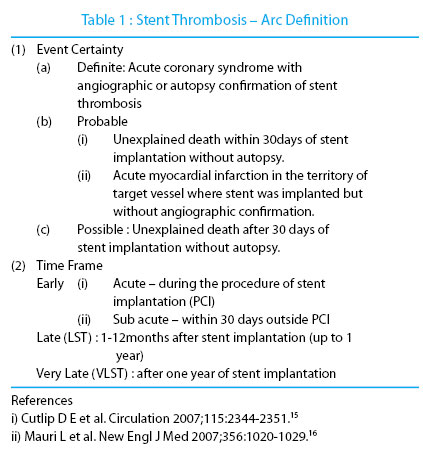
* Reynolds number is a way to predict under ideal conditions when turbulence will occur. The equation for Reynolds number is:

Reynolds number(Where v = mean velocity, D = vessel diameter, ρ = blood density, and η = blood viscosity )
Read Full Post »

We know,management of STEMI is a race against time.It’s rather a group race run by the patient, his close relatives / associates , the ambulance driver, the ER physician, cath lab staff and finally the  treating cardiologist .While the race is on , continuous monitoring and critical decisions are made.

Every minute gone could be a missed opportunity. While a patient is being moved to the hospital, a decision is to be taken whether its going to be primary PCI or lysis or combination of both.

Now,In India, as we embrace the quirky world of medical insurance  and   glamor based medicine , we have one more participant in this race of human life! The coronary flow dynamics in STEMI  appears  to be determined not only by thrombus load the residual plaque but also by the quantum, type and brand of  insurance the patient is blessed with !

I wish , one could hear the silent howls made by the myocardium under distress even as their loved ones are anxiously waiting for insurance  clearance from the  myocardial reperfusion  centers located in the far away back offices of urban metros !

Things won’t stop with that. Once the  PCI is on,and the cardiac team is confronted with a multi-vessel  CAD ,wondering which is true culprit ?, whether to consider  multi-vessel  stenting or early CABG  . Meanwhile the cath lab  liaison officer would desperately struggle to call the insurance guys again and upgrade the request to a newer therapeutic strategy !

Life was simple for every one till recently ,  when we would treat thousands of MI patients with conventional modality with a well proven reduction in mortality , comparable to the current bests .The concept of primary PCI has made things artificially complex without adding on to significant advantage except in some complicated subsets.

I still keep wondering , achieving a near  TIMI -3  flow in a timely fashion  by thrombolysis  in CCU will far exceed the hype of documented TIMI 3 flow in cath lab in  terms of absolute number and of course favorable outcome .Please realise acute myocardial salvage requires a minimum of  TIMI 2 and not TIMI 3 flow !

Read Full Post »

Stent thrombosis is a dreaded complication as the number  of PCIs are increasing in exponential fashion.The key issue is to take care of the stented segment till it gets fully endothleised. We  have excellent , time tested  dual anti-platelet protocol to take care of this . Still , they are  not  infallible . ARC has classified  stent thrombosis with reference to the timing  of implanting the stent .

stent thrombosis

The funny aspect of this classification is , it  hides a fact , whenever a stent concludes suddenly it is acute for that patient and his myocardium . So in a given patient who presents with ACS every stent thrombosis is acute. Of course , chronic thrombotic process can occur in  few  and present as as CTOs within the stent . Generally stent thrombosis is considered resistant to lysis . This  more on our perception than on sound scientific data. Every cardiologist would  have experienced at least few cases of  acute stent occlusion that had been successfully lysed.

Underlying mechanism of acute stent thrombosis.

The single important cause for stent thrombosis is not primarily hemo-rheological  but  related to  the some technical insufficiency at the time of stent deployment (Apart from poor compliance of anti platelet agents )

  • Improper stent placement ( Mal-apposition / Geo Miss / under or oversize)
  • Edge effects
  • Plaque prolapse between struts
  • Fresh lesion eruption  (Another true ACS  is always possible)

FInal message

Though , it is risky to rely on lysis alone it is always worth a try . Lysis is easily available and can be instantly  administered without a need of special expertise . Few lives can be saved  while one ponders over shifting the patient  to a bigger center. Pharmaco-invasive approach  can be perfect for this situation.

And now , a provocative comment

Experience suggest , It may be wise , even if  cath lab is available on site or in the vicinity , the option of thrombolysis  is to be considered first for patients with suspected  acute stent thrombosis , if the patient is otherwise stable .

References thrombolysis for stent thrombosis instent streptokinase tenecteplace http://www.ncbi.nlm.nih.gov/pmc/articles/PMC2722500/

Read Full Post »

« Newer Posts - Older Posts »