Feeds:
Posts
Comments

Posts Tagged ‘affirm study’

In a population‑based perspective, both paroxysmal and chronic atrial fibrillation bothers us more because of stroke risk than hemodynamic instability. AF confers a 3–5‑fold higher stroke risk and accounts for roughly 1 in 5 ischemic strokes overall.
Stroke‑related disability, recurrent events, and higher mortality make thromboembolic risk the dominant public‑health concern.
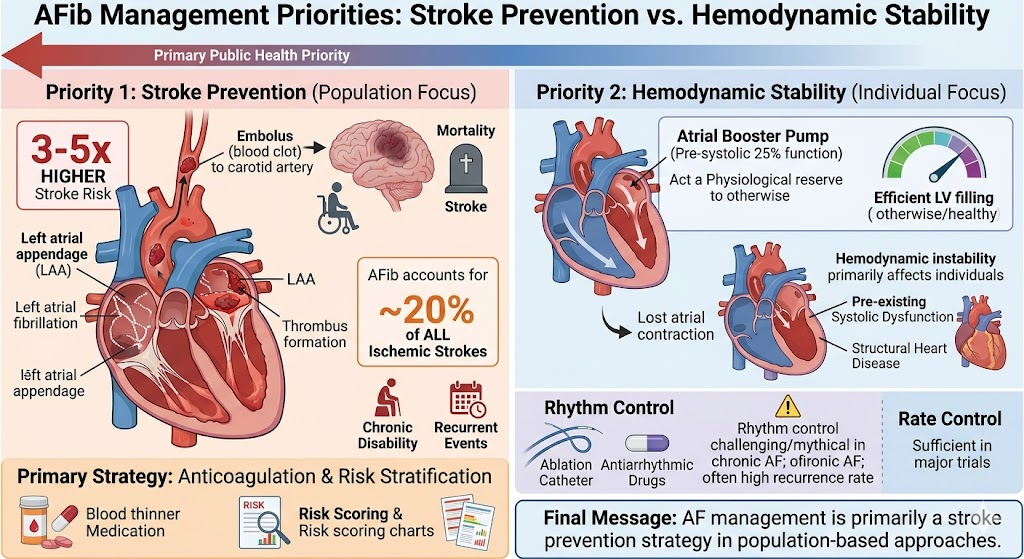

Hemodynamic instability does matter ,in ACS, pre‑existing systolic dysfunction or structural heart disease. At a community level, , stroke prevention (anticoagulation, risk stratification) outweighs rate‑rhythm control as the primary priority. This is exactly the reason, rate control was suffice to beat rhythm in major trials with a optimal anticoagulants.

*The pre-systolic 25% booster pump function acts more as a physiological reserve . We have infinite number of pateints with lone AF , effectively managing the lack of atrial contraction , by the newly recruited LV suction force ( intriguingly, it can function in pre-systole as well )

We must also realise, the much hyped rhythm control modalities actually plays a hide and seek game in many paroxysmal / persistent and most chronic AF . This applies to all sophisticated ablation stuff including the Cryo and PFA. Also, we need to understand stroke in elderly , is not fully prevented even if SR is restored in piecemeals (of time) because the source of embolus can be elsewhere from ventricle, Aorta, Arch, carotids etc.

Final message

Principles of AF management primarily revolves around stroke prevention , while hemodynamics goes to the background. OAC can perfectly take care of the former in most. DOACs are also playing useful alternate role. Contrary to the popular belief, many , LAA occlusion devices and ablation strategies do not necessarily negate the need for OAC in many elderly people.

Reference
1. Andrew Hill Atrial fibrillation and stroke: State-of-the-art and future directions Current Problems in Cardiology Volume 49, Issue 1, January 2024,

Read Full Post »

Up to 25 % of LV filling is done by atrial contraction. Atrial booster function is important in LV outflow lesions. This can be critical in patients who have diastolic deformities of LV. ( an audible or even palpable S4 confirms the atrial kick in these situations )  This is how we were taught for decades right. Still, it may hold good in many left-sided condtions, but in HCM it definitely seems to be not true. 

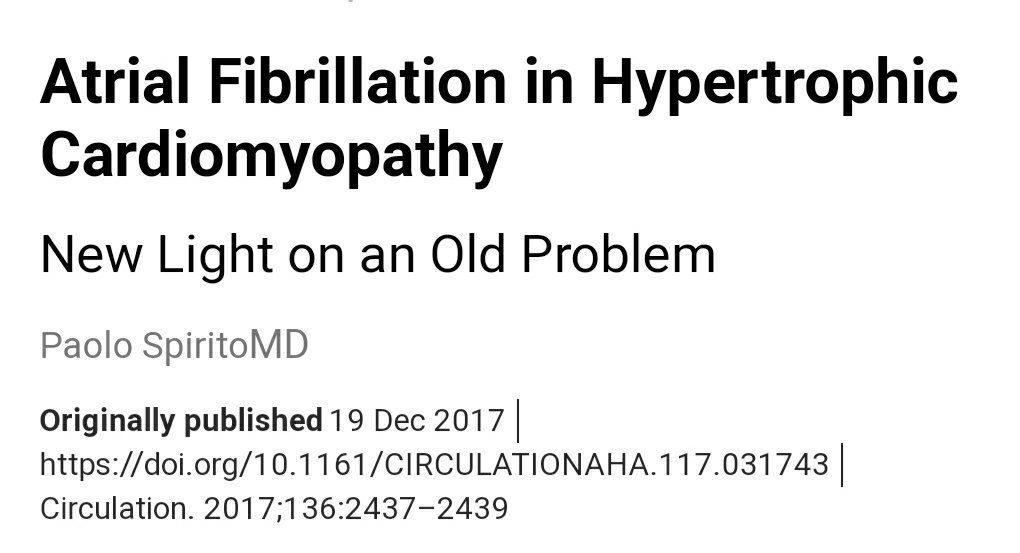
A succinct review of this topic makes a good read.

Incidence if AF in HCM is about 20% (Mostly paroxysmal 70 % , Persistent /Permanent 30 %)

Mechanism of AF IN HCM

  • Increased atrial wall strain(Proven by strain echo studies)
  • Atrial dilatation
  • Atrial pathology (Atrial myocyte  disarray,  myosin is present in atria too. )
  • Unrelated to HCM (SHT etc)

We can confirm with large observatory data, left ventricle handles AF so well. (Ref 1)The onset of AF, (at the least), is, expected to cause some new worsening dyspnea. Even that is not universal (very surprising isn’t it ?)

Does AF correlate with syncope?  again no is the answer. So it’s the LV outflow behavior that determines the hemodynamics not what is happening at the inflow. Even hard outcomes like heart failure, sudden death, net mortality was not found to be altered much by the lesser chamber fibrillation. But, the only issue relevant here is thromboembolism that has to be taken care of.

How is that AF make little hemodynamic Impact in HCM ?

It is difficult to comprehend this scenario. For this to happen the mean LA pressure should remain within the physiological range even when the atria goes to fibrillation. But it seems distinctly possible as many patients with HCM are not aware of this arrhythmia. The LA pressure-volume loop is an enigma. It is likely LA “v” wave loop can adjust to “a” wave deficiency in an exemplary manner.

Further, the hyper-contractile left ventricle can assist itself by sucking blood in very late diastole (to be precise with the onset of systole )and so it need not really depend on the atrial kick.  A similar phenomenon explains the persistence of presystolic accentuation in the murmur of mitral stenosis. The fact that rate control in AF is able to compete with rhythm control in  AFFIRM/RACE study vouch for the negligible hemodynamic impact between SR/AF.

Clinical implication

  • A well-tolerated AF doesn’t preclude the need for thromboprophylaxis. We must ensure  NOAC/Warfarin in all those with persistent AF.
  • Attempts to convert AF to sinus rhythm with all those Invasive LA mapping and Pulmonary vein is unwarranted if not contraindicated.
  • When ICD is indicated additional  Atrial leads to reduce AF is again becomes reductant. 

Final message

Many of the hemodynamic concepts we have learned over the years could be based on logical perceptions that may not manifest at the bedside. Constant flux in our understanding of cardiovascular physiology is required. 

Reference

1.Rowin EJ, Hausvater A, Link MS, Abt P, Gionfriddo W, Wang W, Rastegar H, Estes NAM, Maron MS, Maron BJ. Clinical profile and consequences of atrial fibrillation in hypertrophic cardiomyopathy.Circulation2017136:2420–2436. 


Read Full Post »
