Feeds:
Posts
Comments

Posts Tagged ‘race trial’

In a population‑based perspective, both paroxysmal and chronic atrial fibrillation bothers us more because of stroke risk than hemodynamic instability. AF confers a 3–5‑fold higher stroke risk and accounts for roughly 1 in 5 ischemic strokes overall.
Stroke‑related disability, recurrent events, and higher mortality make thromboembolic risk the dominant public‑health concern.
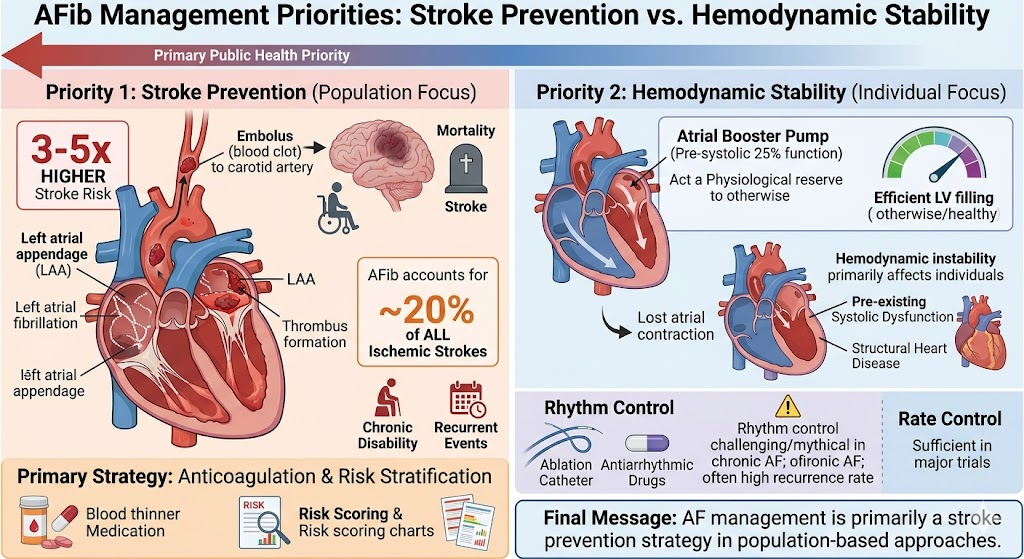

Hemodynamic instability does matter ,in ACS, pre‑existing systolic dysfunction or structural heart disease. At a community level, , stroke prevention (anticoagulation, risk stratification) outweighs rate‑rhythm control as the primary priority. This is exactly the reason, rate control was suffice to beat rhythm in major trials with a optimal anticoagulants.

*The pre-systolic 25% booster pump function acts more as a physiological reserve . We have infinite number of pateints with lone AF , effectively managing the lack of atrial contraction , by the newly recruited LV suction force ( intriguingly, it can function in pre-systole as well )

We must also realise, the much hyped rhythm control modalities actually plays a hide and seek game in many paroxysmal / persistent and most chronic AF . This applies to all sophisticated ablation stuff including the Cryo and PFA. Also, we need to understand stroke in elderly , is not fully prevented even if SR is restored in piecemeals (of time) because the source of embolus can be elsewhere from ventricle, Aorta, Arch, carotids etc.

Final message

Principles of AF management primarily revolves around stroke prevention , while hemodynamics goes to the background. OAC can perfectly take care of the former in most. DOACs are also playing useful alternate role. Contrary to the popular belief, many , LAA occlusion devices and ablation strategies do not necessarily negate the need for OAC in many elderly people.

Reference
1. Andrew Hill Atrial fibrillation and stroke: State-of-the-art and future directions Current Problems in Cardiology Volume 49, Issue 1, January 2024,

Read Full Post »

AF is not only the most common cardiac arrhythmia,it is also an extensively researched entity in cardiology literature. We are trying to rein in, this arrhythmia for the past three decades with multiple strategies. Drugs, pacemakers, ICDs devices, surgical cuts, RF catheters, and the latest technique is trying to frostbite the atrial electrical circuits with ICE. ( Karl-Heinz Kuck,N Engl J Med 2016 )

It is believed that up 60% of AF originate from pulmonary veins. What does it mean?  So, when we blindly suggest PV Isolation routinely for all PAF,  there is 40% futility straightaway! Apart from the hugely variable anatomy of the pulmonary veins, there are prohibitive levels of recurrence due to  PV reconnections. Maybe, will find new technical solutions as we are now moving in 2nd or third generation cryo balloons, 4D imaging, contact force sensing, etc. But let us not forget there are other sources of focal electrical activity too  

Importance of non-PV ectopic beats initiating  AF(Ref 1,2)

  1. Superior vena cava (SVC),
  2. left atrial posterior free wall (LPFW),
  3. LA appendage
  4. crista terminalis (CT),
  5. coronary sinus ostium (CSO),
  6. Ligament of Marshall
  7. Interatrial septum (IAS) 

Ablation or no ablation, we need to reflect on two things in the management of AF.

1. AF can be triggered by totally different mechanisms like intermittent hypoxia, adverse electrolytic flux, diffuse atrial interstitial pathology or amyloid, etc. Before calling the appointment desk of the EP guy’s office please rule out all the systemic causes. This could be your last (lost) chance to save the atria from pulmonary burns.

2. This one is more important. Read carefully. It is not a divine protocol that demands us to restore sinus rhythm in all patients with AF. There is an excellent knowledge base, backed up by wonderfully done studies. (Need not mention the trial name, I think) that should effectively neutralize our compulsive &  misplaced urge to bring back sinus rhythm in all chronic AF.

With respect to the overall outcome, It hardly matters whether you treat the AF by rate control or rhythm control. While there is major technological leap in our fight with AF.It is heartening to know simple measures like regular exercise can control or reverse AF by atrial fatty mass regression.

Final message

We have played with fire for quite some time within the innocent lesser chambers of the heart  (RF ablation) and burnt our reputation considerably. Now, silently we have decided to fall for a more friendly weapon ICE. But we must remember our obsession with the pulmonary vein as the only source of initiation of AF is essentially flawed. Further, all these hyper-technology-based combat of AF is indicated only in a fraction of our patients (Maybe 5-10%) 

Reference 

1.Chen SA, Tai CT, Yu WC, Chen YJ,  Right atrial focal atrial fibrillation: electrophysiologic characteristics and radiofrequency catheter ablation. J Cardiovasc Electrophysiol. 1999 Mar;10(3):328-35. doi: 10.1111/j.1540-8167.1999.tb00679.x. PMID: 10210494.

2.Lin, Wei-Shiang, et al. “Catheter ablation of paroxysmal atrial fibrillation initiated by non–pulmonary vein ectopy.” Circulation 107.25 (2003): 3176-3183.

Postamble

If you think this write-up is too biased, please read the CABANA trial fully before ditching this post into the dustbin.

Read Full Post »

Management of  atrial fibrillation has been a  big puzzle for cardiologists  for many  decades  till  it became a corporate game , and  now in the era of recession it has become  medicare’s  night mare !

So , we  were  made to dance to the tunes of the so called evidence based cardiology . . .

  • From only rhythm control to . . . in 1990s
  • Either rhythm or rate control  . . .       in early  late 1990s
  • Then cost control  was found  more important than rate control  . . .
  • . . . So rate control became superior to rhythm control in early 2000s

In 2010 , even the  rate control  became  a luxury ,  here comes the  real ace !   ” Casual rate control may be  suffice in most cases of AF “

Read this article  from  NEJM , which tries to  make  sense out of nonsense  and judge for yourself

Probably the most influential  article  in electrophysiology over  the  next decade

Click  below to reach Nejm article

http://content.nejm.org/cgi/content/full/NEJMoa1001337?query=TOC

http://content.nejm.org/cgi/content/full/NEJMe1002301?query=TOC

Gist of the trial

Technically and literally it  means a  “Take it easy attitude” as long as patient is comfortable , even a rate  of  more than 100 is allowed . Few years back the above concept could be termed a “non sense”

Final message

In this  perennial  management issue  of AF  ,  Whether ,   we were successful in  restoring   sinus rhythm or not , we have restored  the common sense*  Thanks to RACE 2 investigators.

* Do not unnecessarily trouble a  asymptomatic  patient with those powerful  and costly  antiarrhythmic drugs .

Read Full Post »
