Feeds:
Posts
Comments

Posts Tagged ‘core valve’

TAVI has become a popular Aortic Intervention, but the risk of coronary obstruction (Left main & RCA too) is often underestimated , it can happen during the procedure or in the long term .High degree of anticipation is essential. The exact incidence is not known as reporting the event is far less than, what it is actually. Following are the suggested precautions to prevent coronary obstruction.

Pre-Procedural Assessment

  • Low Coronary Ostial Height: Identify if the Left Main origin is (< 10–12 mm )from the aortic annular plane, that will increase  the chance of struts covering the ostia.
  • Shallow Sinuses of Valsalva : A shallow sinus( < 30 mm )leaves insufficient room for the displaced native leaflet, directing it toward the ostium.
  • Leaflet Length and Calcification: Evaluate for heavy calcification or a long native leaflet that exceeds the height of the coronary ostium, as these are easily pushed into the vessel opening.
  • Virtual Valve-to-Coronary (VTC) Distance: In Valve-in-Valve (ViV) procedures, calculate the VTC distance. A computed distance less than 4 mm indicates risk of coronary obstruction.

Risk factors for potential coronary obstruction.
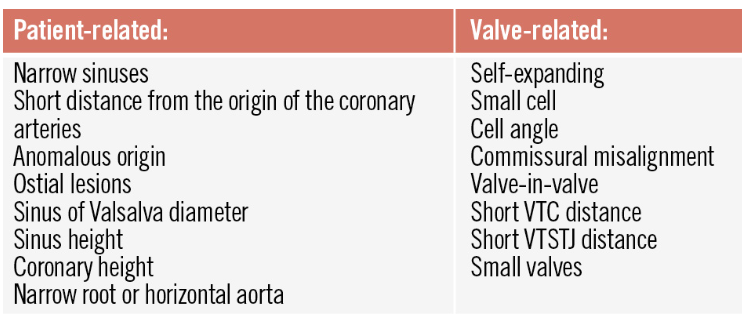
Image source Ref 2

*Leaflet length is a very critical parameter, which was ignored in the past. (It is more Important than even, the coronary height.Mind you coronary height matters little if leaflet is long enough to reach the ostium , when TAVI flushed it with wall of Aorta.)

Intra procedural precautions(In small shallow roots)

  • Chimney Stenting: Prophylactic wire in the Left Main and park an undeployed drug-eluting stent. If any segment of TAVI tends to occlude deploy the stent.
  • BASILICA/Leaflet Splitting: This is used in ultra-high risk or valve-in-valve cases, use radiofrequency energy or mechanical cutting devices to lacerate the target aortic cusp before valve deployment, forcing it to part like a curtain instead of blocking the ostium.This is not an easy procedure as it may look. Prone for its own complication.

Post-Procedural & Long-Term Management

Dual antiplatelet therapy is critical . Routine echocardiography and follow-up CT angiograms to monitor for delayed coronary obstruction or stent deformation . Documenting the valve-stent alignment is encouraged for a possible future coronary interventions.

Planning a PCI with TAVI
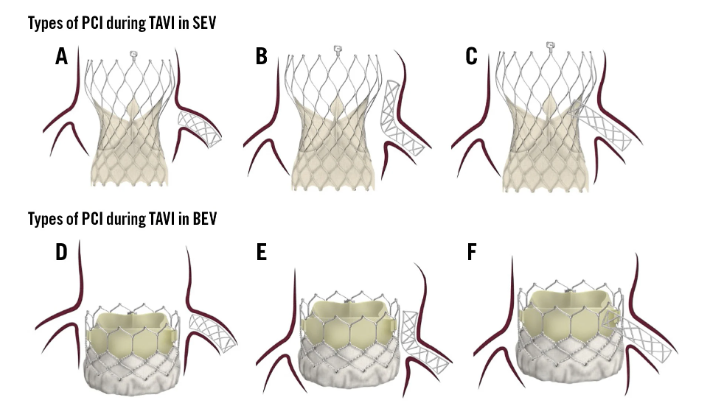
Image source : Ref 2

PCI types in different types of valves. A) PCI with minimal stent protrusion due to limited space between the valve and the STJ. B) Adequate space between the valve and the STJ, allowing for the chimney technique. C) Valve-directed stenting from the coronary ostium towards the valve frame. D) PCI with minimal protrusion, as the coronary ostium is located above the valve. E) Coronary ostium located below the valve frame, with sufficient space between the valve and the STJ to perform the chimney/snorkel technique. F) Coronary ostium located below the valve frame, with limited space between the valve and the STJ; therefore, stenting is directed from the ostium towards the valve. BEV: balloon-expandable valve; PCI: percutaneous coronary intervention; SEV: self-expanding valve; STJ: sinotubular junction; TAVI: transcatheter aortic valve implantation

Final message

TAVI is a popular Aortic Intervention, but the risk of coronary obstruction is often underestimated by cardiologists, and it can happen during the procedure or in the long term; thus, preparedness is essential.

Reference

1.Aquino_bruno.pdf TAVI and coronary interventions: indications, technical considerations, and clinical scenarios Euro Interventions Volume 22 Number 11 Jun 1, 2026

2.https://eurointervention.pcronline.com/article/tavi-and-coronary-interventions-indications-technical-considerations-and-clinical-scenarios

Read Full Post »

A. The Aortic Radiologist

B. The Principal operator of TAVI

C. The co-operator or the proctor

D. The device type, behavior & destiny

Answer : A. The radiologist, (rather the soft-warist ) tell us best landing zone in the pre procedure work up taking into the account of shape, size, leaflet morphology ,3D analysis of aortic root, and calcium distribution. He plays a vital role. Though B, is the logically correct answer, ie the expertise of the primary Operator it is not to be. Considering the complexity of the anatomy, device, and momentary longitudinal and circumferential alterations in radial forces, In reality, the answer is D.

Evidence? No one has tested so far the true intended landing zone and the final one.


One may argue , the question need to be reframed as, What are the factors that decide the landing zone in TAVI ?

Though deployment is under the control of primary operator , the valve often defies operators’ hand commands and decides to home in its own place of comfort and peace adjusting to the complex anatomy around. It never bothers about the consequences .The unpredictability of calcium crystals, the annular tensile strength, the distorted native leaflet and the blind plastering against the aortic wall all are responsible for the complications. One less talked dynamism of aortic root which finetunes micro adjustments of the valve. Para valvular leak is primarily determined by either excess (or lack )of this modulatory forces.

Following are some of the crucial factors that determine landing zone.

Anatomy of the Aortic root

 The ascending aortic curvature and angulation is a major factor of the TAVI landing site. , stretching from the aortic annulus to the proximal ascending aorta. This anatomy may vary depending on the patient and affects different types of valves (such as balloon-expandable or self-expanding). For instance, higher aortic angulation (Ex – a horizontal aorta) can influence the final depth of valve implantation, especially for self-expanding valves with longer stent frames.

The invisible radial & longitudinal forces

The resistance offered by the distorted native valve and its delicate balance with the instant radial force of in case of balloon expandable or the gradual built in force of self expandible balloon system. Apart from the radial forces. the longitudinal deformation forces in long axis as the stent expands , in the last few seconds determine the final residence of the valve.

Valve Type and Device Design

The intended implantation depth is usually planned based on the valve type—balloon-expandable valves have a short stent frame and are deployed differently than self-expanding valves with a taller frame. More precision is required in balloon expandable valves. This is because the anchoring mechanisms and the metallurgy is entirely different between the two.(SE-TAVI uses Nitinol frame, and it has wide contact area so more stable ,)

Intra-Procedural Adjustments: 

The final landing zone is also influenced by the need to avoid complications such as valve migration, aortic regurgitation, and coronary obstruction.

Final mesage

Some times, TAVI landing looks like SpaceX Dragon docking with a space station. Extreme precision is required to avoid complications. The bulk of the complications are due to inappropriate landing (too high or too low). Fortunately, aortic annulus exists in multiple transverse planes; patients can often tolerate some geographical miss. Still even a few mm error can crash the patient as well as our reputation.

Postamble

What are the chances of immediate post -procedural movement and late migration of the valve from the landing site in TAVI ?

The chances of immediate post-procedural movement and late migration of the valve from the landing site in Transcatheter Aortic Valve Implantation (TAVI) are generally low but represent serious complications when they occur. Incidence is up to 7.5%

Reference

https://www.frontiersin.org/journals/cardiovascular-medicine/articles/10.3389/fcvm.2022.928740/full

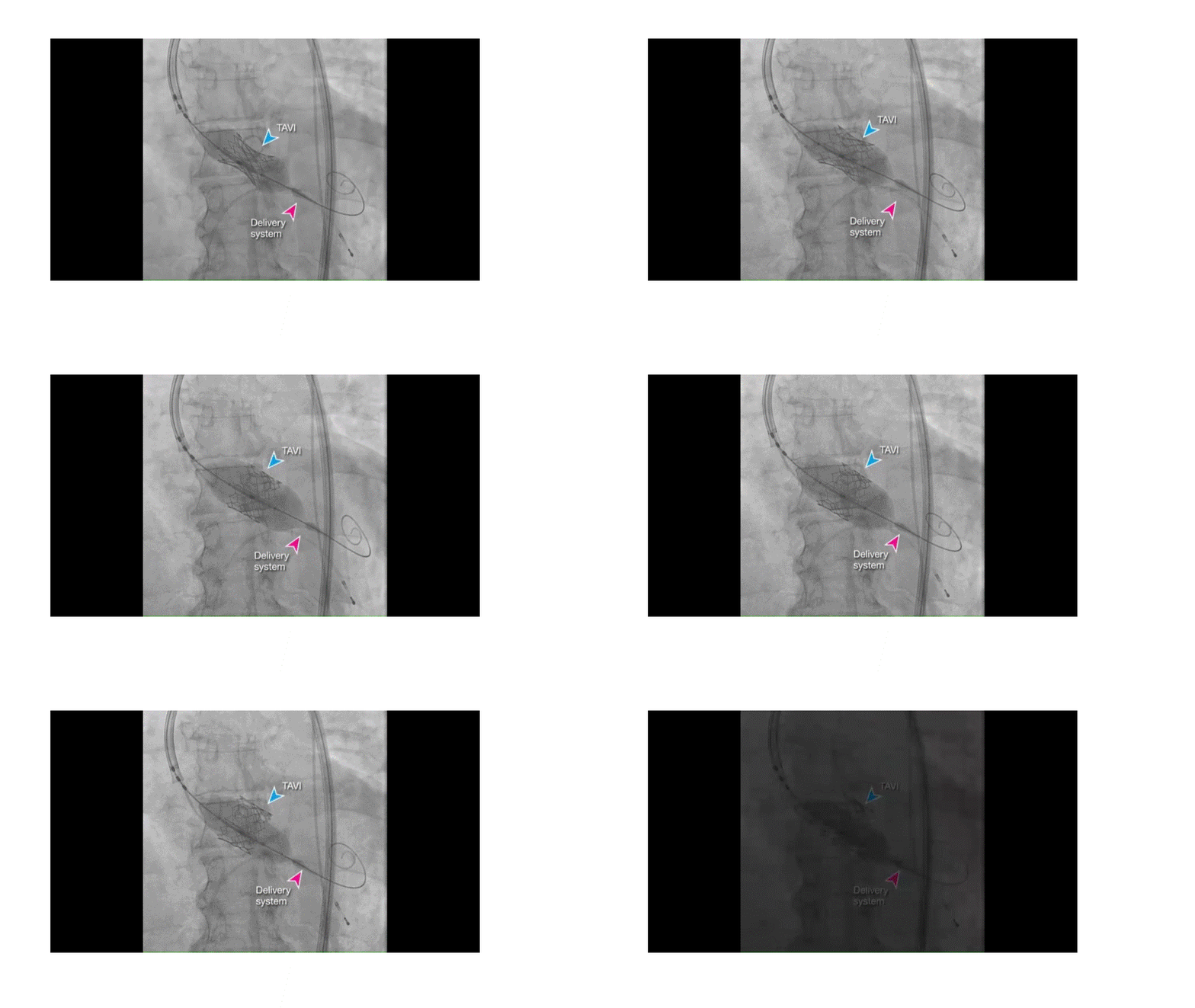
* Video source and courtesy

Read Full Post »

Reviewing NOTION study, the Nordic TAVI 10 year follow up has just been released (Ref 1) :

Caution :Non-academic content

This study reports the long-term outcome in low-risk individuals who required AVR. The study basically compared the blind and passive deployment of bio-prosthetic aortic valve aided by the catheter skills of new-age cardiologists with sophisticated image backup versus Open surgical replacement of the aortic valve by experienced cardiac surgeons, after meticulously removing and debriding the native leaflets and suturing the prosthetic valve permanently in the optimal target site under direct vision.

Study summary

Conclusion

The study results finds the valve deployed percutaneously under semi- blind vision, was equipoise with SAVR done under direct vision. The surprise however is, TAVI was superior to cardiac surgeons in multiple aspects .The mysterious finding is TAVI had less Structural valve dysfunction, and possibly low bio valvular failure (BVF), if Kaplan -Myer curve trend is little extrapolated. No doubt ,the Aortic interventional world is applauding and everyone is joining the party.

Now, some academic queries ?

1.Did the trial compared best practices of TAVI & SAVR ?

No. Because it was done in 2010-2013. (Which grew faster TAVI or SAVR in the last10 years ? in terms of both hardware and expertise . How it will impact now ?)

2..Was the outcome assessment blinded ?

No

3.Why there is 50 % cardio vascular and 60% all cause mortality in both groups even though they belong to low risk category ?

Don’t know. Not clear.

4.Why the gradient was high in SAVR in the follow up ?

There are two important factors. More than 98% of TAVI patients had a valve sized 26–31 mm, while 98% of SAVR patients received a size 19–25 mm . Apart from valve size aortic annular enlargement before SAVR was not done in majority, there by enhancing the gradient and valve mis-match.(Note :The TAVI begins at 26mm and SAVR ends at 25mm. For how many of you this looks odd ?)

4a. Was doppler velocity index measured in all to assess EOA in follow up ?

No. It was not mandatory.

5..Is it Ok to define structural valve dysfunction(SVD) based on gradient alone ? Did TEE/CT follow up imaging done ?

No. Flow is physiology. Sub physiological valve destruction very much possible without affecting gradient.

6.The rate of severe SVD was higher after SAVR. Is there any meaningful explanation why surgeons valve deteriorated fast ? 

No .

7.Was CAD accounted for outcome difference ?

No .CAD patients were excluded.

8.Did this study address technical issues in performing PCI with new onset CAD and its possible impact in outcome

No. TAVI induced coronary ostial encroachment not reported.

9.Why didn’t they use bi-leaflet mechanical valves in SAVR group ?

Don’t know .(*One possible reason is given in the foot notes)

10.Is this study still valid ?

Sorry,  I don’t know.

Final message

Whatever is written here, NOTION will remain a great study with a 10 year meticulous follow up . As a cardiologist, very soon we will be allowed legally to choose TAVI even in more younger , low risk cohort of Aortic stenosis without co-morbid conditions. Still, if you put patient first approach ,CAUTION should precede NOTION .

* One version of answer for question 9 , would be TAVI vs Bi-leaflet St-Judes study was in-fact proposed, but was apparently not approved for (un)ethical reasons,of comparing a short living bio-valve valve with a long lasting mechanical valve.

Reference

1.Hans Gustav Hørsted Thyregod, Troels Højsgaard Jørgensen, Nikolaj Ihlemann, Daniel Andreas Steinbrüchel, Henrik Nissen, Bo Juel Kjeldsen, Petur Petursson, Ole De Backer, Peter Skov Olsen, Lars Søndergaard, Transcatheter or surgical aortic valve implantation: 10-year outcomes of the NOTION trial, European Heart Journal, 2024;, ehae043https://doi.org/10.1093/eurheartj/ehae043

2.TCT -MD article from the INTEGRITY group / Link 2

Read Full Post »