Feeds:
Posts
Comments

Posts Tagged ‘coronary ectasia’

Stent scaffolds are supposed to match the natural size of the coronary artery. Cardiologists take a lot of effort to match stent size and vessel wall. Choosing the optimal size, both width and length, is the foundational parameter. However, there is no perfect match possible with the extent of the lesion.

While stent length mismatch is much more common and taken less seriously,diameter mismatch can be more problematic since it looks strikingly odd & ugly .Still, one section of cardiologists believes a little amount of oversizing is safe and good. There is equal opposition to this concept as well. It is not surprising , acquired stent-ectasia of coronary artery during PCI ,has both advantages as well as troubling issues.
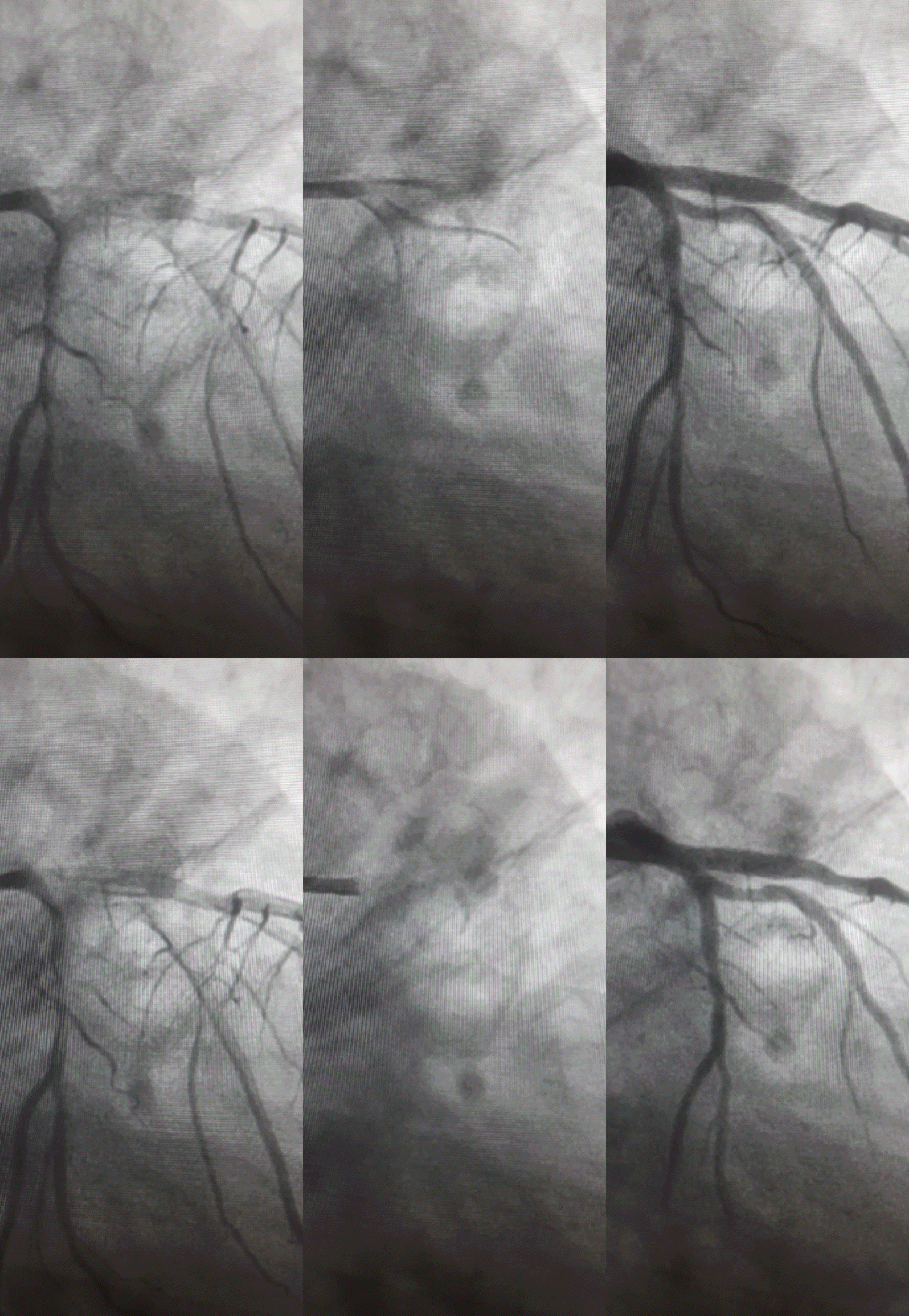
Please note the (?intentional) proximal LAD pythonisation , by oversizing the stent , which provides more lumen reserve area. What are cost and benefits of this bad principles in PCI practice ? Read below

Advantages of Stent Oversizing

Better Apposition and Expansion

Oversizing can ensure full contact between the stent struts and vessel wall, especially in moderately calcified lesions, reducing malapposition. Prevents stent under-expansion, which is a known predictor of restenosis and thrombosis.

Improved Flow Dynamics

Slight oversizing may restore vessel diameter more completely, improving luminal flow and reducing turbulence.

Reduced Risk of Stent Edge Dissection(in selected cases)

If stent is properly deployed and well apposed, oversizing slightly may prevent gaps at the edges where dissection can initiate.

Helpful in Plaque Compression

Facilitates better plaque redistribution and compression, especially in fibro-calcific lesions.


Disadvantages of Oversizing

Risk of Vessel Injury or Perforation : A stent that is too large can overstretch the vessel, causing deep medial injury, dissection, or even perforation especially in fragile vessels or older patients.

Increased Elastic Recoil : Oversized stents in small or elastic vessels (e.g., RCA) may provoke recoil, paradoxically reducing the luminal gain.

Edge Dissections and Geographic Miss : If oversizing leads to excessive radial force at edges, it can cause edge dissections, especially if not well matched with tapering vessel anatomy.

Neoatherosclerosis and Late Malapposition : Chronic vessel injury from over-expansion may lead to inflammatory changes and promote neo-atherosclerosis, stent fracture, or late acquired malapposition.

Stent Fracture Risk : Over-expansion of certain stent platforms beyond their elastic range increases risk of metal fatigue and fracture, especially in tortuous or mobile segments.

Final message

De novo coronary ectasia is quite a common and fairly benign entity seen in 20 to 30% of normal coronary arteries. However, acquired ectasia (stent-ectasia) can’t be taken lightly. No one can predict who is going to accrue the potential benefit and risk. Slight oversizing of stents (typically within 0.5 mm above reference vessel diameter) can be beneficial in selected clinical situations, such as in fibrotic or calcific lesions, or in large proximal segments. However, it must be done cautiously, guided by imaging (IVUS or OCT), and never exceed the manufacturer’s recommended expansion limits.

Reference

1.Kitahara H, Okada K, Kimura T, Yock PG, Lansky AJ, Popma JJ, Yeung AC, Fitzgerald PJ, Honda Y. Impact of Stent Size Selection on Acute and Long-Term Outcomes After Drug-Eluting Stent Implantation in De Novo Coronary Lesions. Circ Cardiovasc Interv. 2017 Oct;10(10):e004795. doi: 10.1161/CIRCINTERVENTIONS.116.004795. PMID: 28951394.

This IVUS-based study on nearly 3,000 lesions found that slight stent oversizing (within 0.5 mm of reference diameter) led to better stent expansion and lower restenosis, without increasing complications.

2.Hong SJ, Kim BK, Shin DH, Nam CM, Kim JS, Ko YG, Choi D, Kang TS, Kang WC, Her AY, Kim YH, Hur SH, Hong BK, Kwon H, Jang Y, Hong MK; IVUS-XPL Investigators. Effect of Intravascular Ultrasound-Guided vs Angiography-Guided Everolimus-Eluting Stent Implantation: The IVUS-XPL Randomized Clinical Trial. JAMA. 2015 Nov 24;314(20):2155-63. doi: 10.1001/jama.2015.15454. Erratum in: JAMA. 2016 Feb 2;315(5):518. doi: 10.1001/jama.2015.18563.. Kim, Yonghoon [corrected to Kim, Yong Hoon]. PMID: 26556051.

This landmark randomized trial (IVUS-XPL) showed that IVUS-guided stent sizing often resulting in slightly larger stent selection and greater expansion reduced major adverse cardiac events significantly at 1 and 3 years.

Post-amble

Can we do an intentional post-dilatation to increase the lumen size in small vessels ?
Read Full Post »

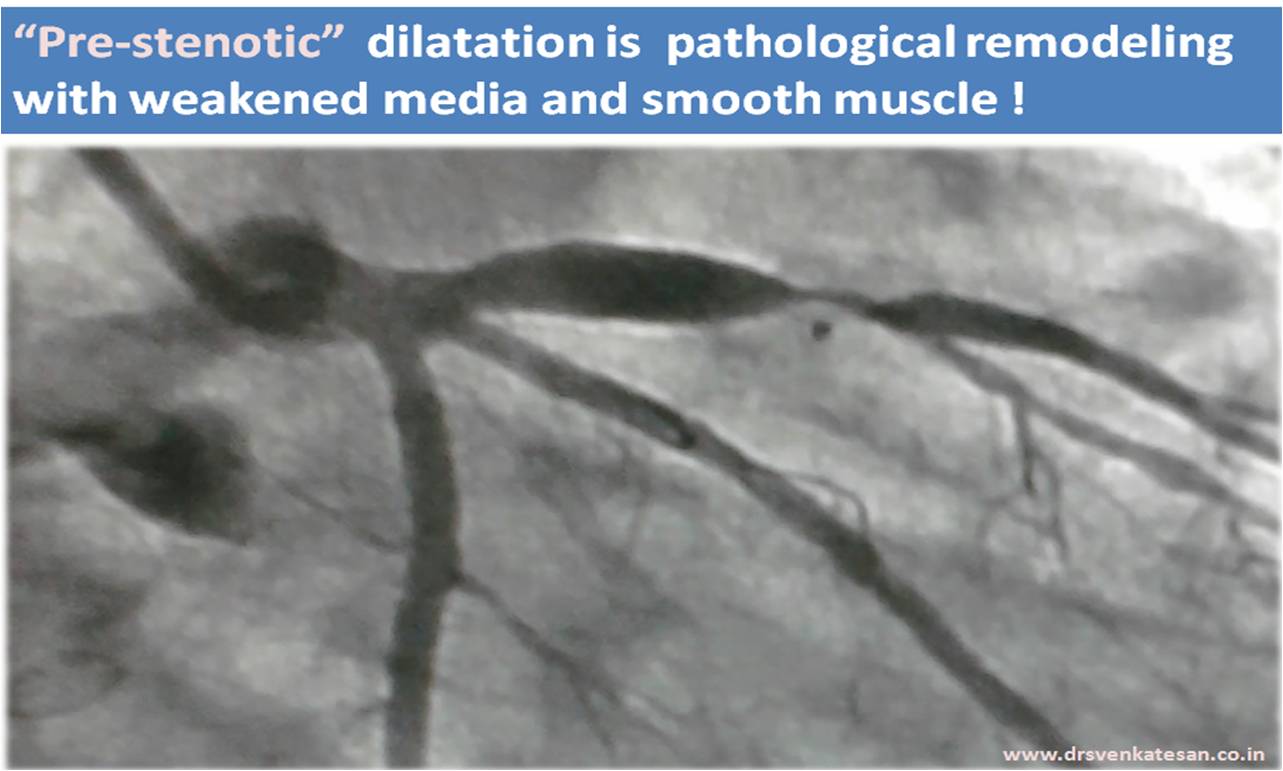
Laws of fluid dynamics dictate there is a pressure drop across   a point of narrowing  and recovery  thereafter  . At  recovery point if the vessel wall is weak it tends to balloon out .This is called post- stenotic dilatation .This is  the anatomical equivalent of Bernoulli or venturi  effect. This theoretically  occur only distal to obstruction .

How do you explain the common observation of pre- stenotic dilatation?

  • Intimal weakening due to disease process is the prime  suspect.
  • Pre stenotic  increment in mean pressure  also play a role .
  • Mechanical distention due to stagnated blood  proximal to  critical obstruction  is  a  logical explanation.
  • Finally and most importantly ,contagious , sub – angiographic  atherosclerosis.

How is  dilatation  different from ectasia ?

May be they are all related phenomenon. The definitions  of ectasia ,  dilatation, aneurysm are  more to do  with semantics than with academics.

Clinical and hemodynamic implication in cath lab

  • Sluggish  flow prone for thrombus
  • Stent selection errors likely
  • Stent dislodgment  and migration

Long term effects

  • In stent re-stenosis is more common if adjacent segment show dilatation.

Finale

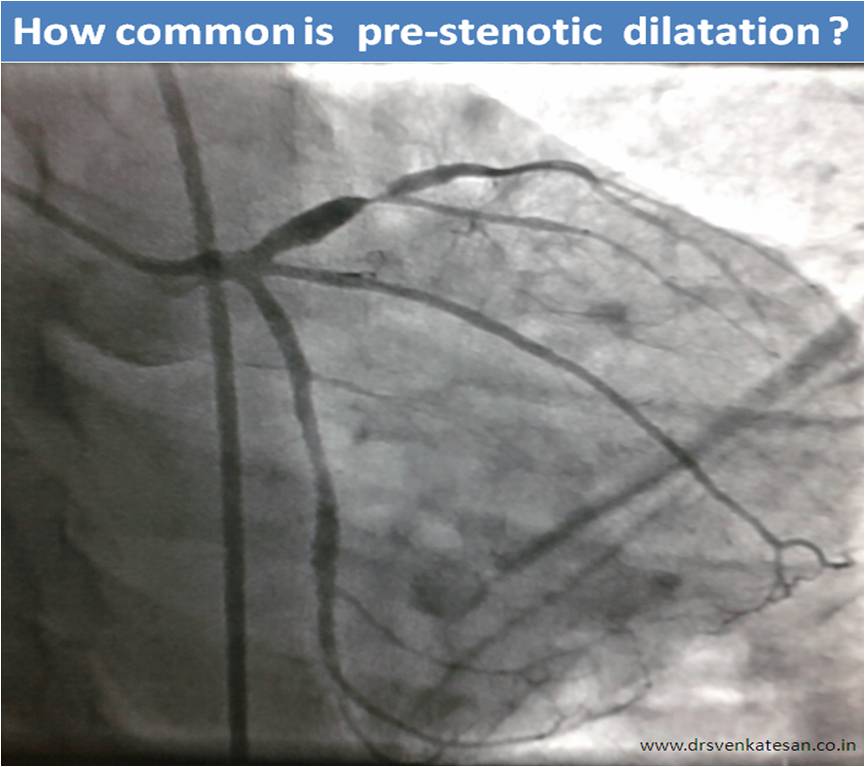
Enlargement of vessel wall in both pre and post stenotic segments are possible . In small vessels pre- stenotic dilatation is  more common , while in large vessels post stenotic dilatation is  more prevalent .(Aorta, Pulmonary artery)  The mechanisms are slightly different. Apart from the lesion tightness ,  hemodynamic  and genetic factors are also responsible These dilatations are  often labeled as ectasia in coronary artery  and  most cardiologists  tend to   ignore this finding especially if  the margins are smooth.

But , newer imaging modalities like IVUS, OCT have given   better  insight about these dilatations.These   are  actually an  expression  of the  contagious  atherosclerosis .  Pre-  stenotic segments are prone for extensive disease  than even the diseased segment due to  more hemodynamic turbulence. There is some evidence atherosclerosis progresses  proximally more than distally.Smooth margins within the  pre -stenotic dilatation  does  not guarantee  disease free status.

During PCI  there could be  an  argument for covering the dilated  pre- and post stenotic segments  as well* . (We vouch for endovascular stenting when aorta is dilated why  do we hesitate  in coronary  ?)  .Careful selection of  coronary stent size  is  recommended  and  allowance should be given  for these two (Pre and post coronary dilatation ) patho -anatomic phenomenon.

* Stent missing a lesion is stylishly called geographical  miss ! This should logically include dilated segments also.

Read Full Post »

Coronary artery dilatation is a less discussed entity in clinical cardiology .It is important to realise  coronary artery has one more behavioral pattern in response to atherosclerosis .  Atherosclerosis not necessarily means obstructive disease . Dilatation is also  a common  expression of coronary atherosclerosis .

It all depends upon the medial weakness and resistance.If the medial weakness  is more plaque grows inwards ,  if the resistance  is more plaque grows out.(Read the related topic -Glagovian phenomenon )

What is the difference between aneurysm and ectasia?

The difference between ectasia, aneurysm are often subtle and  mainly  semantic. . If the length of the dilated segment is more than 50 % of diameter it is called ectasia. When  the diameter is more than 50 % of length it is termed aneurysm .( With a  minimal enlargement of 150 % of the reference segment.  To add to the  complexity both can occur in the same vessel.

Here is the patient from our institute  who has an Aneurysm in LAD and ectasia in RCA.


Clinical Implication

  • Ectasia generally do not limit blood flow.
  • Thrombus formation in the walls can be  common.

*Obstructive Ectasia.This can happen  either when ectasia develops in  an obstructive  lesion or a ectatic lesion getting obstructed .

Stenting and ectasia .

Ectasia creates special  challenges in the Interventional era. Stenting an ectatic segment confers  a real danger ,   as  these stents are prone for  dislodgement   or  even collapse  into the lumen or  migrate downstream   triggering an  ACS. In fact , such complications of PCI are never recognised  and hence not  reported.

Final message

Coronary artery dilatation is also an  important pathological state like coronary  stenosis . Since it rarely limits the blood flow  in  isolation  , it is a less respected lesion.

But , interventional cardiologists beware :  PCI in a ectatic vessels can give you (And your patients too !)  sleepless nights .

Treatment of isolated ectatic segments is controversial .Less aggression is always better . CAD risk factor profile management  is adviced . If severe ectatic changes  are present   it is a good practice to add  oral anticoagulants like Warfarin. Surgical excision of aneurysm is rarely required.

Kawasaki disease is a distinct entity that need to be addressed separately in pediatric population.

Read Full Post »