Feeds:
Posts
Comments

Posts Tagged ‘focal atrial tachycardia’

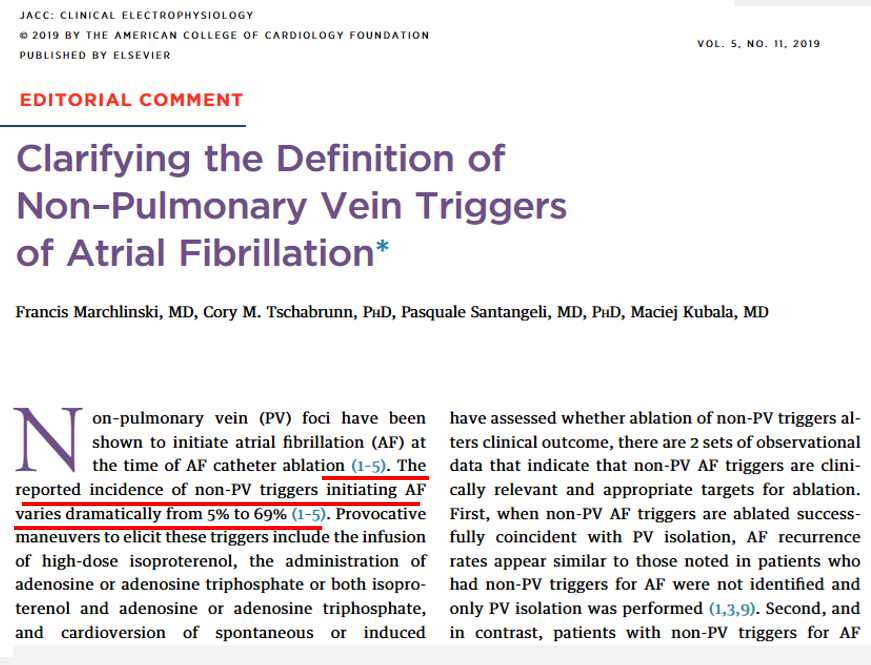
For right or wrong reasons, the world of electrophysiology has pushed us into a belief system that, if it is AF, the culprit must be pulmonary veins. In fact, non-pulmonary vein origins can be a staggering 70% in some series. (See below) It can be in the free walls of the left atrium, LA appendage, IAS, IV, SVC junctions, coronary sinus, ligament of Marshall, crista terminalis, etc. (Ref 2)
For example , where will be the initial focal trigger for AF in a pateint with COPD ?

Can you ever think of ablating PVs in a patient with AF and COPD, where the right atrium is under stress and strain? It doesn’t require any extraordinary intelligence to conclude any chronic focal atrial tachycardia can get degenerated to AF in the long run. In that case, the famous atrial tachycardia localizing map from Peter Kistler et al from Australia JACC 2006 holds good for location AF focus too.
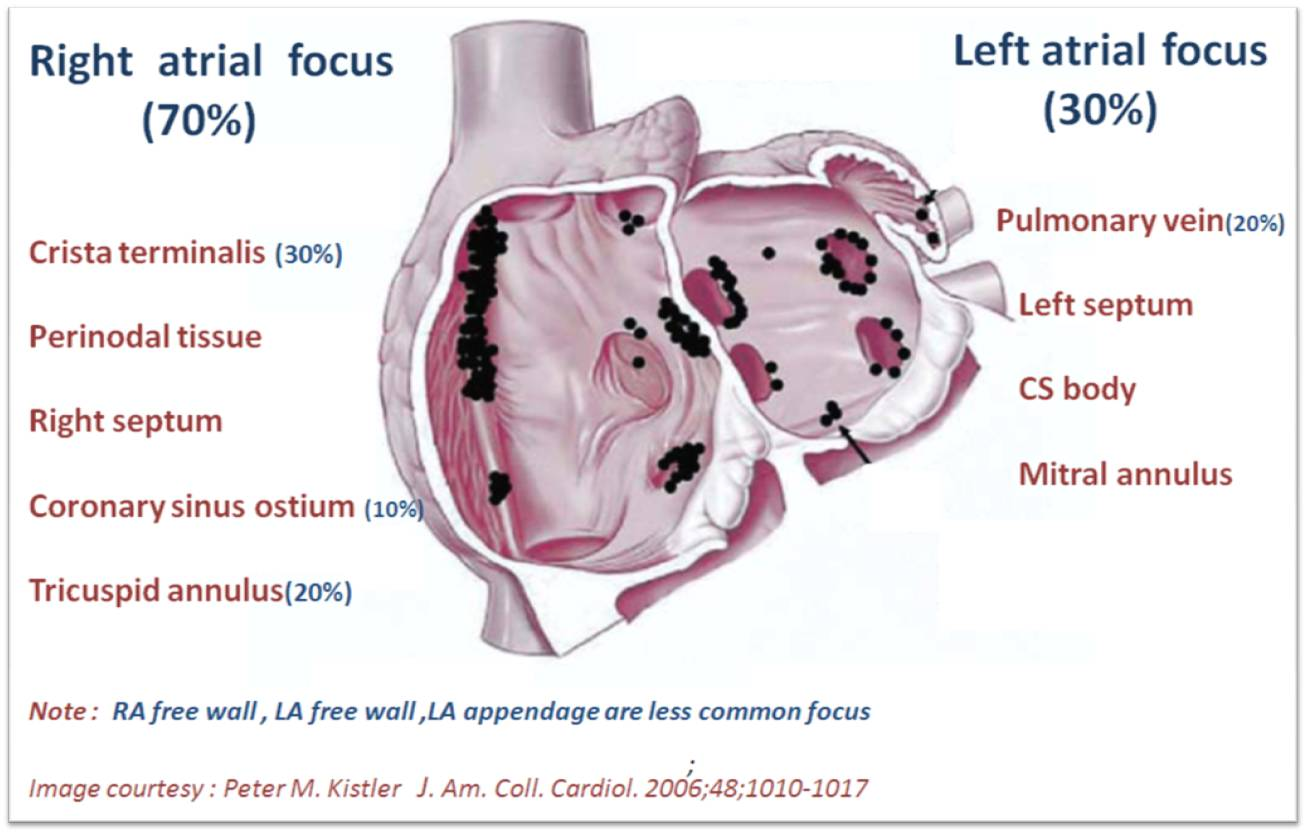
If we look at the above map,RA prevails over LA convincigly in termes of focal atrial tachycardia. Only 20% of focal AT arise from pulmonary veins. I guess, the same should be true for AF.

Focus-less Atrial fibrillation

Right from the days of James Mckenzie, when AF was refered to as delirium cordis or ataxia of pulse, AF was always considered as a chaotic, focus-less arrhythmia. It is still true in many cases. The recent pulmonary vein triggers are just a small revelation and need not be a revolutionary paradigm shift , as we are taught. There are innumerable patients who develop de-novo AF without any focus. Hypoxic or acidotic milleu of a single atrial myocyte can iniitiate an AF, alosan episode of atrial ischemia, diffuse inflammation as in atrial epi-myocardiits can trigger AF from any spot on the atrium.

Reference

1.Francis Marchlinski Cory M. Tschabrunn Pasquale Santangeli , Maciej Kubala J Am Coll Cardiol EP. 2019 Nov, 5 (11) 1328–1330

2.Yang, S.Y., Cha, MJ., Oh, H.J. et al. Role of non-pulmonary vein triggers in persistent atrial fibrillation. Int J Arrhythm 24, 7 (2023). https://doi.org/10.1186/s42444-023-00088-0

3.Aronson JK. One hundred years of atrial fibrillation. Br J Clin Pharmacol. 2005 Oct;60(4):345-6. doi: 10.1111/j.1365-2125.2005.02501.x. PMID: 16187965; PMCID: PMC1884824.

Read Full Post »

Human atria is a rough terrain infested with peaks and  troughs like the  Himalayan range . The two atria together has a minimum of ten entry or exit points . Cardiac arrhythmias are   something similar to the  uneven  earth plates  triggering an  earth quake.  Like the earth surface there are  areas in the atria  with high seismic activity !

It is now discovered there are nine vulnerable points in human atria that can initiate focal electrical activity at times of hemodynamic/ischemic/metabolic stress .

The common causes for Focal /Ectopic atrial tachycardia are

  • Hypoxic AT -COPD ( Probably the most common cause .If persistent it will degenerate to MAT- AF )
  • Structural atrial disease
  • Hypertensive heart
  • CAD
  • Valvular heart disease
  • Drug induced

Note ,  all these  vulnerable points are located either in the  junction of  an anastomosis  with a venous structure or valve or septum.

Further, these sites are often the  embryological fusion points making it still more vulnerable due to tissue defects.

Why free wall of atrium  is  a less common  focus ?

They are relatively smooth, lack ridges and joints. Unless the walls of atria are diseased  focal tachycardias are less common from these sites .

Other forms of Focal atrial tachycardias

Indian perspective  and Rheumatic atrial tachycardia.

In developing  countries  focal atrial tachycardia in rheumatic heart  differ very much from the tachycardia described above. In fact many of the rheumatic atria present straight away  to atrial flutter or fibrillation.

Pulmonary vein focus should rarely be considered in atrial tachycardia that occur in RHD.

Post operative tachycardias

Surgical scars can result in what  is called  Incisional tachycardia.(Especially after complex atrial  surgeries like Sennings, Glean/TCPC  etc )

Multi focal atrial tachycardia .

This is nothing but a focal tachycardia which tend to fire from different angles towards different targets  often lead to a chaotic atrial rhythm .  Digoxin and DC shock paradoxically aggravate this arrhytmia.

Atrial epicardium/pericardium interface as a focus

When pericarditis is the predisposing  event  then it can emanate from anywhere from  epicardial surface .

Since left atrium is only  partially covered by pericardium it is not logical to assume pericarditis related AT arise from RA epicardium.

Atrial tachycardias in congenital heart disease.

Complex atrial anomalies, SVC type ASDs, PAPVCs can  give raise to abnormal  electrical focus

Reference

An excellent original work from  Royal Melbourne Hospital, Melbourne  Australia.

A must read  . . . http://content.onlinejacc.org/cgi/reprint/48/5/1010.pdf

//

Read Full Post »