Feeds:
Posts
Comments

Posts Tagged ‘inclisiran’


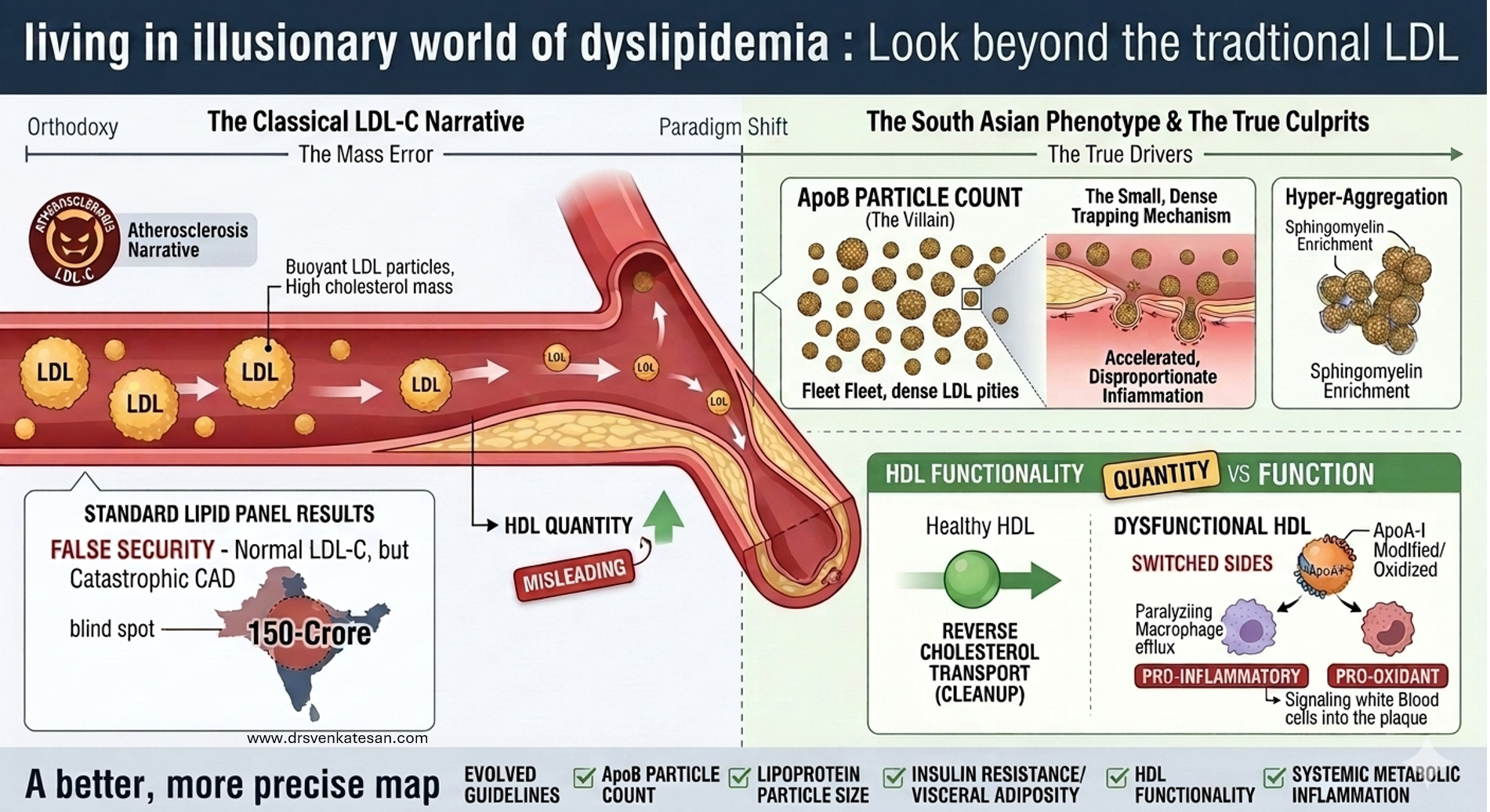
We know south Asians (who constitute about 2 billion people) consistently develop premature and severe atherosclerosis despite largely normal or only mildly elevated LDL-C levels. This “Lipid Paradox” is driven by small dense LDL particles, elevated ApoB, high triglycerides, low HDL, and insulin resistance not classical high LDL cholesterol.

This reveals a fundamental flaw in the current LDL-centric model of atherosclerosis genesis. When one-quarter of humanity develops CAD without high LDL, we must question whether LDL reduction is the primary target or merely a convenient proxy. A broader focus on ApoB, metabolic health, and visceral fat may be more scientifically honest and cost-effective.

Further, HDL molecule has its own problems in being a savior. At a level more than 60 mg/dl, it loses its protective value; rather, excess dysfunctional HDL is harmful as well. Since we have failed to increase HDL by pharmacological means, LDL reduction has gained more attention.(Franczyk B Et all , 2021)

Forget the patient .. target the LDL

Yet, aggressive marketing promotes expensive drugs like, PCSK antagonists, SiRNAs like Inclisiran and ATP citrate blocker Bempedoic acid to target ultra-low LDL levels (<55 or <50 mg/dL) in a population where LDL-C is often a weak tentative target. The latest to join the LDL rat race is the VERVE* 102 yearly Injection , a dramatic temporary RNA editing drug by the pharma giant Eli lilly.

*VERVE-102 consists of a messenger RNA encoding an adenine base-editor protein and a guide RNA targeting PCSK9, which are encapsulated in a lipid nanoparticle incorporating N-acetylgalactosamine (NEJM 2026)

Final message

LDL is definitely one of the culprit in human Atherosclerosis , but it is very difficult to prove , it is a major, universal, risk factor in isolation.This is not mocking the science. This is true at least in our part of the world. To treat a South Asian patient exclusively on standard LDL lowering protocols and projecting it as villain de chief, is not a scientically sound cardiology practice.

Reference

  1. Volgman AS, Palaniappan LS, Aggarwal NT, et al. Atherosclerotic Cardiovascular Disease in South Asians in the United States: Epidemiology, Risk Factors, and Treatments: A Scientific Statement From the American Heart Association. Circulation. 2018;138(1):e1-e34.
  2. Agarwala A, Satish P, Al Rifai M, et al. Identification and Management of Atherosclerotic Cardiovascular Disease Risk in South Asian Populations in the U.S. JACC Adv. 2023;2(2):100258.
  3. Bilen O, Kamal A, Virani SS. Lipoprotein abnormalities in South Asians and its association with cardiovascular disease: Current and future perspectives. J Clin Lipidol. 2016;10(3):543-552.

Postamble

The word “wrong culprit” in the title is intentional. It actually means “not a primary culprit”

Read Full Post »

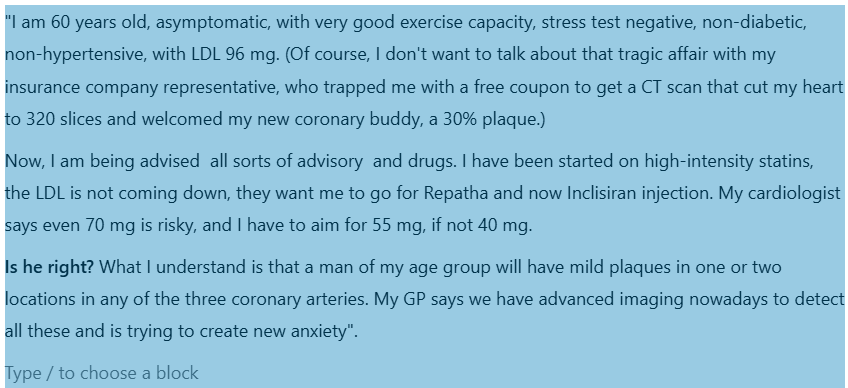
Fixing the target LDL, in both primary and secondary prevention is becoming more & more complex . The reason being, there is a huge healthy population ( with zero risk factor) , but showing insignificant or minimal coronary plaques. This subset of population is anxiously unmasked by inclusion of CT angiogram in many master health check-up programs.

A case profile & a debate

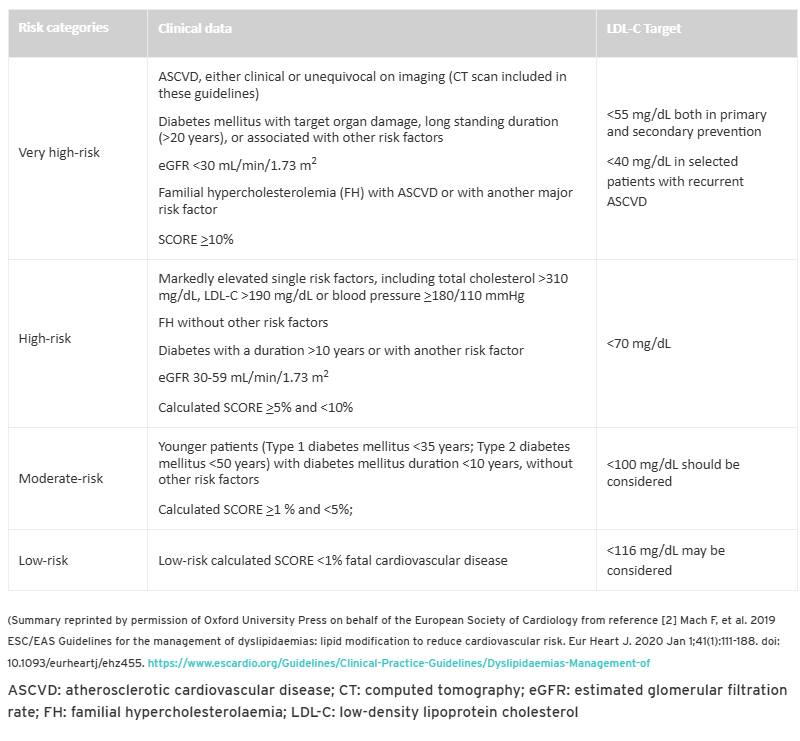
What does the guidelines say ?

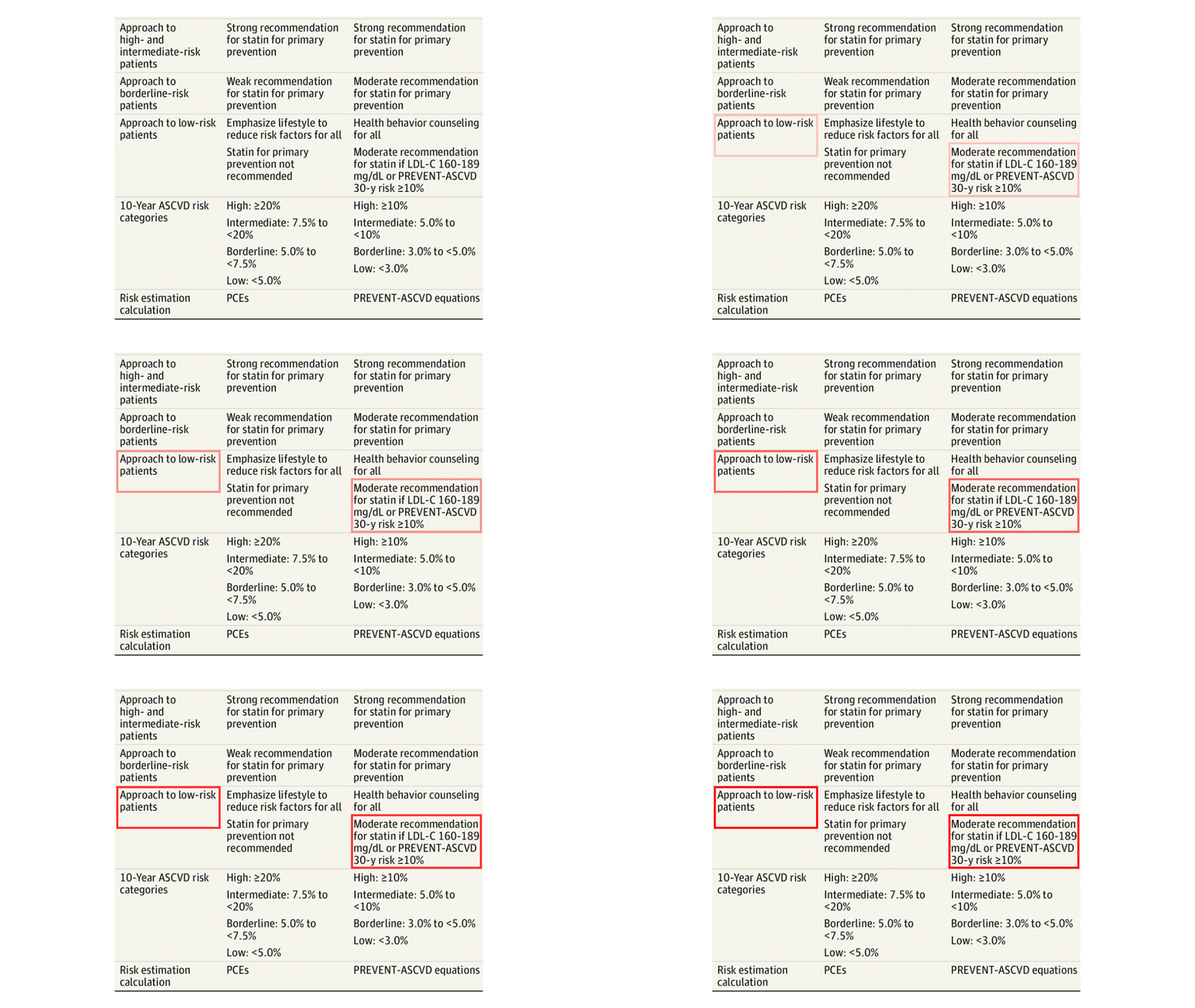
If you have any athero-sclerotic cardio vascular disease(ASVD) documented by clinical or Imaging , you belong to very high risk category. It clearly says the target is 55mg both in primary and secondary prevention.

LDL is not only the enemy of the coronary artery. Fatty streaks in the coronary artery begin in the fetal stage itself. In adults, some of these streaks become prominent locally and turn out to be plaque. The argument for intensive statin therapy is to stabilize these plaques. We would not know if the plaque is stable or not. We can’t do OCT imaging, an invasive test, to know about the vulnerability. So, for the sake of safety, everyone advises intense statin therapy. The irony is ACS continues to occur at any level of LDL.

Final message

Is my cardiologist right about the LDL target of 55 mg ?

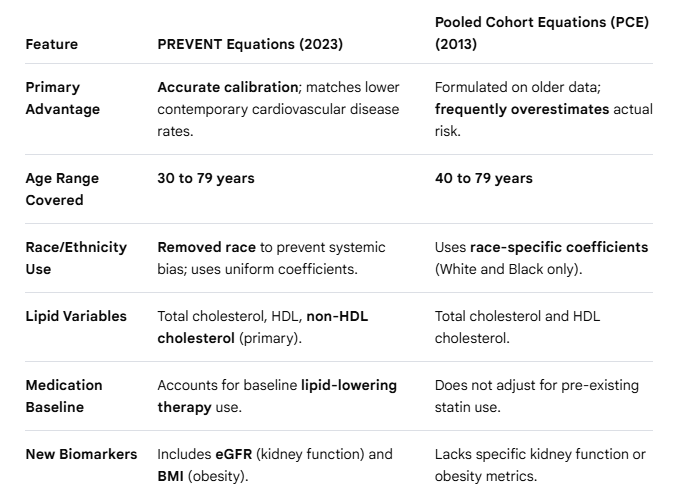
If you look at the above table of risk categorization, your cardiologist may be right. But the deeper issue is whether such a recommendation is correct or not. In our opinion LDL 70mg is good target to achieve. Lowering further, has its own risk. I am sorry, you can’t escape from the guidelines as of now, Further you don’t have any other risk factors to treat as well. Then, this question, will always hang above your shoulders , why the hell I got this plaque over there?

I think ,its time ,we need ask more questions that are difficult to answer ?

1.Does ASVD includes even 10-20 % plaques by CT angiogram ? How specific these X RAY – stitched slices of CT scans done on moving heart. Then ,what about luminal irregularities ? Should it to be counted as ASCVD as well ?

2.Do we need to refine the definition of by introducing a new term significant ASCVD?

3.Also like subcategorization of clinical ASCVD from image-based ASCVD with reference to target LDL?

Reference

1.https://www.escardio.org/Councils/Council-for-Cardiology-Practice-(CCP)/Cardiopractice/lipidology-update-targets-and-timing-of-well-established-therapies

2.O’Keefe JH Jr, Cordain L, Harris WH, Moe RM, Vogel R. Optimal low-density lipoprotein is 50 to 70 mg/dl: lower is better and physiologically normal. J Am Coll Cardiol. 2004 Jun 2;43(11):2142-6. doi: 10.1016/j.jacc.2004.03.046. PMID: 15172426.

Postamble

Dear patient, wait, there can be more shocking advisories soon. With the famous PREVENT trial (Lancet 2024), results are waiting on the sidelines trying to penetrate the fragile barriers of various guideline writing committee offices. By the way, PREVENT study demands an OCT for all non-flow limiting plaques, and stents if they are found be vulnerable.( Read about The TCFA story)

Park SJ, Ahn JM, Kang DY,; PREVENT Investigators. Preventive percutaneous coronary intervention versus optimal medical therapy alone for the treatment of vulnerable atherosclerotic coronary plaques (PREVENT): a multicentre, open-label, randomised controlled trial. Lancet. 2024 May 4;403(10438):1753-1765.

Read Full Post »

Sharing a presentation on lipid control done in 2020. This talks about newer strategies beyond statins.


Read Full Post »