Left main coronary artery is considered as the sanctum sanatorium for the cardiologists .
One would wish to rule out disease of left main in any given patient with CAD.

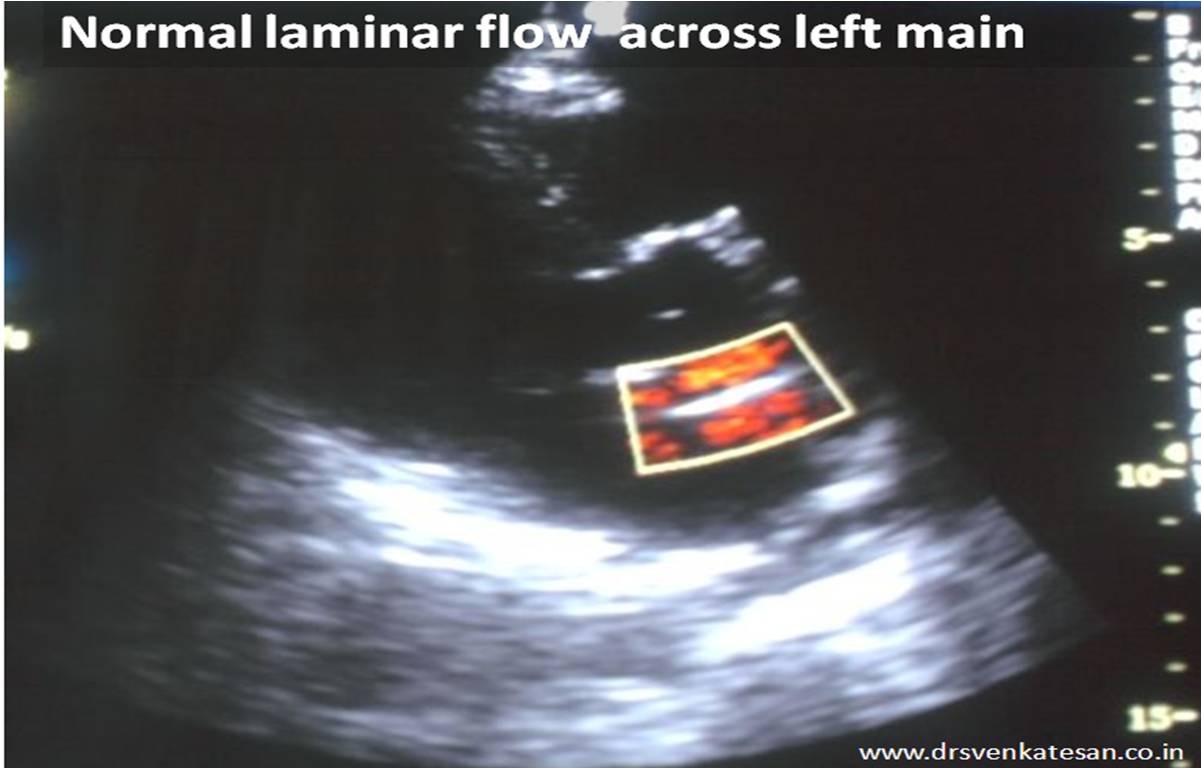
Though there are strong clinical predictors of LMD, this segment of the coronary artery tends to throw surprises.
A strongly positive stress test, ST elevation in AVR , fall in blood pressure with exertion are good markers of left main disease.
Still, in the era of optical coherence tomography (OCT ) and IVUS , we do have a simple tool that can image the left main coronary artery fairly accurately .
We know the resolution power of routine trans thoracic echo is 3mm and above . (It can detect vegetation of that size easily !)
So , it can easily accomplish the task of imaging the left main ostium .(which is a minimum of 4-5mm diameter )
How to image left main by echo ?
- Parasteranal long axis or short axis the ideal view. Short axis would also help.
- Normal left main is easily diagnosed by two parallel lines . ( See above picture )
- Plaques are diagnosed when this line is distorted and filled by haziness.
- Significant ostio proximal lesion must never be missed by TTE .However distal left main can not be assessed in most .
- Doppler assessment may not be possible in all as pulse doppler sample volume can not be placed in left main.
- Trans esophageal echo would increase the yield.
Final message
Processing power of echo machines and their image quality has improved vastly over the years. The existing literature about left main imaging by echo are based on old generation machines. The data are as obsolete as those machines . This has to be kept in mind.
I wonder why most cardiologist are averse ( rather feel guilty ) to report the status of left main artery by echo cardiography .
Every patient with a positive TMT must undergo a focused echocardiogram of left main . You will be rewarded with a good glimpse of the sacred segment of coronary artery 9 out of 10 times !
So , can we shoot the Left main at the bed side ?
Yes definitely . . . if only we wish to !
* A correction
The left coronary visualised in this parasternal Long axis view is in fact exceptional. The ostium and shaft often better seen in short axis in around 3-4 O clock position.



 Dr.S.Venkatesan MD