Feeds:
Posts
Comments

Posts Tagged ‘medical statistics’

We know TAVI is in the striking distance , to literally take over most aortic valve interventions. From a humble beginning from very high surgical risk with prohibitive comorbidity, now it has almost touched the totally asymptomatic, relatively morbid-free patients. Thanks to the hardware, expertise, and motivation from multiple forces.

While the numbers increase, still the debate between SAVR and TAVR is riddled with speculation, skepticism, and absolute confidence. (Reason: TAVI is a passively fixed valve in a blind procedure at a self-selected annular plane, with no option to remove the crushed native leaflet debris and the resultant complications. Lastly, TAVI’s lifespan* is currently less than half of a mechanical valve. *Expected to improve with polymer valves)

The latest trial to join the litereture is EARLY TAVR in October 2024
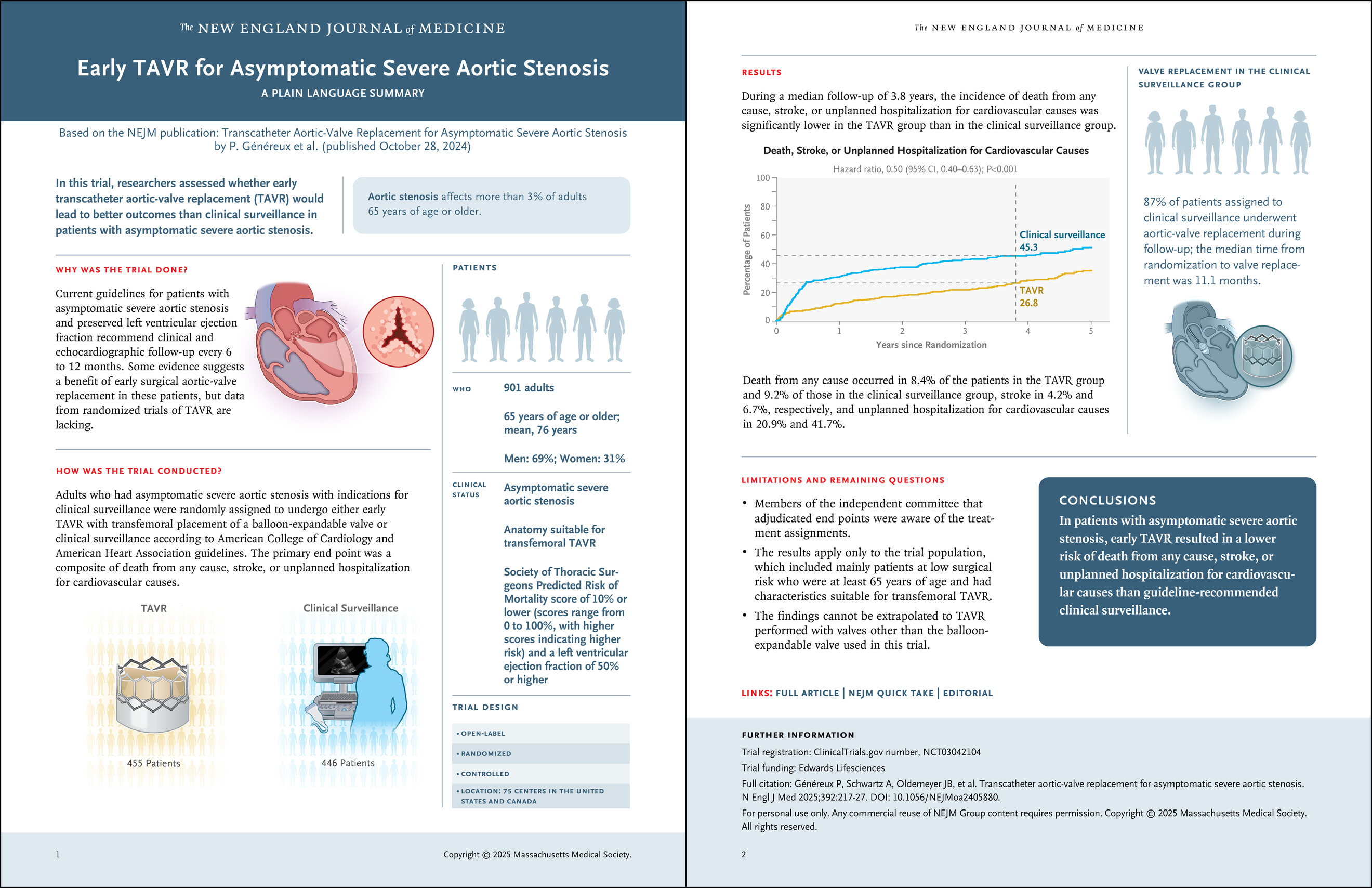
Here is a brief, personal comment about the paper for non-academic consumption. Look carefully at the 15th second of the video. Pause it, look at the number over there on the bar of unplanned hospitalisation.

It is a staggering 41.7% in clinical surveillance group, twice more than TAVI group, pathologically tilting the conclusion of the study.

Video source and courtesy https://youtu.be/3wwQEEG4aWg

By the way, what is that unplanned hospital admission? Who is planning that admission in the asymptomatic control group? If 41% of people in the clinical surveillance group needed hospital admission, what does it mean? Does that mean clinical surveillance was so poor that they were rushed to the hospital despite being asymptomatic and stable in the surveillance period?

Why should totally asymptomatic patients get admitted in the control arm, in such huge numbers? You can presume what could be the reason. My guess is too sinister.

Another issue plaguing the RCTs for decades, is continuing even in 2025. That is putting together death, stroke, and unplanned hospital admission as a combined endpoint in the same basket. This is the familiar old cheat story i.e., used to intentionally torture the truth.

Final message

Any student with basic sense of statisitcs can interpret the result of this landmark trial from NEJM correctly. The question we need to ask is, what are the triggers for those unplanned hospital admissions?

Further, it is good for NEJM (and the medical community) not to accept any papers, if the studys’ endpoints are not appropriate or defined with the intention to manipulate, which happens in many sponsored trials.

Read Full Post »

In one sense, meta-analysis would come closer to a milder form of ethical plagiarism”


Can meta-analysis really be called as original scientific research ?

No it is not, but some may say yes. It is very difficult to dispute either. But, the fact of the matter is, meta-analyses are not a true science of innovation. It is using some others’ work( sort of intellectual steal ?) done by a group of scientists interested in the same research topic, trying to squeeze more info from these studies. It is a glorified group journal club activity.

Image source & Courtesy http://www.inquasar.com

At best, meta-analysis can be referred to as knowledge and evidence aggregation. Surprisingly, mostof the academia seems to give more weight to meta-analysis, disproportionately more than the original researchers. This is because meta-analytic scientists backed by big journals claim, they can bring out more info out of the original. The assumed scientific superiority of meta-analysis is expected to be downgraded soon, as these sort of evidence aggregation can be done easily by any AI-powered engines. Network meta analysis, by dedicated medical scholastic AI networks can do this in a fraction of a second.

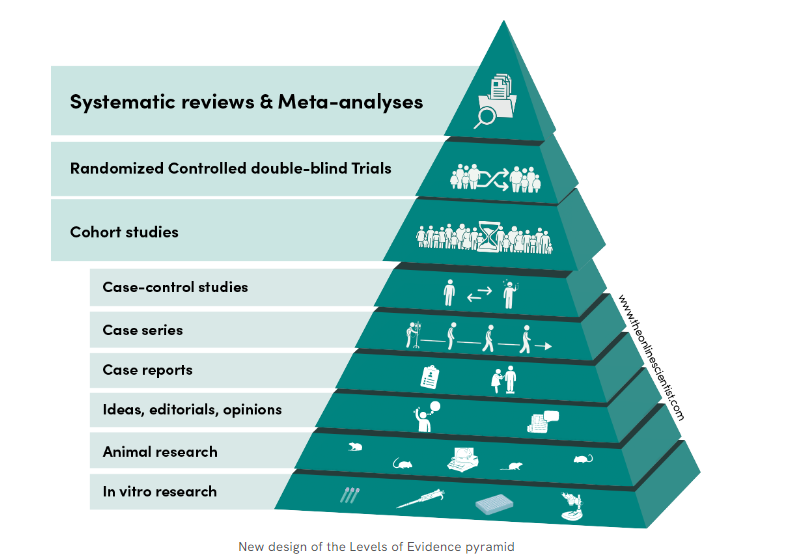
Meta analyses as of now is sitting proudly as crowning glory at the top of evidence pyramid. This is one of the reasons for the false glory surrounding anyone (or anything ) associated with meta-analyses. I doubt whether it really deserve the top slot. (An excellent debate between RCT vs metanalysis) Wish, the meta-analysis taste its own medicine at least once. We need to have a meta-analysis to show it is really superior to other forms of evidence. I cant find one as yet.

What about systematic review ? This looks better, as it has less statistical content , and the researcher is at least compelled to go deep and get enlightened on the topic as they spend months together on the topic.

How is meta analysis different from original research?

There is no new data collection ,no primary hypothesis testing . It primarily focus on summarizing existing evidence. To do it properly, there are certain standards.

  1. PRISMA (Preferred Reporting Items for Systematic Reviews and Meta-Analyses)
  2. Cochrane Handbook for Systematic Reviews of Interventions
  3. MOOSE (Meta-analysis of Observational Studies in Epidemiology)

Ref :Finckh A, Tramèr MR. Primer: strengths and weaknesses of meta-analysis. Nat Clin Pract Rheumatol. 2008 Mar;4(3):146-52.

Positive side of metanalysis

While meta-analyses aren’t original research, it’s a crucial tool for evidence synthesis, research translation informed decision-making.

Flaws of metanalysis

It is a academic business with done studies. So it is 100% retrospective. It might come with irreversible errors. Unless every error in the past studies is accounted for and curated the result of meta-analysis, it can never be foolproof.

Should we get permission from all the authors who did their original studies before doing a meta-analysis?

As long as fair use criteria applies there is no need , but a moral obligation is definitely there . Other wise metanalyses will come closer to a milder form of academic plagiarism of others’ work. (Of course legally and scientifically approved)

Final message

In the world of true scientific research, meta-analyses can not be considered as great scientific work. It is just evidence aggregation, which of course could be meaningful if and only if the studies taken were done properly.

However, meta-analysis has undisputed value in aggregating rare cases, scenarios, diseases, and problems where there are very few published studies. Collecting them together in an organized fashion serves a real good purpose.

Reference

1.Pearson K. Report on certain enteric fever inoculation statistics. Br Med J. 1904;3:1243–6.

2 Smith, Mary L.; Glass, Gene V. (1977). “Meta-analysis of psychotherapy outcome studies”. American Psychologist32 (9): 752–760. doi:10.1037/0003-066X.32.9.752.

3. Eysenck, H. J. (1978). “An exercise in mega-silliness”. American Psychologist33 (5): 517. doi:10.1037/0003-066X.33.5.517.a.

Read Full Post »

medical ethics stastistics www.drsvenkatesan.com

Read Full Post »

Of late many drugs are entering the  market  for human  consumption backed up by  Non -Inferiority trials (NIT ) .Few examples.

“The ONTARGET trial: Telmisartan is non-inferior to Ramipril in  New Study Results Published in the New England …”

Feb 20, 2013 – in the New England Journal of Medicine Show Dabigatran Etexilate ... daily was non-inferior to warfarin (p=0.01) in preventing recurrent VTE, …”

What is the logic behind these  Non inferiority trials ?

Why it came into vogue ? 

Do you agree with the concept of NIT ?

I have taken the  privilege  of putting my answer in the title. Believers  of NIT please excuse me.

Reference

Non inferiority drug trial

Non inferiority drug trial 2

Read Full Post »

In this world of  evidence based medicine  the  funny bedside vocabulary of  medical statistics   has withstood the test of  time. The following words are liberally used by physicians of all walks of life.

We never bother to find what these words mean to our patients  !

Here is a crude and  wild   numerical attempt to  decode  these words.

  • Always                                    99 %
  • It s a rule                                  95-99%
  • Almost always                       90-95%
  • Very common                       > 90 %
  • Common                                  > 75%
  • Uncommon                            < 30 %
  • Rare                                          < 10 %
  • Very rare                                < 5 %
  • It is an exception                2 -5 %
  • Remote                                   < 2 %
  • Never                                     < 1%

Apart from the above   there two  hugely popular  medical words used over  million times every day in all walks of medical practice.

They are  ” May” and “May not”

The greatness of these words lies  in the fact   it can convey any of the above  10 meanings in a single phrase without any fuss !

Further ,  the words may and may not are numberless un-quantified statistical  jargons that   can convey a deep meaning or  . . . no meaning  depending upon the circumstances !

Doctor ,  is there a possibility of  my stent getting occluded    as i have skipped  the  clopidgrel ,and aspirin for the past two weeks

You may  be at risk  . . . but you may not develop  an heart attack immediately . I would advice you start the drug immediately .

Read Full Post »