Feeds:
Posts
Comments

Archive for 2010

Cadiac resynchrnonisation (CRT) therapy , is  the most famed  as well as  ridiculed treatment modality for refractory failure . It is facing a real tough time for survival now .(At least in class 4 CHF.)

Confident and  authentic data  are emerging  now , that CRT should not be  used  in advanced heart failure .(This is in total contrast with the original concept  ,  when CRT was introduced nearly  a decade ago !  more  of class 3 and 4 were enrolled ) . Bad outcomes are expected in advanced CHF. This is something similar to whipping the tired horse concept  which  found inotropes   to increase the mortality in severe heart failure .

The article in the current issue of circulation  shows  no mercy to CRT  in advanced CHF

http://circ.ahajournals.org/cgi/content/abstract/CIRCULATIONAHA.110.956011v1

So what  is  the answer to the ailing CRT industry ?

Go and catch class 1 and class 2 CHF population* .You will get plenty  , of course  it got ratified by MADIT -CRT trial .

* It is attractively called prevention of cardiac failure

Read Full Post »

For todays cardiologists traveling in time machine  may be made as   an  essential assignment . It seems  there is more to learn from history than the core medical science.

How  the knowledge evolved  ? . How  our ancestors toiled  ?  Where  are  the good old  medical   inspirations  ?

How  can we enjoy the fruits of success without knowing the  tree of it’s  origin ?

What you are going to leave for  the future man kind  ?

Learn how a  dream heart team led by Christian Barnard  created history in the year  1967 in a remote southern hemisphere  town ( To be precise Cape town ) , South africa .Click the link or over the image .Courtesey of Life magazine

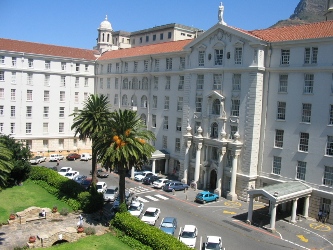
Groote schuur hospital where Christian Barnard made history

Thanks  to the Life magazine  for providing these stunning pictures to the present generation


Christian Barnard and team after the historic  surgery .Groote schuur hospital .Cape town


Let us  salute  the men of  past  .We shall  take an oath   to  strive harder and  harder   and the least  , trivial achievements are not  glorified . .


Read Full Post »

A female child aged 14 was referred for progressive breathlessness  and  abdominal distension

Abnormally dilated right atrium with significant pericardial effusion .www.drsvenkatesan.com

Can you guess the diagnosis ?

Apart form RA ,RV dilatation , the RV apex is seen filled with coarse treabeculations.This is believed to be a type of non compaction http://www.drsvenkatesan.com

Still difficult to conclude  ?   Look at the following Image.

Tricuspid regurgitation is significant . http://www.drsvenkatesan.com

If you have thought  . . .

  • ASD with TR
  • Severe PAH/COPD
  • RV cardiomyopathy

All are  acceptable  differential diagnosis

But the real diagnosis is none of the above .

Need  more time  . . . the following   Doppler tracing  will settle the issue !

Doppler velocity in RVOT at 88mmhg. http://www.drsvenkatean.com

The final diagnosis was . . .

  • Severe valvular pulmonary stenosis
  • Marked RV,RA dilatation
  • Acquired non compaction of right ventricle
  • TR -Moderate
  • Pericardial effusion -Moderate
  • This patient also had dilated IVC, Hepatic veins that  lead to clinical ascites.

Here , RV functional assessment becomes vital , but it is difficult many times. A simple clue is , as  the RV is able to generate 88mmhg pressure it implies ,   the   contractility  should be near normal .

RV EF %,  RV Dp/Dt , Tricuspid annular motion by  tissue Doppler are additional measures. Cine MRI can be a useful investigation prior to intervention.

Final message

  • VPS is a common acyanotic disease. Most are benign  and  milder  forms are the rule.
  • Dysplastic valves preclude balloon valvotomy. (In late stages   little  difference between dysplastic / non dysplastic VPS is noted  )
  • Severe progressive VPS  , like in this patient needs immediate balloon dilatation or surgery.
  • Long term outcome  is excellent except in advances cases where irreversible RV dysfunction sets in.

Read Full Post »

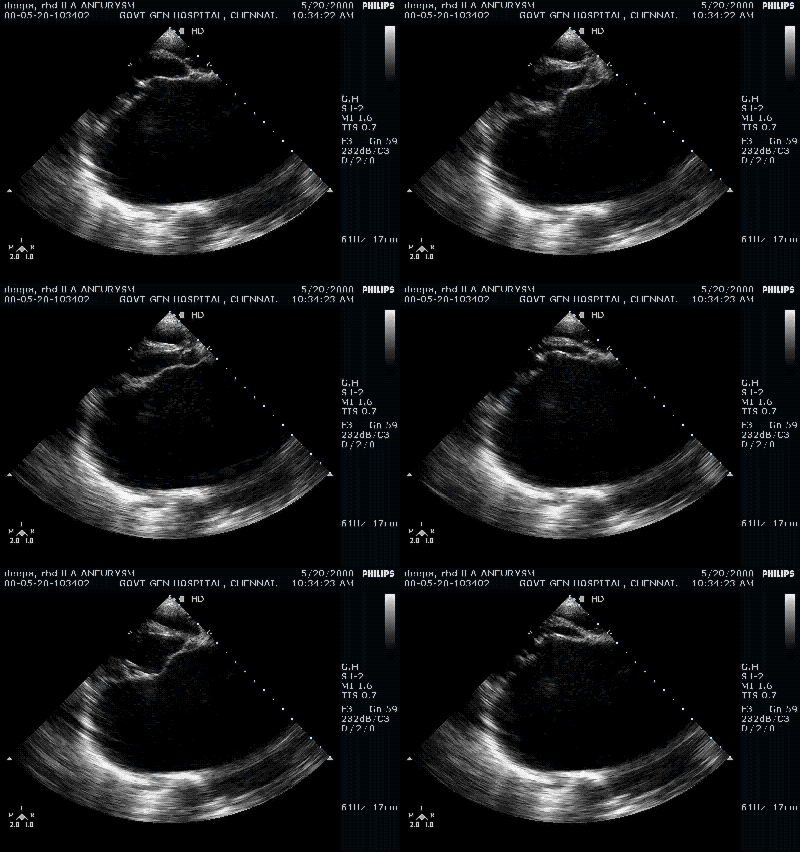
A young women  with Rheumatic heart disease .
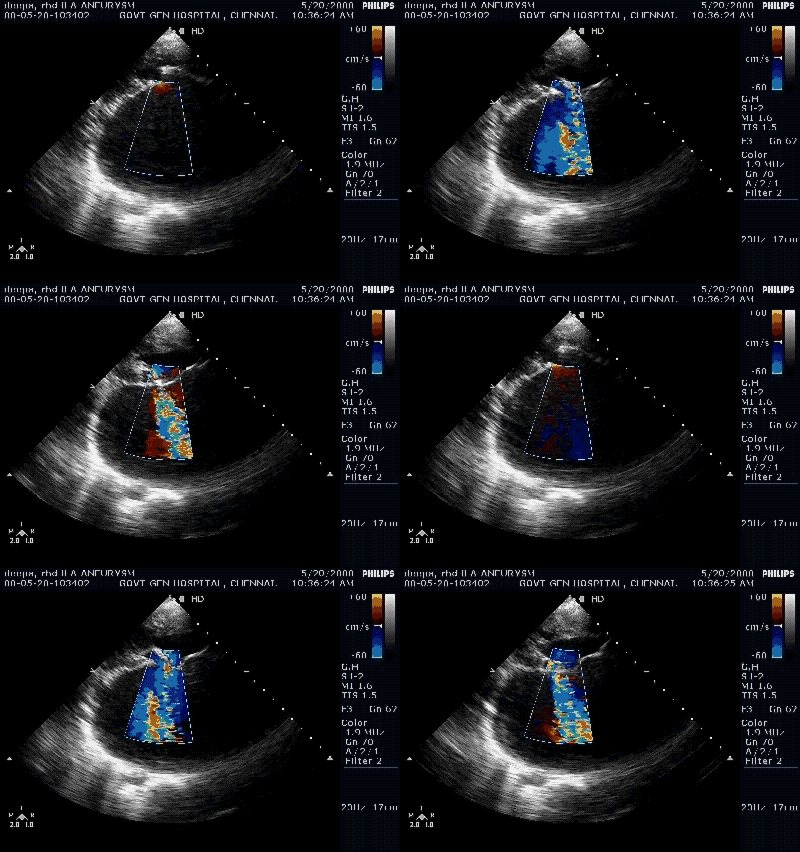
 

LA aneurysm

Giant left atrium in rheumatic MS . http://www.drsvenkatesan.com

Mitral regurgitation is significant .www.drsvenkatesan.com


When do you call  a left atrium as   giant  ?  When it is referred to as  Aneurysmal dilatation ?

It is all semantics. Whenever LA becomes more than 6 cm ,  at least in two diameters  many prefer to call it giant .

In India , 6 cm LA is such a common finding , we have kept a  cut off at an  arbitrary 9 cm .

What factors determine a LA to dilate like a balloon ?

The exact mechanism is not known.It could be  the  intrinsic weakness of LA wall ,  as very few with RHD develop this. Many LAs resists dilatation even in the midst of extreme LA pressure. But , it is a well-known fact , mitral regurgitation provokes greater LA dilatation than MS alone .This implies volumetrics  play a major role than  pressure dynamics  in determining LA size. Acuteness of hemodynamic insult is  inversely proportional to LA size.

By the way, what is the purpose of  recognizing  the LA as Aneurysmal ?

  • In plain X -ray chest , LA may  form the right heart border  over shooting the RA.
  • When LA becomes huge  , there is a  chance for mechanical complications  like dysphagia, phrenic nerve , bronchial compression etc .
  • Giant LA invariably increases the chance of LA clot.

Electro-physiological Issues

  • Atrial fibrillation , a usual accompaniment of giant LA ,  is often refractory . There is no  purpose  to convert to sinus rhythm . In fact ,  one should not attempt this. There was a time when surgical incisions  ,corridors , mazes were quiet popular.Now it is believed all these are adding further injury to the ill-fated LA .Electro-physiologists should be restrained . Pulmonary vein ablation should never be attempted in such cases as the focus of AF is elsewhere .

Implication in cath lab

During PTMC LA size can be an issue  as the plane of IAS is distorted and make things difficult for septal puncture . Further the balloon , guidewire  may often slip  back into RA .

Implication for the surgeon.

For the surgeon the implication could be more. As a cardiologist I can’t comment about that .One thing we have observed is when LA becomes huge , the size of mitral annulus is too fictitious and funnily enough we have recorded up to 6 cm of mitral annulus . No valve is available for this size . We learnt from the surgeons ,   large LA  rarely pose a  problem as they suture the much  smaller valve in a larger annulus .(Which  makes the task  that easier )

Does the LA size regress after surgery ?

In many  it does regress  , in as many it doesn’t. We have seen giant LAs continuing to trouble the patient even after a successful mitral valve replacement.

Read Full Post »
A classical echo of  a common AV canal .


Note  the free floating common AV leaflet

An ASD

A  VSD

With all chambers interconnected it is a free for all circulation . The blood  seems to get mixed at the level of common AV orifice . Even though one expects severe cyanosis in common AV canal , the intensity of which is primarily determined

Common AV canal with free for all shunting . http://www.drsvenkatesan.com


the net blood flow to lungs which is dictated by  the pulmonary vascular resistance or the RVOT obstruction. This patient had no RVOT obstruction   but had  severe  pulmonary arterial hypertension.  In spite of raised PVR ,  some amount of volume over load of lungs  occur.

How to assess the  operability ?

Read Full Post »

Ever since coronary stents were introduced   metal market is having a  good time within human coronary arteries.The search  for the the elusive , ideal metal is still on   . . .  Nickel , stainless steel  , platinum  etc .

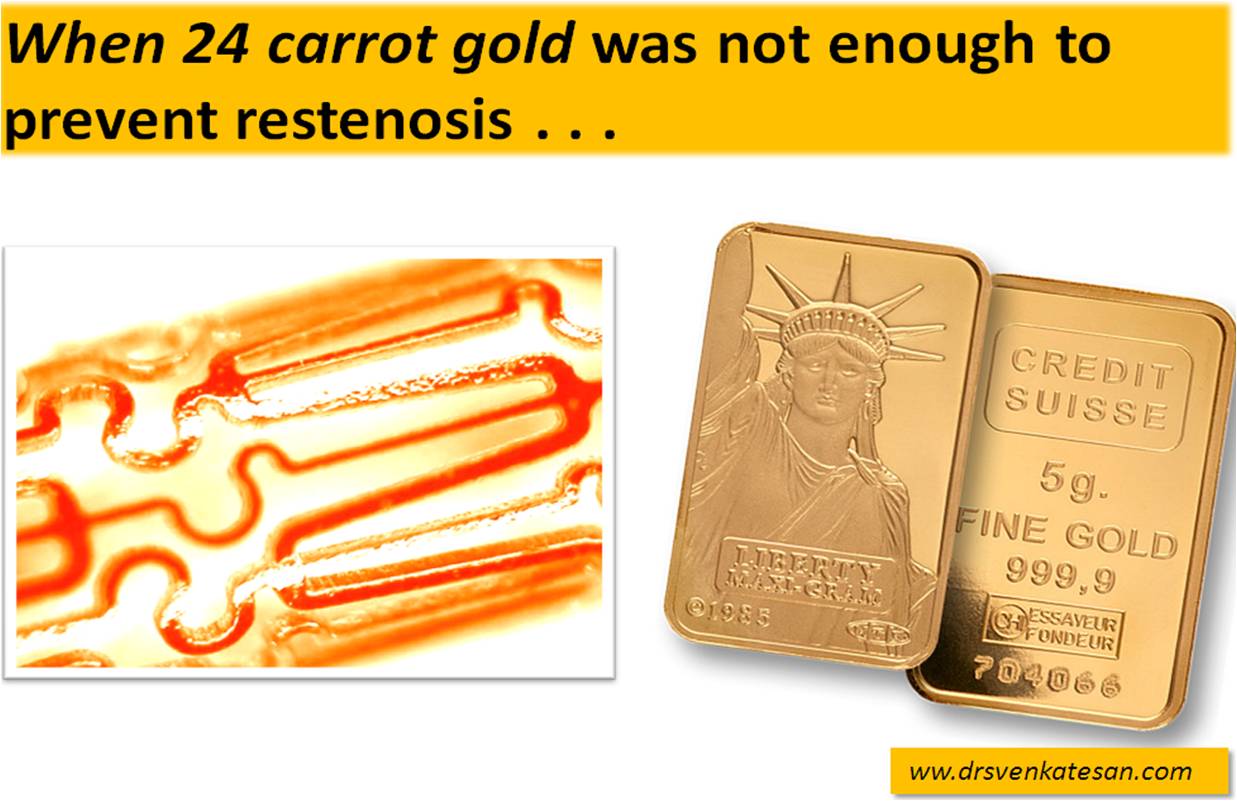
Some body thought , why not gold ?

For long ,  gold is known to be a good bio -compatible metal .

Two Gold stents were tried  .

  • Inflow dynamics  – AG Germany
  • Boston scientific –  NIR stent

Surprisingly , both showed   increased reactivity  with  coronary endothlium . The verdict  was  clear . Gold coated stent  was not good enough.

http://circ.ahajournals.org/cgi/content/abstract/101/21/2478?ijkey=f03f3c40dc4c5b2673d783f91c19f5ea685ed514&keytype2=tf_ipsecsha

Gold allergy

http://onlinelibrary.wiley.com/doi/10.1111/j.0105-1873.2005.00522.x/abstract

Final message

With the advent of DES ,  gold coating of stents lost it’s popularity  .Unless  new innovations happen in gold metallurgy , the  future looks bleak  for this precious metal  , at-least  in  the human coronary arteries.

Read Full Post »

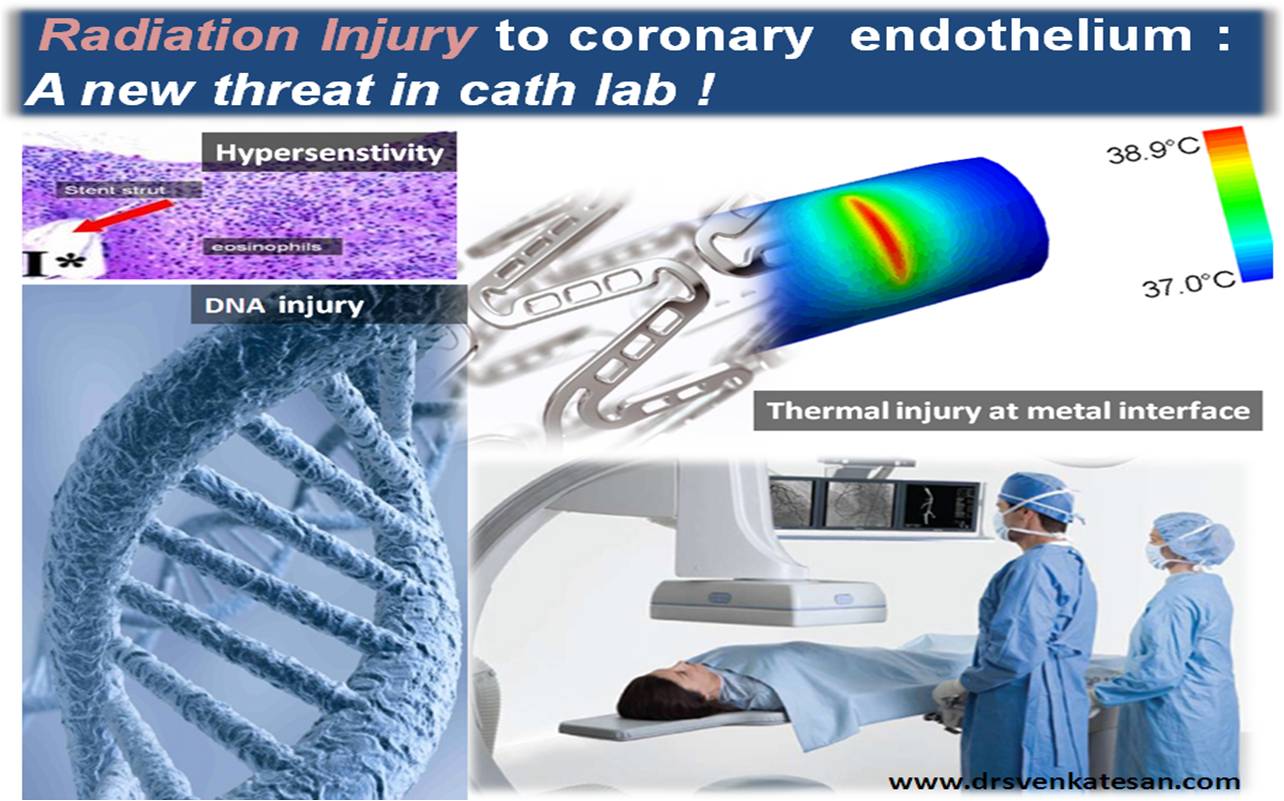
Radiation injury to coronary artery  is rarely given a thought , in spite of   prolonged fluro-scopic time  during  many complex angioplasties.While the cardiologists are fully protected the patient’s heart takes on the brunt of the attack.

What happens to the coronary endothelium -metal interface when X -rays pass through it ?

It is well known the radiation delivered to a tissue is many times  amplified if a metal interface is present. Further , the metals can produce heat on exposure to radiation . This absorption and heat varies with different metals .

The radiation injury to coronary endothelium  could be  significantly higher with DES , as the polymer in it absorbs more radiation than the bare metal stent. This could be responsible for late complications of DES.

The above  concept (unproven though !) is  proposed  by  http://circ.ahajournals.org/cgi/content/full/104/5/e23 .In this study Gold coated coronary stents were found to be less safe than conventional stent

It may take many years to know the truths  about  radiation injury caused by  of coronary stents  .

But always remember , unproven concepts are  not synonymous with wrong concepts !

Read Full Post »

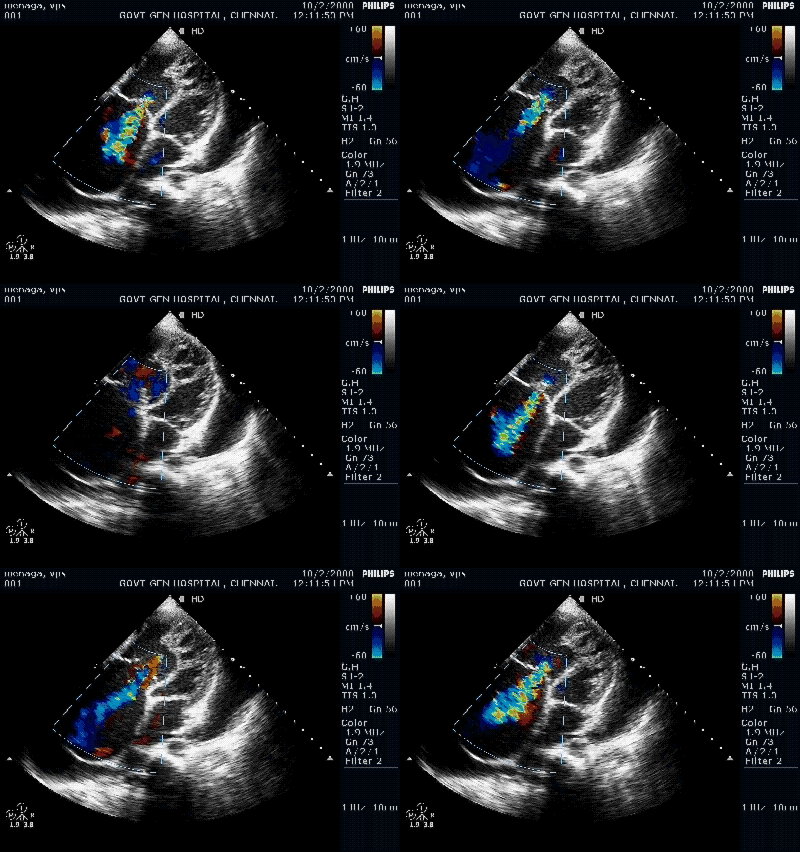
A middle aged female came with palpitation and breathlessness for two months duration  to  our OPD.

Clinically a non ejection click was present .She was referred with a diagnosis of MVPS  to the echo lab

Her echocardiogram created a  real buzz in the lab .

What is the diagnosis ?

The diagnosis is  hidden somewhere in the frame.

How common is this entity ?

A Color flow imaging is available  will be posted  if requested .

Read Full Post »

Internet has revolutionsed the way we learn . Now,  you can watch experts  perfoming  complex cardiac surgries sitting at any where in the globe !

The credit not only goes to the broad-band internet , but also the greatness of   European association of cardiothoracic  surgery  which has made it available free of cost .

A must visit website for all those  physicians and surgeons ,  concerned with  cardiac care of our population .

Read Full Post »

LBBB is a common ECG abnormality .The ECG is so classical , no one ever misses the diagnosis. But , what we miss  often is the significance of it .

What is the cause of LBBB in a given patient is much more important than the LBBB itself !

Though the commonest cause of LBBB is a benign one (Pure electrical defect without any valvular , myocardial or ischemic heart disease ) , it is prudent to rule out organic LBBB   . The term  organic  here refers to structural or ischemic etiology .

LBBB  & STEMI

To diagnose STEMI in LBBB we have the much famed  Sgarbosa criteria .It is a too popular to forget in spite of  it’s limited utility . Applying it in an emergency is not easy exercise . Clinical prediction , cardiac enzymes are  safe and could be more accurate. Thanks to  ACC guidelines  , it has simplified our task .You  are encouraged to thrombolyse all cases of  new  onset LBBB* if clinical picture is strongly  suggestive of ACS.(*The term  “presumably new” onset LBBB  was included  , implying  it is better to err on the safe side )


LBBB & NSTEMI

No one knows how to recognise NSTEMI in LBBB. Logic would say, primary ST depression might occur. How sensitive it is , and which  lead to look for is not known.

LBBB in DCM

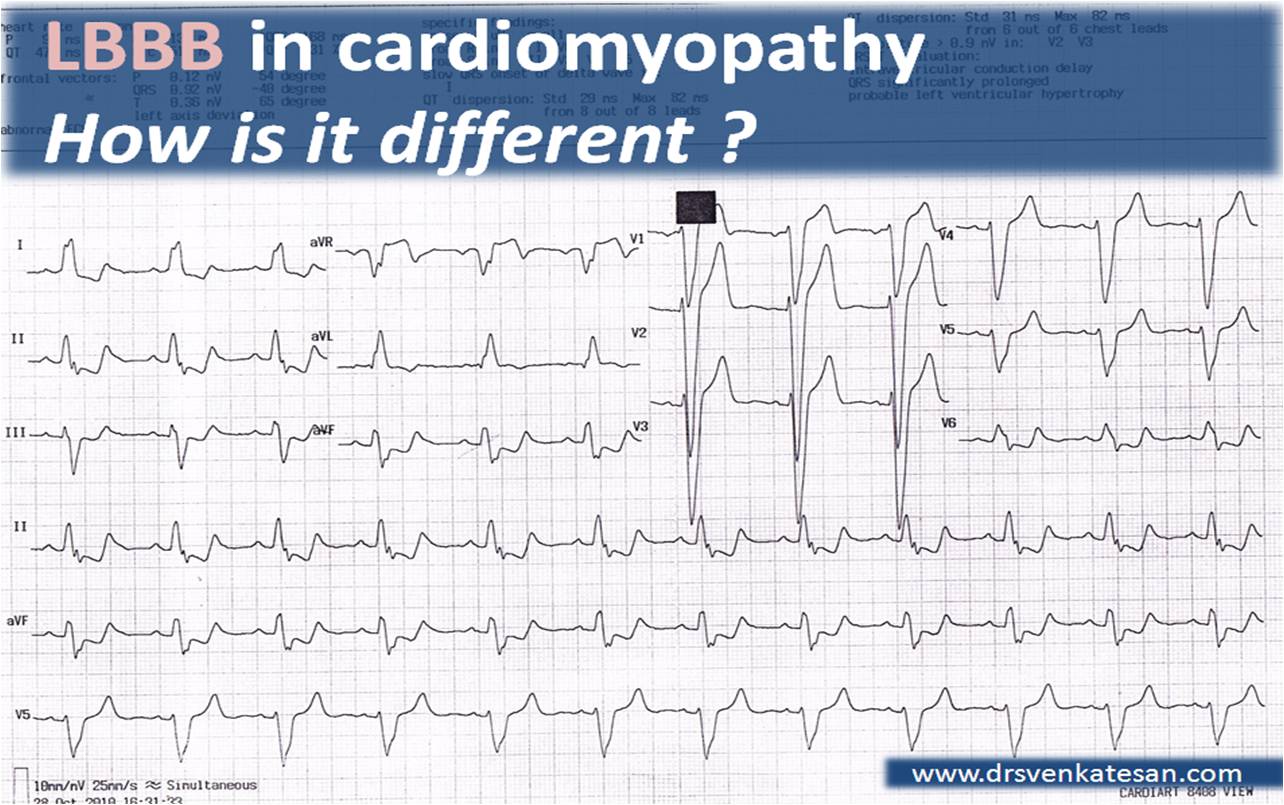
Here is an  ECG of a patient who came to our OPD  absolutely asymptomatic for a routine review . He is been diagnosed as a case of  dilated  cardiomyopathy with 30% EF and  no evidence of  ongoing  ischemia.If the history is not known he would have been  diagnosed as a ACS.

To diagnose cardiomyopathy in LBBB we have no specific criteria. But  we have found the following useful

  • Extreme left axis deviation > Minus 45-60 degrees/AVR positivity
  • Low voltage QRS , especially in limb leads
  • ST depression is more flatish  than  the typical  secondary ST/T changes of LBBB
  • QRS notching or slurring either in the r wave or s wave.
  • Atrial abnormalites as evidence by wide P waves.
  • Associated VPDs

Further inputs are welcome to differentiate organic from benign LBBB

Counter point : When we have  facility to do  bedside  echo , why should we  scratch our heads ?

Do not waste time , do a spot echo  . . .

Echo can be very useful in ruling out cardiomyopathies and old MI.But  remember , echocardiography is  unpredictable to detect acute septal MI in the presence of LBBB  , as  paradoxical motion of IVS tend to mask the  ischemic wall motion defect .A simple clue is normal systolic wall thickening will be observed in benign LBBB ,  in spite of  paradoxical  motion .This thickening appears as  post systolic beaking  that  face posteriorly . In STEMI and LBBB thinning or absence of thickening is expected.

Read Full Post »

« Newer Posts - Older Posts »