Feeds:
Posts
Comments

Archive for February, 2013

Welcome to the  future of  valvular heart disease . This is just the beginning.Expect more dramatic break through  . (Already mitral valve prototype is in advanced stages of development .)

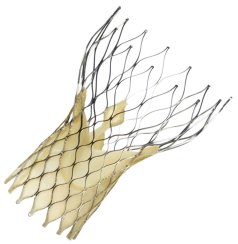
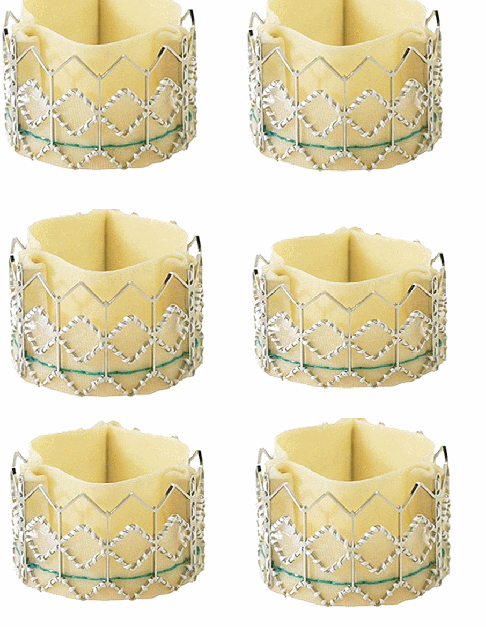
Currently we have two approved percutaneous aortic valves for use in isolated Aortic stenosis. The Edwards valve is popular in  USA  ( 2011 ) and Medtronic  is used extensively in  Europe (From 2007)

Though both valves appear suitable .There are major differences in the concept , design , and technique of implantation .

tavi edward sapiens vs medtronic core valve

Reference

Major  issues to be addressed. Late onset Para valvular leak :
Please remember, these valves are not sutured around the aortic annulus ,  which our surgeons do it meticulously . The force that keep the valve  within the  aortic root is nothing but the disease process itself . The stiffened, elastic aortic root .(Does it appear  foolish to expect the diseased  aorta to hold the valve in situ ? but that is the reality  ! )
If the aortic root  dilates  for  some reason  which is very likely in  atherosclerotic  process    the very foundation of valve is shaken and para valvular leak is certain.

Read Full Post »

Dear Cardiologist, why don’t you spare that extra minute in cath lab?

clock

Suddenly  . . .  a primitive ,  common sense based question is asked!  How many seconds are required to optimally dilate and deploy the coronary stent ?

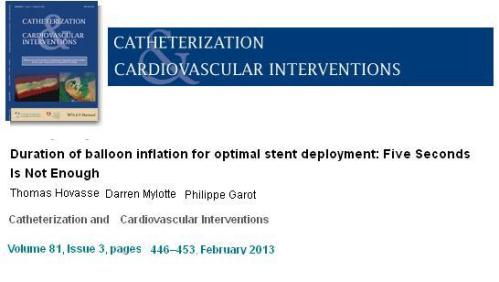
This simple and elegant study from the prestigious CCI journal tries to answer.

cci journal ptca pci balooln inflation time

Highlights

  • 105 patients, 150 lesions , Three different stents were used
  • Cypher Select (55%)  , Xience V (30.%), Taxus Liberté (15.%)
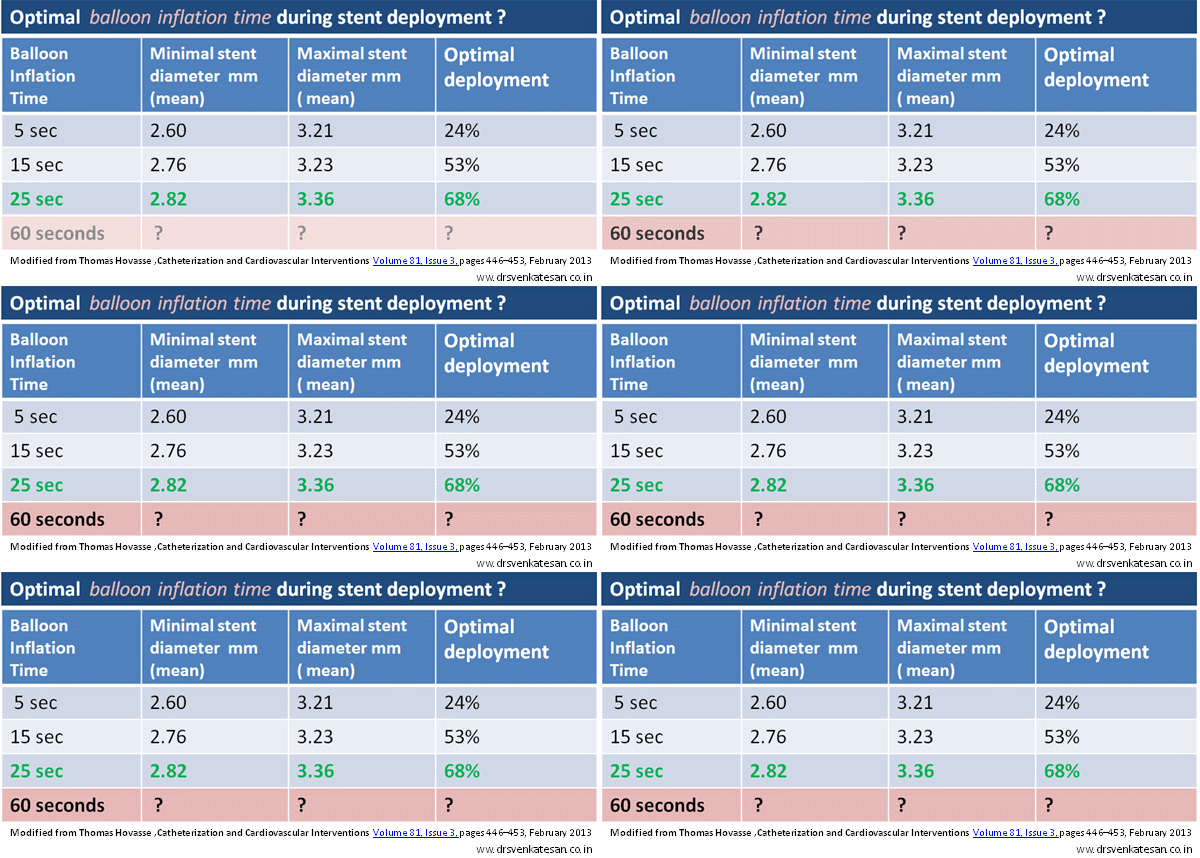
  • Three  balloon inflation timing
  • 5, 15, 25 seconds
  • Complex lesion (B2) formed 26 %

balloon inflation time pci ptca


This paper concludes, duration of stent balloon inflation has a significant impact on stent expansion. Stent deployment for >25 sec is recommended.

It again keeps the vital answer to our guess! Can we inflate it for 60 seconds  ?

Final message

This seemingly simple paper conveys a strong message.

Time is every thing , . . . we have to be fast . . . where we need to  (Time is muscle)  and we have to be slow where we  need to*  

Reference

http://onlinelibrary.wiley.com/doi/10.1002/ccd.23343/abstract

Further questions ?

  1. Can post dilatation be as  efficacious   as that of  stent- balloon  dilatation ?
  2. In difficult lesions  , the sum of  “Pre  / Per / Post”  balloon dilatation  gives  us net inflation  time(NIT)  Does it  add any sense to our understanding of optimal stent deployment  ?

Read Full Post »

Answer

Each of the above can be important in diseased heart .The most important component seems to be Inter- ventricular  synchrony .This is closely followed by AV synchrony .In dysfunctional  ventricles Intra-ventricular  synchrony  also becomes important .In  structurally  normal hearts  none seems to be important  (This statement can be debated  )

VVI pacemakers causes  both AV  and Inter-ventricular (VV ) dys-synchrony

DDD pacemaker  may still  induce  Inter-ventricular ( VV ) dys-synchrony  whenever  RV is paced for any reason .This may happen up to 60 % of pace making time in real world.

Some more facts

*Chronic VVI pacing may  induce adverse  remodeling of both atria and may worsen LV dilatation. In contrast isolated chronic organic LBBB is well tolerated and with paradoxical septal motion rarely worsen the LV function.

**Please note the paradoxical septal motion , which is  noted in  all LBBBs is  same as inter-ventricular  dyssynchrony .

***Inter atrial synchrony is a less discussed issue .It becomes  important in diseased atria which manifest gross   intra atrial conduction blocks  , atrial inhomogeneity and AF .Onset and offset  of AF has a major impact in the way DDD pacing is going to fire .

Read Full Post »

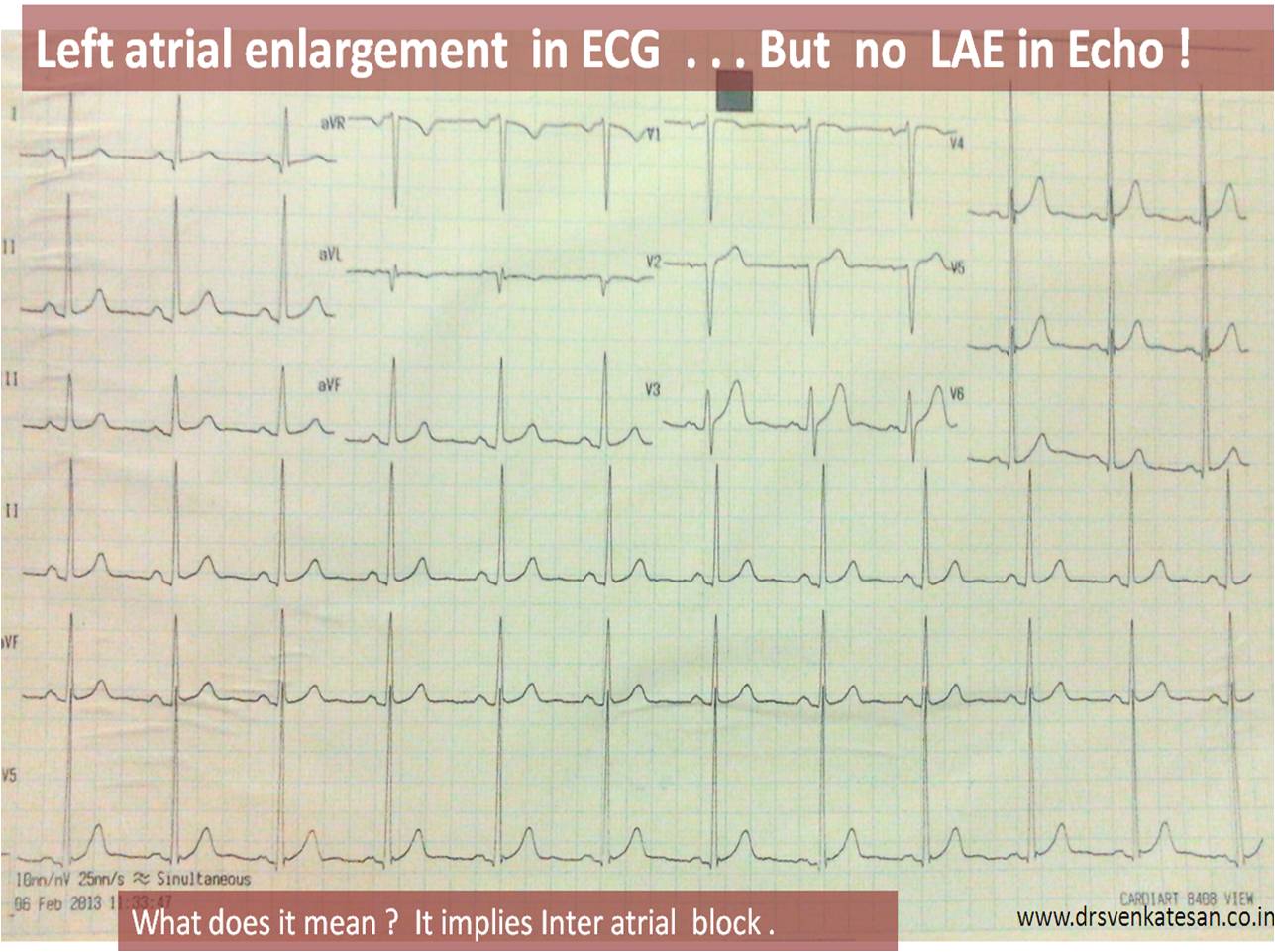
This is an ECG of a 42 year old man .He was reported as  Left atrial  enlargement (LAE) and was referred for  echocardiography . His echo was normal . LA measured 2.5 X 3.1 cm .The consultant  called back the echo lab ,  to verify   the left atrial dimension .He thought he was very sure of LAE .It took  considerable time to convince him about the credibility  of the echocardiographer . He was  right after all  . . . still . . .  ECG was  also looked  convincing  for LAE !

left atrial  enlargement by ecg limitations sensitivity

left atrial  enlargement by ecg limitations sensitivity  echo la dimension

                         Is this phenomenon  of wide P wave with normal atrial dimension  common ?

Yes it is . It  underscores  poor sensitivity of ECG in the  diagnosis  of LAE .The P wave abnormality in the above patient is due to Inter atrial block (IAB ) . This widens the p wave .

What  are the types of Inter atrial block ?

inter atrial block europace 1999 de luna


P wave widening is not synonymous with LAE .(Here P waves  widened   due to sluggish inter nodal pathway and inter atrial pathway .It is something like QRS widening in  bundle branch blocks  )

Final message

IAB is an important differential diagnosis for LAE . The significance of which is not entirely clear . It  is possible  IAB   precede LA enlargement  .It can even trigger AF due to  inhomogeneity.

Even though IAB was reported in 1950s  (Puech P* ) ,  it was  rarely  considered important With  increasing incidence of atrial arrhythmia in aging population , IAB is expected to  come into the lime- light again . The sophisticated electro anatomical mapping  can unravel the mysteries surrounding this entity .

Reference

INTER ATRIAL BLOCK

*Puech P. L’activite´ electrique auriculaire normale et pathologuique. Paris: Masson, 1956; 206.

http://www.jecgonline.com/article/S0022-0736%2812%2900227-0/abstract

http://europace.oxfordjournals.org/content/1/1/43.full.pdf

Bachman bundle branch block

Read Full Post »

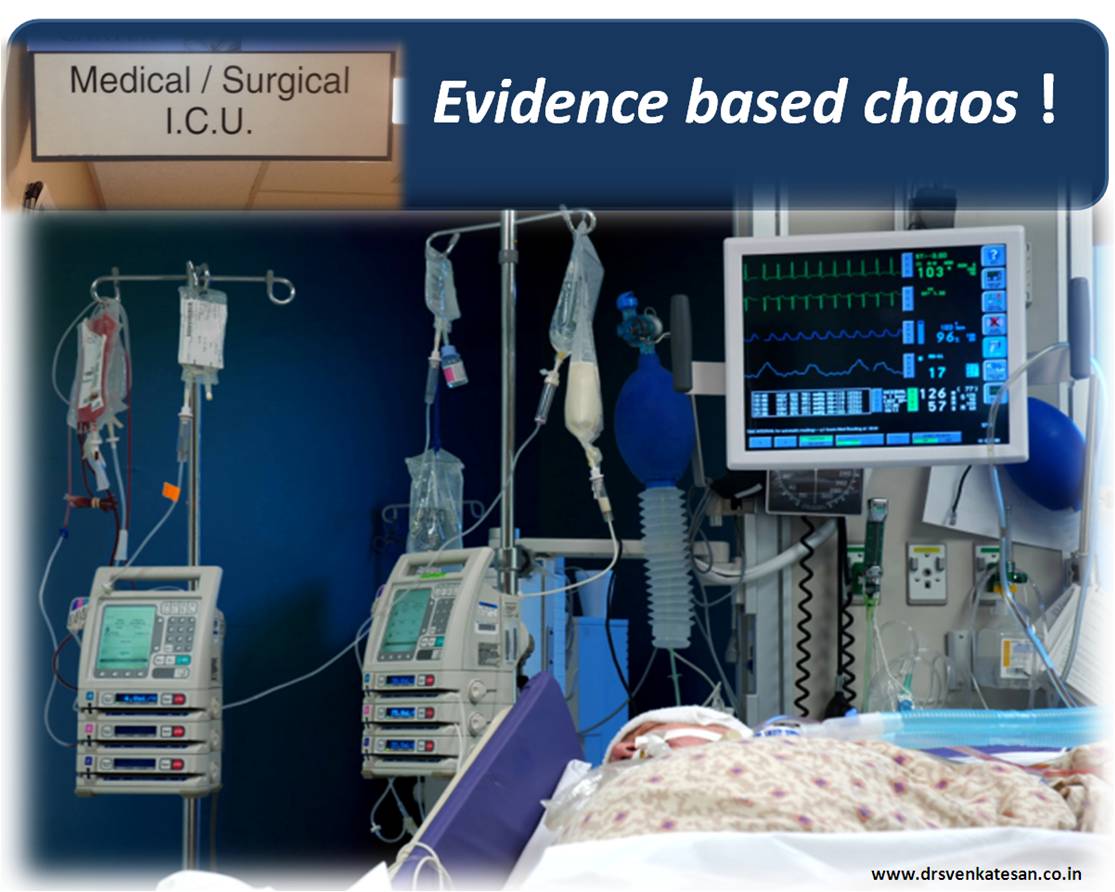
Critical  and intensive medical care is meant for supporting  an  individual organ (or multiple organs )  at times of extreme distress ,  till the  healing process  prevails over .Later , the patient  shall be shifted safely out of the unit .

Whatever be the modern technology , the single most important factor that  determines the success of ICU outcome  lies within the  patient body ( One estimate says  patient factor constitutes almost  85-90% -Dukes medical center )

Ironically , the modern gadgets, drugs , devices  threatens  . . .  rather  fights . . . with this  inherent  patient fighting  mechanism . We will  never-ever know how many cellular switches are turned on by our biological high  command ,  that compensates  and tries to restore  body  homeostasis.
critical care unit icu ccu.jpg evidecne based medicine modern medicine

Here is a  personal experience with a patient management scenario in an ICU  . The  patient is none other than my father !

He  is a 82 year old man who has  developed a acute febrile illness which rapidly degenerated into  acute respiratory failure  and  X ray  showing  infective bilateral pneumonia  and  probable ARDS  .He was on ventilator for 4 days  and subsequently weaned  off but still  heavily dependent on oxygen . His lung is wet with crackles and wheeze intermittently . His cardiac function was excellent . In one of the episodes of hypoxia he  developed  , mild shooting of blood pressure and minimal ST changes .  Alarmed  by this he was started on  beta blocker , for the first time  . It  was titrated up to maximum doses for a suspected ischemic  episode .

It is  well-known , ECG changes are extremely common in hypoxia , tachycardiac  stressed individuals .

Sympathetic  blockade  is important , only  if ,  it is an inappropriate surge  . When the body fights a disease it is the only major biological weapon available to him .How is it justified to block it ?

When this was discussed with the  team they said they have no power to deviate from  protocol and there is one article , that says  BBs are  beneficial even in COPD !

The patient  continues to be in ICU dependent on oxygen with extreme  ICU fatigue  definitely worsened by the heavy dose of adrenergic blockers which is in my opinion delaying recovery !

Different   organ specialist are prescribing  drugs  according to their level of understanding  (evidence is always available for them  . . . some where )  and radiology fellows  keep taking  snaps of  distressed  organs  in various angles  in HD quality images . Meanwhile , CT scan  seems to have revealed a chronic  interstitial  process   . . . how to diagnose a chronic lung condition  in a man who is  yet to recover from major acute inflammatory lung Injury ! I do not know ? And the current development is they are considering disseminated tuberculosis !

You may a big physician , the patient  may be a very close family member  , modern health care  system makes you watch  helplessly once you hand over  patient to a   complex care  unit .

We hope for the  best .

Final message

               Medical practice  . . . however intensive the care may be  . . .   the bottom line is  . . . it  should be based on  common sense . Modern medicine  tends  to make  this faculty of our brain  blunted .

The  specialty of Intensivist   is largely  misunderstood  . It goes more with  satisfying scientific egos  and public  perceptions  rather than true patient needs .

We need not react to every changing parameter that emanates  from the modern machines  that  keep sending out live  data from a seriously ill patient ,  on a moment  to moment  basis ! (We simply do  not need that ! If only a pilot  reacts with  jitters to every air pocket turbulence ,  he will  not reach the destination safely  ! )

From a cardiologist perspective ,  the humble  request  to all Intensivists   and critical  care physicians   is ,   avoid being  in  “fire fighting mode”   for all  those subtle ECG changes  that occur  in ICUs ,  especially with multi- system disorder (Caution : Acute coronary syndrome in CCU / post PCI  set up   is different story altogether where even a minor ST shift can be significant ! )

Heaven’s  sake  let us  rely more  in  our  brain rather than  the machines and devices !

Above story is not even a tip of an Iceberg . I come across it  every day  in  many ICUs  I visit  . The  most saddening aspect  is ,  we can not point out these mistakes  to our fellow professionals ,  as it  amounts to   hurting academic egos .They are more important  than patient care at any given point of time !

Counter point

For any system to work  , it  needs  a  strict set of guidelines ,  other wise the system of care will fail. This is a  fundamental basis on which modem medical  care works . The only issue is ,  we  should keep checking for any inadequacies in the evidence base and try to correct it. So do not blame the  EBM . It has come to stay .That is the future ! You are very pessimistic towards  modern science !

Rapid response to counter point

But the real issue is  . . . by the time next evidence base finds a major flaw  in the existing system of care ,  damages are already done . So with your clinical acumen  every learned physician is free to create  his own real world  experience .(That is also called Level 3 evidence now ) ** Protocols are not  sacred sermons . It  may  be (rather must be !)   violated if there is a need for the benefit of patient .

Disclaimer

* This is not an  attempt to disgrace the concept  of intensive  medical care . Please remember ,  finding fault  could be same as finding facts .(At least in   medical care )


Update ( February 24th, 2013  Sunday , 12.05  AM )

After 25 days of  intensive and aggressive  medical care   we lost one of the great lives

of modern times  which will be celebrated by his  sons and daughters forever !

Read Full Post »
« Newer Posts