Yes, it is a provocative study with important health data of 65,364 persons published in the American Journal of Preventive Medicine .It sort of, censures the traditional epidemiological paradigms, revealing a striking “wealth paradox” in India. In contrast to Western nations where affluence tends to shield against CVD, high socioeconomic status in India comes with a hitherto unknown (but strongly suspected) downside and a possible new CVD risk factor.
Glad this article went mainstream in India and appeared in today’s The Hindu, India’s national newspaper. It will definitely create greater awareness about the topic of wealth and CVD risk (Ref 1).
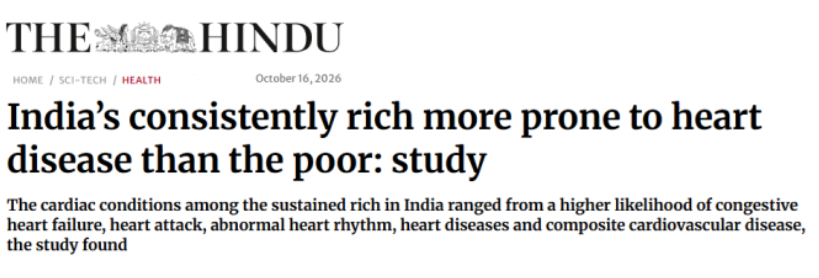
This longitudinal population based analysis revealed that 40% of participants maintained sustained wealth, while 19% remained poor, and 20% each documented either upward or downward mobility in wealth status. The study revealed a surprising fact. The sustained cohort faced a staggering 1.70 times higher odds of myocardial infarction and cardiac failure compared to the sustained poor.
What is not addressed in this study?
It seems highly plausible there could be a screening bias. In developing healthcare infrastructures, affluent populations possess superior healthcare literacy and financial access, leading to higher rates of clinical detection and self-reporting. (In India, it is called a “Master Health Check-up”—who the master is, we do not know!) Conversely, subclinical cardiovascular pathology among the poor often goes undiagnosed, or the first episode might present as a fatal ACS, skewing the relative risk data.
The new economic J-curve of CAD in India
It is clear , Indian CAD population represents a J-curve (or even a U-curve) of epidemiological transition . Past data from western economies told the same story. .CVD risks were concentrated among the wealthy who adopt sedentary lifestyles, physical inactivity, and hyper-caloric diets. As a country transitions into a mature economy, this curve flattens and ultimately reverses, as seen in Western populations. This happens because public health interventions reduce risks among the wealthy, while the commercialization of cheap, processed foods shifts the metabolic burden onto the poor (the dogma of “the rich are thin and healthy, and the poor are obese” seen in highly developed countries).
India currently sits at the peak of this curve. The irony in India is that the rich are flocking to McDonald’s and Burger King with pride. I am not sure when the aforementioned transition will fully happen. Managing the side effects of economic prosperity is no longer optional; it is a social compulsion.
Welcome wealth to your home, but allow wisdom to enter first
This epidemiological transition must not be mistaken as Health vs wealth vs poverty debate. The strong belief that the affluent people will emerge healthy as economies mature is a risky illusion. Both the wealthy and the poor should be aware of how our lives get spoiled by external forces in the name of style. For a healthy life, remove “style” from your lifestyle. Wealth is still welcome.
Reference
2.Gupta, I., Jose, A.P., Prabhakaran, D. (2025). Socioeconomic Status and Cardiovascular Disease Prevention in India. In: Romero, T., Nazal, C.N., Lanas, F. (eds) Global Challenges in Cardiovascular Prevention in Populations with Low Socioeconomic Status. Springer, Cham. https://doi.org/10.1007/978-3-031-79051-5_11