Feeds:
Posts
Comments

Archive for the ‘Cardiology – Clinical’ Category

Heart is one of the unique organs , that a physician can touch and feel before diagnosing a disease .The fact that ,  the heart is located superficially within the thoracic cavity makes tactile examination possible . The current generation cardiologists should realise cardiac palpation was a huge scientific specialty by itself centuries ago . Apical impulse demonstration  in class rooms  would go on for hours together in the days of Leannc and Dressler .

It is an irony , when we are able to see and feel many areas of the heart in the direct vision ( RV parasternal impulse, pulmonary arterial pulsation, contractility of LV ) we got addicted to imaging modalities now.

This article tries to extrapolate the  morphology of  apical impulse  with that of ehocardiographic LV function . A normal apical impulse is a very subtle impulse often absent in a third of population.Some times it is called tapping impulse .The  two common abnormalities  of apical  impulse are hyperdynamic and heaving .

Read the link for normal apical impulse

A hyperdynamic apical impulse

The  hyperdynamic apical impulse is diffuse (Occupying at least two rib spaces >  3Sqcms) and very active  with brisk motions visible to naked eye .This implies the leftventricle is dilated significantly and the wall is not much hypertrophied. This is eccentric LV enlargement . It also tells us the LV function is well-preserved as the term hyperdynamic infers very active LV .It is obvious , a dysfunctional LV can not be hyperactive. A hyperdynamic LV apex in a patients with AR or MR indicates they will do well after surgery for the simple reason their LV function is preserved. In the same logic a patient with hyperdynamic apex often complaints of palpitation as the apex hits the chestwall . Which is a good sign with reference to LV function .

Note :A patient with heaving apex rarely complaints of palpitation.

Hyperdynamism occur in systole or diastole ?

Logic would say apical impulse would be palpable only in  systole .But in a hyperdynamic LV diastolic phase is also palpable (A palpable S3 is common associate of hyperdynamic apex)

Heaving apical impulse

The term heaving apex by definition indicate there is a brief localized sustained LV apex lasting at least 50% of systole.

  •  Aortic stenosis with normal LV function
  • Any dysfunctional and dilated LV which increases the after load

The sustained lift may disappear with very severe LV dysfunction , apical impulse is barely perceptible in failing hearts . A sustained LV apex suggest reduced dp/dt of  LV contractility .

Relationship between apical impulse character and LVH ?

Hyperdynamic LV apex is rare to be associated with LVH .Except probably in HOCM where the LV systole is interrupted very early in the ejection phase.

Heaving apex can be a marker of LVH .But, the onset of LV dysfunction can confound this finding.

Can a hyperdynamic and heaving characters occur together in apical impulse?

We have been taught cardiology with a black and white learning concept but unfortunately science more often exists in shades of grey An apical impulse can indeed have characters of both . A diffuse apical impulse with a heaving nature is common in regurgitating lesions with the onset of LV dysfunction Such situation can occur in LV apical aneurysm

Final message

Looking for apical impulse in current cardiology practice  may be considered as  the most foolish job  a physician can indulge !

Ask the secretary to record the history ,  take an ECG, do an Echo  , send both deserving (and of course  many undeserving patients too !)  to cath lab at the earliest  . . . This is the  modern-day cardiology mantra !

This article , does not vouch  for the accuracy of   what  some may consider as  a  “medieval clinical sign” . But , it  confers the patient  a better rapport  strightaway   as  the physician  puts  his or her hand on the patients heart  . Some  call this  as a healing touch ! It work  wonders in many !
Read Full Post »

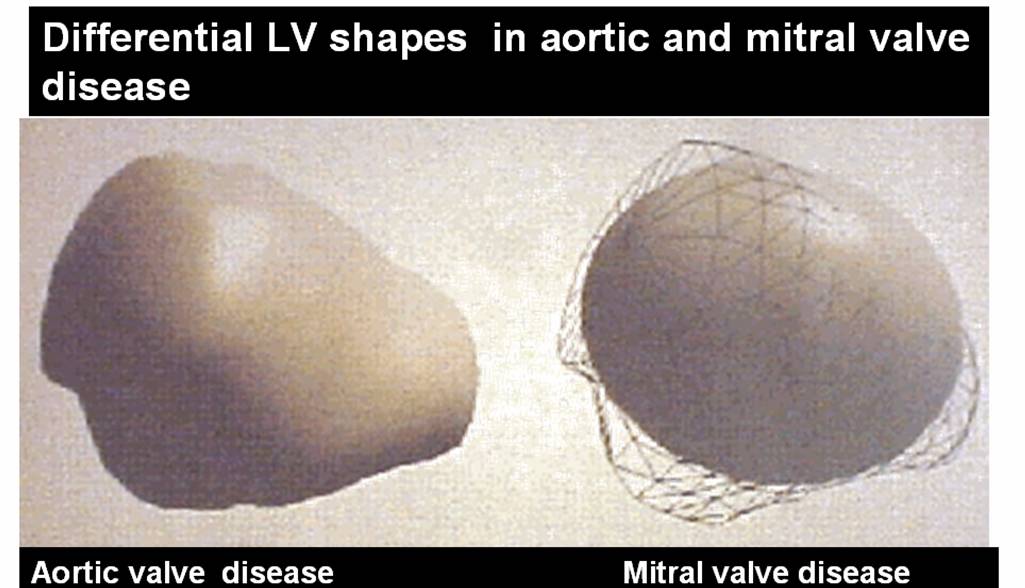
Let ventricle is an elliptical or ovoid chamber .The pattern of LV enlargement can vary considerably in different pathologies. We know a dilated , globular heart is the typical feature of terminal congestive heart failure. But in the early stages of cadiac enlargement there are some distinct differences in the contour. (Aortic stenotic lesions retain the ellipitical shape till late in the course )

LV enlargement due to mitral regurgitation is somewhat different from aortic regurgitation. A globular configuration occurs more often in severe MR than AR. This is due to the fact, the long axis and short axis ratio of LV  is maintained till late in the course  of aortic valve disease . Cardiac long axis enlargement is more pronounced in aortic valve disease than in MR. The AR jet reaches LV  at a higher pressure gradient (Diastolic pressure of aorta) than mitral inflow velocity . (Often mimic physiological flow with an S3)

For a given degree of regurgitant volume AR will cause more cardiac enlargement than MR. In the same note , one should realise  the LA becomes huge in MR which receives high pressure regurgitant jet . Further ,mitral valve disease is more likely to result in early PAH and that results in right sided chamber enlargement giving the cardiac contour a more globular configuration

Is the cardiac contour different in rheumatic and degenerative(Myxamatous) mitral regurgitation ?

Yes , rheumatic MR results in less enlargement of the base of the heart as the fibrotic process restricts and restrains LV and prevents uncontrolled LV dilatation . In fact , giant LV are often  reported in mitral regurgitation due to mitral valve prolapse than rheumatic MR.

Why the configuration of LV important in the management of cadiac failure ?

The globular configuration of LV implies , the papillary muscles are attached in a disadvantaged angle and keep the free wall stress high. Specialized procedures are required to restore the LV shape especially in secondary to mitral annular dilatation. Isolated aortic valve disease rarely require LV remodeling surgeries , even if AVR is done late stages.

What is the maximum dimension of LV reported in cardiac failure ?

The upper limit of normal for LV diastolic dimension is 5.6cms. In MR it often reaches 6-7 cms . The maximum of 10cm has been reported with AR. An LV beyond this level looses it’s elasticity and likely to be incompatible with survival unless LV reduction surgeries like Batista are performed.

Is secondary valvular cardiomyopathy an accepted entity ?

 The  term cardiomyopathy when originally defined decades ago ,  required exclusion of all known cases of cardiac enlargement. But now we have a more liberal working concept , if the LV enlarges disproportionate to the loading conditions of the valvular lesions  , secondary cardiomyopathy is said to be present. If cadiomyopathy sets in,  the cardiac shape invariably takes in a globular configuration irrespective of the valvular lesions. So, the simple parameter of shape of LV in X ray chest can give us a clue regarding the outcome in valvular heart disease.

Further reading

Also read sphericity index by echocardiography A spherical LV can be easily quantified by echocardiography

Read Full Post »

 Excercise physiology has been studied most extensively in the last century.The hemodynamic impact of excercise in various disorders of heart has been well established.
Dyspnea on exertion is the commonest symptom in clinical cardiology practice. It is well-known pulmonary stretch receptors located in pulmonary vasculature is one of the  major mechanism of dyspnea.

Excercise increases the cardiac output manyfold.Transporting  up to 10-12 litres of blood every minute across the lungs with a narrow pressure  head (about 10 mmhg ) is not an easy job . It needs lot of lung discipline .

It is surprising to note, there is little data on excercise induced pulmonary hypertension in the evaluation of patients with unexplained dyspnea.

We know, excercise increases the systemic blood pressure ,we  presume it should not raise the PAP (however severe the exertion is 1 )as pulmonary circulation  is a  high compliant low pressure system. 

Is our presumption correct ?

Exercise induced PAH can occur in both   health and disease 

In patients with preexisting disease

  • Stress induced LV dysfunction and resultant raise in LVEDP-PCWP-PAP .This is the most common mechanism in valvular and myocardial  disease.

Apparently healthy population

  • Excercise  induced PAH as a  marker for silent CAD .
  • Transient Hyperkinetic PAH* (Note :Here PCWP is usually normal )

This is similar  to hypertensive response to EST in systemic circulation.Existence  of this entity , is controversial, But this may reflect  reduced pulmonary vascular reserve  or reduced pulmonary nitric oxide secretion.

*The main difference here is the PAH is more often an  isolated systolic PAH. While LV dysfunction induced PAH is  a combined diastolic and systolic PAH .
How to assess excercise induced  PAH ?
It is not an easy job. Invasive catheter derived pressure measurements have been done ,but it is not practical .

The simplest way is to look for the TR /PR jet in echo in both pre and post excercise phase.

Final message

Excercise induced PAH is an inadequately studied entity in cardiology , in spite  it’s great significance .
This phenomenon is observed  in both diseased and normal heart.

The quantum of excercise induced PAH  is  widely variable depending upon the cardiac  status especially  LV function and the  functional integrity of pulmonary microvasculature .

Read Full Post »

Wide qrs tachycardia often  evoke a   OCD like reaction  among  many  cardiologists (Obsessive compulsive disorder).  Whenever we are given a strip of wide qrs tachycardia  we are compelled to initiate a  conscious or  subconscious debate , whether it is VT  or SVT . Tens of thousands of articles, seminars, CMEs , have been conducted for over 30 years  for  decoding  wide qrs tachycardias  . The fact that the confusion  is still widely prevalent indicate only two things

  1. Either , it is not possible to arrive at a simple fool proof  bed side modality  to confirm either VT or SVT
  2. Or it is a too trivial  electrophysiological   issue  that   need  not be worried about  as we have broad spectrum antiarrhythmics (Like antibiotics ! , where we  rarely  bother about identity of the culprit  bacteria  )

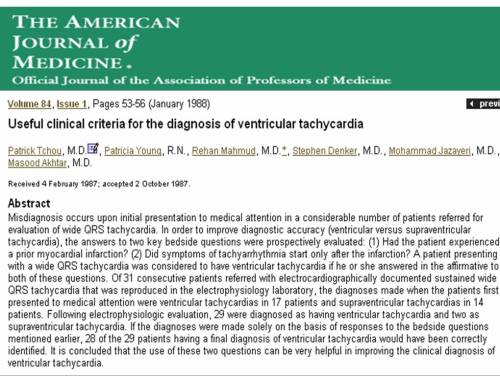
The power of statistics and commonsense have never been applied  in the management this vital cardiac entity  .While a  75% sensitive  exercise  stress test (EST) has a huge following in clinical cardiology , a   99 % sensitive   clinical criteria*  for diagnosing VT is  not respected .

*All wide QRS  tachycardia  in patients with   with history of   CAD/STEMI would be VT

If only we had applied our mind to this article published in 1988 we will never ever have the need to split our hairs for decades.(That too without success !)

In  pursuit of  knowledge , are we often  chasing  an imaginary  issue ?

The cardinal  principle of medicine says

“Diagnosis should precede treatment  whenever possible

But there need to be a correction  in the above statement .  Time , effort , cost involved in arriving at a  diagnosis  should be meaningful .( Needless to say  . . . it should  a correct diagnosis  too ) And if the power of statistics far exceeds the  frivolous scientific data  , street sense can be applied  liberally even though current generation may call it un scientific .

The issue here is  not being  scientific or unscientific , but whether you are right or wrong  . The article  which is quoted here  has a great insight  about the philosophy of VT diagnosis.

The message form this article goes something like this . . .

In the diagnosis of  wide qrs tachycardia , If we apply  the so called scientific principles   the chances  for missing   a real VT is extraordinarily high , while  if you blindly apply common sense and logic you are going to be 90% right .

What a powerful  statement this !  even though it appears  absurd ,  it is absolutely true !

A young physician  should realize the importance of this . Scientific  decoding of arrhythmia  may be an academic  pursuit but in a given patient at bedside  diagnosing by experience and common  logic are  far more productive and accurate. Miss diagnosis of VT was not common prior to 1980s .  It has become a recent phenomenon .

Probably too much of electrophysiology haS  made a simple diagnostic pathway a complex one. When we relied only on commonsense the errors were less . I  have  often observed  fellows  making mistakes quite frequently  while  nurses  were too confident  to call a wide qrs tachycardia   as VT .

Final message

Medical decision making is an art , in fact it is  a “fine art ”   We keep saying this for centuries , still medicine as a  science  easily overtakes medicine as an art. Here comes the problem . Some times (or is it many times ! ) too much of inquisitiveness in the   name of  science  make practice of medicine  complicated and the victims are often the patients !

Let us simplify medicine  . . . let us accept an occasional  bad outcome  . . . for not being 100 % scientific  ! After all  , a million mistakes happen every day in the  pure  scientific  pathway .

Reference

http://www.amjmed.com/article/0002-9343(88)90008-3/abstract

Also read Knowledge disease

Read Full Post »

Like in neurological disease, one can locate the site of block in bundle branch blocks. Though it has never been thought ,  to be clinically important to localise a BBB . (Unlike coronary lesions)

Generally ,  RBBB can be proximal  or  distal peripheral type.The commonest site could be the distal  type.

It should be realised , for over 100 years in  electrocardiology , we have been using some inaccurate terminologies just because it is easy to understand or being traditional .It is difficult  to assimilate a fact , even today that   “An electrical delay in conduction and block are one and the same ”

In fact,  bulk  of  the RBBB is nothing but delayed conduction over this bundle. So whenever we say RBBB  , we imply an incomplete block  ie conduction still occurring   over the  so called blocked bundle.(This dogma applies for LBBB and AV blocks also to a lesser  extent)

Examples of delayed  RV /RVOT conduction

  • Any disease where  RVOT dilatation  occur can cause a RBBB
  • Atrial septal defect
  • Many cases of RVH
  • Pulmonary arterial hypertension

What is the benign rSr’ pattern in V1 ?

This is nothing but a relatively late depolarisation of  RV outflow or conus that produce a terminal RV activity .

Many of the ostium secundum ASD may show just this rSr’ pattern   confirming there is no organic damage to RBB in ASD .

Calling rSr’ pattern as incomplete RBBB is not advisable (As many ECG books may suggest ) .This is because , even full blown RBBB pattern may actually be an incomplete one .Further , the degree of terminal r’ in V1 or s in lead 1  does  not always   determine the completeness of RBBB.

Is there a totally blocked right bundle branch block ?

Yes , it is not common .

  • It can occur in extensive anterior MI .
  • Some cases of Ebstein anomaly.

It can be an working rule , complete RBBBs  locate the lesion proximally and incomplete  ones distally .

What is the other evidence for RBBB in ASD  is  only a simple   delay  in conduction ?

After ASD closure  in many of the patients the RBBB pattern may disappear.This indicate RVOT regression .

Can you clinically differentiate the proximal from  distal RBBB ?

Ironically ,what is difficult in ECG may some times be possible clinically.The classical description of wide splitting S2 occur often in peripheral RBBB.

It represents a delay in the closure of pulmonary valve due to delayed electrical activation or increased hangout interval as in ASD .Logically S1 should also be split in RBBB. But this is not often discussed.

This is because , the split in S1 is lesser in magnitude and is not influenced by the hangout interval .(Hang out interval is the time taken for the blood ejected from RV to fill the pulmonary circulation. Due to the low impedence of pulmonary circulation the the blood that is ejected into the MPA continue  to run off for about 100milli seconds even after the RV/PA pressure crossover .)

S1(T 1) occurs  immediately with the onset  of RV contraction . Similarly M1 occur with LV contraction.It should be recalled it requires hardly 5mmhg of RV pressure to close the tricuspid valve and about 10mmhg for LV to close the mitral valve.

If for some reason if  there is a delay  in RV contraction , as in very proximal RBBB the T1 is delayed and hence S 1 split.

Note in most of the peripheral or distal RBBB the bulk of the RV free wall contraction is not interfered with . So , in distal RBBB it is highly unlikely the S1 will be delayed or split while S2 will be delayed.

What happens to S2 in proximal RBBB ?

Logic would dictate both S1 and S2 should be wide split.

Final message

There is a simple way (Some would call this an futile  academic  excercise  !)to  differntiate proximal from distal RBBB.If the first heart sound is split wide , it fixes the lesion proximally. This may  indicate a more adverse outcome than a simple peripheral delay in conduction.

Read Full Post »

The LV angiogram that stunned me  !

See how a heart is encased within the pericardial shell , still fighting hard

Thanks to circulation for it’s greatness  to offer such great video free

http://circ.ahajournals.org/content/vol118/issue16/images/data/1685/DC1/CI191060.DSmovie2.AVI

Read Full Post »

It is  over a century old dictum , that  edema legs and elevated JVP is the hallmark of cardiac failure.In fact , these two  constitute  major criteria of Framingham  cardiac failure score.When these criterias were formulated the concept of diastolic heart failure was not in vogue. So we  do not know whether the same would apply for diastolic heart failure also.

In all probability these  conventional criteria may not apply to diastolic heart failure  .

But why not ?

We know diastolic heart failure  of the left ventricle  is less likely raise the  systemic  venous pressure  to cause the edema and raised JVP. But still ,  isolated LV diastolic dysfunction can increase the PCWP and PAP and RVP . Remember diastolic  septal dysfunction , may compromise RV relaxation also.(Reverend Bernheim like  effect)

We should  also realise , raised  venous pressure is not the only mechanism for edema legs.

Diastolic dysfunction can trigger  ACE genes  .IT can get activated and hence renal conservation of sodium.This neurohormonal activation can be dominant  mechanism of edema in few. This  prevails over  the hydrostatic forces. And  hence edema can result in isolated diastolic dysfunction.

What about RV diastolic dysfunction as a cause for right sided failure ?

This is a poorly  understood entity.Logic suggests  it may have clinical significance. Since  morphologically and developmentally LV  and RV share a common  sheet of muscle  , LV diastolic dysfunction can have it’s impact t on the RV as well.

Final message

Edema legs and raised JVP is a hall-mark of  isolated  systolic heart failure or combined systolic and diastolic failure   .It is not rare to find an occasional patient isolated diastolic dysfunction*  to present  symptoms of  systemic congestion .

*Of course ,  in this era of hi tech cardiology practice  it may be  inappropriate  to  depend on these  primitive clincal criterias  to diagnose CHF . (These  manifest very late in the course of CHF!)

Read also

Why  some patients with cardiac failure never develop edema ?

Read Full Post »

LBBB is probably the most important  conduction defect of the heart .When we say LBBB , we visualize a  strikingly  wide bizarre qrs complex .

Left bundle even though is considered  a discrete structure , the fascicles  make it a diffusely spread structure. Many varieties of LBBB with various degrees of involvement occur.

Talking about the basics of  LBBB  electrophysiology  is out of place for the current generation cardiologists,  who  have little spare time as  they sweat it out inside the cathlabs.

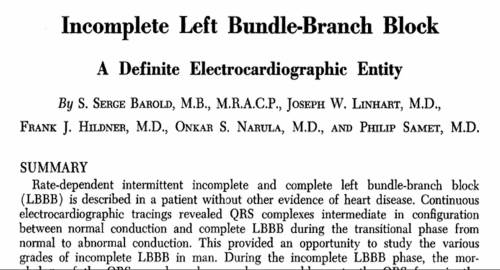
In early 1960s and 70s great articles came from pioneers regarding these defects. If we want get a good insight  read  this  articles from  Sodi palleres .Who  says LBBB is a dynamic process, where it can occur from mild functional  delay to a total block .

The conduction  properties of left bundle is very much influenced by heart rate.

Law of statistics would  suggest  for every complete LBBB  at least three to 4 times incidence of incomplete  LBBB

Then . . .

Why we are not diagnosing ILBBB often ?

  • We miss it
  • Mistake it with LVH
  • We know it  is there , but we do not  want  to diagnose it .

How to diagnose ILBBB?

See  Sodi palleres criteria*

What is the relationship between qrs width and completeness of LBBB ?

Surprisingly and contrary to the belief , the width of the qrs has no linear correlation between severity of LBBB. In fact incomplete  LBBB can occur with even 150ms qrs !

Then ,  what  exactly determine the completeness of LBBB ?

What  matters is , whether the down coming impulse gets blocked  and split in the  left side of the IVS or not ? This causes the  the septal vector to  change  it’s direction ( ie  right to left instead of the normal left to right) It  removes the initial small r wave in v1  and q in v6  in complete LBBB. In  incomplete LBBB these  r and q are  often retained .

What is the differential diagnosis of ILBBB ?

Type B WPW may mimic LBBB and vice versa.

LV hypertrophy .

Differences : See table in  the Barold’s article  linked above .

Unanswered questions

  1. How common is ILBBB in STEMI ?
  2. How often ILBBB progress to LBBB ?
  3. ILBBB in dilated cardiomyopathy : Is desynchrony an issue ? (Normal QRS CHF !)
  4. Is functional  rate dependent  LBBB in cornary care units  same as transient  ischemic LBBB ?
  5. Intermittent LBBB and Incomplete LBBB  aren’t they  synonymous ?

Final message

ILBBB is not that uncommon as one would  tend to perceive.

Reference

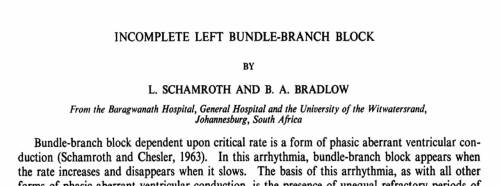
My humble tributes to  Barold, Sodi -palleres , and Leo  Schamroth . Probably  one of the best  article on ILBBB is linked below. Reviewed    in 1963 !  Not much data has been added  in the next 47 years as on 2010

Read Full Post »

Association of pediatrics of India  has done a wonderful job .This may the first of it’s kind to formulate a excellent guidelines for managing CHD in India . This was made possible by the consensus conference on CHD held in AIIMS in 2007.

A must read for every physician, pediatrician and  cardiologist

It is recommended , this  guideline should be incorporated in every undergraduate curriculum of  medicine .This article which was published three years ago ,  should  have been published in the Indian  heart journal also.

Thanks to Indian association of pediatrics for providing this article  free

Link to article.2007 consenus conference on CHD Newdelhi

Read Full Post »

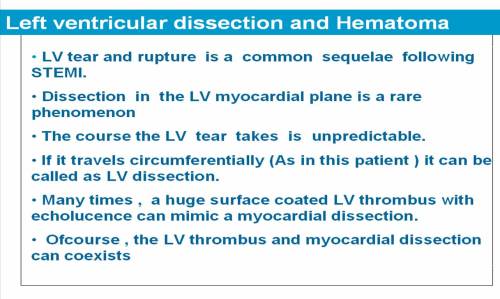
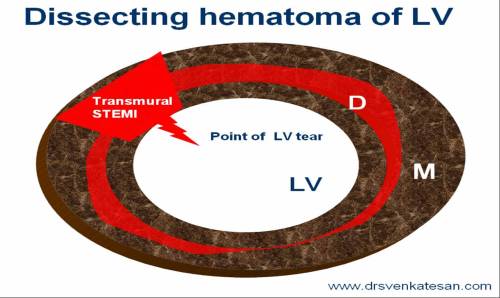
Left ventricular dissection is a rare complication of STEMI .A case report

Click on the slide to see the video  hosted in  youtube

Slide 1

Slide 2

Reference

http://www.ingentaconnect.com/content/bsc/echo/2009/00000026/00000003/art00006

http://resources.metapress.com/pdf-preview.axd?code=g4kqby7wnkjepetx&size=largest

Read Full Post »

« Newer Posts - Older Posts »