Feeds:
Posts
Comments

Archive for the ‘Cardiology -Interventional -PCI’ Category

The primary determinant of pulmonary artery systolic pressure is . . . ?

  1. Pulmonary arterial tone
  2. Pulmonary venous pressure
  3. RV contractility
  4. Pulmonary blood flow

Answer : All of the above

But what is the relative contribution of each ?

I am  100 %  sure  ,  no  one can answer this question  correctly !

It is  true  , in some  pathological situations  one can  be  fairly certain about  cause of   elevated pulmonary arterial pressure .

When we confront a patient  with left heart disease  it is the transmission of  mean venous pressure .

Whatever be  our understanding ( Pre/Post capillary pulmonary hyper tension and the related stuff !  ), the one parameter that makes mystery contribution  to PA pressure is RV contractility !
In physiology  RV   generates  about 30mmhg systolic pressure that becomes the  pulmonary systolic  pressure .The  diastolic pressure  will be around 15 and mean around 20 . During exercise  contractility of both RV and LV increase .There has been documented PASP up to 50 mmhg in normal healthy adults during   exertion .

Here one can assume RV contractility is causing  a entity called transient Isolated  systolic  pulmonary arterial  hypertension.(ISPAH)

Consider a entirely different situation

A patient with COPD  with raised  PASP .  The right ventricle pressure has to equilibrate with PASP  during systole .For this to happen   it has to generate the 60mmhg .  If the RV fails  to augment it’s contractility for some reason ,  will the  ineffective RV contraction will  lower the  PASP  ? This is the perplexing question !

While the popular understanding is ,  RV dysfunction will under- estimate the severity of   pulmonary hypertension   . . . still  . . .  we are not sure whether RV dysfunction will  reduce the PASP   per-se  ( and  subsequently PA  diastolic pressure as well )

We often see a  good example  . A patient who develops tricuspid valve disease and RV  dysfunction get symptomatic relief  from  lung congestion .

Final message

The relationship between RV function and pulmonary artery pressure is a real enigma. Though hyper functioning  RV is expected to elevate PASP  and hypo functioning  RV would pull  it down  , the relationship  is not that simple. If only we decode this  mysteries   we can try  specific  RV negative inotropic  agents  as a  modality to treat pulmonary hypertension .

After thought

Total artificial hearts  are going to come in a big way in the coming decades .It  will specifically address this issue  ,  as RV and LV contractility  need to  be individually tuned to avoid pulmonary congestion.

Coming soon

While  RV function is critical for human survival  ,  Fontan  principle  simply says entire RV is dispensable . How ?
Read Full Post »

Rescue PCI rescues

  1. Myocardium
  2. Patient’s life
  3. Both
  4. None
  5. Cardiologist pride

Answer:

All of the above can be a correct response in varying situations.

Read Full Post »

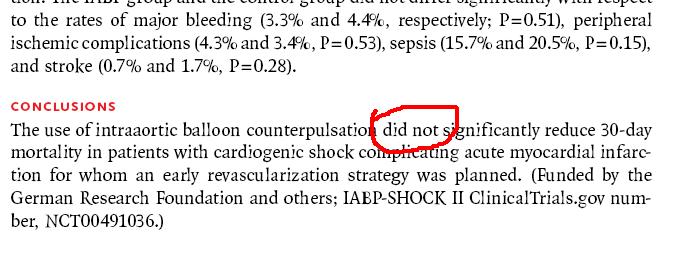
The last rites for routine   Swan Ganz catheterisation ( In STEMI ) was  performed  by a  land mark JAMA article  in 1996 .

Now . . .  is the turn for intra aortic balloon counter pulsation (IABP) .

A conceptually attractive concept  was laid to rest in Munich ,West Germany , this week at annual  European society of cardiology ,  Scientific Sessions  .August 2012 .

What a crash for a great  hemo-dynamic  principle    in acute MI which ruled the roost for over three  decades !
Just Imagine ,   how many man hours , millions of  worth of consumables  wasted  . . .  better  not to talk about  associated   aortic injuries .

This is what we call   premature evidence based harm”

I  wonder  . . .  whether  I am  justified in making this extreme comment .

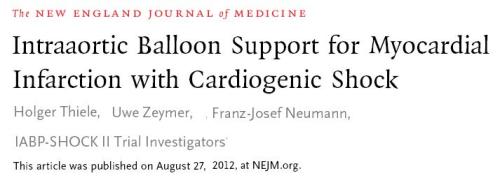
Please read for yourself  , this early online release alert  from  NEJM .

http://www.nejm.org/doi/pdf/10.1056/NEJMoa1208410

Reference

Connors A, Speroff T, Dawson N, Thomas C, Harrell FE Jr, Wagner D, etal. The effectiveness of right heart catheterization in the initial care of critically ill patients. JAMA 1996;276:  889-97.

http://www.ncbi.nlm.nih.gov/pmc/articles/PMC2352214/pdf/bmj00561-0005.pdf

Read Full Post »

An awkward  argument for routine EST following primary PCI

Please remember,  primary PCI is not the end of the management of STEMI. Primary PCI is an IRA focused intervention. We need to study other lesions and their the flow pattern as well. Logically we need to do a test for adequacy of  baseline vascularity and the current revascularisation . Simple deployment of  a stent in IRA (without documentation of good flow during exertion ) is not acceptable to believers of  scientific medicine  . Resting TIMI 3 flow conveys no meaning for a patient who is going to be ambulant and active. A stress test will come in handy .

The micro-vascular integrity and resistance following an extensive STEMI is best studied by the adequacy of exercise induced  coronary hyperemia (This is physiologically equivalent to the much fancied FFR in cath lab ) . One can consider EST following a primary PCI as an non invasive substitute for the collective FFR of all three vessels including the IRA that is stented .

Does any cardiologist have guts to do a pre- discharge EST after a successful primary PCI ?

Typical responses would be

  • Why the hell I should do it ?
  • Do you know how risky it is to do a EST early after a primary PCI ?
  • If at all I have any doubt , I would prefer a non invasive PET or Thallium to study the adequacy of revascularisation.

If you think , it is too risky to exert a successfully revascularised patient early after a STEMI . . .   at the same time   argue  to do it in non revascularised patient routinely .  Do we not see a huge irony here ?

Other inference could be . . . we are still suspecting the quality of our revascularisation during PCI !

If  EST is contraindicated after a primary PCI , are we going to advice  these patients against indulging in any activity requiring moderate exertion fearing a stent occlusion ?

. . . What a way to interpret the aftermath  of a   ‘state of the art ‘ procedure called primary PCI !

In science ,  correctness is more important than politeness !

Read Full Post »

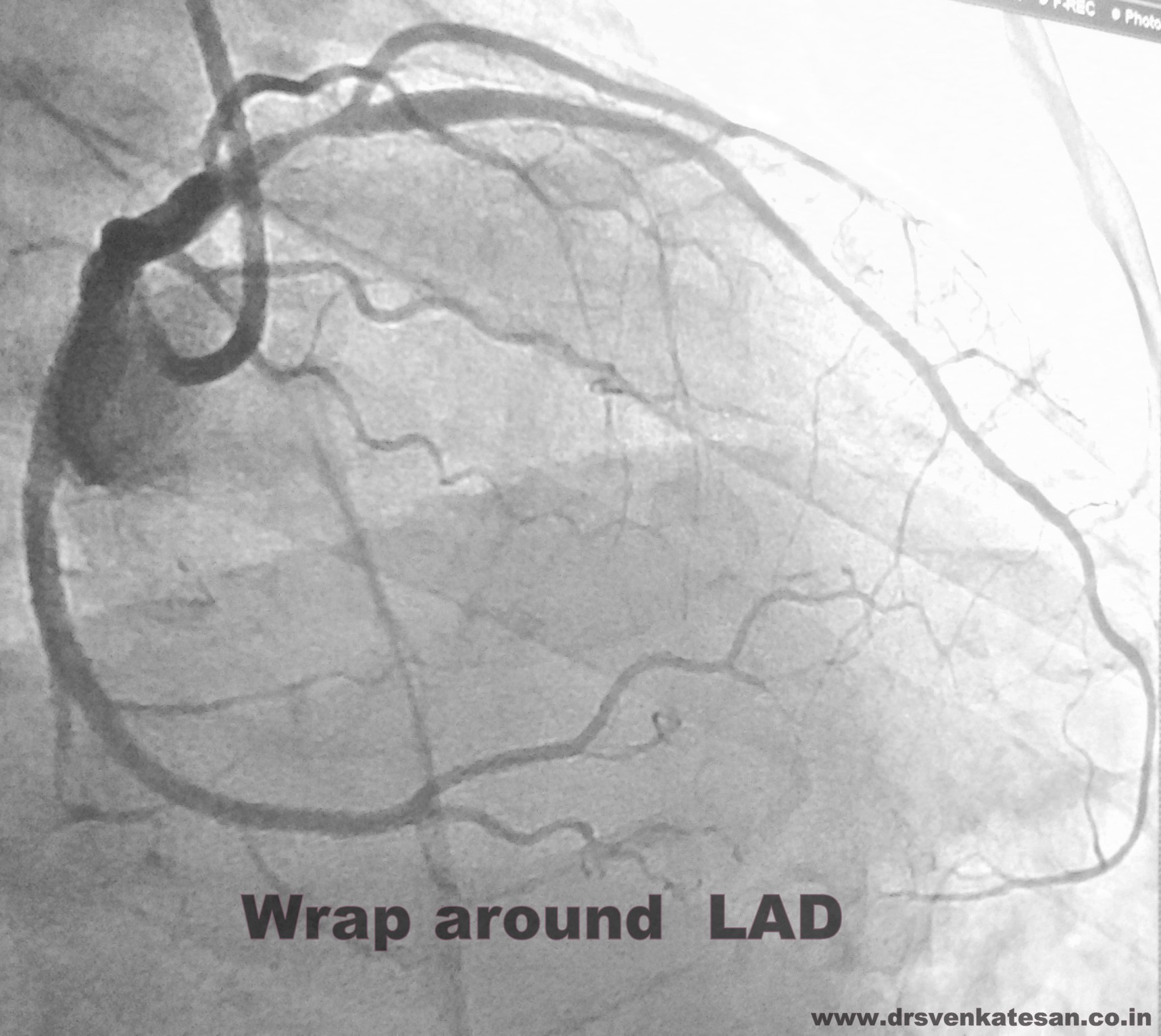
LAD is  graded into three types according to

Type 1  :  Falls short  of Apex

Type 2 :   Reach up to the LV apex

Type 3 : Wraps around LV apex and travels some distance in the posterior Inter-ventricular groove.

Clinical  Importance of Wrap around LAD

As the name implies , LAD   should descend only in anterior aspect  in about 15 %  population it can take a posterior descending course as well .

When LAD  wants to conquer more areas of heart is it a clinical advantage  ?

When LAD wraps around the LV apex,  anterior MI due to LAD occlusions can show changes in inferior leads. (Antero Inferior MI )

In ideal anatomic /Physiologic conditions  LAD  should nearly  meet the  PDA   to prevent any water shed  area.

There is usually a trade off between the  terminal LAD and  length of PDA ( whether it arises from LCX or RCA.)

There is some evidence to  suggest the site of ventricular rupture in anterior MI is related to the gap  in the LAD/PDA drainage zones.

Patients with Type  1 LAD  are at risk of   LV apical  ischemia if the  dominant LCX /RCA is  not supportive .

Final message

A long LAD is definitely a  hemo-dynamic  advantage   in physiology ,   Of course  it goes  without saying    . . .   when  it’s   likely  to get  obstructed it is always better to have a Type 1 !

Read Full Post »

It is estimated multi-vessel CAD occur in about  70 % of NSTEMI/UA.In high risk NSTEMI early invasive strategy is popular (Though it is not yet  an undisputed choice !) .Tackling the culprit artery and restoring the blood flow ,   providing immediate  relief from angina is the primary aim  . Myocardial salvage is a lesser aim !

The lesion that is immediately  responsible for  angina is referred to as culprit  lesion and artery .(Ideally may  be called as Angina related artery ARA .)

If we have  multiple culprit like  lesions  it is difficult to identify the target lesion. Inexperienced cardiologists  may not consider  this as an    issue !

The following features  may be helpful

  1. The tighter the stenosis , it is  more likely to be a culprit . (Of course , blind  belief on this rule  can result in huge errors ! )
  2. Eccentric lesions
  3. Thrombotic lesions
  4. Grafts /Post PCI lesions if present carry high chances of becoming culprits.
  5. ECG characteristics may  be use full (Global ST depression can not occur with isolated  RCA/LCX NSTEMI   .It  generally indicate LAD  lesion to be  the  culprit.
  6. Deep ST depression in V1 to V3 would indicate LCX a definite culprit .(It could even be a STEMI equivalent )
  7. Echo – Angio correlation can provide a useful clue in identifying the culprit. (Example : In a patient with Multi vessel CAD  , if there is severe resting wall motion defect in Infero -Lateral segments with relative sparing of septum   LCX lesion should be the culprit .)

Exceptions

  • It is not always easy to identify the culprit artery .There can be multiple active  plaques .
  • Diffuse inflammatory vessel are reported in few with NSTEMI
  • Occasionally there can be no  culprit lesion at all (No active plaques ) ,  as the rest angina may be related to excess demand like fever or anemia with  a stable non critical plaque.

Final message

The  delicate   exercise of identifying the angina related  artery is  important  for two reasons.

  1. We can not afford to   prolong the PCI procedure in the setting of ACS  as increased procedure time is clearly related to peri- procedural events.
  2. Secondly , stenting a wrong lesion   and persistence of angina after a  PCI  will take  away  the  hard earned credentials  of  cardiologists  instantaneously !

Reference

Read a related presentation

Read Full Post »

Stress related wall motion defect  is a well-known entity . It is referred to as Takotsubo cardiomyopathy .

These stress are often

  • Emotional
  • Neurological
  • General systemic stress

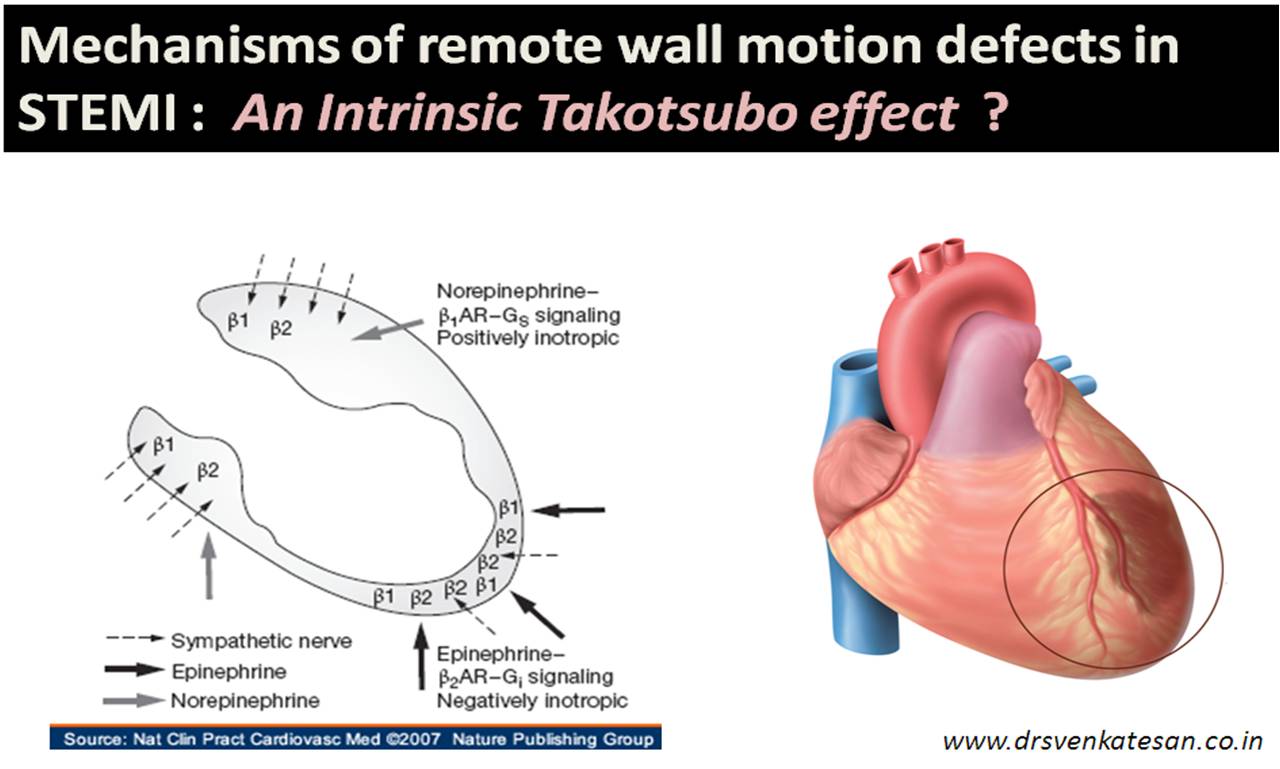
The culprit seems to be pooling of adrenaline and nor adrenaline in myocardium .These remote  neurogenic stress can cause significant wall motion defect due to adrenergic  downpour

The image depicts the wide variation in the density of beta receptors in heart.The stress of MI can result in varying degrees of wall motion defect .It is important to realise the wall motion defect in STEMI has two components .One is related to ischemia and other is due to excess catecholamines. This explains many of the unexplained remote wall motion defects during STEMI .This  may be referred to as Intrinsic Takosubo effect !

Then   . . . the following    questions arise

When systemic stress can have a profound  effect on myocardium , what   about local stress ?

Acute STEMI  is  a huge stress for the heart   . . .   isn’t  . If  so , can it   alter  the wall motion defect in adjacent  or remote myocardial segments  independent of ischemia ?

With the distribution  of adrenergic receptors  showing  huge variation ,  we do not know how an acutely ischemic heart  spills the adrenaline all over .  Is there a pattern to it  ?  or it happens at random ?  Further , the  response to  accumulated  catecholamines  is  not  going to be  uniform. This will explain why certain patients  go into ischemic  LVF  , very early in the course of STEMI  even before the myocardium is necrosed. It will  also explain  the  benefits that accrue in selected patients  who receive early IV beta  blockade  ( Which is  of course currently not popular after COMET study ! )

Final message

We  have seen at least  two patients  with severe  transient ballooning  wall  motion defect in LAD region  (LV apex)  with isolated RCA lesion and inferior Infarct .

The question raised is this 

Can  the  stress of  Inferior  STEMI   . . . result in  apical Takatsubo  like  effect ?

Reference

http://www.medscape.org/viewarticle/567069_4

http://www.takotsubo.com/

Read Full Post »

IRA localization for both LAD and RCA , LCX  is a fascinating  exercise for cardiologists.I suspect  our understanding  about this crucial issue is  far from complete .While  localizing  level of lesion within LCA  or RCA requires more precise data and erring is acceptable  , it is not uncommon to  call  even the  IRA wrong  especially in multi -vessel disease.

Why current   criteria of IRA localisation goes awry many times  ?

The  factors  that operate are not few   . . .  it  runs into a dozen  at least  !

  1. Dominance  is never considered during IRA localization  (A right dominate system can vastly influence the LAD localization  algorithm PLV branches  can protect LV postero- lateral segments in spite of proximal LAD lesions )
  2. The length of  mid LAD   IS  controversial entity ( Traditionally  it refers  to  the  segment  between first major diagonal to second  major diagonal or septal  leads to faulty   coronary mensuration .It is not uncommon to have a  mid LAD measuring few  mm  when  full the full  length of  LAD  is about 15-19cm
  3. Diagonal vs OM  trade off occurs  in every alternate patient which is ignored  !
  4. Ramus  is never considered worthy enough  to be included in the IRA  localization scheme (In spite its presence  in 20 % )
  5. Type of LAD is not given allowance.
  6. Finally &  most importantly these rules of IRA localization will not apply in  the setting of  multivessel  CAD
  7. In the presence of Pre existing CTO
  8. STEMI following chronic stable angina
  9. Extensive collaterals
  10. Re Infarctions
  11. Post CABG etc

Final message

Decide for yourself  . . .  how good is the value of IRA localization  after  considering all the above variable. . It is not a great thing to predict  correctly RCA from LCX in an  inferoposterior MI  with a  70 % accuracy  . (It actually means  20 % accuracy  )    statistically when there are only two options  . . .  we are blindly  right 50% of times   !

Read Full Post »

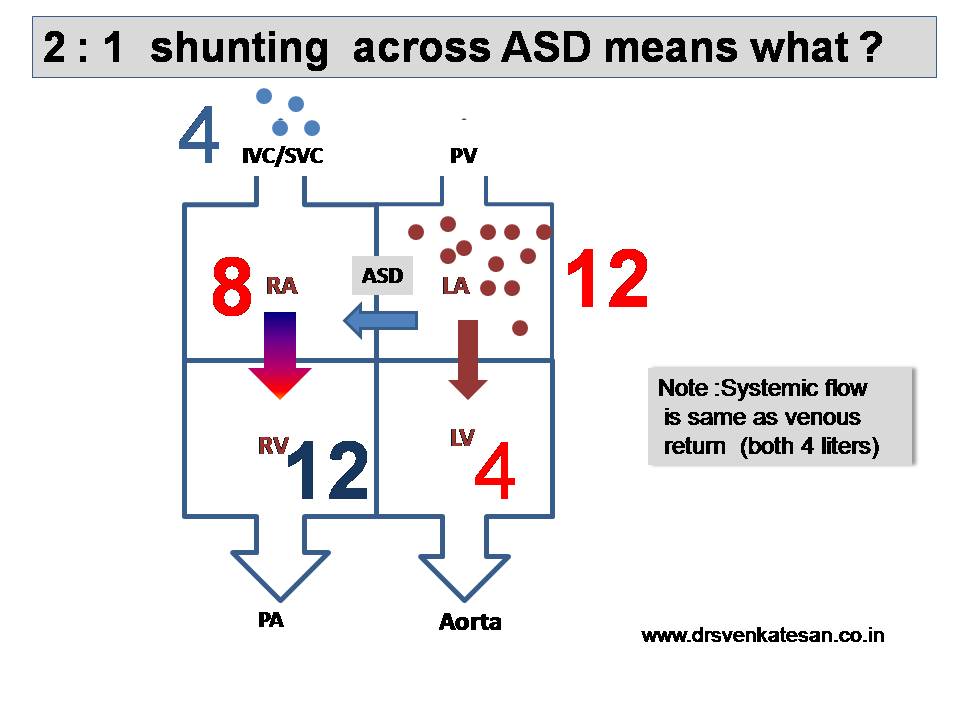
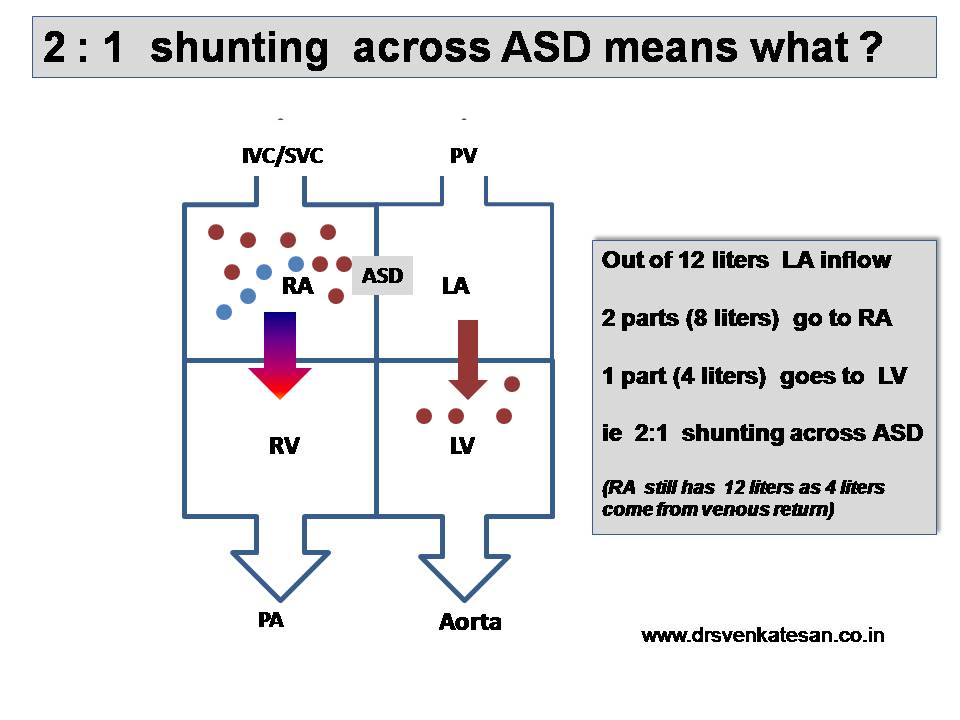
There was a big debate in one of my classes with cardiology fellows regarding the shunt quantification of ASD . We were talking about the significance of ASD shunting . We suddenly realised 2:1 left to right shunt is not a simple equation to comprehend . I was thinking 2:1 shunt would mean pulmonary flow would be twice the systemic flow . It was not to be !

Is the ratio of shunting and Qp/Qs convey the same thing ?

No . Qp /Qs is the ratio of pulmonary to systemic blood flow flow . When we want to quantify shunt we express it in two different ways .

1. The amount of blood shunted form left side to right side of the heart .

2. The amount of pulmonary blood flow to systemic blood flow in absolute terms .

Though both are closely linked entities they do not denote the same meaning . When we say 2: 1 shunt we refer to the shunted blood across the defect but when we calculate pulmonary blood flow we take into account venous blood which does not take part in the shunting .

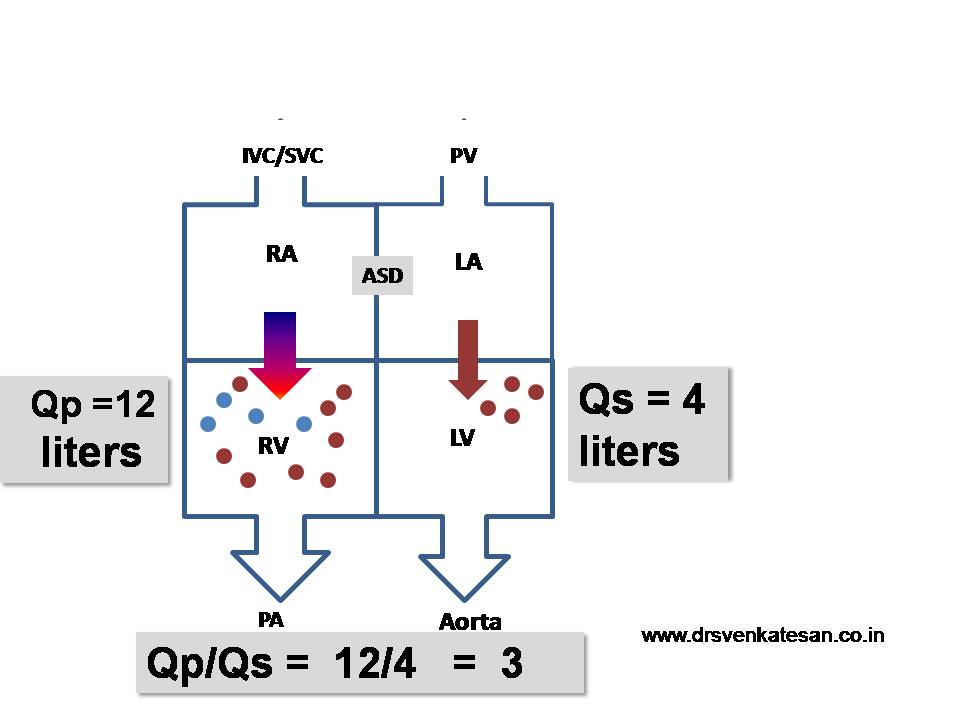
The confusion arises because we use both terms interchangeably.The following illustration will try to prove A 2: 1 shunt would actually correspond to a qp/qs of three (Pulmonary flow is 3 times the systemic flow !)

Let us begin with a hypothetical ASD patient who has systemic cardiac output of 4 liters.

He shunts 2 : 1 from left to right . ie he shunts 2 /3 of three parts into RA (66% ) .

A patient who delivers 4 liters from LA in the presence of 2;1 ASD shunt would mean he would receive 12 liters from the lung as pulmonary blood flow.

Final message

I am still not fully convinced about the above reasoning . I guess it is correct. I argue the fellows to give further insight into this equation. The complexities in bi- directional shunt and effective pulmonary blood flow in Eisenmenger syndrome is going beyond my heads !

Answer found after a decade

All the above cartoons are wrong

The word shunt itself has been mis interpreted by us . Shunt at the level of ASD is different from Qp/ Qs ie excess flow to pulmonary circuit.

Correct explnnation for a 2:1 Shunt:

  • Right Atrium (RA): Receives 1 unit (venous return) + 1 unit (shunt) = 2 units total, which goes to the right ventricle and lungs (Qp = 2).
  • Left Atrium (LA): Receives 2 units from the pulmonary veins, of which:
    • 1 unit (~50%) crosses the ASD to the RA.
    • 1 unit (~50%) passes through the mitral valve to the LV (Qs = 1).
  • Pulmonary-to-Systemic Flow Ratio: Qp/Qs = 2/1 = 2, confirming the shunt ratio.

Read Full Post »

Time and again cardiologists are called to opine  in critically ill ICU patients with  hypotension.  The circulatory shock of septic shock  is often refractory  . Many  times it  degenerates  into multi -organ failure . The mortality remains high in- spite modern treatment .Even in those patients who recover , they require prolonged  inotropic support  (for days or even weeks)

Here is a  recent call I attended to .

A 44 year old   febrile   , ventilated patient  (With a pneumonitic patch , PEEP of  6 , near ARDS )  ,  precarious renal function and altered sensorium , maintaining a blood pressure of 100/70mmhg with high dose dopamine and nor- adrenaline  , monitor showing a heart rate of 125 /mt sinus  .This status -quo  has continued for more than 72 hours. To my surprise,  the ICU physician told  me there is  in-fact a  minor improvement in general condition than before  . After blinking  at the patient’s  file for few  minutes  , I did a customary bed side echocardiogram .The only positive finding  I  found was  his  heart was  structurally normal  and EF was  64 %  , still the right heart chambers were struggling  to do it’s job   fighting with the PEEP.

The physician had  a very  specific query  from the cardiologist . How to wean the inotropic support and shift him off  ICU ?

(The poor patient  has no  insurance  , and has to shell  Rs 10000 everyday  which is equal to his monthly income ! )

A very  valid question indeed   !   After all  , cardiologists  claim to  have special  knowledge  and wisdom about disorders of  vascular system .

Heart being normal , the crux of the problem is loss of vascular tone. (Autonomic dysfunction ) .How to improve it ? I  discussed the following suggestions.

  • Early passive muscle exercise (Augmenting  muscle tone and transforming it to  into arteriolar and venous tone )
  • Venous support ,stockings etc.
  • Ensure adequate intra-vascular  fluids
  • Sodium supplements
  • Corticosteroids.
  • Fludro-cortisone , the mineralo-corticoid may have a specific advantage as it could retain sodium in vessel wall that can be exchanged with smooth muscle calcium and improve vascular tone .
  • ECMO is  often a pre terminal intervention .
  • Will power . We know vascular  tone is in fact neurogenic in origin .The tone flows from brain stem .Administering  will power could be a useful intervention . (parental infusion of fighting spirit !)It can be done through pep talks from  close family  members   in   conscious patients .(One controversial advice is to allow  near and dear  into bedside , ICU phobia may delay recovery of vascular tone !)
  • Finally  I suggested , a  vascular consult from the GOD  . Organised prayer .  There is some evidence ,  even  proxy prayers do exert benefits in unconscious patients .

After a 15 minutes stay in the ICU , for doing nothing  I  received a significant consultation fee  , and I left the  place  sheepishly  with a  definite dose of guilt !

Reference for role of Hydrocortisone in septic shock

The CORTICUS study

It has no overall impact but hastens recovery from septic shock . Even though the study appears to denote a negative connotation

it has the role in selected individuals .http://www.nejm.org/doi/full/10.1056/NEJMoa071366

Read Full Post »

« Newer Posts - Older Posts »