Feeds:
Posts
Comments

Archive for the ‘Cardiology – Electrophysiology -Pacemaker’ Category

Current guidelines advice us to wait for 40 days following STEMI to implant ICD in most high risk patients.

Why this  cool off period.? *

  • Essentially  we are waiting for the Infarct healing process to be completed.
  • By this time electrical stability may be restored. The  risk of VT/VF  declines per naturalis.
  • LV function recovery  is possible. As stunned and hibernating myocardium resumes its mechanical function and patient might  jump out of the MADIT-2  cutoff point. (EF< 30%)
  • Introducing  ICD very early  after STEMI may be a myocardial irritant and that it self can generate  arrhythmias.
  • There is a possible interference by the leads in the physiological remodeling  process.

Final message

So the cool off period is  not only to reduce  the unnecessary  ICD implantation  but also to  avoid lead related issues .

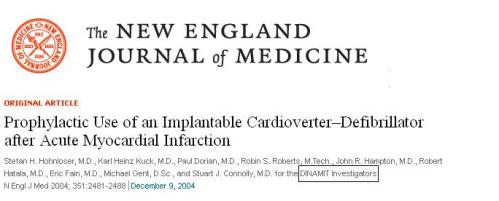
*  This 40 day rule is based on one  large study from Germany. (DINAMIT, 2004  ) . However  few believe  the rule is not absolute. There can be individual   exceptions in high risk patients with critical LV dysfunction .

Other  wise   . . . How do you digest  a death occurring on  35th day  in a patient  who is waiting for an ICD scheduled one week later ?

Reference

DINAMIT trial ICD nejm

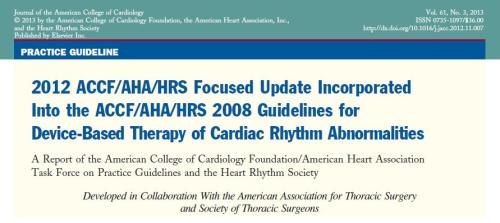
Link to  ACC/AHA  Guidelines for ICD Implantation 2013

New development

How to bridge the 40 day gap in really high risk post MI patient ?

We can’t keep him in CCU. Here comes the role of WCD (Wearable cardiovertor defibrillator.) Life vest is  from Zoll . WCD can act like a bridge till the 40 days when the patient becomes eligible for ICD.

http://lifevest.zoll.com/


Read Full Post »

  • CRT -Cardiac resynchronisation is done  by putting multiple wires and electrically organizing the contraction  sequence and improving mechanical function.
  • ICD-Implantable cardiovertor defibrillator shocks whenever VT or VF occur and suden death is prevented.
  • CRT-D (Combo device which functions as both )

CRT is done for advanced heart failure to improve exercise capacity and hence the quality of life .It does not do any thing significant in prolonging life .ICD is again implanted  in advanced LV dysfunction with either documented VT/VF or patients who are at  propensity for VT .It has dramatic benefit in preventing  sudden cardiac death.

Both CRT and ICD has some overlapping indication in cardiac failure. Attention young cardiologists,   please realise among these two the value of ICD is many  many  fold higher than CRT.This fact is rarely discussed and disseminated.

 True benefits of CRT is realised only when it is combined with ICD.

Summary

  • Ideally all advanced cardiac failure patients should receive both ICD and CRT (CRT-D)
  • ICD as stand alone therapy has a  distinct role in patients with severe LV dysfunction (LV EF<30%) without  wide QRS in ECG
  • There is no role for  CRT  as a standalone procedure in cardiac failure  .it should  always  be combined with ICD (ie CRT-D) *

*Except  in patient with  degenerative complete heart block , both ventricles are paced  the term Bi-Vi pacing is used  instead of CRT.Since LV function is normal here , there is no de-synchrony in the first place .The synchronised  BIVI pacing is meant to prevent future heart failure

Final message

Always use a combo device in advanced symptomatic heart failure which  is refractory to medical therapy.

After all , there need to be a life in the first place  so that we can improve it . ICD ensures life while  CRT tries to improve it.

http://europace.oxfordjournals.org/content/14/9/1236.long

Read Full Post »

Every pacemaker has  a metallic “Reed switch” . Putting this switch on and  off is possible with an external magnet .The circuitry is such that , switching on  makes sensing function null and void.It functions as asynchronous mode.In other words  pacemaker converts to a mandatory  pacing mode .All  sensing  related issues are immediately removed.
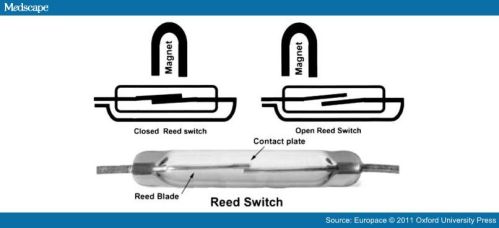
magnet rate reed switchNote : This switch can be activated by any strong magnetic filed applied externally .And removing the magnet disconnects the circuit.

When a magnet is applied the pacemakers changes the mode in the following way.

  1. VVI  to VOO (Paces only ventricle  without sensing)
  2. AAI  to AOO (Paces only Atria)
  3. DDD to DOO  (Paces both ventricle and atrial with a fixed AV interval )
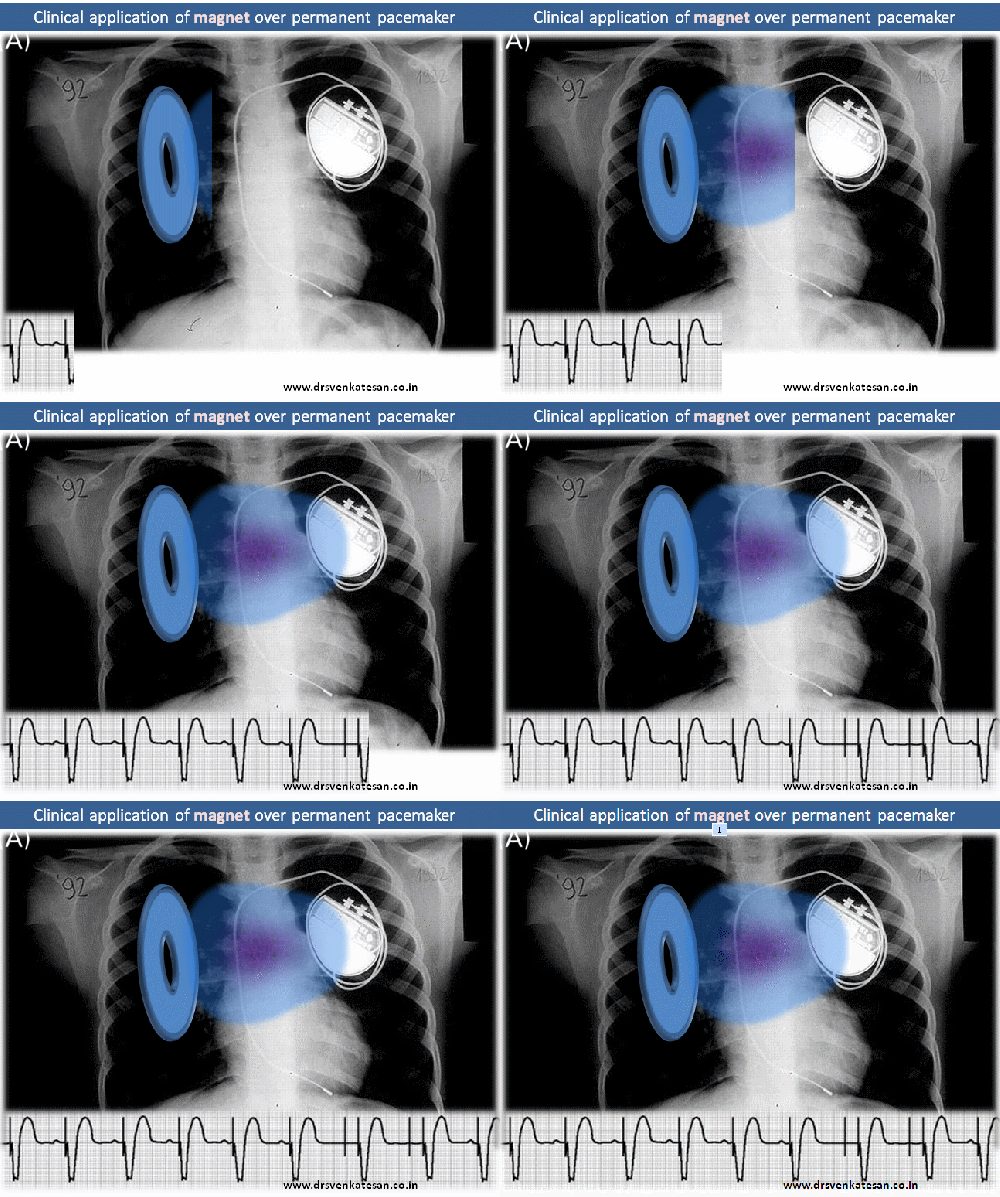
magnet application permanent pacemaker ecg 002

Purpose of magnet application .

Essentially it may be called as a safety mechanism to prevent external sensing in strong electrical fields in case the need arises.

Indirectly , it may aid us in detecting end of life  of  battery as well

During elctrocautery and related procedures  application of magnet will help.

What is magnet  rate* ?

  • The moment you apply the magnet the pacing rate  changes
  • This is variable with each make and preset.
  • End of life magnet rate will be different . It can be 65 to 85  fixed depend upon the make.
  • Some pace makers  fire initial magnet rates with 3-6 beat fast run and later revert  to steady baseline rate.(One should not be confused )

* Always check with the pacemaker manual for the exact response.

When I put a magnet over nothing happened .What is the inference ?

  • Magnet is not placed properly
  • Pacemaker battery  is totally dead.
  • Very rarely some pacemakers  have magnet function  turned off

What happens  during magnet application in ICD ?

  • There is no change in ICD mode.
  • All anti tachycardia functions are immediately suspended. (A major use in an unusual runaway inappropriate  ICD shock situation )

Is there any risk of applying magnet ?

Since magnet removes the sensing function , interfering a cardiac rhythm which  is dependent on sensing can be  problematic.Similar situation arises in MRI scans and other magnetic fields.

Hence , application of magnet in a patient  as a part of pacemaker trouble shooting who has no pacing spikes is rarely a problem While one should not do it without supervision of  a learned cardiologist.

What is smart magnet ?

Each pacemaker  and ICD  is interrogated with the respective programmer.As such , there is no cross brand  programmer  available.This makes it difficult for patient( as well as physicians)  to call for help in case of malfunction.

The solution is to make standard universal analyser and programmer .This requires  cooperation between various stake holders.Meanwhile as temporary relief a magnet which can community two way with  basic functional switches can be developed .

There is a need for universal smart magnet with constant interaction between device and magnet ..

Since , the generation next generation human  heart  is going to be wired and deviced in a complex manner,  we need to know the basics about these  issues.

Final message

Magnet application is akin to novice’s  pacemaker analyzer. Every cardiac care unit must have one in their shelf. It aids us to diagnose over-sensing as a cause for pacemaker  malfunction.(* please note , it has little  role in all other pacemaker issues !) .In an emergency it can help stop inappropriate ICD shocks.(More importatnly  It gives  time to call an expert ! )

Reference
role of magnet application on pacemkakers icd  oversensing magnet rate

Read Full Post »

We expect LBBB in RV pacing . . .but if RBBB is recorded we are worried ! (Often times it may be neither  LBBB nor RBBB )

Is it really a panic situation ?

  • Not necessarily. The only issue is septal perforation .It is rare , can be recognised by echo or fluro .
  • In true RV apical pacing with tined leads , RBBB  is extremely uncommon .
  • If the lead  is fixed  in the septum and para hisian  area ,  there is  definite  possibility of  deviation from typical LBBB pattern . Screwing leads  that faces high septum  or outflow , RBBB  can be noted occasionally.
  • The commonest cause for RBBB pattern in RV pacing ,  is due to  screw tip going deeper into septal planes  and activating the fibers of left bundle early .
  • For LBBB pattern to occur right  bundle should be morphologically intact .In diffuse CHB  with bilateral bundle branch blocks  the relative contribution ( Impulse conduction ) will determine the QRS morphology . If right bundle is more damaged than left bundle ,RBBB pattern  may prevail  even in the midst of RV pacing !
  • In elderly men with sigmoid septum typical LBBBs are not observed.
  • Anther plausible mechanism would be , even though RV is paced , the pacemaker current’s  exit route may be from LV side .
  • Finally , always  think about coronary  sinus pacing .It is extremely common in blind temporary pacing.

What should we do if we encounter RBBB morphology after PPM ?

  • Analyse the ECG meticulosuly for capture or sensing failure .
  • Do an echocardiography in RV inflow view.
  • Screen the lead by fluroscopy
  • Check the pacing  parameters.
  • Do a holter if  you are really anxious .

If everything is fine , just forget the RBBB.Don’t split your hair for this apparent paradox. In medicine  impossibilities will always  galore !

This paper from Taiwan would vouch for this

RBBB during RV pacing safe ecg

Read Full Post »

This post , is  probably not meant for cardiology professionals.

Few technologies are clear winners in modern medicine. ICDs play  games  that would rival the God !

What is an ICD ?

http://www.youtube.com/watch?v=dlert3zh8fo

Here is a man , who  drops almost dead by a fatal cardiac arrhythmia . In few seconds  ICD  machine recognises this arrhythmia ,charges itself and  fires a shock  of about 30 joules direct current .The arrhythmia is reverted and the fellow gets up as if  nothing has happened !

Watch this video

This revolutionary devices are  to be used judiciously in individuals with high risk  for dangerous cardiac arrhythmia.

The current  indications  as on 2012

Post MI  ( Only after  4O days*)
LV dysfunction EF ≤ 35%   NYHA  II or III  ( Please note , If  ≤ 30%, even Class I  NYHA can be implanted an ICD) *Why 40 days ?  Residual ischemic, Irritable  focus  should settle down
Myocardial disease
  • Nonischemic DCM  EF ≤ 35% with documented VT
  • Rarely other structural heart disease with recurrent risk for VT ( Few HCMs)
Primary electrical disease
  • Survivors of cardiac arrest due to VF without any completely reversible causes (Includes Brugada )
  • Malignant forms of syncope  with   idiopathic recurrent VT /VF
  • Congenital Long QT syndromes not amenable to beta blockers

Reference

Guidelines ICD pacemaker 2012 ACC AHA

Read Full Post »

This question always creeps in any coronary care unit.

Often times , there is a significant  histo-pathological overlap between severe degrees of  Ischemia* and  myocyte necrosis . (What is called micro infarcts, lacunar infarcts,  make us over diagnose MI). It is not yet clear , whether leaky myocyte cell membrane can release free cytoplasmic enzymes without actual cell necrosis.
Clinical Implication
Fortunately , there is not much .These bio markers are primarily used as prognostication tools .Many of these patients  need to  undergo early revascularisation. However , It is unwise ,to get alarmed by  just  Troponin positivity  in an other wise comfortable ACS patient.
* Some call severe degrees of Ischemia as Injury ! It is an old thought based entirely on ECG  .There is no specific cellular equivalent of electrical injury current !

Read Full Post »

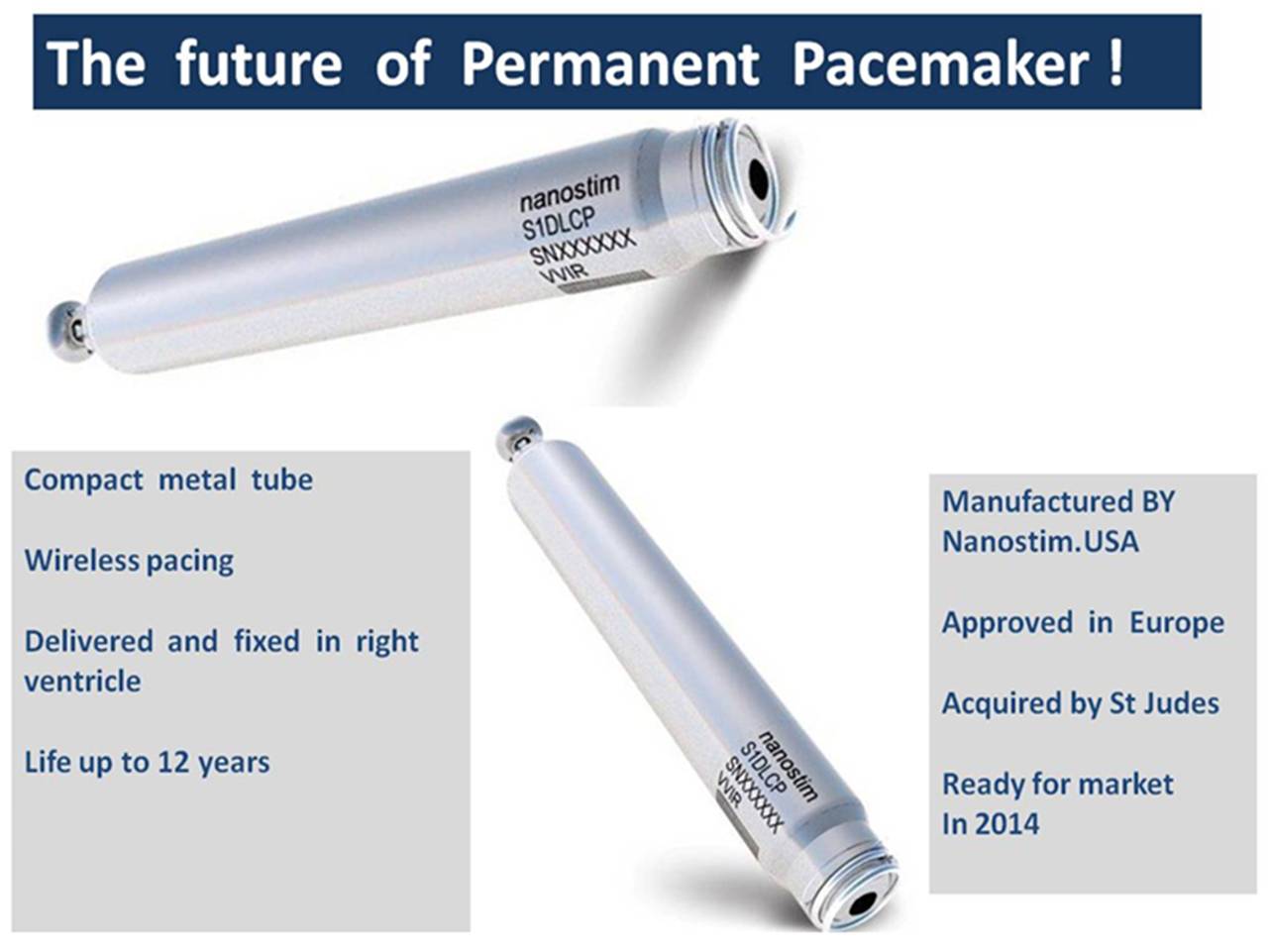
Few Innovations are real breakthroughs in cardiology . Here is an imminent technology waiting to explode in the  permanent pacing . Expected to hit market next year (2014 in Europe ) FDA approves clinical studies .

nanastim

Click over for the animation video  of the procedure .

  • The wireless pacemaker has many advantages. (It’s devoid of all those pocket and wire related issues.)
  • The ability to change batteries is  a  going to be a  new paradigm shift in the filed of electro physiology. .
  • Down side would be,  right now it can be only VVI pacing . All that hype about    physiological pacing  will go to the background !

Future directions in Permanent pacing.

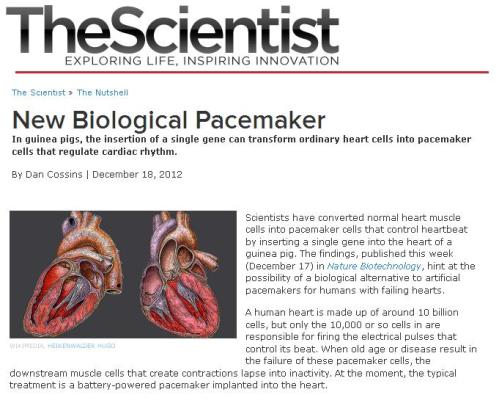
The only threat for this technology is the  concept of biological pacemaker Converting ordinary myocytes into  pacing cells by genetic engineering.This is expected to happen within few decades.

biological pacemaker

Read Full Post »

No procedure is  impossible in medicine    . . . but it should be useful for the patient !
Where will you ablate ? What is the purpose ?
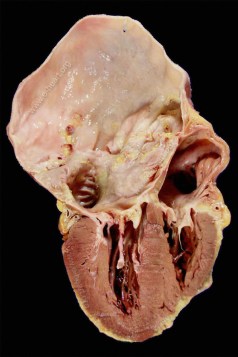
The much  hyped*  ablation of pulmonary vein  is never going to help in rheumatic heart since  arrhythmia focus occurs at  random . How can you  locate a   focus of AF over a  huge , scarred  left atrium  ? ( which looks like a lunar surface  sprinkled with a rocky terrain ! )
Gross specimen
                                      Note the huge , scarred LA .It would
                                      be a wild guess to locate the true focus
                                      of AF . (Image source : http://www.e-heart.org)
So , the other option was disconnecting atria electrically . In the past  surgeons advocated  linear  or multiple incisions as in Maze and  Corridor procedure  after mitral commissurotomy .This  helped to a certain extent , still effective , organised atrial contraction was not restored in many.
Now , some electrophysiologists tried to do the same with catheters without much benefit.* Please realise , pulmonary vein ablation even in lone and ischemic AF is struggling  with a concept collision !
Can Right atrial focus trigger and  sustain  AF in RHD ?
Autopsy studies reveal tricuspid valve scarring in 33%  of all RHD .Since RHD is a diffuse process , RA lesions can  be very well be the focus .  It is not an easy task to identify the real culprit focus. So ,concentrating  LA  for ablation may end up in futility.
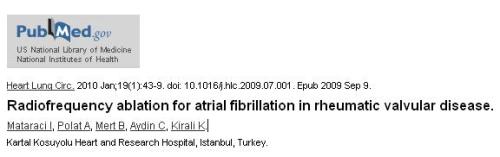
There are only few studies available on RF ablation in RHD  .This one from Istanbul ,Turkey  and it  does not favor it as recurrence rate is still significant .
rf ablation in rheumatic atrial fibrillation
Final message
Approach  to AF in RHD  : Opening up the mitral valve (or replacing it )  and controlling ventricular rate  with beta /calcium blocker along with  adequate  oral  anti-coagulation substantially reduce the risk of embolic events .One may never need to contemplate restoring sinus rhythm  in rheumatic atrial fibrillation.

//

Read Full Post »

Pacemaker lead implantation is basically a blind procedure .We are supposed to pace the RV apex . It is akin to anchor a ship in the sea bed. Screwing leads are preferred in permanent pacing  ,but tined leads have few unique advantages as well .

Can we combine the advantage of both ?

pacemaker lead in rv apex anchoring how to

It is believed displacements are more common with tined leads . May be yes . . . or  is it really so ?

It is not the tines  or screws that is going to  determine the early displacement , rather ,  it is the expertise , commitment and the time spent during the implantation that matters . I have witnessed equal number of  early lead dislodgement in both .

One issue often goes unreported is that , when screwing lead is used operator is subconsciously complacent.While cardiologists who implant  tined lead is more cautious , make sure it is well trapped in RV.

Screwing leads.

  • Screwing leads should not be positioned in the same place as tine leads.
  • This is because , RV apex is rich in trabeculae. Screws can enter one of the trabeculae or it may even enter  inter  trabecular  space. or poke  thin trabeculae which may  break in near future.(Realise ,how blind we are !)
  • Screwing  should be done in area where there is least  trabeculae  ideally in  lower end of septum. Since we do it blindly , we can’t be sure where exactly we have screwed .
  • Please note , pacing parameters are less  reliable than anatomy One may get surprisingly good pacing threshold even in trabecular pacing.
  • RV non apical pacing is possible only with screwing leads . However , the superiority of RVOT, para hisian pacing is yet to established in patients with normal LV function (Note  90 % of individuals who require PPM have normal LV function )

Tined leads

  • In contrary,tined leads are best placed where there is dense trabeculae.
  • It is natural entrapment.
  • The expertise of screwing  in a best place of RV is not required.
  • Whether screwing  predispose   to septal perforations in long term follow up is not known. Logic would suggest it may  !  (The Initial of few mm  of IVS tunneling  is done by us ! )
  • Diaphragmatic twtiching is more common with screwing leads.
  • Explantation  issues  is similar in both .

What does experienced cardiologists say ?

Cardiologists before the era of EPs were using  only tined leads  without any major hitch . I know electrophysiologists rarely use tined leads now . In our institute ,  with a  cumulative experience of over 3000  pacemakers  over 30 years( 99% are with tined leads ) , we  have no reason to believe they are vastly superior technique.

However there are few definite Indication for screwing lead

  • Abnormal RV anatomy
  • Loss of RV trabeculae
  • Marked Tricuspid regurgitation
  • Pulmonary hypertension
  • Second lead in RV
  • LTGV

* Note all atrial based pacing are screw based as atria lack trabeculae.

A suggestion

pacemaker lead in rv apex anchoring how to tined vs screwing lead   003

Final message

I would believe ,there is no major difference in both short and long term outcome between these two system of leads.Each has it’s own advantage.

After thought

Why can’t  we accrue  the benefits of both ? I think we have good scientific reason to request the pacemaker industry   to  design  a lead which  can have both tines and screws to  provide  double safety .Simple isn’t ?

Read Full Post »

« Newer Posts - Older Posts »