Feeds:
Posts
Comments

Archive for the ‘Uncategorized’ Category

No one can deny ,  there is a huge revascularisation  dilemma  between CABG and PCI  in patients with CAD. This is especially  prevalent in multivessel disease in chronic coronary syndromes.

In acute STEMI , CABG is never considered as a primary revascularisation  procedure.There should be strong reason for this !  Few studies , suggested a role for CABG in acute MI if it is done within3- 6 hours .But it became very clear , by and large CABG for acute STEMI is contraindicated . This especially applicable when q waves are formed.

Reasons.

Performing a complex surgery  on a   blood vessel subtending a  dead  , irritable ,myocardium is dangerous. Even a graft for non IRA vessel has no great benefit in the acute setting. The mortality of CABG in the first 48hours of MI  can be up to 15%.  Primary PCI  opens up the IRA without the hazards of major surgery

Issues  for  CABG in STEMI

Failed thrombolysis :  Rescue PCI  could be useful provided it is also performed within the same time window . In most situations  there is nothing called  “rescue CABG ” 

Some would believe Left main and critical TVD is an  indication for an emergency  CABG. Yes , CABG may be indicated  in this setting , but even here it may be delayed for a week if there is no ongoing ischemia , angina or hemodynamic instability.

Still  , there is a  definite role for CABG in STEMI in the following situations.

  • Mechanical complication- VSR/MR/Free wall rupture
  • Cardiogenic shock
  • Failed  and complicated primary PCI.( Note : Simple failure to open a IRA is not an indication for CABG , there need to be a life threatening situation ! )

 Coming soon

Routine  CABG  is  generally  dangerous and contraindicated   for STEMI ,  while it  is  a great ,  life saving surgery  in  most of  the  refractory  NSTEMI : How ?

Read Full Post »

Amiodarone has brought a major change in the medical management of ventricular arrhythmias over  the last  few decades. It is  a powerful antiarrhytmic drug , with all class 1 -4 action  (of vaugan williams classification.) It  has   sodium , pottasium, calcium and beta blocking properties.  Hence there is no surprise, amiodarone is  aptly called a broadspectrum anti arrhythmic as it  acts  on many of the cardiac receptors .

Of course , the major action is thought to be pottasium channel blocking effect(Class 3) that prolongs the action potential duration and refractory period resulting in termination of many re entrant arrhythmias.  While , amiodarone by structure resembles thyroid hormone, takes a long time to reach the steady state plasma levels  .Oral amiodarone takes  up to a week time to exert it’s action.

If amiodarone is a slow acting drug , is it not  surprising  , Why  IV amiodarone is given in the emergency managment of  VT ?

Typically , there is difference between the mechanism of  action between  oral and IV amiodarone

The class 3 property of amiodarone ,  is a late observation following oral adminstration. QT prolongation rarely  occurs  following bolus iv amiodarone . So , VT  terminating effect is thought to be some thing , other than class 3 action. Many believe the combined beta and calcium channel blocking effect could be responsible for rapid reversion of ventricular arrhythmias. The sodium channel blocking action with fast kineticks may also contribute.

Final message.

While amiodarone is a  prototype class 3 anti arrhythmic drug,  it’s  VT terminating property  may  be ,   attibutible to other class action. mean while  , the Class 3 action is responsible for long term prevention of VT/VF .

Read Full Post »

Exercise  stress test ( Also called treadmill test ) is an important investigation  not only in patients  with suspected  CAD  but also in  established CAD . In the former  group ,  it helps us to exclude CAD in patients with chest  pain and in the later group ,  it helps us to assess  functional capacity , risk stratification and to detect any  additional ( New or residual ) ischemia.

Stress test being a physiological test , has a huge  advantage of assessing the adequacy of myocardial blood flow without even  knowing the coronary anatomy , while Coronary angiogram (CAG)   has a zero physiological value* in spite of   excellent assessment of the coronary anatomy !

It is an irony , in the assessment of angina we are expected to assess the physiological adequacy of myocardial blood flow ,  we have kept coronary angiogram as a gold standard  over and above the much  neglected  physiological stress test.

Of course, the limitation of stress test is that ,  it has only 75%  specificity(  to rule out CAD ) and about 80% sensitivity (To detect CAD ) .In simple terms  stress test is likely to miss  20% times to miss a CAD  in patients with CAD  and 25% of times falsely diagnose CAD  in patients without CAD.

In the above statistics  ,  coronary angiogram was considered   gold standard . The problem with this data is that , CAG is not the real gold standard ,but it was  nominated  as a gold standard . We now know normal coronary angiogram is not equivalent  to  normal coronary arteries and vice versa.

While both test have limitations , it is logical to believe CAG has an edge over stress test since it visualises the anatomy. But ,  once an obstruction is demonstrated by CAG, stress test scores over in assessing the physiological impact of the lesion.

Is a 70% LAD lesion significant or not ?

Stress test will give vital information to answer this question.If this patient performs 10-12Met exercise without symptoms it means , the obstruction is not impeding the flow even during stress. He may do well with medical therapy.

What does a positive stress *mean for the patient and for the physician ?

(* A false positive EST in LVH, anemia, baseline ST shifts are included in discussion )
  • A positive stress test  with or without angina at low workload <5 METS  indicates very significant obstructive CAD either in left main , or proximal LAD/LCX. They should get immediate CAG.
  • A positive stress test at load  5-10METS  is again significant and patients should get early CAG
  • A positive stress test with angina at good work load >10-12 mets  would indicate insignificant or minimally obstructive  CAD.
  • A positive stress test at  the peak of exercise  at good work load > 10-12METS without angina could indicate a false positive or very minimal CAD.

For the physician , the proper way  of interpretation  should be , the fact that a person performs 10-12  METS  indicate the myoacardial blood flow  would  be  more than adequate in most life situations. Knowing the coronary anatomy serves no purpose here, as no revascularisation will be attempted even if he is going to have a significant CAD ( Which again , is also highly unlikely ) .He should be managed with appropriate lifestyle (Diet, activity, relaxation )  anti anginal drugs,  aspirin , good lipid control and plaque stabilisation with statins .

Can a  patient with critical left main  or proximal LAD  perform >10METS in exercise stress test ?

No , large clinical experience (Also refered to Class C evidence  by ACC/AHA!) indicate no patient with critical  left main or equivalent disease  can perform 10 METS  excercise

While  ,  EST may be less hyped investigation, but it is the  only  noninvasive test , ( that too , simple and  cheap ) that can rule out * a significant left main  or equivalent almost   100%  correctly .

Now that,   the results of COURAGE  and BARI 2D have clearly indicated medical therapy is best form of management  in chronic  CAD , ( except in severe obstructive CAD in vital locations)  a  positive EST  at > 10-12Mets  , has absolutely no indication* to for doing a CAG.

*Some would advocate a policy of  doing a  CAG as a baseline investigation in all patients with positive EST  to know the coronary anatomy and will not proceed onto revascularisation if there is insignificant lesions.

Further ,  real life experience has taught us , routine  CAG in these patients

  1. Increases patient anxiety as he is given a report with a diagram of obstructed heart vessels
  2. Leads to multiple cardiac consultations
  3. Divergence of opinions
  4. Finally end up in  the likely hood of a inappropriate  revascularisation for a  insignificant distal CAD.

Final message

Every patient,  who has positive stress test  , ( Please note , it could  even be  true positive  )  need not undergo CAG .  Most  interventional cardiologists could  feel  otherwise , but one should also  remember ,  There is one  more role  for the interventional cardiologist ie  , to intervene when inappropriate interventions are done to their patients.

//

Read Full Post »

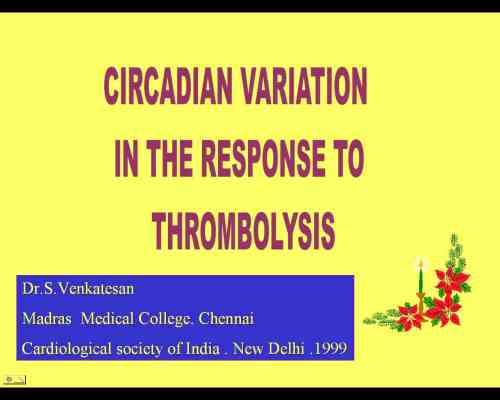
In  thrombolysis  of  STEMI ,  there is a   less  published ,  but   interesting observation . It is  often noted , variation  in the efficacy of streptokinase according to the time it was administered.It was most effective in the evenings and least effective in the early morning hours. The mechanism  is thought to be  due to  ,  pineal gland driven   endocrine   spikes    ,  that result in  a  less pronounced  progoagulant activity in the evening hours.    There could be a therapeutic significance for this phenomenon.

The following paper was presented as an abstract in the cardiological society of India annual scientific sessions in New Delhi in 1999.

CIRCADIAN

Download full PPT presentation stemi thrombolysis ppt

Read Full Post »

Sinus tachycardia in the early hours of STEMI is  a very common arrhythmia. This seemingly simple problem can be really worrisome to many cardiologists and give sleepless nights(While the patient may sleep comfortably !)

The importance of sinus tachycardia in STEMI  primarily lies in answering the following question

A.  Is it compensatory sinus tachycardia ? ,  Where in  , the left ventricle is struggling to maintain the cardiac output and works more  per minute to maintain the vital cardiac index

Or

B. Is it a non compensatory -Inappropriate Sinus tachycardia ?  It is a simple  response to heightened adrenergic tone  and   increased neural traffic from the injured ventricular myocardium . (or  high  baseline anxiety levels  )

It should be recalled , tachycardia in any form is  detrimental  following STEMI as it increases the MVo2 ie myocardial oxygen consumption. This is the reason ,  beta blockers are administered in this situation. Compensatory tachycardia  denotes , myocardium is working at it’s reserve capacity  , to prevent an  LVF that is impending . Hence ,  one should recognise , the compensatory tachycardia can not be  tampered  with ,  as we like ! .

How do you clinically differentiate a largely benign inappropriate tachycardia from potentially  harmful compensatory tachycardia ?

It is not an easy task. Heart rate  is typically around 120/mt   in  compensation to impending LVF.  While inappropriate tachycardia has no limits , it can exceed up to 140 or so . Further , tachycardia due to LV dysfunction has reduced variability.( Typically hovers around 120( +/- 5) .In stress or anxiety  heart rate  fluctuates  more .

Accompanying S3 suggest compensatory tachycardia . Even a few basal  crackles would make a diagnosis of  LVF .

The definite way to differentiate  could be   ( Also the dangerous way !  ) looking for  therapeutic worsening to beta blockers .

How to control the sinus tachycardia in STEMI ?

Beta blockers are  the  mainstay. Any of the beta blockers ,  metoprolol, atenolol, carvidilol can be used.Oral metoprolol up to 50 mg can be used. Beta blocker usage is primarily useful in non compensatory tacycardia. It should be  realised , the wide spread routine use of intravenous beta blockade has largely been discontinued as it has adverse outcome.The greatness of carvidilol,  in cardiac failure mainly applies to stable chronic cardiac failures. So ,  it is important to  recognise,  carvidilol can not be used liberally ,  in sinus tachycardia associated with impending or manifest LVF in STEMI.

*The potential source for tachycardia like dopamine,  dobutamine etc should be excluded.

Other options are

Digoxin ( Not withstanding the critics ,  it is still useful in acute MI with persistent sinus tachycardia ,The advantage is ,  it can be used without a need to differentiate whether it is compensatory or non compensatory!)

Ivabradine , a  wonder drug supposed to reduce selcetively  reduce the sinus rate without negative inotropic action could be tried.(Data lacking for this use )

Final message

Sinus tachycardia ,  may be seen as a simple arrhythmia .  but, the circumstances  in which it occurs , it’s mechanism and  the limited therapeutic options , narrow safety margin of beta blockers  , makes it a interesting clinical issue.

Read Full Post »

Poverty is the number one killer in this world . Malnutrition, infectious diseases  , poor maternal child and health are the leading killers. The life expectancy is short in many underdeveloped countries.

While the scenario  is dismal for most of the poor people in this world.

Can affulence be a risk factor for poor health ?

Yes. This seemingly awkward  answer is  many times true. The disease  acquired by affluence is labeled attractively as life style diseases . They are : Obesity, Diabetes mellitus, cardiovascular diseases, some forms of cancer etc .

coronary angiogram cardiology

How else can affluence affect the health of an individual ?

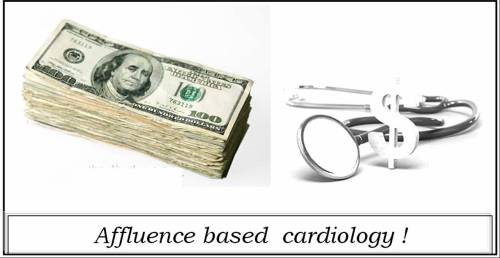
Apart from affluence being a risk factor ,  it  is a powerful  risk factor for getting  inappropriate  medicines,  procedures  &   surgeries  ,  hence  the resultant  adverse effects.

It is a  non-established fact , in  both  developed  and developing world , the single important  predictor of a given form of treatment  say  revascualrisation or  surgery  for CAD  is affordability to the treatment (Either  by insurance or  self payment) .Financial well being , interferes with applying  valid scientific principles on them . Applying  the  results of  the  land mark trials CAD trials ,   COURAGE  &  BARI 2D  are very difficult  for them , which argues for   simple , less costly , less glamorous medical therapy for CAD.

Example 1

A wealthy adult  male  who  lands  up for master health check up  in a big state of the art  hospital found to have a  borderline stress test , CAG reveals a single vessel distal RCA disease .He was given an  option of PCI , undergoes  it ,  and ends up in a complication and damages his entire  inferior myocardial  territory.

Had he been a poor uninsured  guy , he would have promptly be  labeled as stable CAD and would have been on  good medical therapy*  and his  myocardium could have been saved .

* PCI can never be an option  for him ,  courtesy : His wealth status !

Mind you , this is not an isolated  example, such  affordability  guided treatment modalities  are rampant in the society and has a potential to make  our rich and  affluent a major health risk target !

Final message

Being wealthy and affluent can also be a health risk factor. While the poor suffer from lack of health care the  rich many times suffer because of  too much health care ! (or  Is it care less ,  health care ?)

Coming Soon

How reccession  time  is a  boon  for human health  !

Read Full Post »

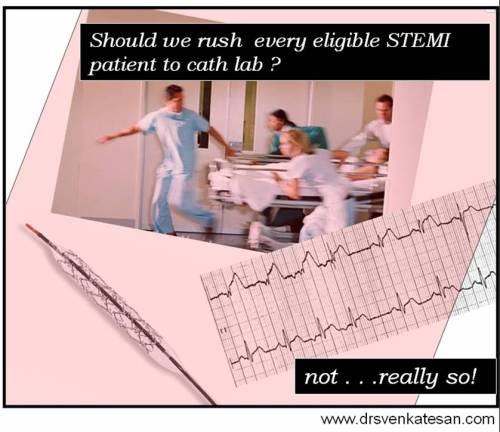
Primary PCI  has proven to be the   best  option for management of STEMI . But it need to be  done very early by a an experienced team in a good facility . (Note ,  it is not the individual expertise that matters !  Ronalodo alone can never guarantee a   match win  !  )

Any treatment ,  which has a great therapeutic potential also  carries a hazard .

So , these treatment must be used with caution.  Not every STEMI patient , has a high risk of death.  In fact the mortality  in some of the subsets of STEMI ,  can be less than 1%. If , a  STEMI patient with a likely 1% mortality   is going to get a procedure with  3-4% ,  risk it is bound to raise a  validity  question ?

primary PCI PTCA STEMI CORONARY ANGIOGRAMS

What are the situations in  STEMI , where primary  PCI could be dangerous*?

* The  term dangerous here  means ,  Risk > Benefit .

Side vessel STEMI : STEMI in  branch coronary arteries. Main vessel STEMI(LAD,RCA,LCX ) has higher risk than side vessel STEMI( Diagonals, OMs, Septal) .

Side vessel  STEMI is not easy to diagnose in ECG ,  but an MI with ST elvation restricted to  only  2 leads  could be a side vessel STEMI.

The following could be some examples.

  • 1 /AVL , High lateral
  • V2 V3 ,   Septal
  • 3 AVF ,  PDA/RV/ Acute  marginal
  • V5 V6     OMs/Ramus

A spontaneously evolving  STEMI , with  ST segment   returning   towards  baseline  and T wave  getting inverted .This indicates IRA is either partially patent and  the coronary blood flow is in the salvage mode. Here , thrombolysis is going to be very effective .

Final message

In the management of  STEMI  , primary PCI could be  consciously avoided in some of the patients   to improve the overall outcome .

Read Full Post »

CAD management has been riddled with controversy for over decades. Should we  revascularise  all  obstructive CAD  we encounter ? Logic and scientific presumptions argued a strong case for it , and hence most of these patient population got some form  of revascularisation .(PCI or CABG ) .

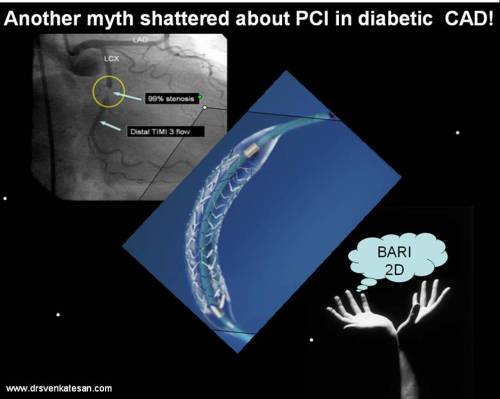
This continued for years  till COURAGE study threw a shocker !  ie  medical management is as good as any from revascularisation in stable angina patients. While , the cardiology community was divided over the COURAGE conclusion ,  here comes another shocker  from the New England journal of medicine  ( June 2009 ) ,  against  revascularisation  The BARI 2D  trial . It shattered  the ultimate  myth,    in  diabetic  CAD patients  , neither PCI nor CABG  has  survival advantage among   diabetic population .

bari 2d  pci coronary

The art of  unlearning  cardiology:

The beauty of  evidence based medicine (EBM )  is  ,  genuine science  will ultimately   prevail  over  pseudo science. But  the danger with  EBM  is  , it   conquers the  truth  in it’s own time frame .In the process ,  EBM has to overcome so many hurdles , both natural , man made,  advertent or  inadvertent but ultimately truth must triumph  , at least we hope it triumphs . In the intervening time ,  it   has become   absolutely essential ,   for the   humans  to  suffer . The only way ,  mankind ,  can be protected  from  this deadly game of EBM  is that ,  our physicians  should have  the  inherent  fore- sight to identify &  ignore the “Would be doomed evidence” !

There are many such physicians  in this world . . . who  ignore  some of the  standard  scientific  guidelines  for the betterment of their patients

Reference

1.NEJM article June 11 20o9

2.Journal watch cardiology

Read Full Post »

Coronary arterial obstruction  is  considered,  dangerous because it obstructs the coronary blood flow . Is it possible ,  for an  obstruction  to have  little  impact  on the blood flow  ? Fortunately ,”yes” , the physics of   fluid dynamics  is patient  friendly .It is  well known , coronary blood flow goes on smoothly, uninterrupted until very late stages of obstruction .*This  has created the concept of flow limiting lesions and non flow limiting lesion .

The most popular form of reporting coronary blood flow across a stenosis is TIMI grading. Originally used   following thrombolysis , now universally used for all angiogram (Is it appropriate ?)

TIMI Grading

Grade 0 (No perfusion): There is no antegrade flow beyond the point of occlusion.

Grade 1 (Penetration without perfusion): The contrast material passes beyond the area of obstruction but “hangs up” and fails to opacify the entire coronary bed distal to the obstruction.

Grade 2 (Partial perfusion): The contrast material passes across the obstruction and opacifies the coronary bed distal to the obstruction. However, the rate of entry of contrast material into the vessel distal to the obstruction or its rate of clearance from the distal bed (or both) is perceptibly slow.

Grade 3 (Complete perfusion): Antegrade flow and clearance  of the dye   distal to the obstruction occurs as promptly as antegrade flow .

When does a coronary blood  flow gets impeded  following obstruction ?

Contrary to the  popular belief , the distal blood flow in a coronary artery  is  less dependent on the degree obstruction than the status of the  distal microvasculature.Classical teaching tells us if a coronary artery narrows >70% diameter stenosis (90%area) the blood flow gets impeded on exertion . For resting blood flow to get blocked it needs still further narrowing .

These rules are written in the era  before we knew the concept of coronary vascular  reserve . We , have since understood  ( or confused !)  more about coronary microcirculation.The major misconception could be what we interpret as epicardial blood flow is actually reflect the status of coronary micro vascular integrity.

How else you explain a patient with a same degree of coronary obstruction has vastly different distal blood flow profile ! There are innumerable examples of patients with 50% obstruction having  TIMI one flow and a 99% obstruction with TIMI 3 flow  !

Have a look at this angiogram ,  / Click  here  to view the video

LCX TIMI 3 FLOW CORONARY ANGIOGRAM

What are the factors  other than the  degree obstruction that determine  the  distal  flow?

  • Acuteness of obstruction.
  • Status of   coronary microvascular bed
  • Interstitial  (Myocardial)  edema
  • Coronary microvascular  reactivity
  • Recruitment of collaterals
  • Coronary perfusion pressure (Aortic diastolic pressure – RVEDP/Coronary sinus pressure)

Final  message

The most important determinant of  blood flow distal to obstruction is the vascular reactivity , tone  and the integrity microvascular reserve .This rule  applies  both in  in acute  and chronic coronary syndrome  . In  CTOs  it may  not apply as distal flow is near zero.  Here  also  the  inherent  intraluminal resistance   of collapsed distal vessel  will determine the  distal flow.

Note :TIMI 3  flow  ,does not represent  a homogeneous class of coronary blood flow .They can have variable myocarial blush and frame counts.It may need further analysis.

Read Full Post »

Coronary arterial spasm is a commonly discussed entity  in clinical cardiology. Originally described by prinzmetal decades ago .It was reported to occur only in coronary care units as variant angina .There is nothing called stable spasm every episode of spasm is considered as unstable angina.

How common is coronary artery spasm ?

This condition thought to be very  common during ACS , but  notoriously difficult to confirm.In fact many of episodes are clinically suspected and never confirmed. There has been lot of provocative tests for confirming coronary spasm like ergonavine etc.None of these tests were  neither useful nor practical.

What are the clinical situations where coronary spasm occur ?

Old concepts die hard.Most of us believe , the most common cause for coronary spasm is prinzmetal’s  angina ie , angina   in normal coronary arteries or  with minimal lesions .Clinical experience ,  has taught us coronary spasm can occur in all spectrum of acute coronary syndrome or even chronic coronary syndromes.

Some believe every episode of STEMI will have a component of coronary spasm.

In NSTEMI/Unstable angina spontaneous coronary spasm is an important pathogenetic mechanism

Now,  we witness transient coronary artery spasm in the cath lab due to catheter and other hard ware.The spasm  here  , is secondary to mechanical stress and this in no way related to the coronary spasm described by prinzmetal in the pre cath era.

What is the link between coronary spasm and electrocardiogram ?

The most common  fallacy among  coronary care physician is , if it is spasm  there must be ST elevation

The classical cardiology teaching all over the world , has been so powerful  this myth continues to prevail over . The fact  of the matter is ,  the  coronary arterial spasm  , can never have any direct impact on the ECG. (Unless , coronary smooth muscle generate ST currents !)  . So , whatever  be  the effect of spasm it  is through it’s effect on the myocardial  blood flow.

Hence ,  it is not the coronary artery spasm that will dictate  the movement of ST segment . It is the impact of myocardial blood flow  to the layers of the myocadium  namely , endocardium, epicardium  , epicardium (  or a combination of  the above )  that will dictate ST segment dynamics.

What are the  the ECG features of coronary artery spasm ?

It can be

  1. ST depression
  2. ST elevation
  3. Only with T wave changes (Tall or Deep T invrsions)
  4. Flattish ST segment  or  rarely , entirely normal ECG indicating balanced ST forces

Among this , the most common manifestation of coronary spasm is thought to be ,  subendocardial ischemia and resultant ST depression .This classically occur in many cases of NSTEMI/UA .

This makes  ST depression  the dominant manifestation of spasm  ,

How coronary spasm can elevate the ST segment ?

If it  can   induce a transmural ischemia  it  can elevate a ST segment . Does  all episodes coronary spasm result in transmural ischemia ? No,not at all .in fact it happens very rare  as we have already seen .

To result in transmural ischemia , the spasm should be total &  sustained ,   at least for few minutes   to   completely   occlude  the blood flow .

Milder forms of spasm can elicit only  a  sub endocardial ischemia  that  depress the ST segment.

*There is a rare variety of spasm where subepicardium is more affected than endocardium and hence ST elevation may occur.

What is the effect of Nitroglycerine on coronary spasm ?

This is a very powerful coronary spasmolytic agent.We can witness it’s action more vividly in cath lab .

It brings back the ST segment to neutral position , from either a elevated or depressed state  .Many believe , ( may it’s a fact ) much of the early  benefit of angina relief in UA/NSTEMI is  amelioration of coronary spasm

Is coronary spasm a neural event or a biochemical event ?

The exact  answer is not known .It should be chemicals as  neural  signals are also mediated by chemicals.

What are the biochemical mediators of coronary spasm ?

  • Smooth muscle calcium : Calcium flux is the immediate cause for spasm
  • Mediators .Neural :Catecholamine ,
  • Thrombus  secretes  Thromoxane A2  which is a powerful vasoconstrictor

Smooth muscle calcium

Is  coronary vasoconstriction  and  coronary spasm  are synonymous ?

Both terms are synonymous . Vasoconstriction is often used to refer  constriction of  microvasculature

while  spasm  often describes  the event in large  epicardial vessel. Some times the term coronary vasomotion is used to describe  fluctuating coronary arterial tone.

What are the determinants of coronary artery spasm ?

  • Location (RCA>LCA)
  • Lesion characteristics -Eccentric overhanging lesion can trigger a spasm by  the plaque ‘s weight.
  • Thrombus content
  • Acuteness of the event
  • Adrenergic tone and nerve activity
  • Concomitant betablockade  .  Theoretical risk ?

What are the types  of coronary spasm ?

  • Discrete ring or band like  spasm
  • Segmental
  • Diffuse long segment  spasm
  • Multilevel spasm in same coronary artery
  • Pan coronary spasm entire vessel (rare)
  • Remote spasm away from catheter tip

Unanswered questions in coronary spasm

Can a totally normal  coronary artery go for spasm all of a sudden ?

It is thought to be rare. Even in prinxmetal series some amount of atherosclerosis was documented in most patients.

What is the relationship between spasm and adjacent lesion ?

Spasm following PCI :Can spasm crush a stent ?

Can a  coronary collaterals go for spasm ?

Logically  Spasm  can  occur  coronary collaterals .But it is difficult to document .coronary collaterals eventhough  has three layes as that of artery (Intima, media, adventia) th medial smooth muscles are less sparse. Advential lack vasa nervorum and hence neural input is less.So spasm is a rare event in coronary collaterals

Read Full Post »
« Newer Posts - Older Posts »