Feeds:
Posts
Comments

We have read extensively  about LV pressure volume loops . What about Left atrial pressure volume relationship ?

This could be vitally important to  understand left atrial failure . While, it is often taught that , LA comes to the rescue of  left ventricle  at time of stress , we rarely talk about left  atrial failure !

Where  will the LA look  for help  when it is stressed ?

Pulmonary veins ?  , No , the LA  simply succumb and patient deteriorates.The only way it can react  is by a  panic response and starts fibrillating !. This is what happens in many  cases of dilated cardiomyopathy  and late stages of aortic valve disease . This AF is very poorly tolerated . ( Of course , we do not understand fully ,  why AF is relatively well  tolerated in severe  mitral stenosis  , inspite of very high  LA pressures Often >40mmHg?)

The  importance of left atrium as a mechanical chamber   is well  recognised .It is supposed to empty the blood  it receives  from pulmonary veins  within a narrow  pressure zone of  8-12mmhg within a  fraction of a second. Even a slight increase in LA pressure may result in pulmonary venous regurgitation and  the incoming venous tides are reversed(“a” reversal in pulmonary vein echo )  that results in the so called pulmonary congestion /Pulmonary venous hypertension.

If only god has created  additional pulmonary venous  valves** at it’s  entry , LA can perhaps a  relax a little bit  . But it is not the case  . So,  LA function becomes as  vital  as LV.

(**Can we create pulmonary venous check valves  ?  . . . will it be  an answer for preventing recurrent LVF in cardiomyopathies etc)

Here is an  article from European heart journal , which gives  great insight into Left atrial function.

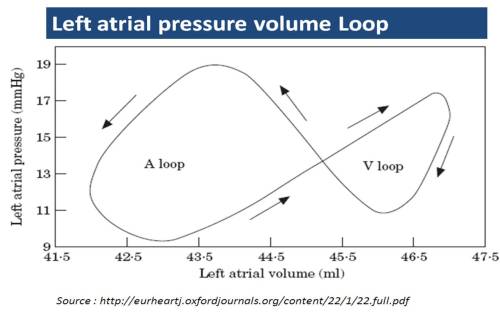
The one that has fascinated me is the  LA  pressure volume loop.

The two pressure waves in left atrium reflect distinct  properties . “v” wave  is a  volume dependent wave and  “a” wave a pressure generated wave . Surprisingly the volume dependent wave generates more pressure than the atrial contraction wave.(Note in LA  v > a while in RA a>v)

http://eurheartj.oxfordjournals.org/content/22/1/22.full.pdf

Ascites precox

Fluid retention is  a classical sign  of  cardiac failure . (Elevated JVP, hepatomegaly , edema legs ) The mechanism of fluid retention are many .But, traditionally we have given importance to   venous back pressure  (Hydrostatic pressure)  . Equally important (if not more !) is the renal sodium  and  fluid  conservation  in response to reduced effective renal blood flow.

How common is ascites in cardiac failure ?

While we see hydrothorax  little  more frequently  it is rare to  get ascites in cardiac failure .However ascites often manifests late  in the pre terminal phase of cardiac failure *. This is due to congestive hepatomegaly, secondary hyperaldosteronism and renal dysfunction .

When does ascites come early before edema of extremities in cardiac failure ?

It is  classically  reported in  constrictive pericarditis. The reason why ascites precedes edema legs is  long  been speculative . Now we have evidence , the pericardial pathology , has a direct effect on the hepatic venous morphology. There can be a  selective  , partial constrictor effect on at least one of the hepatic vein as it enters the right atrium .In fact , the entry point of hepatic vein is  delicately  close to IVC/RA junction.

*It should be remembered in the current era we are expected to diagnose cardiac  failure even before  the onset of edema !

Anatomical   constriction has a mechanical effect on the hepatic venous drainage  and subsequently alters the hepatic function . Segmental hepatic dysfunction is thought to  ooze out the   ascitic fluid  from the surface of liver .Ultimately severe raise of hepatic venous pressure results in congestive hepatomegaly and could result in now obsolete , cardiac cirrhosis.

Other mechanisms of ascites  in constrictive pericarditis , include

  • Hypoprotenimia
  • Common infection of  peritoneum and pericardium( like tueberculosis)

Is ascites precox an exclusive feature of constrictive pericarditis ?

Not necessarily so  . Even though , it was first described in this condition ,clinical experience  suggest, any  congestive cardiac failure with predominate right sided  pathology like organic tricuspid valve stenosis or regurgitation, right ventricular  endomyocardial  fibrosis  , all can result in significant ascites which may precede edema  legs.

What is  effect of  of severe TR on hepatic venous  hydrodynamics ?

TR like MR  can be eccentric and some times hits upon  the hepatic veins directly

and result in disproportionate elevation of hepatic venaous presure than even IVC pressure

which  may contribute to early ascites in organic tricuspid valve disease.

A related article in this blog

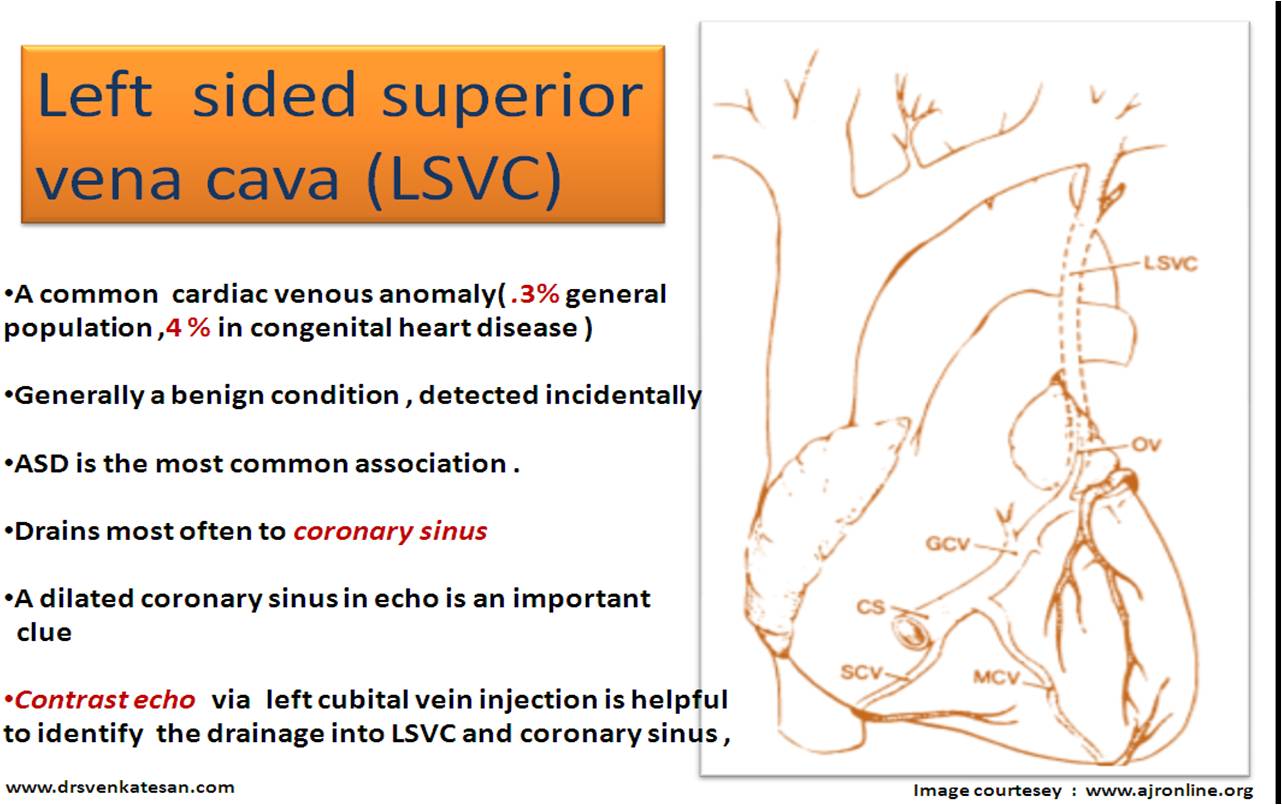
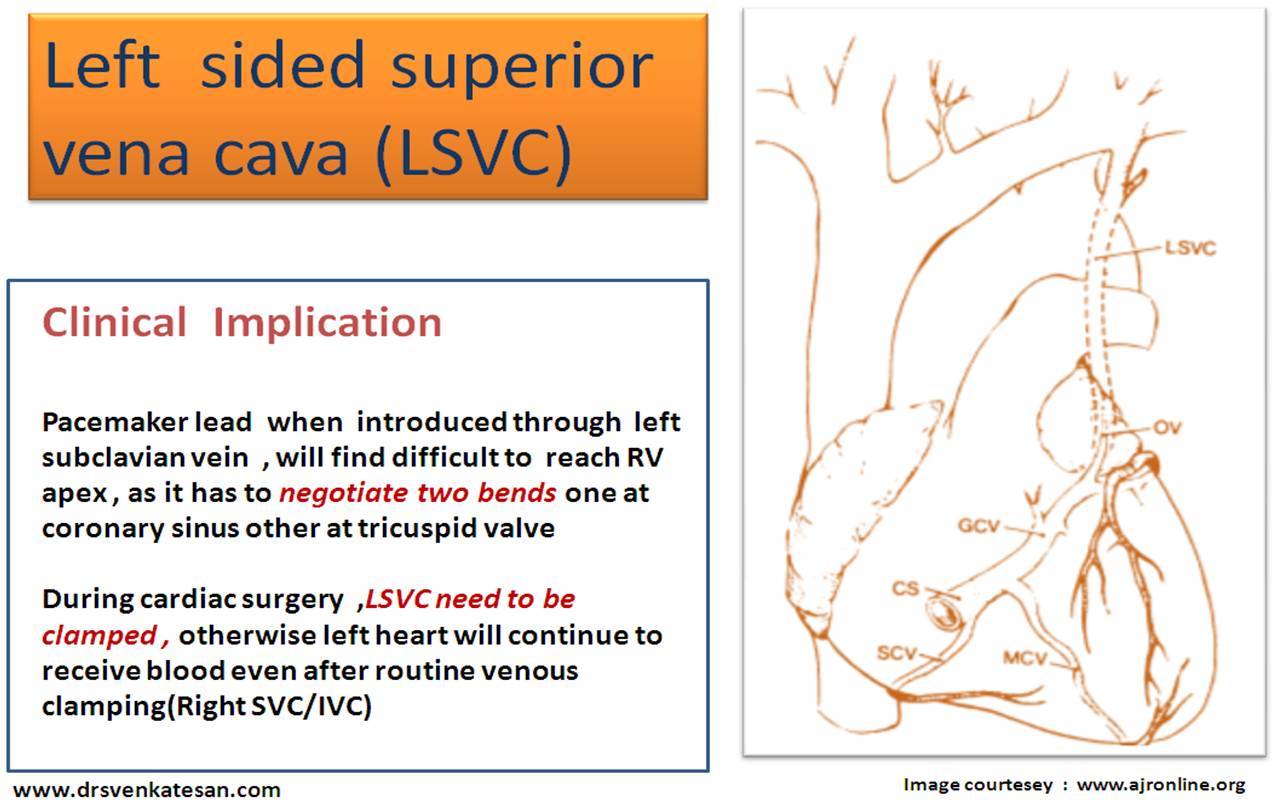
Un-roofed coronary sinus

Further reading :

A rare comprehensive review article on Thoracic venous anomalies

Fr0m American journal of  Roentgenology


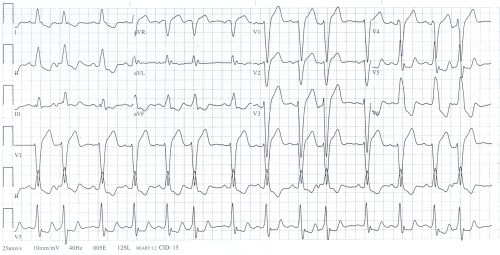
Why the qrs complex becomes wide and tall in LBBB ?

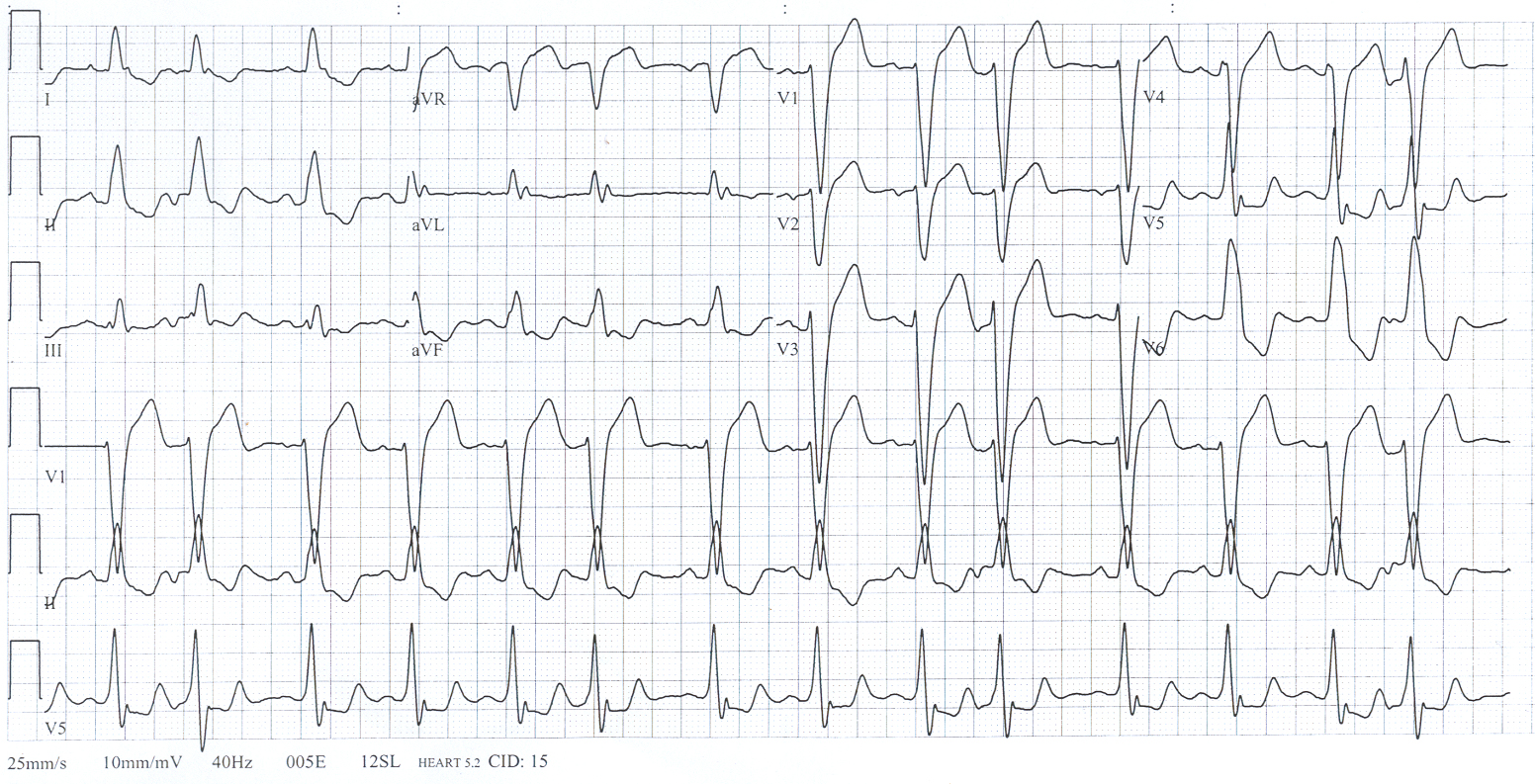
The qrs  complex is  wide , due to delayed conduction over non specialized fibres .The qrs  becomes are  tall due to temporal dissociation of RV  and  LV forces ,  which  leaves  the LV forces  unopposed , thus  a tall qrs  is inscribed  , without the neutralizing effect of RV forces.

Is muscle to muscle  conduction a hall mark of LBBB ?

No , it is not . Even though the left bundle is blocked , much of the conduction tend to occur in

specialized  conduction  system  . It depends upon the level of block of LBBB.

What is the mechanism and clinical significance of left axis deviation in isolated LBBB?

The mean qrs axis is surprisingly  not  altered greatly ,  in LBBB . If there is a significant left ward shift  it may imply associated organic LV pathology or involve ment of predominately  left anterior fascicle

What is  the impact of IVS contraction and timing in LBBB ?

In isolated LBBB, it is expected an abnormal septal motion due to altered sequence of septal activation. This results in an abnormal appearance of  septal motion in Mode (Septal beak immediately following qrs complex) .In fact , this sharp downward movement indicate good LV  function  .Absence  of which  is a  good clue  for a pathological LBBB due to structural heart disease

Why does the abnormal  septal motion in LBBB  ,  do not  desynchronize  the normal LV ?

CRT is the much fancied  treatment in patients with LBBB and cardiac failure. In normal ventricles LBBB do not destabilize LV function in spite of septal /free wall desynchronisation  .This is still a mystery how IVS is cope up with the totally unexpected  insult of asking to work in head over heal situation !In spite of  this the ventricle gets used to the altered conduction pattern and the contractile pattern.(Nature’s  at it’s best !)

What are the mechanical disadvantage of LBBB

  • Septal contraction is  ill-timed
  • Mitral  regurgitation

Most isolated chronic LBBBs  do not  confer  any hemodynamic  disadvantage  to LV  – why ?

LBBBs are dangerous looking ECG , but in most patients it is benign , in the absence  0f structural heart disease like valvular , myocardial or ischemic  disease.

Can there be a small r wave in V1 and V2 in LBBB ?

Yes . Though we expect the  reversal of septal depolarization  extinguish  the initial r in v1 to v3 .It is  noted in many. Hence presence of small r in v1 to   v3 does not rule out LBBB. 

  1. The commonest explanation given is un-masking of RV free wall forces which is   normally  masked by early LV forces .
  2. Another possibility is the   orientation of septum  in pathological states.
  3. Third possibility is  “r” may  actually represent  the  septal q waves as in LVH or old AWMI  .(Counterpart of small  q in lateral leads )

How do we explain concordant  pattern  of QRS  v1 to v6  in LBBB ?

We expect the qrs to  transit from QS  complex  to RS ,  at-least by lead  v5/v6 .Some times even V6  shows a RS complex.This is usually due to faulty lead  position or a grossly enlarged  LV,  ie  if we  record V 7 or V8 we will be able to pick up the qs complex.

What will be the morphology of a VPD that is arising  from LV in the presence of  LBBB ?

A premature beat arising  from a  ventricle which is having  a bundle block  is  sort of  electrical blessing !The VPD often bye  passes the block and makes  the conduction near normal  and a normal  qrs may be  recorded. So , when a patient with LBBB suddenly develops a normal qrs beat or  normal qrs tachycardia  one  should consider a VT arising from the  Left ventricle .

And a studious electro physiology fellow  should  be able to answer the following !

What will be the morphology of  VPD if it arises from RV and septum in the presence of  LBBB ?

Kindwall has tried answer  this question

What is the effect of  LBBB on S1 and  S 2 ?

The classical  description in LBBB   is

  • Paradoxical split of S2
  • Wide split of S1

You are supposed to hear  4 components in complete LBBB  !  In reality this does not happen . At best you can hear the reversed  split of  S2 with difficulty .

One  more reason  for the  non manifestation of these splits is  confounding factors like LV dysfunction , MR , PR interval etc .(Each one tend to pull or push  S1 and S 2 in different directions )

Do  patients with LBBB  , are at increased risk for developing  complete heart block   when

beta blockers , calcium blockers etc  are administered ?

Common sense would say yes. Scientific  sense has  no answer .

We know, ventricles are innervated by two bundles  .When only one bundle  is  functional, it means the ventricles  are experiencing  50 % power shutdown .   In CAD  , single vessel blood supply due to a CTO  is considered  dangerous but in electrical  flow it is not so !  In spite of the fact  that  ventricle has numerous  cell cell electromotive conduction   it is  always better to exercise caution  when administering  beta blockers, calcium blockers and digoxin in patients with LBBB . If it is a must periodic  monitoring is advised .(HV interval in isolated LBBB is slightly prolonged ) Never administer beat blocker in a patient with recent onset LBBB and ACS

Also read the related article  in this blog  Incomplete LBBB
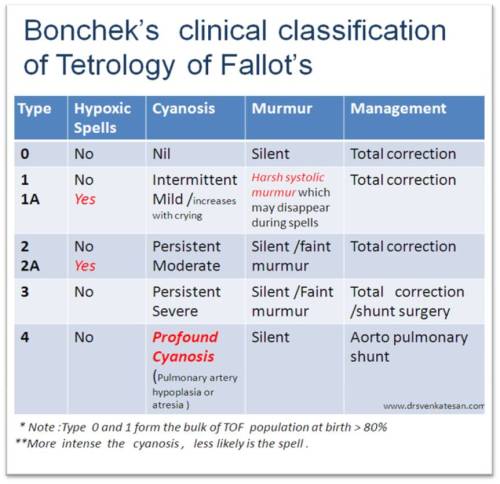
Tetrology of Fallot is the commonest cyanotic heart disease . In 1973 , working at Portland,  Oregon , Bonchek  and colleagues created this classic with intense clinical acumen , that defined the way   how we understood TOF   in infancy  . Such studies  have  become extinct in this fast paced cardiology academia !

With due tributes , here is a slightly modified version of Bonchek classification of  TOF in infancy .

Every cardiologist must read every line of this article  which came 37 years ago  !

Welcome to the new era of “medical avatar “

Cardiologist’s ultimate dream  of  monitoring  their patients

Live ECG feed in your cell phone  !

Thanks to the American “scientific  pursuit” and the mankind  will be  the beneficiary !

Courtesy :

Airstrip technologies

What’s next ?

Remote DC shock and pacing  .

Watch out  . . . it is going to happen in next 5-10 years !

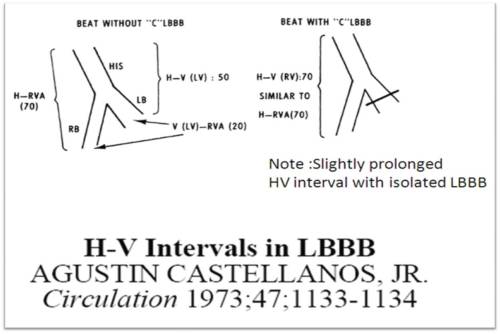
These simple questions were asked once upon a time  when cardiologists were not known as interventionists.Now many of them  have neither time  nor interest  to ask such questions .! An article   which came in Circulation 1974 addresses this question lucidly.

It is known, HV interval represents infra hisian conduction . And LBBB is  just that ! Then , why it is not prolonging it ?

The answer is ,  it does prolong  the HV interval  by 20 -40 ms , but , it is not manifested in surface ECG .  A 20 ms increment in PR interval (Say 160 to 180 ms ) is not a big issue generally.

* Then the concept of incomplete and complete LBBB is always there to confront us !

Many believe , the intraventricular conduction delay in LBBB may simply represent  the  “unmaking effect”  of   LBBB   which  re-routes  the conduction  in the slightly delayed  , circuitous   right bundle  highway   . But it is only a   assumption.Many things can happen in a  ischemic , degenerative, dysfunctional heart.

When does the HV interval prolong pathologically in LBBB ?

Acute LBBB (Note Left bundle  has two fascicles , technically  equivalent to bifasicular  block )  A 40ms  increment in HV interval (Hence in  PR interval also)   can be a dangerous delay in LBBB .

The commonest cause of syncope is the neuro-cardiogenic or vasovagal syncope .

The following is  the possible neural  circuit  of this syncope . In fact . it is a  “Neuro -vascular circuit”

The afferent* (Two components  are present  -Both trigger sympathetic signal )

  1. Sympathetic (Prodrome /Anxiety /fear )
  2. Cardiac mechano /stetch receptors  located mainly in LV .(Can be in Aorta/Carotid )

* In some cases sensors  and afferent can be same entities.

The centre – Medullary Nucleus ambiguous /Tractus solitarius

The efferent -Strong parasympathetic overshoot and sympathetic withdrawal

Parasympathetic excess lead to bradycardia primarily, while sympathetic  withdrawal lead to

hypotension

Syncope recovery

As patient recumbent posture ; LV gets filled and  LV mechanoreceptors are passified .

Final message

The exact pathophysiologic basis of this syncope  still  not elucidated.But one thing is clear , the syncope is due to sympatho- parasympatho signal mismatch( and sort of a rivalry reaction)  !In this neural game , heart’s behavior is all the more funny , it initiates the reflex  while  the brain stem  “Boomerangs” it back to heart and vascular system ,  with a vagal onslaught .

To call this  simply as vasovagal  is not proper , that is why neuro -cardiogenic syncope was used.

Ideal terminology  would be  to call it as  cardio -neuro -cardiac syncope   as the cardiac component form the afferent limb as well as the efferent (target organ )

Reference

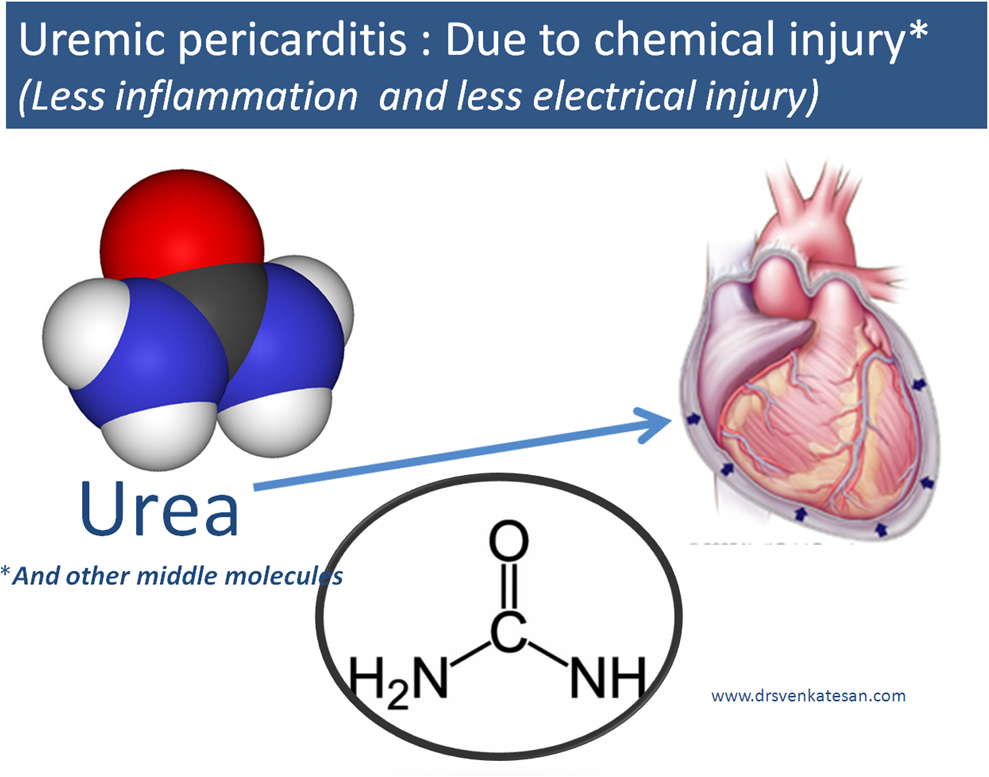
Pericardium is a  fine  biological sensor. It   makes   noise when the kidney is in distress .

We call   this as uremic pericardial  rub .  This is not a universal phenomenon in renal failure.

Occurs in about 10% of renal failure .

Mechanism

  • Chemical pericarditis . Uremic middle molecules ?
  • Dialysis related pericarditis
  • Associated infection

Two  themes can occur .

  • Pericarditis without effusion .
  • Effusion without pericarditis

The later is more common .

Is it a exudate or transudate ?

Usually a transudate. Protein accumulation may occur .

Hemorrhagic or non hemorrhagic effusion ?

Again both can occur. Platelet dysfunction is well known feature of renal failure .Bleeding into pericardial space  even a few cc of blood is suffice ,  to color the entire effusion  red  .

ECG features of uremic pericarditis , how is it different ?

The uremic pericarditis  less often results  in classical ST elevation  (concavity upwards)  instead the hyperkalemia features dominate , if present.

The reason for less conspicuous ST  elevation is due to the relative lack of  epicardial electrical injury . Further , the pericardial fluid  is enriched with  oppositely charged uremic molecules  which neutralise’s the

electrical gradient .

Relationship  of pericarditis  with acuteness of renal failure

Though it can occur in any form of uremia.It is more often observed in rapidly worsening renal failure

Relationship to dialysis

  • Presence of  pericardial rub is a classical indication for dialysis .(But not presence of effusion per se  )
  • While pericardial rub disappears in many ,  a  pericardial  rub that is  exclusively  observed  for the first time  after dialysis is well known .
  • The exact mechanism is not  clear . One explanation could be  the pericardial   surfaces gets approximated once pericardial fluid is filtered by dialysis.

Complication

Tamponade is common .Usually tolerated well till late stages as  LVH  and mild PAH are common which resists fluid compression.

Constriction can rarely occur. Tuberculosis can co exist.

Management

  • Indomethacin /Other NSAIDS
  • Steroids
  • Pericardiocenetesis
  • Surgery may be needed if recurrent pericarditis occur

Patients with pericardial rub should be dialysed heparin free .

Reference

Review article

http://emedicine.medscape.com/article/244810-overview

http://circ.ahajournals.org/cgi/content/short/53/5/896

Surgical management

http://ats.ctsnetjournals.org/cgi/content/abstract/22/6/588

Detection of  pericardial effusion was  the earliest  clinical application of echocardiography. Diagnosing  large effusions is a non issue .Assessing  minimal effusions (Systolic vs diastolic echo free space) and associated  thickened pericardium is tough even after 50 years of echocardiography.

Mainly , we are limited by the resolution power of echo. Further , lack of echocardiographic landmark for visceral  layer of pericardium (It is same as epicardium !) makes  diagnosis of  thickened pericardium a real tough exercise.It is said , normal pericardium is less than 4mm .

Where to measure it ?  how to measure is still not clear.

Why differentiating  minimal  pericardial effusion from  thickened pericardium  is important ?

  • Mild  pericardial effusion is  largely a benign finding in vast majority.
  • But , even a minimally thickened pericardium  due to active inflammation  can be significant.
  • Sticky pericardial effusion predispose to thickening and constriction.
  • Early recognition of this dreaded pericardial pathology is essential to interrupt the inflammatory process.
  • In CRF (With or without dialysis) even a  minimal pericardial  effusion can denote a dismal outcome .

Here is a link to Horowitz classification of mild  pericardial  effusion ...

http://circ.ahajournals.org/cgi/reprint/50/2/239

It could help us understand, How thickened pericardium presents in echo. Of course, CT and MRI now have increased sensitivity for diagnosing  pericardial thickening.