Feeds:
Posts
Comments

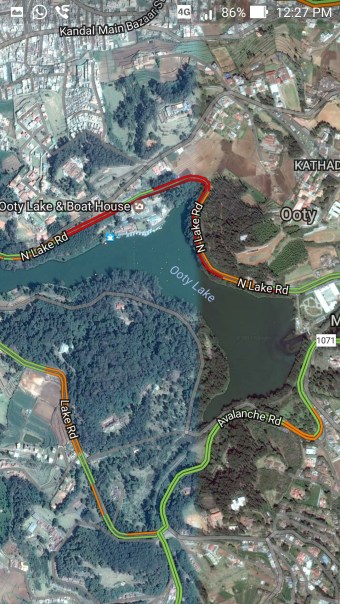
Technology is a great equalizer.Never in my dreams, I would  have thought as I drive through the dense Nilgiris forest , a satellite  located 36000 Km up in the sky would guide  me through  every turn and bend most accurately.

The curvy roads are coded with  live traffic  flow in Red ,orange & green . That’s “Google map”  for you. (By the way, proud to note Google runs with an Indian CEO who hails from my city Chennai !)

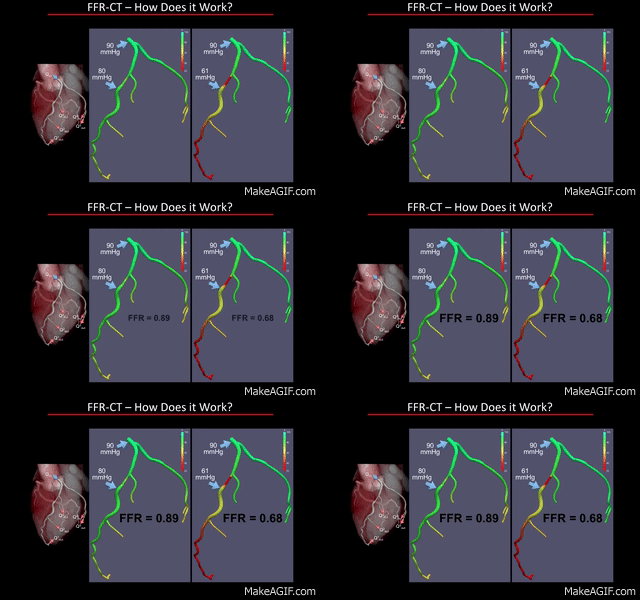
Now , coming to academics , . .Some one thought,  if the traffic in the entire globe can be monitored with few clicks,  How about  adding live traffic data to the otherwise  dumb anatomical coronary angiogram images we get in a non Invasive  CT scan ?  We can even color code the different segments of coronary artery based on the velocity profile and pressure drop. That is CT- FFR . Now technology is  available to get online live FFR as well. (Siemens )

Live coronary traffic blood flow 

Fractional_Flow_Reserve_Coronary_CTA (1)

Heart flow the newest technology in coronary Imaging and  non invasive Quantitative assessment is possible .It provides direct information about how to navigate the coronaries and intervene only the reddish areas  leaving the greens untouched.

Principle

Its called computational fluid dynamics .A super computer calculates live FFR for the entire segment by measuring the drop in  CT density data in Hounsfield units and translates into pressure equivalents and hence non invasive FFR.This modality has been approved by FDA.The heart -flow and Siemens has come out with onsite CT FFR.

Reality check :Have we conquered the coronary physiology ?

Trying to  understand coronary flow with a engineering mind-set is Insulting the complexities of biology. Be reminded , Invasive FFR is assumed as a gold standard, Inspite of the fact that , its blessed with flaws in concept , techniques ,(Hyperemia vs no hyperimia) and lesional variation . Now ,what is the big deal , a non invasive CT -FFR  is compared Impure gold standard  and claiming a breakthrough ?

Of course,logic would suggest,if both FFRs are flawed why not use  a less invasive one that is CT -FFR. It can atleast save time, cost, and potential procedure related issues.May be ideal in ACS situations were catheter FFR can destabilise the patient.Further, it can provide  continuous live information in a hybrid lab , hence post procedure FFR is readily assessed . (Converting Red coronary into Green ones  would become cardiologists new moto!)

Final message

The point of contention for the modern day  cardiologist is ,they have realized (Not all ofcourse !) in a harsh way that , they must use a physiological confirmation of a lesion severity before indulging on fixing it with a metal. Whether CT-FFR will increase the number of angioplasties  or reduce will remain a mystery . Whatever it does , it should do it for appropriate reasons . We know any technology has a shelf life and If MRI can provide the MRI-FFR (Journal of Cardiovascular Magnetic Resonance January 2014, 16:O55)  , CT will be pushed back for obvious reasons (Prohibitive radiation hazard)

Reference

Status of MRI based FFR 

Brugada syndrome is  as an  Inherited sodium Ion channel defect leading to loss of /or reduced sodium channel function.This specifically causes RV epicardial Imbalance of In-flowing(depolarising)  and out-flowing (repolarising)current , potentially triggering ventricular arrhythmia. This happens either spontaneously or during electrical stress times which include, fever, various drugs , adverse autonomic fluxes etc. So far,  we have been thinking it as primary electrical disorder with no macroscopic/ histopathologic  defects.

Newer Insights are emerging

But, how is this primary electrical disease , harbor a well demarcated  RV epicardial phenotypic substrate ? .  . . ablation of which eliminates the VT.

Zone of probable structural defect over RV epicardium (Pink zone) amplified by infusion of Ajmaline. Note the ECG showing typical ST elvation lead V1 to V3 .(Image courtesy Carlo Pappone et all  )

A recent study from Italy from the original founders  (Brugada team Ref 1 ) has confirmed RF ablation of RV epicardial tissue  is indeed feasible in many and should be considered in high risk Brugada syndrome. (Then should we suggest , ICD is no longer a choice in Brugada ?)

MRI findings in Brugada has shown some structural defects .(Ref 3,5) .It seems  Brugada is an Inherited electrical cardiomyopathy with a structural defect. (The overlap between ARVD and Brugada syndrome appear more real than we thought before ! (Ref 7 )

Final message

Still , Brugada is more of a electrical disorder,  but soon we may refer it as structural heart disease.

Reference

4.Catalano O,Antonaci S,Moro G,Magnetic resonance investigations in Brugada syndrome reveal unexpectedly high rate of structural abnormalities. Eur Heart J. 2009;30:22412248Abstract/FREE Full Text/Google Scholar
A best review comparing Brugada vs ARVC

An event that happened recently  that shook my country’s  collective conscience .It was, loss of  hugely popular and beloved  President of India , Dr Abdul Kalam on 27-07-2015. He was 84.Death came in a most dramatic way when he fell down midway  during his lecture to students of Indian institute of management ,Shillong in the state of Megalaya.

image

Indian President Kalam addressing the students snapped moments before he dropped down dead due to cardiac arrest

What is the implication of this VVIP’s death for  cardiac Academic ?

I believe , there is lot .The presumed cause of death was cardiac arrest . As we know , it must have been an instant electrical death as the local medical personnel  couldn’t  revive him after an Initial  CPR and later shifting him to state of the art facility . The ex-president was known to have a good health record and the heart should have been normal until prior to the cardiac arrest.

Now coming to the key question what is the chances of survival of cardiac  arrest ?

While there have been many survivors  of cardiac arrest within hospital premises  and coronary care units . . . still ,  life cannot be  guaranteed even if prompt CPR is initiated .

It’s the height of  Heisenberg  irony,  some lives can be saved  even when cardiac arrest happens out of hospital , while it’s also a fact deaths due to cardiac arrest happen right inside the cath lab where all emergency strategies are in place .

How much delay is permissible in resuscitating cardiac arrest ?

Cardiac arrest is nothing but activation of  the switch of death . Evey second is important . Experience suggest if reversed within first 2 minutes maximum survival is expected .Beyond 5 minutes and within 10-15 minutes most deaths will ensue.Up to 20 minutes survival is possible though with a risk of brain permanent brain damage.

A  recent study  from Sweden which addressed this  issueand  confirmed a  dismal fact  that even in the presence of best emergency care system,  survival is meager  4 -8% . However , the positive outcome was , If the bystander does some form of CPR till the arrival of  emergency service reaches the spot it can go up to 10.5 %.

cpr cardiac arrest

It is very clear , surviving an unexpected cardiac arrest is in the domain  of  God , still  we must encourage lay persons  to know and learn the techniques of CPR. The protocols has been simplified now , to include chest compression alone as the Initial measure.

Coming back to the question of death of our president,  as some one asked me direct question if the death could have been prevented ? , I said , yes if God willing !

Post-ample

Note : Cardiac arrest in patients who are at high risk with underlying heart disease (structural or genetic ) will require implantable cardiovertor  defibrillator ( ICD ) that can save thousands of life every day across the globe .


BMS, the original stent technology with meticulous metallurgy and design has been silently replaced by the drug eluting stent (DES) for over a decade. DES was introduced to bail out BMS from perceived high rates of  restenosis . It was a fundamental flaw, we failed to give due  weightage to the multiple variables like  operator expertise, lesion morphology, patient factors that determined the restenosis  rate .

There was never a single study done in large scale that compared a well deployed BMS with a poorly deployed BMS/ DES in terms of restenosis rate.This would have clearly quantified the technical component in the  restenosis rate that brought  pseduo -bad name for BMS in early days.

Without applying mind, wrong questions were asked and tested. No body could refute a “novel concept” , when some big names in industry  suggested  we must involve an anti cancer drug to prevent cell growth and neo-vascularisation  and hence restenosis. But , in reality  the technology of DES essentially complicated the metal behavior by adding a drug and drug adhesive agent(Polymer)  to the otherwise inert metal. Further , the , metallurgy  engineers had to restart / reduplicate from the scratch since we had  already well developed stent technology for BMS . The manipulation was  to add a drug to the metal.

The  irony of DES lies in the fact it Intentionally allowed to interfere /damage the endothelial healing and make the extended anti-platelet mandatory.  Still , DES was able to rule the world backed up by hyped data  with   bloated  reduction in restenosis rate. (Now we realise  the true benefits of DES  are nil  or at best marginal or even harmful in certain subsets of ACS .Read NORSTENT Trial linked below  )

Yes DES has a concern , but its not the drug you know !, 

Off late , since the polymer was  assumed as  culprit, variety of new generation stents with disposable /Non durable /Zero poylmer were developed. Still, polymer could not be proven as true culprit , some have started blaming  the drug again. Recently, It led to one famed DES based on Paclitaxel (which has a pride of place in the Land mark SYNTAX  study ) exited the human domain  with disgrace . (I wonder can  we conclude then SYNTAX study is also become invalid !)
This study done with over 9000 patients  concluded  like this  . . .
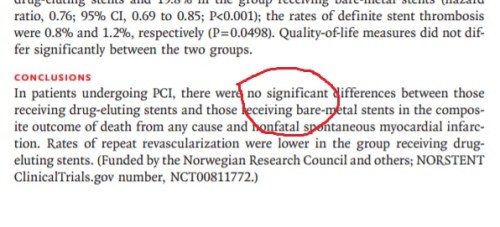
The DES industry was (is) so powerful it could easily shrug  the challenge of truth that came out briefly  in early 2000s when DES got hit with increased  acute complications.

Now, in 2016 NORSTENT study again showed us BMS is as good as DES in all walks of CAD.  Let us see what happens , still  its very unlikely mature cardiologists do not trust BMS.

*I have a belief  (Paranoid or not time will tell !) one of the reasons  DES are strongly promoted  is to sustain DAPT market alive and kicking for a long haul !

Scenerio  in India is frightening.

While the developed countries have DES usage rate around 65 % , India leads the world with DES constituting 95% (NIC registry 2017) of all deployed stents.What a way for a poor country  to  tackle CAD , which doesn’t even have prompt prehospital Aspirin for  bulk of their ACS patients, ready to waste  its resources in DES.

India , a country Infested with an unregulated health industry  became the perfect battle  ground for abusing the stents. With direct collusion with the large hospital managements the issue got exploded recently  .The Govt was compelled to come out with urgent restrictions and price control  in the use of stents.

Funny world this. World’s richest economies  are worried about the cost and want to phase out inappropriate therapy whenever possible, its absolute arrogance most of us feel shamed to keep BMS in their cathlab.

Final message

A  good metal based flexible ,trackable , thin struted  BMS should be the default choice for coronary stenting .( We used have one , now it vanished !)It avoids unnecessary prolonged DAPT .Most importantly one BMS costs 25 % of the cost of DES   . . . think of 4 critical proximal LAD lesions of a poor man can be fixed at the cost of one DES , that’s  definite way forward. Govt of India can pass another regulation in this regard. If you think  NORSTENT is NONSENSE  let us atleaset  insist for a large scale Indian  study for BMS /DES and  Cardiological society of India has much work to do !

Future for BMS  . . . looks bright !

While the  superiority  of DES is being increasingly questioned , the concept of surface modified BMS is being tested .This I believe is a face saving way to bring back the BMS in lieu of DES. There is a distinct  possibility of many of the new generation  DES going the BVS way in the near future.

Reference 

1.Hassan AK1, Bergheanu SC, Stijnen T, van der Hoeven .J Late stent malapposition risk is higher after drug-eluting stent compared with bare-metal stent implantation and associates with late stent thrombosis.Eur Heart 2010 May;31(10):1172-80. 

2.Zhang K1, Liu T, Li JA, Chen JY, Wang J,   Surface modification of implanted cardiovascular metal stents: from antithrombosis and antirestenosis to endothelialization.J Biomed Mater Res A. 2014 Feb;102(2):588-609.

3. https://www.pcronline.com/eurointervention/114th_issue/volume-12/number-17/350/ultra-hydrophilic-stent-platforms-promote-early-vascular-healing-and-minimise-late-tissue-response-a-potential-alternative-to-second-generation-drug-eluting-stents.

4.Drug-Eluting or Bare-Metal Stents for Coronary Artery Disease NORSTENT Investigators N Engl J Med 2016; 375:1242-1252

Post-ample : Only For non believers  ( who think this article is near rubbish ) 

I am  very much  convinced DES should be superior  for the simple reason it elutes a drug and the whole world believes it works !

Do you know, what these drugs do, and what they are expected to do ! In this elegant study  by Hassan AKEur Heart J. 2010 May;31(10):1172-80.  Its proven with IVUS , DES is many fold likely to cause late stent apposition than BMS.( Thus carrying the risk long term )  Reason is simple , patchy and incomplete endothelisation on the luminal side and pathological metal vessel wall interface  in abluminal promoting late mal-apposition.

True patients* present with symptoms , please , don’t ever think all your patients  bring their coronary artery for general servicing !

Ofcourse , we are the service provider to our patients . Though  heart is a mechanical pump it can never be considered equivalent to automobile engine .

For a Heart service station equipped with 24/7 lab,  the benefits may be  more if you treat the angiogram rather than the  patient.

Let us not misunderstand the word service , please show restraint, your patients will thank you forever.

* Silent significant CAD are indeed a problem in minority that requires selective wisdom.However, we can’t be aggressive hunters for CAD in population, as there is huge cost for human hunting !

Reference

Recent article which debates the issue of PCI in CTO
http://circ.ahajournals.org/content/135/15/1382?etoc=#sec-1

Coronary artery lumen has unique character . Its well-known  LAD diameter is not constant , it tapers in its distal course.(Unlike RCA which is more tubular ) It is estimated LAD looses 15 % of its diameter for every 30mm length.Fortunately LCX has no such long course to make tapering a visible threat. (Though it may still be an Issue !)

Is there a hemodyanmic purpose for this tapering in LAD ?

Should be, God never designs anatomy without a physiological purpose.We have to find it  out.(Can it be meant for  flow acceleration as the flow is entriely diastolic in LAD while in RCA its both in systole and diastole ?_

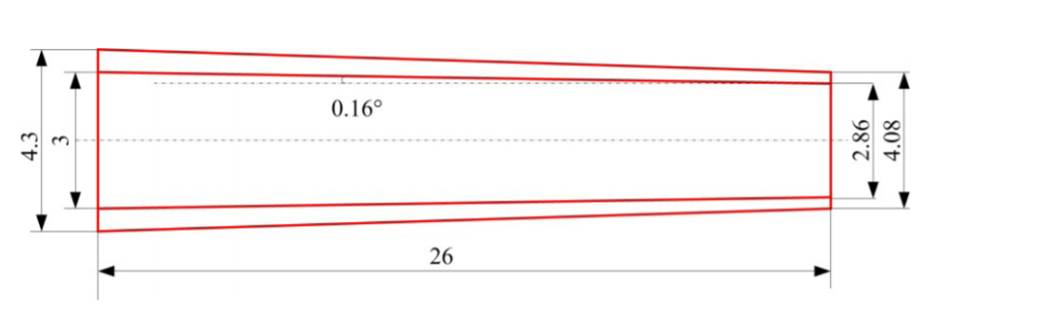
What is the relationship between tapering angle and final distal diameter?

Schematic of an artery with a tapered angle of 0:16 .Ref XIANG SHEN Journal of Mechanics in Medicine and Biology Vol. 16, No. 8 (2016)

So, if you have a long lesion in proximal LAD and planning to stent with a 40 mm or long  stent the distal end is hyperinflated by atleast 1.5mm, if we use a non tapered stent. Though , gain of extra  diameter  in distal segments might appear attractive, this may not work to our advantage , since it defies and distorts  the natural hemodynamic flow pattern. Further , when you have tapering vessel, proximal optimisation becomes more important.

How about a tapering coronary stent ?

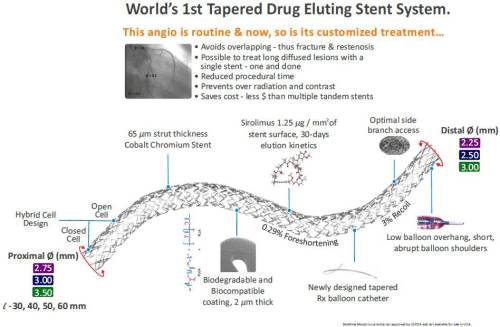
It should be a welcome addition to our already overflowing coronary hardware in fixing long lesions . Its still a surprise why only very few are making this type of stent.

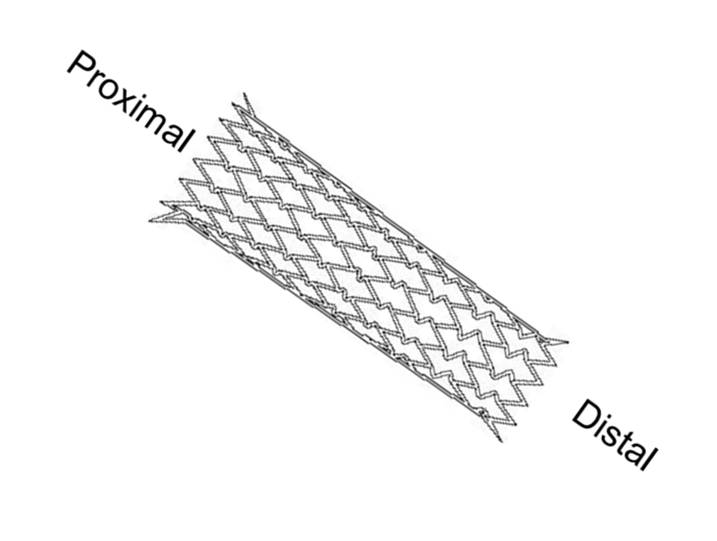
Meril has developed a  tapered stent up to 60 mm long  (Biomime morph).It should be useful in specific lesions sub types.Its worthwhile to note  tapering stents are used more often in carotid artery .

Advantages of long tapering stent over two stents of different sizes.

  • It avoid the vulnerable overlapping zone with double metallic load.
  • Possibly cause less restenosis
  • Low risk for stent fracture
  • It reduces procedure time and of course the cost of stent by 50 %

Why the concept of Tapered stent is not that popular ?

I can only guess, probably lack of free availability and  to a certian extent ignorance as well !  However ,current status about tapering stents is expected to evolve, though many cardiologist still  feel it’s not clinicaly important issue to use a tubular stent in tapering vessel.

Alternative  interventions in tapered vessel.

  • Wall stent and other self expendable stents
  • Tapered balloon Angioplasty (Laird Am Journal of card 1996)

Experts  in this modality are  welcome to share their experience.

Reference 

1.Zubaid MC, Buller C, Mancini GB. “Normal angiographic tapering of the coronary arteries”. Can J Cardiol 2002; 18: 973-980

2.Timmins LH, Meyer CA, Moreno MR, Moore JE Jr. “Mechanical modeling of stents deployed in tapered arteries”. Ann Biomed Eng 2008; 36: 2042-2050

3.Javier SP, Mintz GS, Popma JJ, Pichard AD, Kent KM, Satler LF, Leon MB. “Intravascular ultrasound assessment of the magnitude and mechanism of coronary artery and lumen tapering”. Am J Cardiol 1995; 75: 177-180

4.Laird JR, Popma JJ, Knopf WD, Yakubov S, Satler L, White H, Bergelson B, Hennecken J, Lewis S, Parks JM, Holmes DR. “Angiographic and procedural outcome after coronary angioplasty in high-risk subsets using a decremental diameter (tapered) balloon catheter. Tapered Balloon Registry Investigators”. Am J Cardiol 1996; 77: 561-568

5. YONG-QUAN DENG, ZHONG-MIN XIE and SONG  ASSESSMENT OF CORONARY STENT DEPLOYMENT IN TAPERED ARTERIES: IMPACT OF ARTERIAL TAPERING XIANG SHEN*, Journal of Mechanics in Medicine and Biology Vol. 16, No. 8 (2016) 1640015 

Improper or technically deficient stent deployment is a major factor for post stent events .Few terminologies are used in assessing stent deployment.

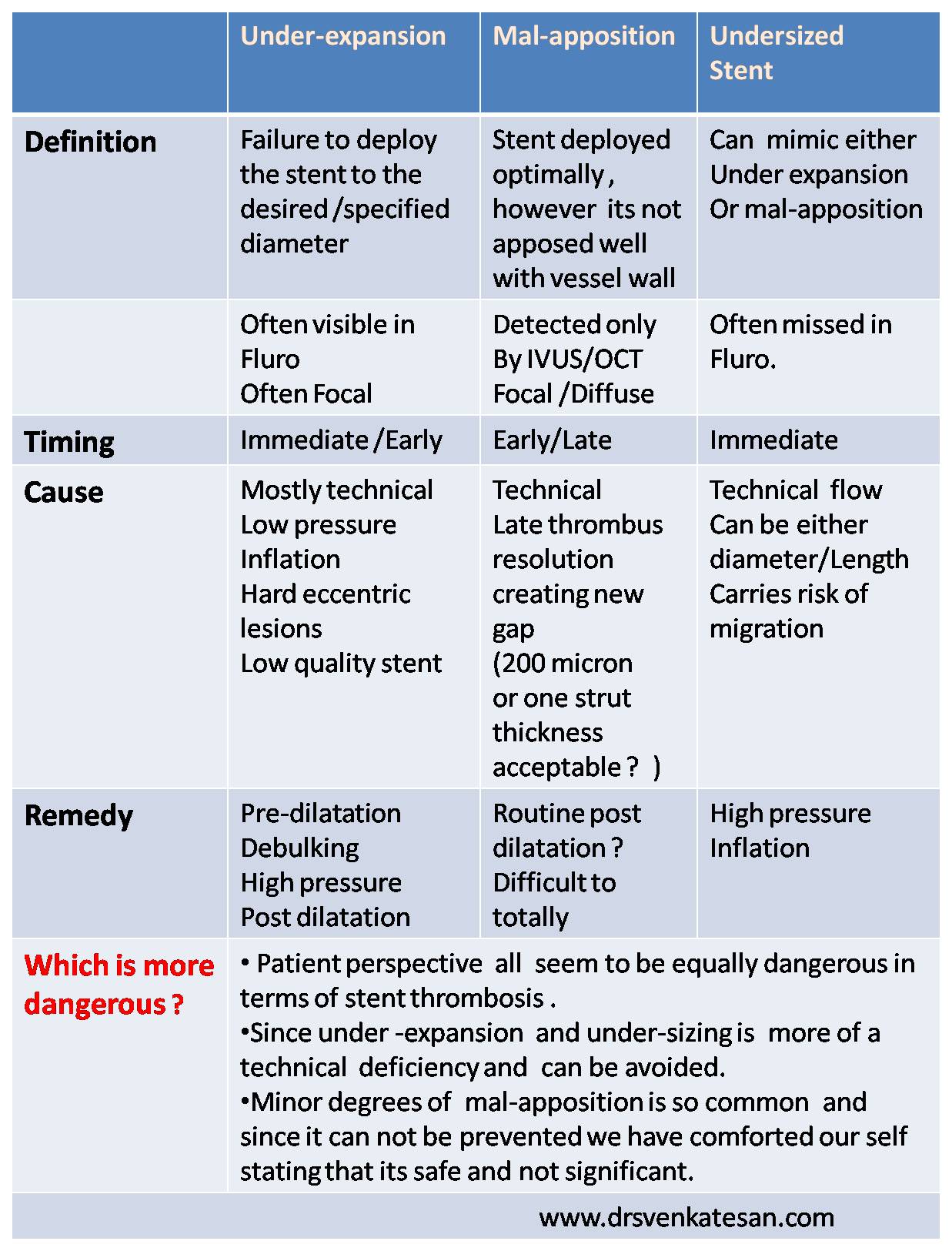
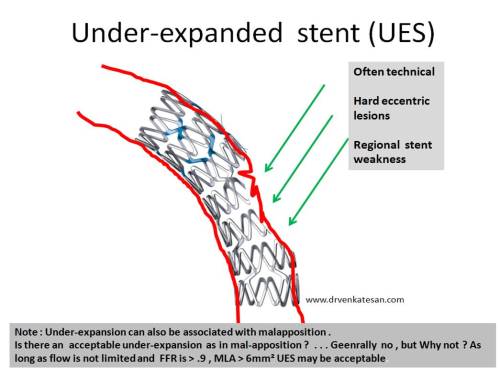
Under expanded stent (UES) 

A stent is not fully  expanded to the desired or to its specified diameter.

This is often due to inadequate balloon pressure during inflation .

Many times its technical and It requires post dilatation.

Under-deployed stent is  often  due to a struts hitting a  hard surface or calcium .

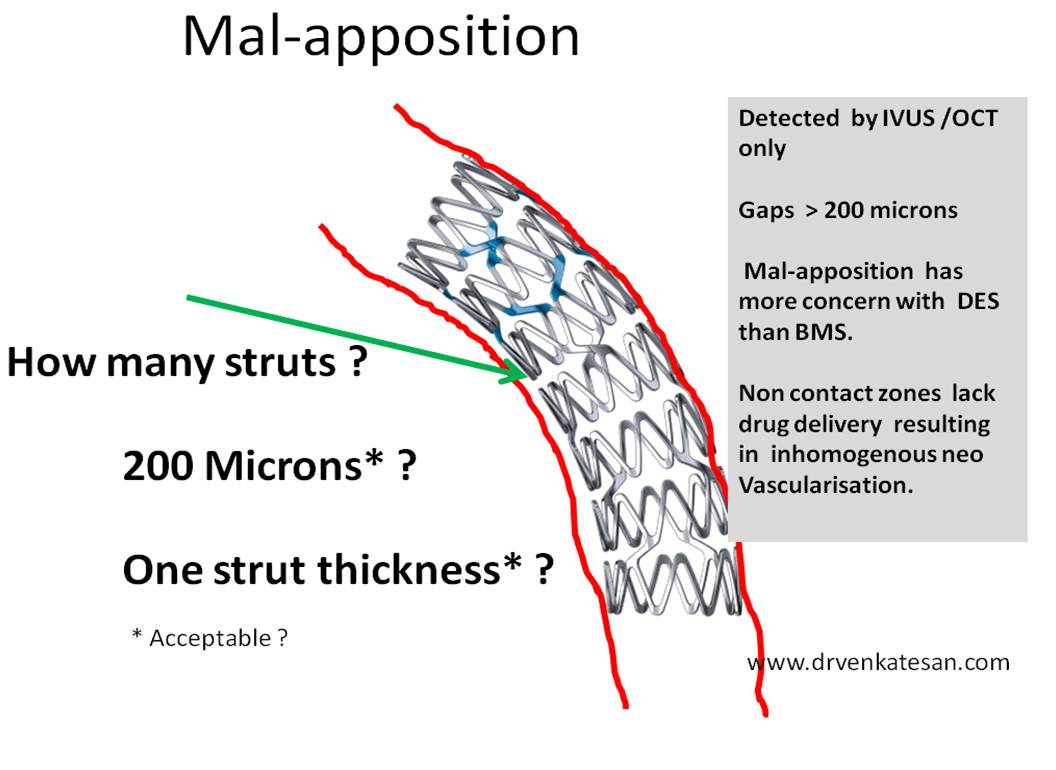
What is mal-apposed stent  ? (MPS)

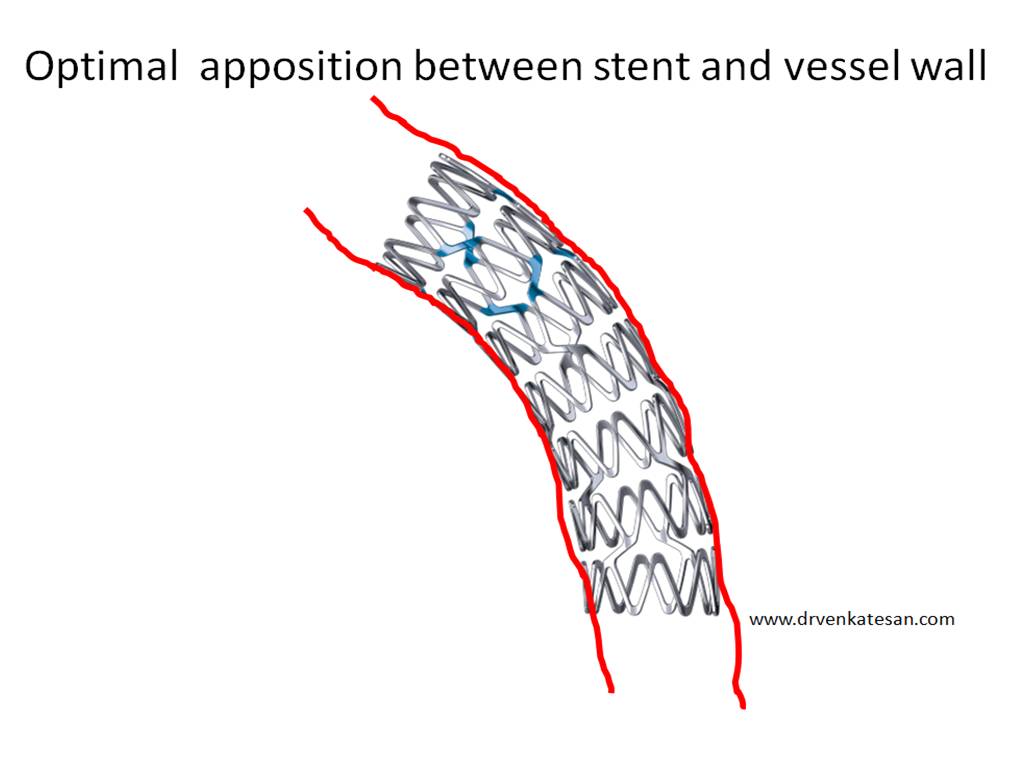
It’s a fine gap between the vessel wall and the stent.

It can be observed immediate or late. Immediate is usually due undersizing of stent.

Intermediate or late malapposition  can be due to many  reasons

  1. Due to dissolution of thrombus in the  vessel stent interface
  2. Positive vessel remodelling creating new gap between vessel wall  and stent remodeling
  3. Vessel wall regaining vasomotion and  ? ( Is it the culprit with bio vascular scaffold)
  4. Stent rejection hypersensitivity and inflammatory reaction is a rare possibility.

What is the acceptable mal-apposition ?

No stent deployment is perfect . Mal-apposition can be focal confined to one or two struts or can be diffuse . (Branch vessel are naturally malapposed)Doing a routine OCT /IVUS is inviting trouble as no cardiologist can sleep in  comfort even after a reasonably good procedure.So we have created a safe  dead space with a width of 200 micron as an acceptable mal-apposition  (As if , the 7 micron RBCs and 2 micron  platelets can’t  get trapped in this dead space)

Is routine post-dilatation the  answer for all  mal-appostion?

Not really , still It is most logical step. Liberal post-dilatation  can be a problem as it may increase plaque prolapse and may re-release or dislodge  the  thrombus trapped during the initial expansion and triggering a no- reflow.

Undersizing vs underexpanded stent

Selecting a smaller stent for a given vessel diameter is another common error that result in MPS. This again can be tackled(Though not ideal)  by high pressure inflations.

under-expanded-stent-vs-malapposition-post-dilatationstent-malapposition-vs-underexpansion-mal-apposition-under-expansion-ivus-oct
under-expanded-stent-vs-malapposition-post-dilatation-200-microns

under-expanded-stent-vs-malapposition

Is self expanding stent best option for preventing mal-apposition ?

May be.It has more radial strength, and it is expected to take care of the current and possible  future gaps of created by positive remodeling.

Other stent related issues 

  • Plaque prolapse
  • Stent edge dissection
  • Longitudinal miss
  • Stent fatigue and fracture

Final message 

UES and MPS , though discussed separately by cardiologists , from the patient point of view , the difference is  camouflaged in technical semantics since both carry risk significant risk of recurrent ACS or restenosis .It has become fashionable to believe one needs to  be worried more about visible UES than invisible MPS.

Reference

Bifurcation  angioplasty is a  newly conquered(Or not yet !)  target  for Interventional cardiologists.We have come a long way  in planning  interventions  for left main  with state of the art  hardware, expertise and  image assistance .However , every  classification , approach, strategy  for BFL talks about tackling the main and  side branches meticulously.

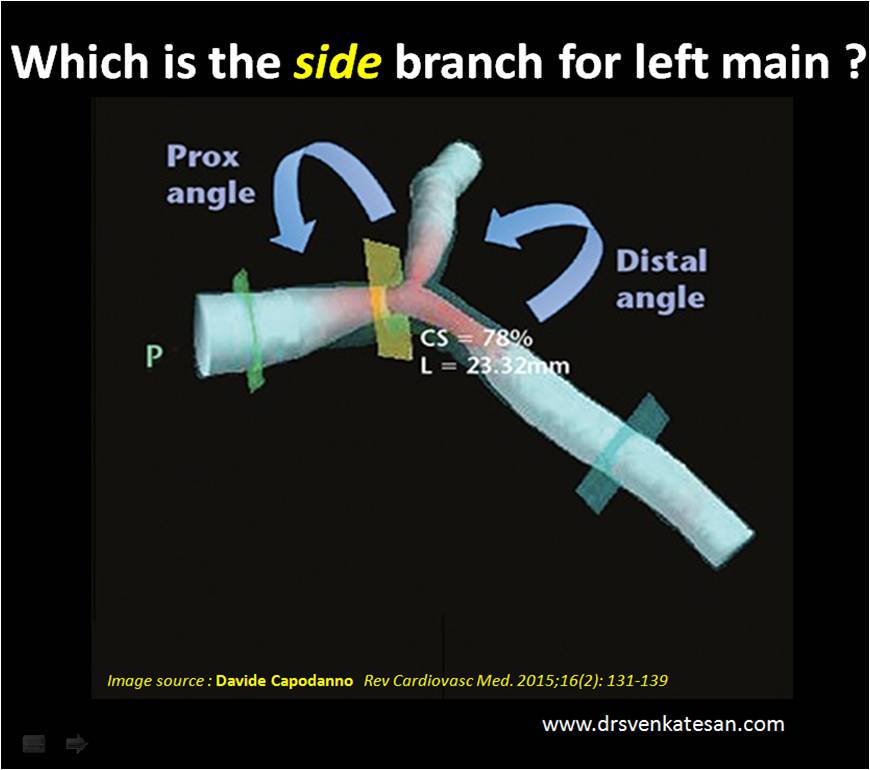
Still . . . one question  is not answered clearly is  . . .

A mini MCQ.

Answer: Open for contribution.

My inference

*It all depends upon the Indication and Individual arterial ischemic burden. In ACS, if  LAD territory is infarcted and beyond 24 hours.LAD becomes a  side kick to the vital LCX which supplies  the remaining life sustaining myocardium which includes the critical basal segments.

Final message 

Since , the risks involved in the interventions of  left main and its bifurcation is inherently linked  with , what exactly we mean (and do ! ) to the side branch .Its mandatory we spare few intellectual moments before our hands invade the coronary battle zone.

Here is an Interaction between  a ER physician  and a cardiologist !


“I should say I am happy for this cartoon cardiologist , It at least thinks , verifies ECG . . . and resists entry for a dubious STEMI to cath lab ”


It has become fashionable for many current generation cardiologists to stent the LAD   with proximal end  liberally extending into left main shaft  in Medina 0, 1, 0 or (1,1,1 )lesions involving distal left main often  jailing the LCX . This concept came into vogue as it helped bail  out few  hemo-dynamically  unstable patients with true left main bifurcation lesions during primary PCI .Of course , it’s potentially useful strategy in  emergency , if  extended into routine situations (like all stable proximal LAD/Bifurcation ) we are bound to create few problems.

the-only-thing-more-dangerous-than-ignorance-is-arrogance-quote-1

Rapidly protecting the left main with a long single stent down into LAD is an easy way out for tackling distal left main /LAD combined lesions.  Conceptually it asks you to forget the LCX outright.(Coronary outrage for some to call LCX as  a side branch of left main ! ).Of course, one can reconstruct the LCX  ostium by other means or a second stent if required.

Final message

Conquering  left main disease  with a long stent right from its origin or mid shaft to  LAD (Some times  from Aortic ostium ! ) may be an  interventional pride for the cardiologist. But , in no way it  imply we have crossed the  final frontier in LM disease.In fact,  putting a left main coil is the  easiest task among all  PCI since there is little expertise required to cross the lesion .Maintaining its patency   medium  long run and thus beating the CABG  is  true achievement  ! Achieving  an acute patency  of left main and wheeling out the patient live from cath lab can not  be reason for permanent rejoice ! One should realise his life is at the mercy of DAPT and its pharmakinetics which we know can be unpredictable !

“Protecting the patient is more important than a protecting left main” 

Just because a technique is easy to accomplish it doesn’t confer the right to misuse it .The argument “my patient” is doing fine with this type of stenting  is not an appropriate way of justification.