Feeds:
Posts
Comments

Less than a century ago an easy chair  was enough to manage this most important medical emergency of mankind. Of course, at that time mortality of STEMI was estimated to be around 30%.We have since pushed the in-hospital death rate down to less than 10 %  and its around 5-8% currently.(*The lifeless chairs were able to save 70 lives is a different story!)

Heparin , thrombolytic agents, critical coronary care has helped us to achieve this , of course It must be admitted primary PCI also played a small role (at best 1 % ) in our fight against this number one killer.

Now, why not combine  both lysis and PCI ?

The concept of PIA (Pharmaco Invasive approach) came into vogue  primarily for two reasons.

1.If thrombolysis and  pPCI are powerful strategies by individual merits why not combine both and achieve double the benefit ?

2. Since pPCI is going to be a logistical nightmare in most points of care and we can’t afford to lose time . So, let us lyse first and consider PCI later !

Unfortunately medical science is not math .One plus one in medicine is rarely two !

Though , it looks attractive , Pharmaco invasive approach  has its own troubles.Fortunately , most of them are man-made, few are beyond our knowledge though.

Following general rules  may help us

  • STEMI  should ideally managed by early thrombolysis (or PCI) in all deserving patients.
  • Don’t wait for PCI if you think , there will be delay or reduced expertise and poor track record of the center in this modality.
  • Pharmaco invasive  therapy is not a default in all STEMI .Do good quality , monitored  lysis , (Not necessarily new generation thrombolytic .(I prefer one hour sustained thrombolytic regimen , not the hit or miss bolus) .As a learned cardiologist we need to assess individual patients according to the type and risk of MI.Its not wise to blindly follow the guidelines ,because these guidelines , though based on evidence never answers a query in a single patient perspective !

The key “branch points”  in decision making  after lysis

  • Invasive strategy  should begin within one hour if the patient has failed  thrombolysis and has developed any mechanical issues.( Mind you, LVF requires good medical stabilization .Rushing  such patients to cath lab without application of mind can be disastrous )
  • If the Initial  lysis is excellent and the patient is asymptomatic  one need not proceed with invasive limb at all.(A significant chunk of apparently failed lysis by ECG are asymptomatic and comfortable , these are patients require delicate assessment regarding further intervention. )
  • If the MI is large and the clinical  stability is “not confirmed” one may  proceed urgently within 24 h.
  • In any case there is no role for invasive approach after 24 hours* Unless fresh ischemia  suspected to come from IRA or  non IRA.
  • Having  said that, there are many centers that do a diagnostic  angiogram alone just prior to discharge  (48-72h) for risk stratification and then take a genuine call for a possible PCI or  CABG. In my opinion it appears a sensible strategy , though a non invasive stress  test pre/post discharge can even avoid that  coronary angiogram !

One issue with Rescue PIA

Though by current definition  PIA is to be done  3-24 hours , don’t wait for the 4th hour if you have recognized a failed thrombolysis earlier than three hours.( Ofcourse , as the gap between P and I gets too narrowed it may  carry some adverse  effects witnessed in routine facilitated PCI -Refer FINESSE study ) Similarly,there need not be a blanket ban on PCI beyond 24 hours if residual ischemia is active.

Final message

PIA is a dynamic  coronary  re -perfusion strategy . Nothing is fixed in science. . The optimal gap between Pharmaco and invasive strategy  can be anywhere between  1 hour to “Infinitely deferred” depending upon individual risk perception and wisdom of the treating cardiologist.


I


It was delicate few minutes  in one of  my recent  visits to a corporate hospital , when I noticed an emergency physician  hesitated to follow my advice to  prescribe IV Digoxin for a patient with  Atrial fibrillation and fast ventricular rate.His fear was, his consultant, a modern day cardiologist wouldn’t like it as Amiodarone has become a default drug for atrial fibrillation in that Institution. I could sense. . .he felt so out of place to take on my suggestion.

I reminded the young physician , the uniqueness  of  Digoxin and its  un-diminished value for this particular indication ,still he was reluctant and didn’t oblige.

I realised , it was my mistake to expect  a place for the humble fox glove in corporate crash-carts of centrally climate controlled  cardiology suits !

“Medicine need to be practiced   not only with best science(Truth) but also in a holistic and  cost efficient manner . There is no place for glamor, glitter  and commerce in your prescriptions !  In near future , teaching Medicine to students would  essentially  become  “more of moral” than “science” .

Reference

Link -Which is the best combination for rate control in Atrial fibrillation

medical ethics stastistics www.drsvenkatesan.com

One casual question in my class led to this search for an anatomical mystery. When we were discussing why left atrial oxygen saturation never reaches 100 % ? , it was attributed to desaturated bronchial venous blood draining into pulmonary vein.

How does this bronchial vein enter pulmonary venous circulation ? How many bronchial veins are there ? What anatomical plane it runs ?

Surprisingly, even in this hi-tech era of academic excess, literature is sparse for this basic anatomical question. It is reported (In Greys anatomy ? ) Bronchial veins are two in number and both drain to Azygos and Hemiazygos veins (systemic) rather than pulmonary veins.

So is our assumption wrong ?

May not be.We realise these are only two visible and named bronchial veins .It is learnt they probably carry only about 13 % of bronchial venous blood to systemic venous circuit.

bronchial venous drainage bronchial circulation

Image showing right and left bronchial veins draining to Azygos and hemiazygos veins.

It is assumed , remaining 87 % of bronchial venous blood drains to pulmonary venous circuit in an invisible fashion (By unnamed twigs ?) desaturating the LA blood by about one percent from 100 to 99 %. This is our current understanding. I haven’t come across any specific human research that quantifies the bronchial venous channels and it saturation . It’s gratifying to find one study specifically looked answer this question in sheep study .(Charan H.B et all Reference 1 )

where does bronchial vein drain drainage circulation pulmonary vein saturation

True physiological bronchial venous drainage seems to be different from anatomical bronchial venous circuits .

Clinical implication of bronchial venous circulation.

In physiology it may not be important . However bronchial circulation (both arterial and venous) can take many anatomical tracts when pulmonary micro vascular bed is structurally and functionally altered as in COPD, , pulmonary atresia with aorto-pulmonary collaterals , congenital left to right shunts,post Fontan circulation pulmonary AV malformations,lung tumors etc .

Hemoptysis in acute pulmonary venous hypertension is thought to be due to rupture of these bronchial veins as elevated pulmonary venous pressure reflect into bronchial veins (As in mitral stenois and other conditions. ) This again would vouch for bronchial veins draining to pulmonary veins.

Final message

As on today , it can be concluded bronchial vein drainage goes both systemic and pulmonary venous circuit.Bulk of them appear to end in pulmonary veins though clear anatomical evidence is lacking.

Postamble

Exploring human anatomy appear a grossly unfinished agenda even today, especially the micro and histo-anatomy. Teachers of basic sciences should impress upon youngsters entering the medical school to pursue translational research relevant to specific clinical problems.

Students may contact <drsvenkatesans@yahoo.co.in> for specific areas of clinical cardiac anatomy topics that still requires answers.

Reference

We know, atrial fibrillation is the commonest clinical cardiac arrhythmia , that is extensively studied , subjected to exotic investigations and state of the art treatment strategies.Interestingly , this arrhythmia also drags the economics of cardiology practice of a community in a big way with heavy influence on drug , device and usage.We know, RF ablation of pulmonary vein is one of the modern ways to manage this arrhythmia.

Iam sharing this article from medscape by an EP specialist Dr. Jhon Mandrola , surprisingly exposes our fundemental ignorance about this arrhythmia and the near futility of certain procedures.

http://www.medscape.com/viewarticle/865209?src=WNL_infoc_160625_MSCPEDIT_v2&uac=44538BX&impID=1137861&faf=1

Scientific cardiology has forced us to believe ACS management must be catheter based and all others are inferior  and  those who pursue the later , carry a risk of  being labelled as unethical in near future. However ,experienced cardiologists will know  where the truth lies.

Now,in the interventional cardiology board rooms  there is a big  debate going on regarding the value of early total revascualrisation in STEMI with multivessel CAD.Suddenly , every lesion looks suspect ( Ex,current or future culprit ! ) and all stentable lesion are stented  either in an emergency or semi emergency fashion (The new age post PCI dialogue goes something like this “I have tackled one culprit , other one seems to hide in LAD ,  we will arrest it  next 48 hours or so* ? ( This is the concept of  deferred or staged  non-IRA stenting )

*Ironically it brings   one more dubious therapeutic time window in ACS !

ptca ira non ira multivesssel pci

The recent  studies like  PRAMI, PRIMULTY ,CvLPRIT are trying to find out an answer to this issue  and suggest acute multivessel PCI may be  good strategy. Some of them advocate a FFR guided non IRA intervention , knowing fully well micro-circulatory bed is completely altered by the index acute thrombotic event.( Mind you , for FFR,  we need to induce maximum hyperemia with Adenosine in a highly varying local autonomic milleu within the thrombus clogged capillary network)

Final message ( Intentionally biased !)

Till we learn or unlearn  it is vital to go with conventional wisdom.Don’t pursue a random hunt for coronary culprits in acute phase of  STEMI.Many of them are innocents and likely to suffer in cross fire.Tender coronary arteries need some rest,peace and time to heal thyself  . Just keep away , they will definitely say big  thanks with folded hands !

Reference

1.Gershlick AH, Khan J, Kelly DJ, et al. Randomized Trial of Complete Versus Lesion-Only Revascularization in Patients Undergoing Primary Percutaneous Coronary Intervention for STEMI and Multivessel Disease: The CvLPRIT Trial. J Am Coll Cardiol. 2015;65(10):963-972.

ICDs are revolutionary devices in the management of patients at risk for electrical sudden death .Its is indeed a boon for patient’ s with a primary electrical disease with occasional risk for VT.

Unfortunately , the usefulness of ICD in patients with severe mechanical dysfunction is marginal at best as these patients succumb sooner or later inspite of ICD, especially if the episodes of arrhythmia is more.

This is understandable as electrical events are directly linked to primary mechanical problem and one begetting the other.Of late , we realised these patients require some methods to stop the arrhythmia generation in the first place rather than terminating it after it manifest.

ICD may be great devices but it simply does nothing in preventing an episode VT.It trys to battle the fire after its ignition.Not a great concept to be pride upon.At best it can be called as back up safety device.So , for long term therapy it seems we need additional support system to ICD .

This can either be RF ablation or medical therapy (Amiodarone ,Sotolol, Mexiletene).It is likely , intensive anti -arrhymic therapy is essential in most.In some patients all three modalities(ICD, RF ablation, drugs) will be required for complete protection.

The VANISH trial has added important data on this issue .

http://www.nejm.org/doi/full/10.1056/NEJMoa1513614?query=OF

We all know to err is human , but most of us probably won’t agree medical mistakes , (bulk of which happen in the name of practicing state of the art of science ! ) could be the dominant theme in modern medical care !

BMJ exposes this  well known secret with the help of most authentic data from an apex scientific body CDC , Atlanta .

Reference

http://www.bmj.com/content/353/bmj.i2139#

Bifurcation lesions (BFL) remain a true challenge to interventional cardiologists. For over two decades , at least a dozen strategies are being tried to conquer it without true success . . . if iam allowed to say that.

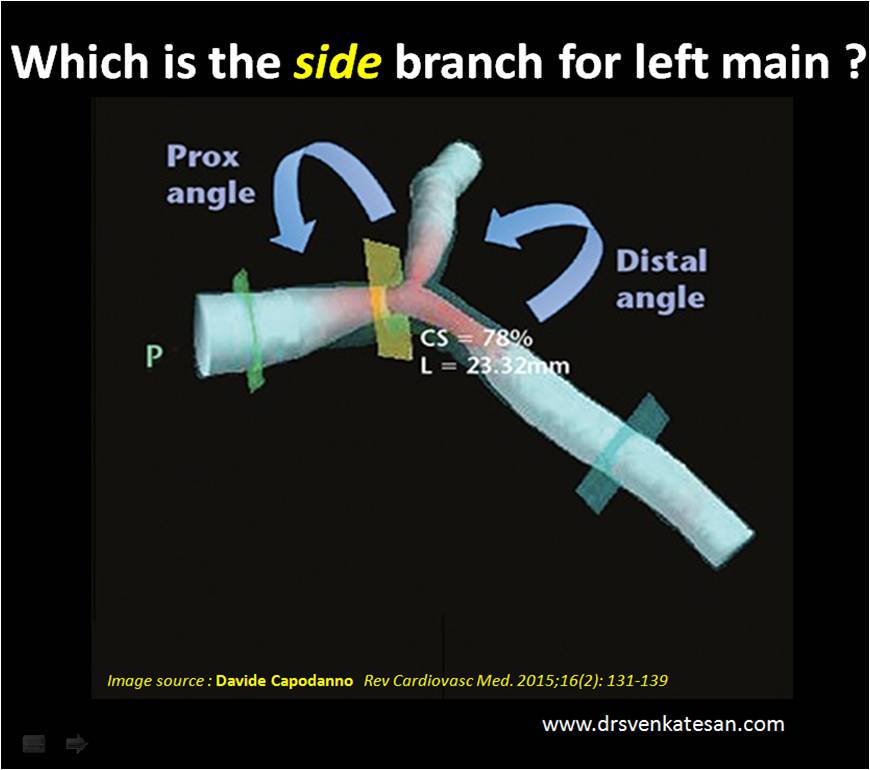
We often talk about side branch in BFLs.Ironically , the importance of side branch is largely determined by our cortical linguistic perception of the word “side”

The much famed Medina classification does little to clarify the importance of side branch with reference to left main vs non left main bifurcation lesions.

In true sense , both LAD or LCX can be side branches in left main BFL depending upon how one views it.
Commonsense would tell us, since LAD is a major vessel , LCX gets the side branch tag by default.

However, If LAD is diminutive, or its serving a infarcted , non functional zone and if LCX is really big and dominant, it has every right to reject the humiliation of being refered to as a sidekick.

Note , in non left main BFL there is no much confusion since main branch continues as main and side branch just exit.

Final message

Interventional cardiologists use the term “side and main branch ” in variety of ways .Though, it could mean vitally important things , oftentimes its simply semantics prevailing over complex coronary hemodynamics.

There can be no debate to call diabetes as major cardiac risk factor . But , how about calling all diabetics to be deemed (Rather doomed ) to suffer from CAD and label them  with a fanciful terminology as CAD equivalent ?

This is what happened few years ago.From the beginging it was a controversial concept. The argument in favour of it was , many diabetics will have micro or macro vascular disease  process in coronary or peripheral disease which are sub-clinical .One major   study from Fiinish population  in (NEJM 1998 ;Ref 1 ) suggested this possibility and was dissiminated without proper scrutinty . The same Finnish group ( I need to confirm this as few authors are same in both studies !)  has comeout with 18 year old data (1998-2016 ) and conclude their earlier conclusion could be wrong after all (Reference 3 )

Premature conceptualisation can be rampant and crucial time is wasted in unlearning. This emphasizes an important aspect of medical learning what I call as “discontinuing medical education” (DME) that would make sense in the future for sure !