Feeds:
Posts
Comments

Holter monitoring is the Initial test for all those with documented  syncope (or Pre syncope ) with suspected cardiac arrhythmia .It is a 24 hour ambulatory  ECG monitoring , expected to pick up any electrical abnormality and its correlation with the resultant symptom if any. Though the test looks  attractive , the diagnostic yield is far less. (About 10%) .The reason being the episodes can be rare  to be  missed by 24hr sample time. We have extended Holter (48hr) , Event monitors , Loop recorders and implantable devices that can record ECG for extended periods.(18 Months ,Reveal Plus Medtronic)  that improve the yield  up to 45%.

One common issue that often confuse us  while reporting  Holter is, the  pauses that occur during day / night .

What is the significance of these pauses * ?  Nocturnal vs Daytime

Pauses are obviously significant when the patient is awake . It is generally accepted pauses more than 3 seconds during day time  (ie Heart rate of < 20/mt ) is significant . This is logical , as pauses more than that,  is expected to cause syncope ( or atleast pre-syncope ).The problem comes when you document pauses more than 3 seconds without any symptoms . Then this  difficult  question comes up ,At what degree of pause syncope occurs ? How is that some persons mange  even prolonged pauses with just giddiness.(Good overall vascular integrity and tone ! )

We know such pauses are  especially  common during sleep. How does the brain react when pauses occur  during sleep ? as there is no question of fall as such and loss of muscle tone is non existing.

*Please note ,when we say pause we mean only Sinus pause , Pauses due to AV blocks are very significant

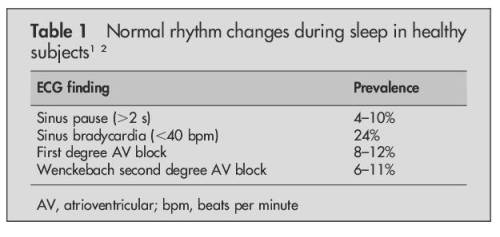
nocturnal pauses during sleep holter

Source : Brodsky M, Wu D, Denes P,et al.Am J Cardiol 1977; .

Dramatic  pauses during sleep do occur

There has been prolonged pauses reported  during sleep without fatality . A 35 second nocturnal pause resulting in seizures has been documented by implantable  recorders.(Mairesse 2003)

Causes for prolonged pauses

  • Sinus node dysfunction
  • Obstructive sleep apnea
  • High dose beta blockers therapy

Final message

 Most bradycardic episodes during sleep are benign.This is due to depressed autonomic control during sleep. Holter interpretation is primarily done with  awake rhythm data in most individuals .So, empirically shall we fix a  5 second pause as significant during sleep ? We don’t know.While this may seem applicable even with structural heart disease , one may be vigilant while interpreting the nocturnal pauses in this population .

Caution

** Please note,  all these rhythm monitoring extravaganza is meant for people  with equivocal symptoms .Patients  with well documented syncope with ECG features suggestive of  cardiac rhythm disorders would never require these tests and go for pacemaker straightaway.

Reference

4.Arrhythmias documented by 24 hour continuous electrocardiographic monitoring in 50 male medical students without apparent heart disease. Brodsky M, Wu D, Denes P,et al.Am J Cardiol 1977;39:390–5.
For Advanced readers
guidelines for syncope nocturnal pause holter

What are the determinants of  dissecting  path   in Aortic dissection ?


Aortic dissection stanford002

Aortic dissection is  taught to us as a dramatic cardiac emergency where the blood  enters one of the planes of aortic wall and travels  in a random way . The wrong way blood instead of flowing within the lumen invades the vessel wall .(Vascular Tsunami ?) It may (or may not) leave the aorta at a distance resulting in various combinations of true and false lumen. Much like a tsumani  its also triggered by an energy releasing  blood pressure spikes hitting on the weakened  aortic wall rupturing the Intima. While acute dissection are often dramatic chronic dissection can be more subtle clinically.

Apart from the site of entry , blood pressure , condition of aortic vessel wall , there seems to be an invisible force that direct the dissecting tract.How it spares or compromises the arch vessels in selected few , as it travels down remain a mystery . If we can predict and track the plane of dissection by any means with computational  hemodynamic models , that will help us plan strategies. Beta blockers are used to reduce the shearing pressure , and emergency surgery is required in many type A dissections.


aortic dissection animation stanford a b classification 002

Do we see a “mini” Interventional opportunity here  ? To arrest or direct the dissecting tracts  into less benign zone. Shall we deploy an emergency  metal ring barrier  just proximal to aortic arch in Type A or  just above renal arteries in type B to prevent vital organ compromise ? This procedure can  be done fast , instead  planning a  elaborate endovascular intervention which is logistically difficult in  arch vessel dissection .This could also act as a bridge to definitive surgery. (Can we compare this with  bush fire fighting which are tamed by c0ntroled artificial fire lines and thus  avoiding spread to residential areas ! )

Preamble * This article is meant  specifically  for cardiac professionals only .There has been so many queries to me about this device Megavac from patients  and public. It is  just another tool for assisting angioplasty in very special situations . Successful angioplasty can be performed without the need for such devices 9 out of 10 times.  I request the non medical readers to skip this article and follow your cardiologist’s advice  and don’t get unduly  anxious.

Dr Venkatesan .Chennai.India

If thrombus is the chief culprit in any vascular emergency  there can be  no second thoughts as it needs immediate  arrest without warrant! (STEMI,Acute pulmonary embolism , DVT, Acute limb ischemia etc) Since pharmacological lysis of thrombus is easy and  be done immediately  it will continue to play a major role still , in many clinical situations that critically compromise organ function .

However , large  thrombus burden  (or in which medical therapy fails to do a good job )  we must  intervene mechanically  to change the course of event.Though vascular surgery is a definitive option its always better we try out catheter based thrombectomy.

Many hardwares are being developed in the recent times. Aspiration catheters, baskets etc * .This  one from vascular capture (Minnesota USA)  appear promising as its a universal capture device that can be  used anywhere coronary , pulmonary or even in deep veins .

Clinical case examples using megavac : Video

*Few  examples of Thrombectomy devices.

1.They can be mechanical rotational devices like Amplatz Thrombectomy Device (ATD) Microvena,  Straub Rotarex (Straub Medical, Wangs, Switzerland) and the Tretorotola Device ( Arrow International, USA) employ a high-velocity rotating helix or nitinol cage that macerates the  thrombus.Disadvantage is endothelial contact with moving mechanical parts.

2.The Angiojet device (Angiojet; Possis, Minneapolis, USA) uses a rheolytic mechanism with possible   less endothelial injury as there is no true contact with endothelium.

3.Ultrasound mediated lyis ( EKOS Endowave (EKOS Corporation, USA) and Omniwave (Omnisonics Medical Technologies,  USA)  fragment with high frequency ultrasonic waves.

Effect of PCI on Long-Term Survival in Patients with Stable Ischemic Heart Disease are just out in NEJM.

The results are as expected !

“Let us get more Courage , to say no when we want to say no !”

Reference

http://www.nejm.org/doi/full/10.1056/NEJMoa1505532?query=TOC

These are the common ECG terminologies with which clinical cardiology is being practiced over the years .In this era of instant interventions the exact meaning for these terms  may not matter much for many of us.Still , Ischemia could denote a more benign connotation , while injury suggests an emergency (like an accident) .Of course , this is a dangerous way of defining them. Still, there may not be an entity called  “chronic injury”. while chronic ischemia is all too common.

Logistically , both could  mean the same (except the perception) and related to the intensity of the index reduction in blood supply to the varying thickness of myocardium.While injury is diagnosed by ST segment elevation , ischemia is diagnosed by ST depression  or T inversion.

No, its wrong , come again please ,

Shall we say . . . most injures are ST elevating  while most ischemia are ST depressing , but  still injuries can be ST depressing  as well.  We know Ischemia can be sub-endocardial , transmural or  rarely sub-epicardial ,while injury can either be sub-endocardial or subepicardial (Rarely transmural ?)

Can you refine it ?

Only  subepicardial ischemia(Injury)  elevates  ST  segment while sub endocardial ischemia depress it.The leads facing the affected subendocardial and epicardial surface will determine whether its going to be ST elevation or depression .

Go further,

Does the opposing sub-endocardial and sub-epicardial forces negate or  cancel out  ? If so what is the status  of reciprocal ST depression in STEMI if remote ischemia occurs in sub-endocardial  or  sub-epicardial zones ?  Can there be reciprocal ST elevation for primary ST depressive forces ?

If ischemia and Injury are to be defined only with reference to ST segment , which area of myocardium is linked to  critical T wave ischemia (Both Tall T and dynamic Wellens type T )

Still more , If Injury is  represented by ST elevation,  then what represents  infarct ?

ST elevation in acute MI-STEMI is actually due to  transmural* injury while infarct is represented by Q waves in strict sense.In that case not all acute STEMIs are not true Infarcts.Thats why many STEMI can get totally aborted with zero LV dysfunction and negligible enzyme release.  (Should we call these as Non Infarct STEMIs ?)

*Though STEMI results in  transmural ischemia , it is the sub-epicardial zone of injury that elevates the ST segment. This  implies any degree of subepicardial injury is suffice to elevate ST segment (eg pericarditis) and transmurality of ischemia is not mandatory.

What is reversible vs irreversible Injury ?

If irreversible injury is equivalent to infarct , reversible injury is same as ischemia ? (Whats the histopathological  correlates , Cell swelling, mitochondrial / nuclear death .(We know , enzyme release are  linked to cell death even in  chronic stable angina )

Where is the epicardium  for the IVS ?

Most ACS involve interventricular septum .In this case does septum has  any defined sub-epicardium or endocardium? How does septal STEMI forces behave with reference to partial or full thickness septal  infarct ?

Final message

Acute Ischemia and injury can mean “one and the same thing” or  “totally different” entities  depending upon  the totality of obstruction within the coronaries and  sparing of  sub epicardial zones of  myocardium. In my view , any acute ischemia can be labeled as injury.Bifurcating ACS into STEMI and NSTEMI has largely removed the embarrassment of these entities .

Be grounded

Forget the basic science , electro-physiological concepts can wait.Lets live in a realistic world. Get to know the underlying lesion . What can be done for it ? Go ahead , wheel your patient to cath lab . Alert the staff .Be pragmatic ,make sure your patient has sufficient insurance coverage to open up  all his blocks ! That’s it !

Postamble

The intention is not to confuse the readers.Only to make us realise ,the gap in  basic science is “huge and wide” which I hope is  filled up by the generation next !

There is something to understand in the movement of dissection flaps with reference to incoming coronary blood flow.Why some dissections dangerously escalate and totally occlude within moments while some others seal spontaneously ? Though uncommon ,  retrograde dissections has some unique hemo–anatomical property .

dissection flaps antegrade vs retrograde


benign dissection no flow limiting self sealing

This year’s Noble prize for economics was conferred  for Dr Angus Deaton  from Princeton,  for an unique revelation, that measurement errors in economic indices such as estimation of poverty and nutrition levels in society  is real and huge .

The crux of argument (My version )  could be , data collection errors , planning with that contaminated data , sets in a chain reaction , that sustain a flawed intellect in young researchers , which  ultimately leads to human beings becoming  victim to their own  data . While Deaton addressed this in economic issues,  one can guess how critical these errors could be , when  one deals with a  continuously variable  biological parameters .

Every day , medical professionals are confronted with  diverging data measured with dubious methods. Measuring health as quantifiable semi mathematical parameter itself is intrinsically flawed , unfortunately this is the only way we can do it as of now.

If  logical extrapolation is the accepted norm and poverty is the most prolific disease  of humanity  (coded in ICD by WHO) its obvious Deaton’s work will have tremendous impact on medical science than any  other field .

As a cardiologist ,I struggle to understand for the past 30 years  , why we need to work towards a goals of  reducing few mmhg of blood pressure  (or few mg of LDL ) in elderly population knowing fully well the evidence for which is  soft with questionable end points. It  appears some times comical , when healthy people who are not taking these medicines in poor countries  are labelled as medically deprived ! by certain non Governmental agencies.

Final message

With existence of people like Deaton , there seems to be light at the end of tunnel , (Hope we don’t create new tunnels) It is heartening , we are witnessing major innovations in the assessment of health outcome,efficiency and impact in recent rimes.. Let us hope some common sense would be infused over the complicated number science !

Reference

Here is an awesome piece of writing  by Reetika Khera an associate of Angus Deaton at  Princeton .(Reproduced with the courtesy of Of “The  Hindu ”  -From the open page,   on the significance  of  Nobel Economics this year 2015)

Angus Deaton, the winner of this year’s Nobel in economics, has contributed immensely to the understanding of poverty, prices, nutrition and well-being in India. His work has been guided by the belief that economic progress must lead to better lives for everyone.

Much of the work by Angus Deaton, the winner of this year’s Nobel Memorial Prize in Economic Sciences, has been focussed on measurement issues. He has questioned the quality of data collected in large surveys and suggested ways of improving the surveys. He has also thought very hard about how these data could or could not be used, how to reduce measurement errors, and what inferences one can, or cannot, draw from data that might suffer from measurement errors.

Boring as that may sound, it has ensured that economists pay attention to detail, and do the hard work that empirical analysis demands. Good data is fundamental to good economics.

One example of this is from India. His contribution to the understanding of price indices and relatedly, poverty estimation, has been very important. He has highlighted the problems with the computation of price indices in India and how these affect poverty estimation. His proposal to use prices implicit in the data collected by the National Sample Survey Office was implemented by the Suresh Tendulkar committee some years ago.

His book on these issues, The Analysis of Household Surveys, published in 1997, remains the best to learn about data issues. Along with poverty estimation, he has applied his deep understanding of several disciplines (ranging from biology to philosophy) to work on mortality, health, nutrition and well-being. In his latest book, The Great Escape: Health, Wealth and the Origins of Wellbeing Inequality, he generously acknowledges Amartya Sen’s influence on this aspect of work.

India-focussed work on poverty

Much of this body of work on nutrition in India (and elsewhere) has come since the 2000s. A large part of it is India-focussed, much of it co-authored with Jean Drèze. In 1999-2000, there was a lot of interest in the poverty estimates as these were the first post-liberalisation estimates. Supporters of liberalisation were keen to show that poverty had declined, and that its rate of decline had accelerated since liberalisation. Those against it were unwilling to accept this.

A change in the methodology for data collection between 1993-94 and 1999-2000 made a straightforward comparison between the two point estimates impossible. Deaton’s work (with Drèze) on comparable estimates disappointed both camps. They found that while the official claim that poverty had declined in the post-liberalisation period was true, the claim that there had been an acceleration in the rate of decline was not.

In 2009, Deaton and Drèze published a paper in the Economic and Political Weekly (EPW) on the nutrition situation in India which once again provoked economists on both sides of the ideological spectrum. On the one hand it led to a debate, in the same journal, with Utsa Patnaik — widely considered to be on the Left — who felt that the decline in calorie consumption was a symptom of rising poverty. They, however, pointed out that calorie intake was declining even at given levels of real per-capita expenditure, especially among the better-off households, and discussed other possible reasons for this pattern.

On the other hand, in 2013, Arvind Panagariya challenged a long-held understanding among economists and nutritionists about anthropometric outcomes. The argument was not so much about whether height is a good indicator of nutrition, human development and well-being. Panagariya’s thesis was that Indians are short, not because they are undernourished but because they are “genetically programmed to be so”. Deaton and his co-authors pointed out in their response, again in the EPW, that “all of his arguments about the role of genetics is residual: if we cannot think of anything else [we assume that] it must be genetics.”

These two debates are illustrative of Deaton’s careful analysis and unwavering honesty, his ability to separate his social commitments from what his meticulous data work suggests. Indeed, at a press conference at Princeton University just after the prize was announced, he said that sometimes his work leads him to “very uncomfortable” places.

Questioning the dominant trend

Another important part of his contribution has been to question dominant fashions in development economics. When “instrumental variables” were a popular tool to establish causality, he wrote “students no longer look for a thesis topic, but for an instrument”.

More recently, a new technique “randomised control trials” (RCTs) has taken development economics by storm. For some, RCTs are seen as the only form of evidence, disregarding not only other forms of quantitative evidence but also other forms of qualitative evidence. Deaton has been among the few voices to question our over-reliance on RCT experiments while that acknowledging it as a valid body of evidence.

“I argue that experiments have no special ability to produce more credible knowledge than other methods, and that actual experiments are frequently subject to practical problems that undermine any claims to statistical or epistemic superiority,” he said.

The “randomistas”, a term used by The Economist, have been influential in several states in India. The Government of Tamil Nadu has signed a Memorandum of Understanding (MoU) “to institutionalise an evidence-based approach to policymaking”. Some experiments have led to greater hardship for the poor — for example, delays in wage payments to National Rural Employment Guarantee Scheme (NREGS) workers — without any accountability for these adverse outcomes.

For Deaton, the problem is not with RCTs per se — some of his current work is on how to use RCTs — but rather with the view that it is the only form of evidence that matters or that it should be the only driver of policy decisions. He has his differences with arguments like that advocated by Abhijit Banerjee when he said that “the World Bank should cease to fund any activity, including presumably macro policy advice, that has not been previously subject to evaluation by an appropriate RCT.”

Advocate for a greater state role

Apart from claims of statistical or epistemic superiority, Deaton has questioned the divorce between policymaking and public discussion. His contribution has not only been as a rigorous economist, but equally as a public intellectual. He is a firm supporter of government action for social policy. Without being blind to the problems of governments in poorer countries, he forcefully argues for their greater accountability.

“The absence of state capacity — that is, of the services and protections that people in rich countries take for granted — is one of the major causes of poverty and deprivation around the world. Without effective states working with active and involved citizens, there is little chance for the growth that is needed to abolish global poverty,” he argued.

On the consequences of inequality, while some inequality can be a good thing, Deaton has argued that too much could potentially have negative consequences for us all.

He noted that:

“The very wealthy have little need for state-provided education or health care… They have even less reason to support health insurance for everyone, or to worry about the low quality of public schools that plagues much of the country…To worry about these consequences of extreme inequality has nothing to do with being envious of the rich and everything to do with the fear that rapidly growing top incomes are a threat to the well-being of everyone else.”

These messages are important because public debate in the past few years in India have tended to belittle various forms of public support through terms like ‘doles’, ‘freebies’, and ‘handouts’. Repetition succeeded in creating an impression — unsubstantiated by facts — that India has gone overboard in its social spending. We have witnessed strong rhetoric on evidence-based policymaking, combined with a resolute disregard for inconvenient facts. We need to engage with Deaton’s contributions very carefully.

(Reetika Khera teaches at IIT Delhi. She did her post-doctoral research at Princeton University under Angus Deaton.)

Hot debate in STEMI

Acute total obstruction (ATO) of coronary artery is an emergency .Opening it  by pharmacological or catheter is the  standard ( logical ) protocol.However, time plays a crucial role in this coronary re-perfusion game.It can either be a sure shot of success or end up in total spoilsport. One more issue as important as time is from the overflowing scientific data  fired  by different regulators  in conflicting directions  (Also called knowledge) .

What to do with STEMI coming late ?

  • ATO with cardiogenic shock is an  absolute emergency at any time.
  • Symptomatic ATO  other than CS beyond 24 hrs still  considered  emergency for most.(Symptom should be true angina )
  • Hemodynamic instability is misunderstood term . Stabilizing it medically is not forbidden.

Asymptomatic stable ATO  beyond  24-72 hours can be  semi emergency, true emergency or as cool  as a cucumber depending upon the cardiologist’s wisdom , experience or inexperience  and the  Institutional Integrity !

*Please be reminded ,LV dysfunction is not an absolute indication for urgent intervention unless it is due to ischemic dysfunction attributable  to a critical non IRA lesion

When does a ATO become safe CTO ?

1 month , 3 months, 6 months ?

Why we are  not defining a sub-acute ATO ? or CTO in transition   ?

Is living peacefully with sub acute ATO or CTO a coronary crime ?

We don’t require a debate , whether these  questions are worth answering  or not !

Final message

Though cardiac professional  are committed  to open up occluded arteries to save  lives , reality is repeatedly teaching different stories ! The greatest danger of keeping an artery open( In disputed indications ) is the newly conferred risk of sudden closure and the attendant  unpredictable aftermath !

Or should we conclude : Living with CTO is ok , but don’t intentionally create one by denying PCI in late  post STEMI ATOs

Anti-thought

Arguing closed artery is better than an open artery is straw man argument and inability to interpret positive things in science.  However it may still be right  when science suffers  from hostile incursions from non academic forces.

Car tyres warrant  replacement  every  20,000 km or so .Its batteries do require periodic attention. Human heart , which runs non stop from womb to tomb . . . deserves how much ? Unfortunately no one (What about your cardiologist?) can  provide  a flawless lifetime maintenance contract to this restless bio-mechanical pump ! Fortunately still, God has  created this wonder organ ,that can with stand the stress of life for nearly 10 decades . . . if we live a proper life !

However ,there are many areas in heart that are prone for mechanical stress even if it’s structurally normal .These are  the zones where the relatively fixed parts  rub against the dynamic zones .The joint between inflows ,outflows to the respective ventricle are at risk . Aortic root, along with the leaflets and annulus  formed by the fibrous skeleton is delicately close to the critical part of the conduction system namely the branching portion of AV node and His Purkinje.The process of degeneration is linked to age, valvular abnormality and genetic and  systemic metabolic profile also seem to matter in few .(Hypercalcemia and cardiac calcification ?)

Importance of the interface between Aortic valve and  AV conduction system in the current Era 

Degenerative aortic valve disease along with  the adjacent conduction system  of elderly is going to be a key cardiovascular disease in the future as the population is aging .We have made a big step forward in tackling this with innovative percutaneous aortic valve implantation  (TAVI) . However ,the artificial valve  is positioned vulnerablely  close to conduction system and incidence of complete heart block either during implantation or follow up is  high and a permanent pacemaker seems to be an integral part of this procedure for many.

aortic valve his bundle complete heart block 003

Heart seen from behind , Mitral annulus to left and tricuspid valve ring to the right .

A  classification of  Polymorphic VT .

It can be classified according the etiology,  morphology  or hemodynamic stability . However , for some reason classifying  PVT with reference to the preceding QT interval and  the manner in which  tachycardia twists its axis along the qrs axis has been the most popular theme . ( Obviously ,the classification  process should  evolve further , and management strategies should be linked with it )

classification of polymorphic vt, torsades de pointes , long qt syndrome

Read a related article :Different Avatars of polymorphic VT
