Feeds:
Posts
Comments

Posts Tagged ‘acc aha esc guidlines’

As the medical literature expands exponentially, the quality and intent of the research questions sound awry. There are only a handful of journals like JAMA that are bold enough to ask some tough and pragmatic questions in this glitzy world of medical extravaganza.

The current issue wants to set the pace for an important debate, on a topic that is rarely discussed.

The question is
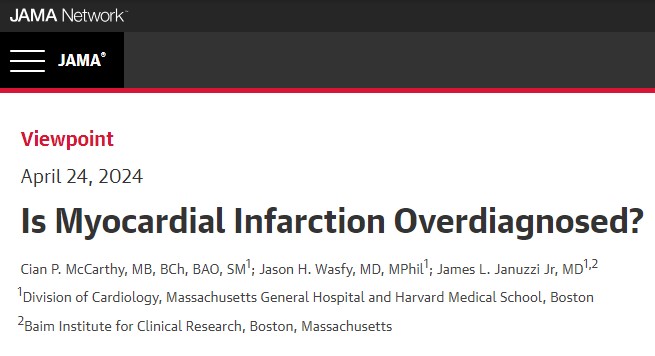
Link to the article

Check whether your answers concur with this crucial query from Harvard Medical School and Massachusetts General Hospital. Three questions this article wishes to address.

1.What is the reason it is happening?

2. What are the implications?

3. What can be done for it?

My thoughts

“It is indeed over diagnosed. Once labeled, a chain reaction is set in. The cost, and resource consumption that follow a misdiagnosis are nearly identical to that of a true MI. More than that, the adversities of the tense investigative protocol can convert a misdiagnosis into a real one because that sadly includes even an overzealous poking right at the mouth of the coronary artery just o exclude a non existing MI . and ICU-related anxiety stand apart in this scientific comical game of ruling out a cardiac emergency.

The paper seems to blame mostly on the powerful screening test high sensitivity Troponin, Everyone will agree it has a major role in this. But, the more important reason is the cardiology community’s vigorous adoption of a universal definition of MI criteria (which is never intended to apply at the bedside) .Next factor is probably more important. The fear of missing a potential MI and legal consequences thereafter. I wish, the experts who sit on medical juries need to learn few extra lessons in the art of medical uncertainties.

Medical jurists, need to take some Intellectual cues from their criminal courts. How is it that, even well-planned criminal murders are successfully allowed to be argued and won in courts,…while inadvertent events such as missing an inconsequential MI by doctors are rarely pardoned?

How to avoid over diagnosis of MI ?

In this scenario, It is sad, that only very few cardiologists have the guts to ignore this omnipotent molecular sub-fraction of cardiac muscle Troponin, with their clinical skills. What we can do, at our level is to incorporate a new term “benign or micro myocardial Infarction” – akin to lacunar infarcts or TIA equivalents of the brain in the heart. We need to de-list the vast majority of chronic ischemic,non-ischemic, or systemic causes of Troponin leaks from the myocardial infarction chart. Physicians must realize, that protocol violation should not be deemed a crime always, rather it has a sure potential to benefit your patient if it is done properly and intelligently.

Final message

Recently one cardiologist in a sub-urban center was thrashed both physically and in social media ,for missing an ACS , which was subsequently recognised and treated well and good.

Doctors should be legally allowed,* (rather forgiven) to make permissible levels of errors in the medical decision-making process ” like any other profession .However, we must ensure our constant pursuit towards zero error, which may not be possible always. This should include overlooking apparently positive lab results if they have reasonably applied their clinical acumen. *Until this happens, the unquantifiable suffering of our patients* due to over-diagnosis and inappropriate interventions can not be reigned in.

*Maybe, this sounds more controversial statement in my 15 years of writing. Beloved patients shall note, it is a rare for me to make what probably, look like an anti-patient statement. Till now, I have been blamed my many of our colleagues, as self slandering my own profession for too many errors in many of the posts. Nothing can be done for this. When you search for truths , you need to tolerate all these.

Reference

1.McCarthy CP, Wasfy JH, Januzzi JL. Is Myocardial Infarction Overdiagnosed? JAMA. Published online April 24, 2024. doi:10.1001/jama.2024.5235

2.Shah  ASV, Sandoval  Y, Noaman  A,  et al.  Patient selection for high sensitivity cardiac troponin testing and diagnosis of myocardial infarction: prospective cohort study.   BMJ. 2017;359:

Read Full Post »

Reviewing NOTION study, the Nordic TAVI 10 year follow up has just been released (Ref 1) :

Caution :Non-academic content

This study reports the long-term outcome in low-risk individuals who required AVR. The study basically compared the blind and passive deployment of bio-prosthetic aortic valve aided by the catheter skills of new-age cardiologists with sophisticated image backup versus Open surgical replacement of the aortic valve by experienced cardiac surgeons, after meticulously removing and debriding the native leaflets and suturing the prosthetic valve permanently in the optimal target site under direct vision.

Study summary

Conclusion

The study results finds the valve deployed percutaneously under semi- blind vision, was equipoise with SAVR done under direct vision. The surprise however is, TAVI was superior to cardiac surgeons in multiple aspects .The mysterious finding is TAVI had less Structural valve dysfunction, and possibly low bio valvular failure (BVF), if Kaplan -Myer curve trend is little extrapolated. No doubt ,the Aortic interventional world is applauding and everyone is joining the party.

Now, some academic queries ?

1.Did the trial compared best practices of TAVI & SAVR ?

No. Because it was done in 2010-2013. (Which grew faster TAVI or SAVR in the last10 years ? in terms of both hardware and expertise . How it will impact now ?)

2..Was the outcome assessment blinded ?

No

3.Why there is 50 % cardio vascular and 60% all cause mortality in both groups even though they belong to low risk category ?

Don’t know. Not clear.

4.Why the gradient was high in SAVR in the follow up ?

There are two important factors. More than 98% of TAVI patients had a valve sized 26–31 mm, while 98% of SAVR patients received a size 19–25 mm . Apart from valve size aortic annular enlargement before SAVR was not done in majority, there by enhancing the gradient and valve mis-match.(Note :The TAVI begins at 26mm and SAVR ends at 25mm. For how many of you this looks odd ?)

4a. Was doppler velocity index measured in all to assess EOA in follow up ?

No. It was not mandatory.

5..Is it Ok to define structural valve dysfunction(SVD) based on gradient alone ? Did TEE/CT follow up imaging done ?

No. Flow is physiology. Sub physiological valve destruction very much possible without affecting gradient.

6.The rate of severe SVD was higher after SAVR. Is there any meaningful explanation why surgeons valve deteriorated fast ? 

No .

7.Was CAD accounted for outcome difference ?

No .CAD patients were excluded.

8.Did this study address technical issues in performing PCI with new onset CAD and its possible impact in outcome

No. TAVI induced coronary ostial encroachment not reported.

9.Why didn’t they use bi-leaflet mechanical valves in SAVR group ?

Don’t know .(*One possible reason is given in the foot notes)

10.Is this study still valid ?

Sorry,  I don’t know.

Final message

Whatever is written here, NOTION will remain a great study with a 10 year meticulous follow up . As a cardiologist, very soon we will be allowed legally to choose TAVI even in more younger , low risk cohort of Aortic stenosis without co-morbid conditions. Still, if you put patient first approach ,CAUTION should precede NOTION .

* One version of answer for question 9 , would be TAVI vs Bi-leaflet St-Judes study was in-fact proposed, but was apparently not approved for (un)ethical reasons,of comparing a short living bio-valve valve with a long lasting mechanical valve.

Reference

1.Hans Gustav Hørsted Thyregod, Troels Højsgaard Jørgensen, Nikolaj Ihlemann, Daniel Andreas Steinbrüchel, Henrik Nissen, Bo Juel Kjeldsen, Petur Petursson, Ole De Backer, Peter Skov Olsen, Lars Søndergaard, Transcatheter or surgical aortic valve implantation: 10-year outcomes of the NOTION trial, European Heart Journal, 2024;, ehae043https://doi.org/10.1093/eurheartj/ehae043

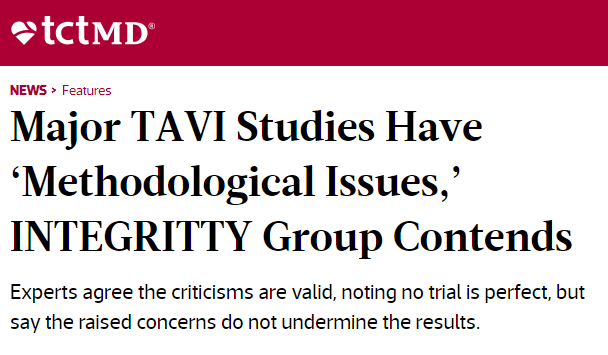
2.TCT -MD article from the INTEGRITY group / Link 2

Read Full Post »

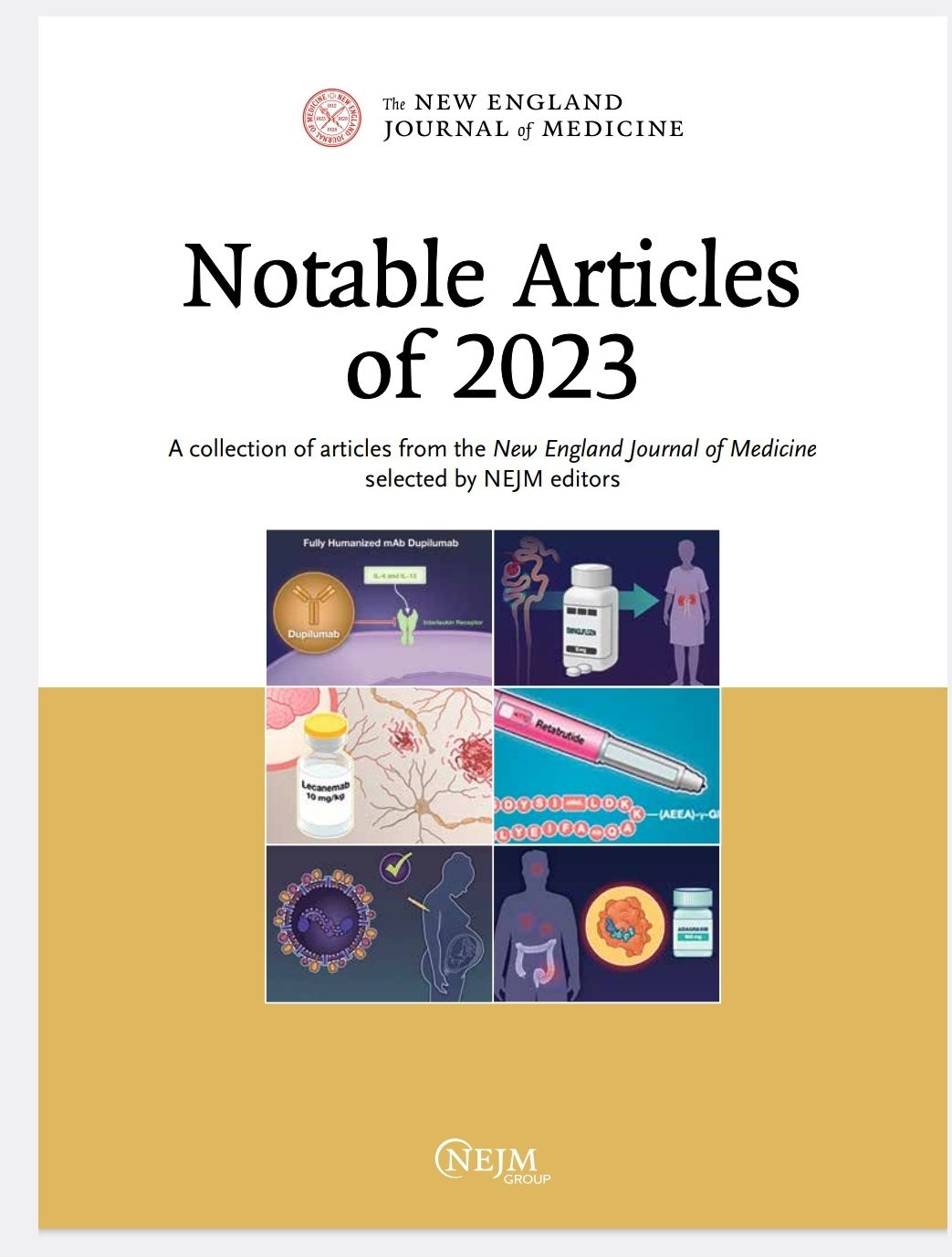
Here is a pleasant surprise, a collectors issue of NEJM year book 2023, is made available free (even for non subscribers, in its website) .It is fascinating to know how fast the Internal medicine has grown. For the busy cardiologists, this will a be refreshing reminder, that there are other important organs and specialties do exist in medicine , with equal breakthroughs and Innovations.

It is indeed an amazing , whirlwind tour of medicine for all those who see medical science as single holistic specialty. It has articles, ranging from from simple clinical studies on postpartum hemorrhage (E-MOTIVE study) from deep inside Africa by Melinda Gate foundation, to Dupilumab for COPD, a stunning monoclonal antibody inhibitor of IL-4 for COPD exacerbations. Shortening tuberculosis treatment with a strategy involving initial treatment with an 8-week Bedaquiline-linezolid regimen (TRUNCATE-TB study) is also a revelation.

Of-course, the mandatory cardiac topics do find a prominent place including the currently omnipresent drug GLP agonist Semaglutide for HFpEF (STEP-HFpEF study). Baxdrostat, an Aldosterone synthase antagonist for treatment-resistant Hypertension, appears promising (BrigHTN).

Final message

However, the crowning glory among all articles appear towards the end of the document, titled Combating misinformation as a core Function of Public Health.

Let me share the link to this PDF document here. Hope it allows open access and there are no copyright issues. Notable articles of 2023 from NEJM .

Read Full Post »

Question

A cath lab is an “optional accessory” in the management of Acute coronary syndrome (ACS).

True or False ?

Answer

Without a CCU…you can never, treat any Acute coronary syndrome … while we can treat most ACSs successfully without a cath lab “ (If you still got the answer wrong …sorry, no comments)

Best comment

Accessory is ok , but it is “20% foolish” to state cath-lab is optional, it should be mandatory.

Read Full Post »