Feeds:
Posts
Comments

Posts Tagged ‘clinical cardiology’

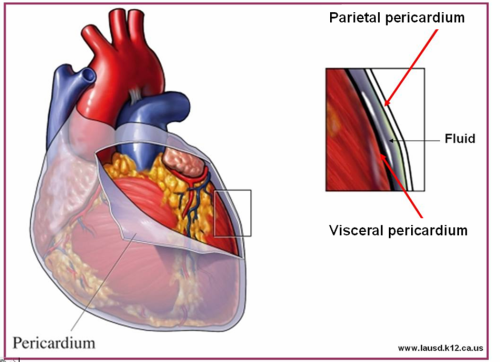
Heart is externally covered by two layers of pericardium .  Pericardial space is formed between parietal and visceral layers of pericardium . It is a narrow space which is normally lubricated with pericardial fluid up to 25ml. When these two tissue surfaces  come into contact ,  pathological  rub takes place.It is heard  whenever the pericardium is inflammed . Pericardial rub is a distinctive but uncommon  clinical sign .

Common clinical conditions

  • Acute pericarditis
  • Uremic pericarditis.
  • Rheumatic pericarditis
  • Post myocardial infarction

Pericardium has two layers .

There are four  possibilities for pericardial rub to take place.

The rub can occur

1.Between the two layers of pericardium

2.Between the visceral pericardium and the epicardial layer of  heart*.

3.Between parietal pericardium and the  chest wall

4.Pericardium can rub with the adjacent pleura( Pleuro pericardial rub )

The second and third mechanisms are very rare.

An update

We have realized one more possibility . Diaphragm forms the floor of the heart on which the hanging heart  rests . Rubbing of pericardium over diaphragmatic surface is a beat to beat affair that lasts the entire life !. In inflammatory states of  diaphragm especially  the contagious  ones from abdomen  , can result in pericardio- diaphragmatic rubs .These rubs are almost impossible to hear clinically.
pericardial effusion rub plural pleuro pericadial

*The anatomic mystery : Is epicardium same as visceral layer of pericardium ?

Some anatomist feel that both are same entities. If that is the case myocardium can never split its relationship with visceral pericardium.But it is also a anatomical fact visceral pericardium engulfs the coronary artery and  are located sub epicardially.

How many components of pericardial rub are clincally heard ?

Pericardial rub  classically has three components. Systolic, mid diastolic, and pressytolic atrial components. Pericardial rubs are typically described as to and fro rub. Systolic component is most consistent. In atrial fibrillation mono component pericardial rub is heard.

Quality

Superficial , scratchy, high pitched ( Can also be low pitched)

Location

Left sternal border , left 2nd or 3rd space  .Best heard in  sitting , leaning forward in inspiration. Many times the rubs are transient and evanescent . Since it has multiple components it may be mistaken for added heart sound like S 3 or S 4.

What is the mechanism of pericardial rub in the immediate post MI phase ?

Presence of pericardial rub post MI indicate a transmural involvement or atleast significant epicardial involvement . Recognition of this is important as presence of pericardial rub increases the risk of rupture  and hemorrhagic effusion if anticoagulants are used.

What is the  relationship between  pericardial effusion and  pericardial rub ?

Generally it is said with the onset of effusion pericardial rub disappear.But this is not necessarily true.

Rubs after contusion chest and fracture ribs can be with the chest wall and may have  no relationship with effusion.

Is pericardial rub a painful condition ?

Pericardial  rub associated with acute inflammatory pathology is severely painful (like a pleuritis).But pericarditis associated with chronic inflammatory conditions are less often generate pain.The exact reason is not known.

What is pleuro pericardial rub ?

This  clinical entity is poorly defined , often taught by veteran professors  in clinical auscultation classes.It can be heard in the mid segment  or diaphragmatic pleuritis with or without pericardial effusion in patients with  atypical pneumonias.
Read Full Post »

Pulse deficit is a clinical sign wherein , one is able to find a difference in count between heart beat (Apical beat or Heart sounds ) and  peripheral pulse .This occurs even as the heart is  contracting , the pulse is not reaching the periphery.This can occur in few clinical situations .

1 . Atrial fibrillation.

2. Very early diastolic  ventricular  ectopic beats

3. Some patients with Pacemaker.

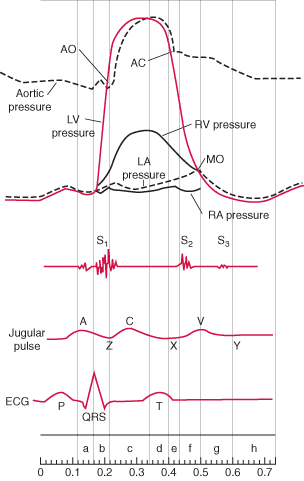
The mechanism is  , the ventricular contractions are  too weak and unable to open the aortic valve  (Or opens feebly*)  , but at the same time they are good enough to close the mitral valve. To open the aortic valve it has to generate atleast 60-80 mmhg pressure , while mitral valve closes even  as LV generates  8-14mmhg  .(LV/LA pressure cross over). So intermitently the  second heart sound  is missed while S1 is retained,  producing more heart sounds and less pulse count in the periphery. The S1 is either felt or heard at the apex but the corresponding pulse is missing . Further , this intermittent absence of  S2  results in totally irregular S1 /S 2 relation.


Why some of the contractions of LV is too weak to open the aortic valve ?

Because the RR interval varies , the ventricular filling also varies , diastole duration is constantly changing some of the diastole are too short  and LV hardly gets filled , as the LV force of contraction is directly decided by the LVEDV and LV  fibre length these contractions are too weak.

Other published studies

There has been some doppler observations ,where there is a midventricular LV blood flow reversal in atrial fibrillation that could  explain the pulse deficit . Mechanism of production of pulse deficit in atrial fibrillation: assessment by blood flow dynamics

Second Department of Internal Medicine, Kagoshima University School of Medicine.

 http://www.ncbi.nlm.nih.gov/pubmed/3221309

What is the clinical significance of pulse deficit ?

Currently there is no great clinical significance of this phenomenon. But an astute clinician will pick up this sign and it may indicate underlying LV dysfunction. In patients with PPM,  pulse deficit  suggests  pacemaker malfunction .Some patients with cardiac tamponade &  pulsus paradoxus  systolic  blood pressure falls too low to make the pulse feeble or not palpable in the periphery .This situation may mimic a pulse deficit if not recognised.

Dr.S.Venkatesan ,Madras Medical College , Chennai, India

* What is the evidence for intermittent absence or feeble Aortic valve opening in Atrial fibrillation ? I could find this from the book written by Harvey Feigenbaum. whom we consider Father of Echocardiography


Read Full Post »

Examinations in  clinical cardiology

It is a brief early systolic outward thrust , followed by late systolic retraction felt by the palpating finger  when  the LV contracts and rotates  ,  the LV apex and the adjacent  interventricular septum hits against the chest wall. It is usually felt at the 5th left intercostal space just inside the mid clavicular line , lasting less than 30% of systole and  occupying less than 3 square cms area.

Source : Horwitz ,signs and symptoms in clinical cardiology .1985. Lippincot 

Should we always be able to palpate an apical impulse ? 

Not really.If apical impulse is not felt in the sitting posture ,  one has to try in the left lateral position .In  thick chest walled persons it may be impossible to feel the apical impulse in any postion. Many times it is so tiny it lies behind a rib and one will not feel it. In  pericardial effusion also apical impulse is absent.

Read Full Post »

« Newer Posts
