Feeds:
Posts
Comments

Posts Tagged ‘lvedp’

I saw two patients recently, with a similar degree of hypertension and LVH. One with a normal-sized LA and the other with a mild LA enlargement.

When checked for the “E” declaration time, it was found to be absolutely normal in the patient who had LAE. The one with normal LA size had a relatively short DT and his functional capacity was less.
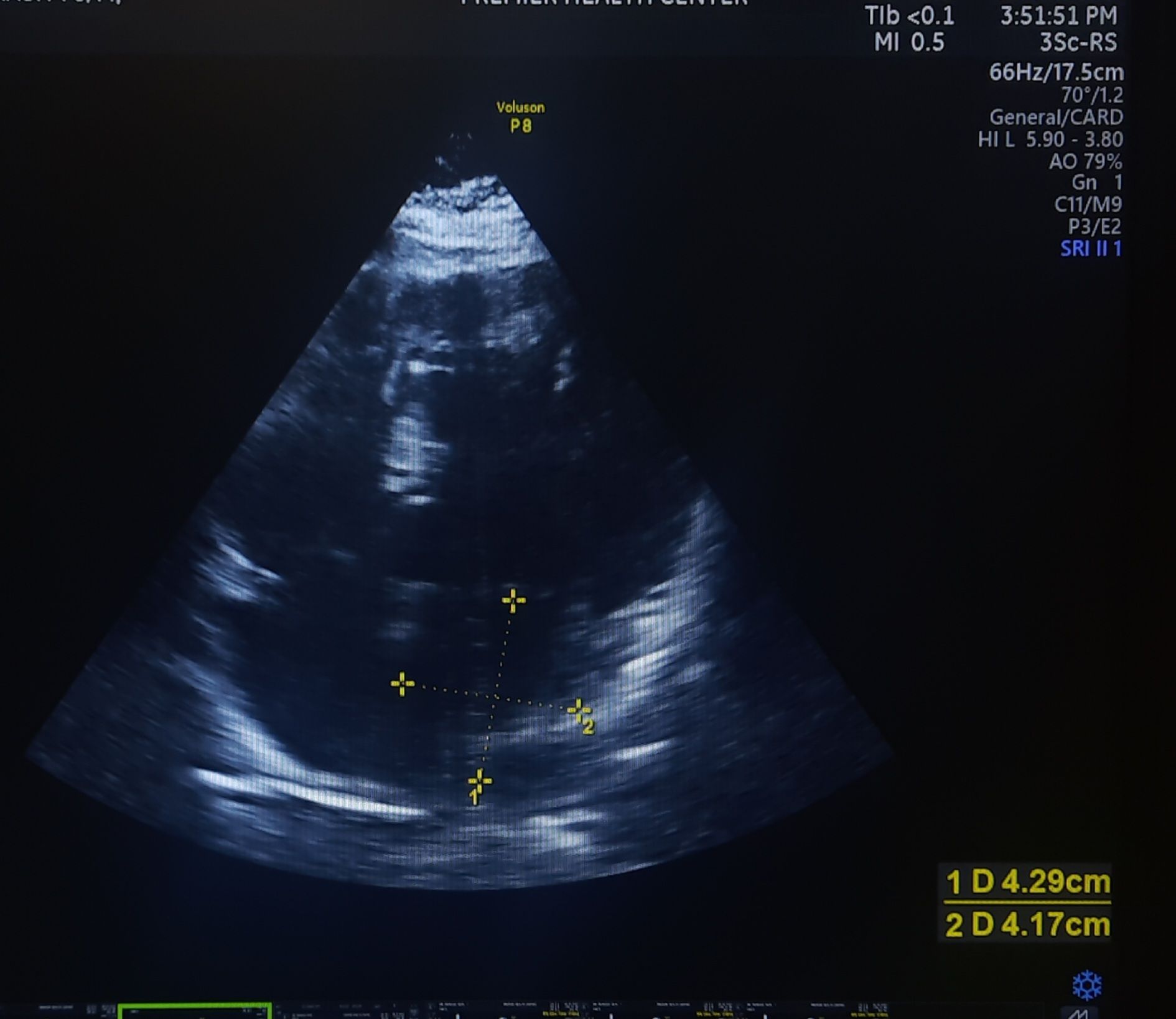
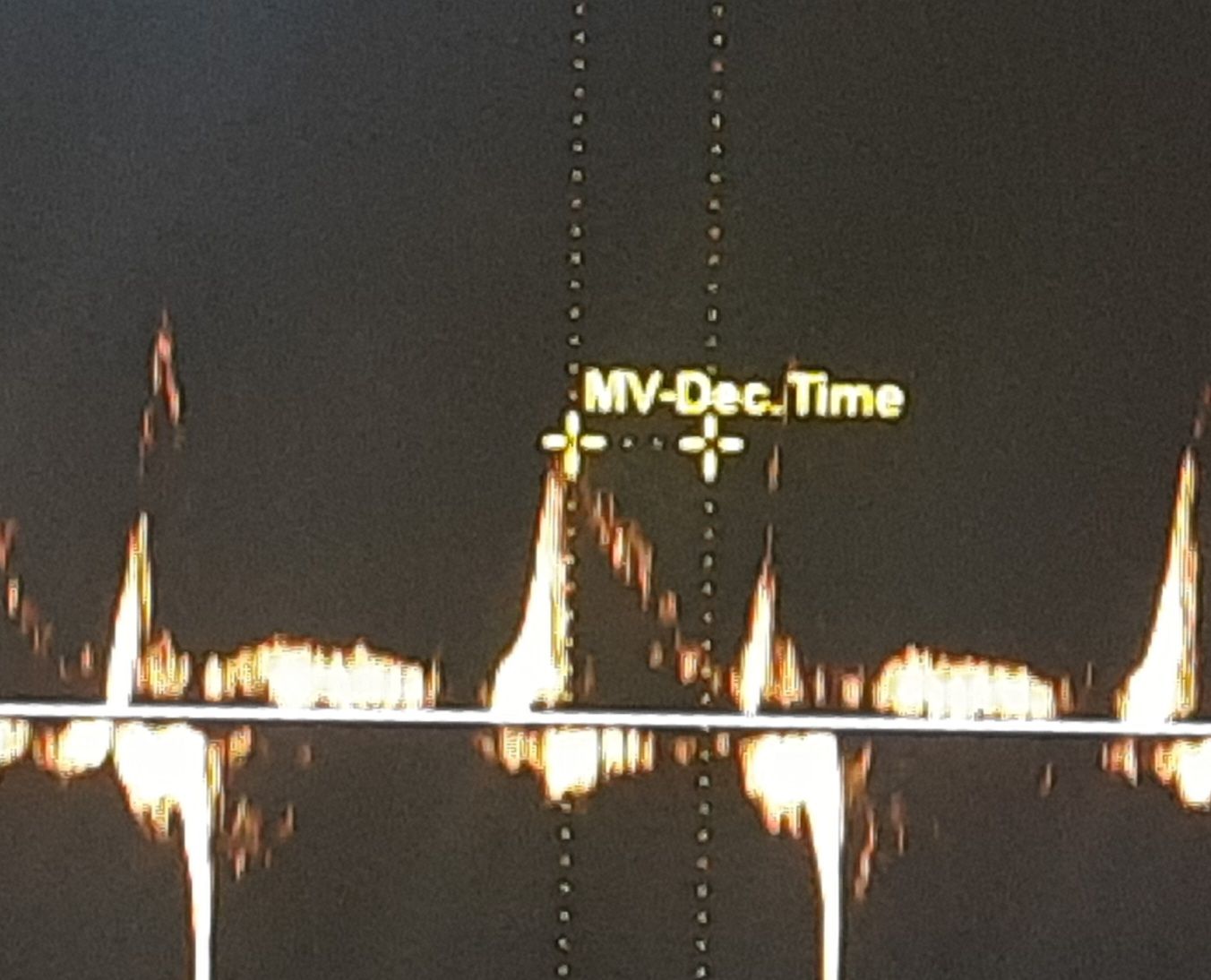
52-year-old man with HT, and LVH with mild LAE. His E DT was very much normal a1 178 ms. He has a good functional capacity. I expected a grade 2 diastolic dysfunction. But, none of the other parameters were convincing. Used to think, if LA is enlarged, it must be a little advanced form of diastolic dysfunction. Though It is still true in many, but, this case, demand us to dwell into these two important parameters of LV diastolic function.

What is the relationship between Left atrial size and Mitral “E” decceleration time ?

The conventional and straightforward answer is they are inversely related.

We know Left atrial size typically reflects the chronicity of elevated left atrial pressure or volume overload, which can result from conditions such as mitral valve disease, left ventricular dysfunction, or atrial fibrillation. An enlarged LA is often a marker of prolonged stress on the atrium due to increased filling pressures or impaired left ventricular relaxation.

Mitral E velocity deceleration time (DT) is a measure derived from Doppler echocardiography, representing the time it takes for the early diastolic filling velocity (E wave) to decline from its peak to baseline.

In healthy individuals with normal LA size and normal diastolic function, DT is typically within a normal range (e.g., 160–240 ms), and LA size does not significantly influence DT. In pathological states, an enlarged LA (e.g., LA volume index >34 mL/m²) combined with a shortened DT (<160 ms) indicate restrictive physiology or advanced diastolic dysfunction.

Question 2

Is this Inverse relation always right ?

There is generally an inverse relationship between LA size and mitral E velocity DT in the context of diastolic dysfunction with elevated LA pressure. LA size increases due to pressure overload, DT tends to decrease. However, the exact relationship is much more complex. If LA enlargement is due to volume overload (e.g., chronic mitral regurgitation) without significantly elevated pressure, DT may not shorten dramatically.

If the LA is stiff and non-compliant, the E deceleration time is likely to be short, and an inverse relation is acceptable logic. But, if the LA is more accommodative and relaxed, mild enlargement actually reduces the LA mean pressure, and E deceleration gets normalized even if it was prolonged earlier due to diastolic dysfunction.

LA behaviour is still a mystery X factor in diastolic dysfunction.

This throws up a fundamental question in our understanding of diastolic dysfunction. Some degree of LA flexibility and compliance reduces the LA mean pressure, and could relieve the symptoms. In this process, the mitral DT also is kept within the normal limits. In fact, now I have asked my fellows to analyze a concept of normalization of DT with progressive LA dilatation in hypertensive patients. This is contrary to the belief that LA dilatation is an ominous sign.

I think it is worth propsoing and pursuing a new concept.” LA dimension has a U curve phenomenon at least within the certain Iniital increments either in size or volume” . LA cannot be too stiff, at the same time it can’t yield out like a balloon.When does an LA decide to dilate and when does it resist is the question ? An agile atria without fibrosis, degeneration, and optimal fluidity extracellular matrix could be the defining factor.

Final message

Understanding the duality in the realtionship between LA size and E deccleration time seems to be crtical. A stiff, non-compliant LA aligns with a short DT and an inverse relationship with LA size in high-pressure states.A relaxed, accommodative LA with mild enlargement may not affect DT significantly and could even normalize it by reducing LA pressure, especially if DT was prolonged due to early LV diastolic dysfunction.

This behavior underscores why LA size and DT must be interpreted along side other factors like LA pressure estimates (e.g., E/e’ ratio), LV compliance, and the underlying pathology.

* A research question for fellows in cardiology

Read Full Post »

Though the left atrium is the superior most chamber of the heart , it loses its gravity-assisted LV filling advantage in a lying posture. In patients with compromised heart function, this becomes a symptom defining factor. No surprise, patients during episodes of LVF or paroxysmal nocturnal dyspnea, natural forces make them sit up by default, and bring the LA superior & over the top of LV hence its filling is augmented. One more factor that operates is that, IVC orientation, which assumes slope and reduce venous return velocity. In the process, they decongest the lungs and patient gets Immediate relief. In fact, pillows work faster than diuretics and we can technically call it low-cost LV assit devices.

Note, how the LA takes control by its superior position, when the patient assumes erect posture from supine. In fact ,the number of pillows used, by the pateint has some direct correlation with LA mean and Echo cardiographic E/e ‘ . ESCAPE study suggest a possiblity of correlation of this LVEDP with right sided JVP as well.( Drazner et al Circ Heart Fail. 2008 )

Final message

This post may not be relevant to cardiology fellows. Whenever we receive a dyspneic patient in heart failure, prop them up with few pillows. This lesson is taught right in the first-year clinical rounds. I wanted to highlight the anatomical and hemodynamic basis of the sitting-up posture and its impact on LA mean and LVEDP. By some crazy stretch of imagination, pillows can be referred to as a temporary LV assist device.

Research suggestion for fellows

Some of you can do you a study in cath lab, how much the LA mean pressure is altered with reference to posture. It could appear a flimsy study in this era of TAVR/Mitra clips. Sill, we have an good opprtunity to analyse these things as we enter all chambers of heart in routine fashion for some indication or other. This will make us understand LV filling physiology in a better way. (Recalling the days of Guyton & Rushmer when they strugggled to know computational models to measure the pressure gradients)

A question for our hemodynamic acumen ?

How does the LA empty in to LV , when LV inflow conduit need to operate against gravity during head down feet up postion as in many sports like bungee jumping or in some asanas (Shirshasana) . Has any one attempted, to know , how would be the E and A velocity across the mitral valve in this posture .Wish some one take on this and report ,if no one has done it before please add some credit . (Just kidding)

Caution

Patients (even some healthy) with diastolic dysfunction especially in elderly, should never attempt to do such sports or indulge in any compromised posture that brings LA below the LV.

Read Full Post »

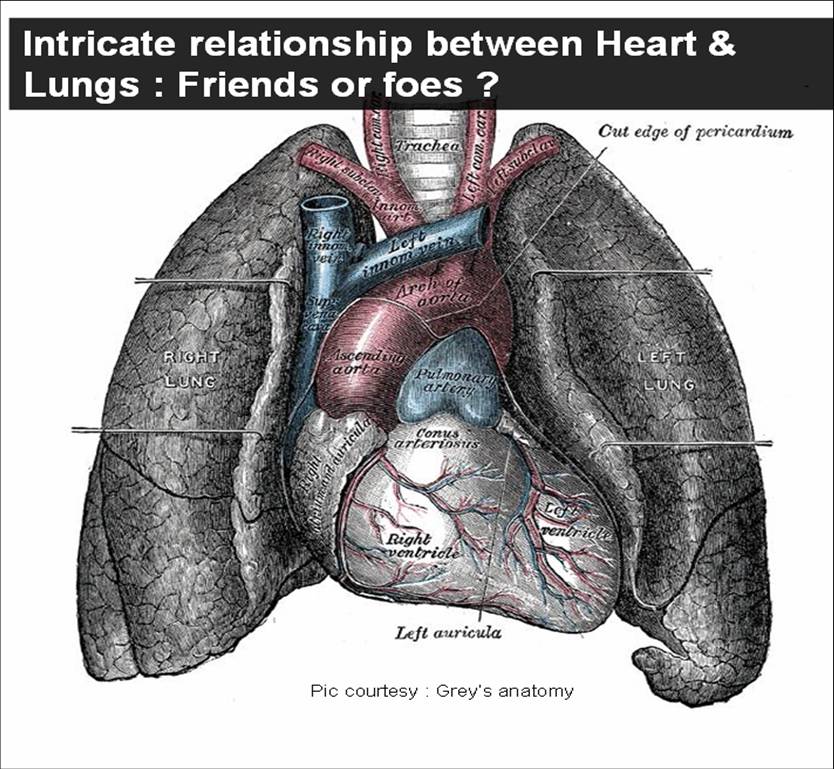
Thorax is a rigid bony box with a fixed space.The intra thoracic organs are snugly arranged within the cavity.The two lungs on either side with the heart in the middle fill the major volume of the mediastinum .In physiological conditions the volume of mediastinum remain almost constant , except for the respiratory swings.

heart lungs pulmonary function test dyspnea cardiomegaly ct ratio

It is to be noted the two major organs inside the thorax has a distinct behavioral pattern. Lung a very pressure sensitive structure tend to collapse whenever confronted with external pressure .This is evident in all cases of large pleural effusion (Note :The heart collapses only in a fraction of patients with large pericardial effusion -ie tamponade) . Similarly in any mediastinal syndromes , first the lung function is affected , logics then dictate , the low pressure venous system to get compressed resulting in SVC /IVC syndrome.Finally the right heart chambers may get interfered with .This is due the dynamic intracardiac pressures that resists any compression from exterior.

So, it is obvious , lung function is affected with raised intrathoracic volume or pressure .The increase in intrathoracic volume can be due to any thing .

cardiomegaly massive dyspnea mechanism lvedp

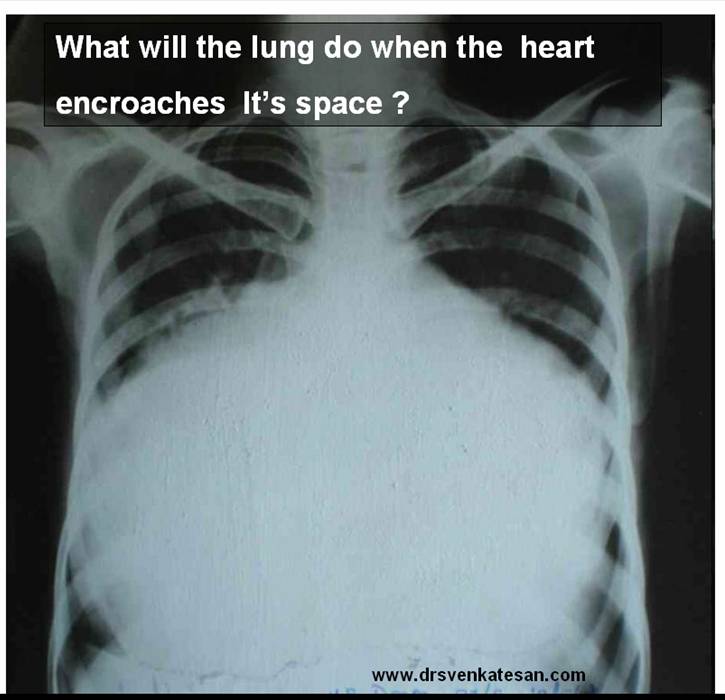
The volume of heart in cardiac failure can increase very significantly .For a fraction raise of CT ratio there is many fold raise in it’s volume.A CT ratio of 75% can cause a huge ” housing & accommodation ” problem for the lungs on either side . As we have discussed , the lung is passive organ has absolutely no other option but to bow down like a touch me not plant . The lung , reduces it’s ventilatory function impairing the already poor exercise capacity .The terminal respiratory units collapse significantly. This collapse is not visible in x rays as there is no intrinsic obstruction within the airways as happens in lung pathology.

The course of events in progressive cardiomegaly is often silent and heart successfully encroaches the the human breathing space until the heart failure is corrected and normal heart size is restored. Complete reversal of heart size may not be possible always !

A new unrecognized mechanism for cardiac dyspnea ?

Yes,the mechanism of cardiac dyspnea always been centered around elevated LVEDP , lung congestion etc and the resultant stimulation of lung receptors.

Now we realise a reduction in the lung ventilatory capacity may also contribute significantly in every patient with cardiac failure and cardiomegaly.

When a person with single pnemonectomy lead a comfortable life what is the big issue of heart compressing few respiratory segments of a patient ?

It is true a single normally functioning lungs is sufficient for living but what we are dealing here is patients with compromised cardiac function.Recruitment or non recruitment of even few respiratory bronchooles may have a bearing on patients symptoms and exercise capacity.

Final message

Cardiomegaly is not an inert consequence of cardiac failure. It can have important functional impact on the pulmonary ventilatory and perfusion capacity .It should be emphasised this mechanical encroachment on the lung space is over and above the hemodynamic effects on pulmonary capillary circulation .

Youngsters should recognise this fact as this offers one more explanation for cardiac dyspnea. This is not often discussed in the clinical classes.

Reference

http://10.1067/mhj.2000.110282

Read Full Post »

                                    Competence of mitral valve is vital  for proper hemodynamics of  heart .A trivial mitral regurgitation ,is observed in nearly 10-20% of normal population detected by doppler echocardiograpgy .This is other wise clinically insignificant. In fact , it is expected  , the sonographers do not report this,  as it might increase the patient anxiety.

Can a mildly incompetent mitral valve be a hemodynamic advantage ?

Left ventricle , physiologically can have only one exit, namely LVOT and aortic valve.If there is normal  impedance , at this level (LV after load )  it  is refered to as  physiological .In disease states , as in cardiac failure there is raised after load or LV wall stress.this makes the LV struggle to pump blood into aorta.The more the dilatation the more the wall stress (Laplace law). more the wall stress more the after load.

 The  main principle of management of cardiac failure  for decades  has been promoting  LV inotropism .Now we have realised this is fundamentally a wrong concept, (Except in acute heart failure). Hence the main option available now is to reduce the after load , ACEI do that most effectively and proven to improve survival.

What is the effect of  trivial or mild MR on LV after load  ?

It is a hemodynamic fact for MR  to increase LV contractility  and Dp/Dt  due to a relative reduction of after load.

In patients with cardiac failure , even a mild improvement in LV contractility can give a  symptomatic improvement .


09tmr1

Can mitral valve act as controlled safety valve allowing only a trivial or mild MR ?

This may be difficult . But it happens naturally in many of our patents in cardiac failure .

Probably , these are same  patients who come under the 20% incidence of physiological  doppler  MR .Other group could  form the  functional MR*

We have found, patients with  DCM  with mild mitral regurgitation tolerate excercise better than patients who have very competent and rigid mitral valve.It is presumed a mitral valve which gives in a little bit , decompresses the LV with a symptomatic benefit.But if the MR , is occurs in an eccentric path or it results in significant volume burden the potential advantage becomes a liability.

Related issues

*Functional mitral regurgitation. Functional MR is said to occur , when patients with cardiac failure, and resultant dilatation of mitral annular ring, and lack of opposition of leaflets

While milder forms of MR are well tolerarted  , when it occurs  acutely ( even if it is mild) ,  it can be dangerous and result in sudden pulmonary edema  .This usually happens in acute MI or infective endocarditis etc.

 Final message

  • Minimal or mild  mitral regurgitation without any significant volume overloding  in some of the patients with dilated cardiomyopathy  could bring  a hemodynamic advantage .
  • So one may not unduly worry about , a mild MR (central jet) in patients with DCM.It could be after all a safety exit for overstrained LV

We will report the results of the ongoing study about the impact of presence /absence    of  mild MR on the 6 minute walk test in patients with dilated cardiomyopathy.

Read Full Post »

Humans have roughly 5 to 6 liters of blood at any given time in their  body  . Out of  this*

50% (2500ml)  is located in the systemic venous compartment.
18% is within the pulmonary circulation participating in the vital oxygenation
12% (500-600ml) is within the cardiac chambers.
8%  is in the arterial tree of  the body.
5%  is  within the  capillaries.
2%  is in the aorta.
* Source : Best & Taylor Physiological basis of  medical practice 1966, 8th edition

What is the implication of this predominantly venous distribution of blood  at rest ?

  • A competent venous tone is essential  for the human beings to maintain the erect posture.
  • Bulk of the cause of syncope in humans is due to peripheral  mechanism like loss of vascular tone and resultant venous pooling.
  • The  concept of venous reservoir is so important in emergency situations like  hypotension  as  simple elevation of legs  is equivalent to  infusing 500 -800 ml of intravenous saline .
  • Similarly during acute left ventricular failure trunk elevation and legs dangling down can reduce the pulmonary congestion very significantly and reduce pulmonary capillary wedge pressure (LVEDP)

 Autonomic dysfunction and venous insufficiency

 Autonomic dysfunction and resultant  orthostatic hypotension is directly related  to venous reservoir dysfunction.Increasing effective circulatory volume by elastic stockings or administration of mineralocorticosteroids like fludrocortisone (.5mg/day ) can be useful in this condition

Read Full Post »