Feeds:
Posts
Comments

Posts Tagged ‘tachycardic cardiomyopathy’

Nothing happens without energy cost both in physics and biology. How much is the metabolic cost of an extra systole ? While an occasional VPD is benign and has a negligible effect, a high burden of VPDs can consume extra energy and drain myocardial metabolic reserves.

Three ways it can happen

  • Inefficiency: VPDs cause premature contractions before AV valves fill and hence there is a mechanically wasted work However the electrical cost is small.
  • Dyssynchrony: dys or desynchrony due to the VPDs also hikes myocardial oxygen consumption (MVO₂) for identical workloads.
  • Post-Extrasystolic Potentiation: We know, the beat following a VPD shows increased force due to calcium accumulation. This can elevates contractility and wall tension, increasing energy demands.

Molecular basis of energy depletion

At the cellular level, the variable timing of VPDs disrupts calcium homeostasis in phase 2 of action potential within the myocytes. The sarcoplasmic reticulum must continuously pump calcium ions against concentration gradients via SERCA2 channels, a process requiring ATP hydrolysis. Additionally, the chronic workload mismatch induces mitochondrial oxidative stress, which damages the electron transport chain, impairs ATP synthesis resulting in energy consumption mis mamtch.

What is the cut off number ?

A high VPD burden* (10% to 20% all heart beats in day ) is considered a chronic strain, leading to cardiomyopathy and heart failure.First step is a Holter monitor assessment. Yet, we are not clear about the exact number For example : Does bigeminy counted then 50 % of all beats )

*VPDS and elEctrical SCD is different topic , and is not discussed here.

Does suppression help ?

We think so. If and only if we can document porgressive LV dysfunction.

Final message

VPDs are usually benign unless linked to LV dysfunction, which complicates prognosis. The electrical energy cost of VPDs is negligible . But its impact on the mechanical behaviour on myocardial contractility is the issue. It’s crucial to determine if they are primarily electrical or secondary to associated LV dysfunction. Treatment is based on individual assessment.

Reference
Link to the article

Postamble

Difference between APD and VPDs in terms of energy consumption ?

Need to be discussed further.(We know frequent focal APDs or ATs, MAT can result in AF or atrial cardiomyopathy)
Read Full Post »

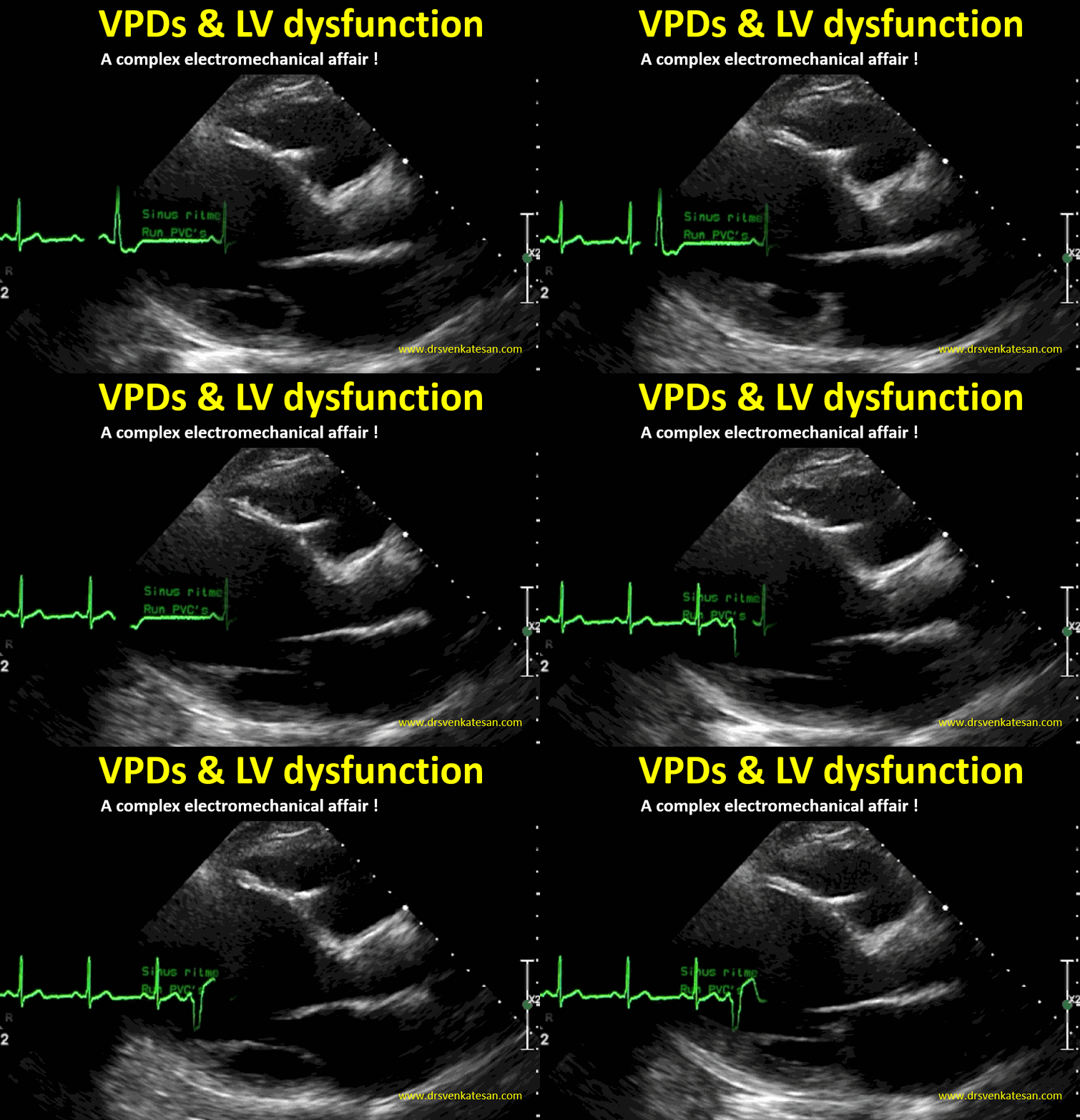
We know, LV dysfunction of any etiology can cause VPDs.This must be differentiated from VPD induced LV dysfunction. Mind you, this is not an easy job at all.

When do you suspect excess VPDs are the cause (or might cause) of LV dysfunction?

  • In young, otherwise healthy persons with “VPDs and LV dysfunction”  would suggest chronic abnormal electrical activity is the cause for subsequent LV dysfunction. (An expression of electromechanical remodeling)
  • Monomorphic VPDs more often suggest primary electrical pathology(Like OTVT, Fascicular VT)
  • VPD count more than >10000 in 24 hrs in Holter will probably Indicate an electrical defect that requires  Intervention.
  • VPD burden (>10% and usually >20%),
  • Frequent NSVT,
  • Retrograde P-wave after the PVCs,(Chronic AV desynchrony)
  • Lastly one may argue its myth as well. VVI (& mode switched DDD) is a perfect example of how our heart tackles undesired VPDS. (We see hearts living comfortably with only with VPDs from the right ventricle (Pacemaker rhythm) without any troubling LVD.

Ref 

1.Baman TS, Lange DC, Ilg KJ, et al. Relationship between burden of premature ventricular complexes and left ventricular function. Heart
Rhythm. 2010;7:865–9.
2.Ban JE, Park HC, Park JS, et al. Electrocardiographic and electrophysiological characteristics of premature ventricular complexes associated with left ventricular dysfunction in patients without structural heart disease. Europace. 2013;15:735–41

When do you suspect VPDs are because of LV dysfunction?

  • History , clinical examination is the key. If there is a known cause for myocardial pathology.

  • Here, the VPDs are more often multifocal (Rarely monomorphic)
  • QRS complex other than VPDs may show slurring or fractured abnormality 
  • More severe forms of LV dysfunction  
  • Severely scarred ventricle obviously would Indicate primary structural disease that causes VPDs

Clinical implication

  • If VPDs are the cause of LV dysfunction we may try to suppress or abolish it.
  • No point in ablating otherwise asymptomatic VPDs in cardiomyopathy. Here we have to identify the cause for LV dysfunction(CAD, Myopathy etc) 
  • Beta-blockers can be useful in both subsets.
  • The over-enthusiasm of ablating all forms of VPDs in any structurally abnormal heart is to be restricted. (Of course, Indication for RF ablation/ ICD may be appropriate in malignant forms )
  • The beenifits of CRT therapy can be negated with frequent VPDs
  • The relationship between the risk of SCD with the number of VPDs,  is never found to be linear. (We have learnt in a hard way, that It is the degree of LV dysfunction that writes the script for SCD in a given patient)

What is the mechanism of VPD induced LV dysfunction?

VPDs alter the way ventricle contracts by inducing wall motion defect. In fact, it is intermittent cardiac desynchrony. Generally, LV tolerates this well. When the number exceeds a critical level LV size, shape and contractility is affected.

We need to differentiate chronic tachycardia mediated LV dysfunction (Tachycardic cardiomyopathy) with VPDs per se. This differentiation we can only guess. 

* Some how cardiologists have not,  implicated RV dysfunction induced VPDS. My guess is, it is equally important. Logically,at least 30% of VPD in end-stage DCM must be attributable( and arise from) RV dysfunction.

How to confirm is it a cause or bcoz ?

The only way is to prove LV function improves to normal or near-normal with ablation of VPDs .This can happen only with primary electrical disorders.

Final message 

The link between VPDs and LV dysfunction is stuck in a complex two-way affair. Though a cause and effect component might be quantified to a certain extent, both can be coupled sequentially . “VPD promoting  LVD” &  “LVD begetting VPD”  is always a possibility. This is the reason, we are tempted to take on any VPDs,  which of course, is definitely not warranted.

  Two resources 

The HRS guidelines must-read for all fellows


This is a real state of the art lecture on VPDs straight from a world-renowned Dr Gacia  Courtesy : Methodist, Houston 

Read Full Post »
