Feeds:
Posts
Comments

Archive for September, 2009

orthopnea paroxysmal nocturnal dyspnea pnd www.drsvenkatesan.com

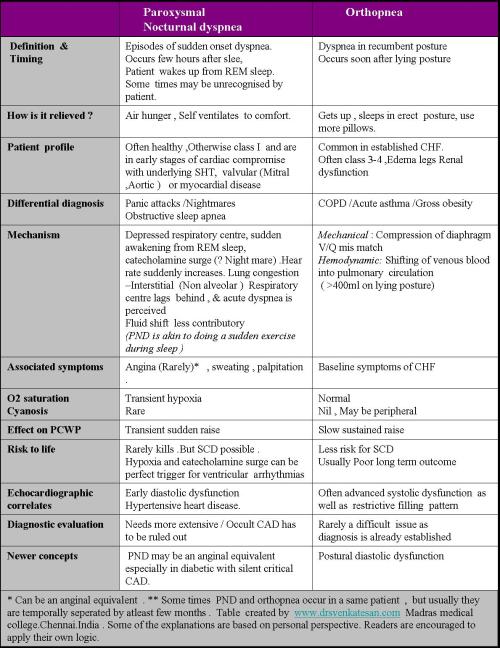
Some Infrequently asked questions in (iFAQ) in PND

What gives relief from PND?

The classical description is, the patient wakes up from sleep. sits up, often to stand up, and go to the nearest window and try to breathe fast and an episode of dyspnea settles down in a few minutes. The relief is completely in many unless the ongoing trigger and baseline cardiac defect overwhelms the reserve mechanism.

What is the hemodynamics behind relief?

Since symptoms are due to sudden unexpected congestion during sleep, assuming erect posture slows down the venous return of 400 ml instantly. It is equivalent to an IV diuretic push. Further standing up (even sitting up is sufficient)  brings the left atrium in its natural superior position, compared to LV. The gravitational forces emerge* and aid in LV filling and improve stroke volume and relieve the congestion backlog. Apart from this two more factors contribute. V/Q mismatch improves as more lungs get perfusion in an erect posture . Finally seeking the window is spontaneous, in search for better fractional oxygen content from the atmosphere. (One more related question. How do pillows give relief of dyspnea in acute LVF? Few of the above mechanism operates)

*Postural changes in LA mean pressure is a complex topic of physics involving lungs, pulmonary circulation, and LA mean pressure.

Is basal rales mandatory during episodes of PND?

Yes. Most will have. But it should be emphasized in orthopnea patients, rales are rare since it takes some time for lung congestion take place. If rales appear immediately after lying down it may Indicate severely compromised LV function.

PND vs Orthopnea: Which is a reproducible symptom?

Obviously orthopnea. PND can never predict which day its going to come as there is CNS component to the circuit in triggering this. (REM sleep, Dreams etc)

How many episodes of PND can occur in one night?

Usually one. Because PND requires a time lag of at least few hours.Usually, these patients will not sleep thereafter or the usual wake-up time ensues.

Can episodes of PND be prevented?

Since its a volume-dependent pulmonary hemodynamic stress, a diuretic at dusk will prevent these episodes in many.

What is the sensitivity of PND for predicting heart disease?

It has low sensitivity( <30% ) but up to 75% specificity to diagnose heart disease.(Class 3 Non-Expert Evidence)

Is PND sign of advanced heart disease?

No.It has very low sensitivity to predict severity of heart disease.

Can PND and Orthopnea occur at same patient at same time a same day ?

Orthopnea has no time lag.It occurs immediately hence it is obviously more severe. Many of these patients, however, do get into sleep after some time as some sort of compensation or adaptation to neural signals of dyspnea take place.

These patients, later on, can get into the same cycle of PND . However, as heart disease (as in cardiomyopathy ) worsens the pulmonary interstitium shows some reactive fibrotic changes resist water logging in the lungs.

Since PND and orthopnea share a close relationship in terms of pathophysiology, we cluster it together in symptomatology. However, they are temporally separated in most patients in natural history.

PND : is it equivalent to acute heart failure?

Yes, it can be called so (If it is due to heart disease*) . It fulfills all criteria of cardiac failure. LV/LA filling pressure raised, forward output (Cardiac Index may still be normal ) .PND is a transient, acute, left-sided failure that results in acute oxygen debt for the body which is self-corrected usually.

* In volume overloaded, CKD patients PND can occur

What is the relationship between RV dysfunction to PND /Orthopnea?

There is a complex fluid regulatory mechanism in the failing heart. The lung can be congested if and only if the RV function is adequate enough to flood the lungs and at the same time LV function matches it with its inadequacy resulting in persistent congestion. In other words, a very high RVEDP is protective against pulmonary edema (However the patient will feel the dyspneic still due to hypoxia /VP VQ etc !)

Its prudent to give importance to PND/Orthopnea with reference to the balance of RV and LV function. One may recall why pericardial disease where right heart filling is impeded rarely lead to lung congestion.

Can PND be associated with Angina ?

Yes, it can but generally its not. Angina occurs due to nocturnal sub-endocardial Ischemia. This combination occurs in critical Aortic valve disease.(Both AS/AR)

Is PND a cardiac emergency?

Difficult question. Most times, no. Since its self-limiting especially if the patient knows he is going to settle with his past experience. But it can trigger dangerous events in severely compromised hearts.As expected, the first episode creates much panic and invariably elicits an emergency alert.

PND has sinister significance if is due to nocturnal ACS.Its a sign of ischemic LVF and requires immediate care.

Which is the most benign form of PND and Orthopnea ?

Students should know, medicine is a funny science. PND as a symptom is benign in some, while it denotes impending death in others.

Benign PND : Obese men, women, in pregnancy may experience terrifying dyspnea at night when they turn around or stretch. This is due to the upward movement of the diaphragm encroaching lung space.

If you record mitral inflow Doppler filling pattern during an episode of PND what will you find?

It’s quite simple logic. You do it yourself and find it as a learning exercise.(Please don’t make the patient suffer by doing echo at times of distress. One of your colleagues to attend to him as you simultaneously do an echo for academic purpose)

Try calculating LVEDP with various echo formulas.

Read Full Post »

AV dissociation is the specific marker for diagnosing VT. Evidence for AV dissociation manifest in many ways in ECG. *Random p waves unrelated to qrs complexes , fusion beats , capture beats are  the common features that help us diagnose AV dissociation. Unfortunately these  occur only in about  40 % of patients  with VT.(Fusion beats in VT are also  called as Dressler’s beat)

For clinical features of AV dissociation follow this link

What is the normal AV association ?

In  normal physiology ,  even though atria are passive , powerless chambers  in terms of mechanical activity  ,  it reigns  supreme control over ventricle and   dominates   electrically  . In fact , the atrium  and the AV node together ,    dictates when the ventricle has to contract and at what rate  .  So,  in normal human  beings in  sinus rhythm ,  there is a complete AV  association   where both chambers live in a perfect harmony.

What is VA association ?

The atrium and ventricles are  not only related   antegradelyy it  also  has a concealed  retrograde  relationship , (which is often pure electrical ! ) called VA conduction .The conduction velocity and the refractory period of VA  junction is  variable .The AV junctional refractory period is determined by the penetrating power of both atrial and ventricular impulses .

What is complete AV dissociation ?

For complete AV dissociation to occur there should be no physiologically or electrically  linked relationship between the atria and ventricle.For it  to occur the atrial impulse has to get  blocked  in AV junction .

This block can   either be functional  or organic,   partial or total , persistent  or intermittent

This occurs in   primarily in   AV junctional pathology like CHB  etc, that result  in complete AV dissociation . The next major cause for AV dissociation , is   by an  interference from  an accelerated lower pacemaker as in ventricular tachycardia or accelerated idioventricular rhythm .

What does the atria do when the ventricle  starts  contracting rapidly and  independently as in ventricular tachycardia ?

When the ventricle , starts firing independently at a rate of > 200 each of the impulse and  tries to  traverse  the AV junction retrograde . At the same time , the sinus impulse which does it’s normal routine job  by beating around 70/beat ,   faces an  unusual interference on its normal downward journey by  the pathological bombardment  from  the upcoming  ventricular impulse .What happens when both these wave fronts  meet head on . (The hither to perfect harmonical  relationship becomes  a rivalry for the electrical control of heart.)

Sadly , the ventricle mostly succeeds  in the race and  most of the   ventricular impulses    retrogradely  enter  the AV  junction and colludes with  the incoming atrial impulses. When this happens , the AV dissociation is said  to occur. The important point here is,  many times if the retrograde VA conduction is fast and optimally timed , it can cross the AV node without difficulty  and reach the atria  and  subsequently  even    depolarise  the SA node   and  reset  it  . If the VT is persistently conducting  retrograde  it can suppress the SA node as long as the VT is there. This makes a P wave becoming totally absent.  (Note of caution : If you say VT as one of the causes of absent P wave you may be failed in your cardiology board , but this remains a fact !)

So the atrial  depolarisation  and contraction During VT is a complex one. It depends  mainly on the  intensity of the  upcoming    electrical wave front   from the ventricle  . The distance traveled by this wave front  determines  the location of  p waves .It may be in one of the following ways .

  • P waves can be totally absent
  • P wave may occur antegrade
  • On the QRS
  • Over the T wave

In effect the P wave can  literally be any where   in the given strip of  VT

When does a fusion  beat occur ?  When does a capture occur ?

This again is determined by the AV  junctional refractory period. If it permits ,  an   occasional atrial impulse may sneak through the AV junction and capture the ventricle . This is capture beat. Capture beats   are usually narrow qrs  . So in a wide qrs tachycardia  if we note  an occasional narrow or relatively narrow  qrs complex it could denote a VT.

If the atrial impulse after crossing the AV junction   collides with the   upcoming ventricular  impulse  the surface ECG inscribes  a fusion beat. An incomplete capture beat is a fusion beat. It is a combination of two qrs complex one activated from above , one from below .The width of the fusion beat may be wide , narrow or intermediate.

So the evidence for AV dissociation  in surface ECG  is rarely  manifested  if the VT is successfully  traverse  the AV junction and   reset  the SA node  or keep it in a semi depolarised state  .This could be clinically important  some times , the SA node takes time to recover following  A DC shock especially in elderly

An episode of VT can unmask  a hidden sinus node dysfunction , as VT is technically similar to an atrial override pacing   of course  from  below .

Final message

During VT , electrophysiologically  there must be a dissociation between  the atrial  and ventricular contraction.But the evidence  for which is not manifested in surface ECG in the majorty.The primary reason for this,  due to  the  intact  VA  conduction  that    result in  retrograde VA  association.This  makes the  classical findings of   AV dissociation a redundant or invisible  one .

Read Full Post »

AV dissociation is  common clinical situation that can occur  during both    bradyarrhythmias  and tachyarrhythmias .

Bradycardias

  • Complete heart block
  • During pacemaker rhythms

Tachycardias

  • Accelerated junctional  rhythm
  • Idioventricular  rhythm
  • Ventricular  tachycardia

AV dissociation is essentially an  ECG diagnosis. But it is associated with some  clinical  signs   ,which can be detected by an astute physician in the bedside. At rapid heart rates  it may be really difficult at times to recognise theses findings, but a  cardiology fellow should look for these whenever they encounter AV dissociation  in ECG.

  1. Varying pulse volume
  2. Varying korotkoff  sounds during BP measurement.
  3. Cannon a waves in JVP
  4. Varying intensity of first heart sound on auscultation
  5. Mitral regurtitant murmur may be heard
  6. Hypotension in compromised hearts

What is the mechanism of clinical signs of AV dissociation ?

During AV dissociation , the atrial and ventricular contractions occur  out of phase  and the sequential contraction  is lost. So atrial contractions  might  occur with a closed AV valves .  This result in reflux of blood into the neck resulting in cannon waves . It may be visible only in few beats as the retrograde conduction VA conduction , is highly variable.

Further , only some atrial beats contribute for ventricular filling some do not.This results  in varying LV volumes and this  could result in changing pulse volume.Occasionally the ventricular and atrial   contraction occur simultaneously  .When this happens ,  some amount of blood  reguritates through the open tricuspid valve and mitral valve  which result in MR or TR .

Clinical utility

This could be important , in differentiating  the perennial  issue   of decoding the   wide qrs  VT from  SVT with  aberrancy .A rapid clinical assessment  here could  aid in the diagnosis  of VT  by  identifying  AV dissociation  . An experienced cardiologists will realise even in a given  ECG  with VT  identifying or ruling out  AV dissociation is not always a  pleasant excercise !

In this era of  high tech gadget  oriented cardiology is it not too much  to call for clinical   recognition of  this  entity ?

Definitely not , if  we know Wencke bach  recognised  the classical type 1 2nd degree  AV block in late 19th century even before the ECG machine was  invented ,

Simply by looking at the neck , by carefully observing progressive prolongation of  distance between a and c waves and subsequent dropping of c waves . Amazing isn’t it ?

Read Full Post »

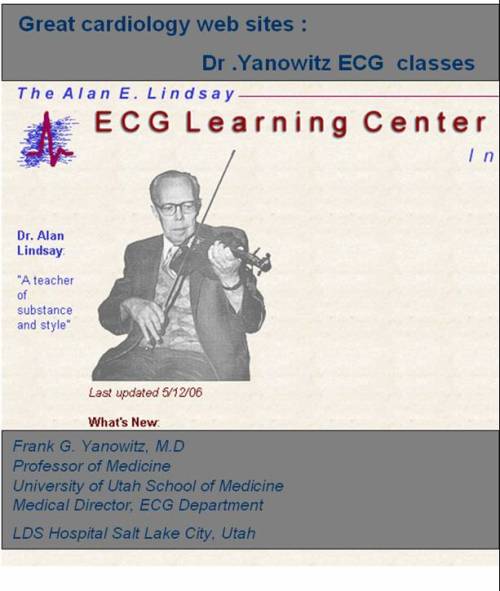
This learning resource is  a must read for all cardiology fellows

Frank G. Yanowitz, M.D
Professor of Medicine
University of Utah School of Medicine
Medical Director, ECG Department
LDS Hospital Salt Lake City, Utah

Click the link to reach the master teacher

yanowitz great cardiology ecg website


Read Full Post »

The   failing heart  enlarges progressively and  attain a globular shape . What  looks  for the  naked eye  as a simple global hypokinesia of LV  , when  analysed  ,  reveal multiple  forms regional desynchronisation .This is especially true if the QRS complex is wide.

It is generally divided into three groups

  • Intraventricular desynchrony (IV)
  • Ventriculo-Ventriculo desynchrony(VV)
  • Atrio ventriculo  desynchrony(AV)

In our search for improving CHF mortality and morbidity  ,  we have  stumbled upon this concept of restoring the lost synchrony of the heart. Cardiac resynchronisation therapy  has become ( Rather projected to become !)  a  great modality for patients  with cardiac failure.It was   initially advocated only   for severe forms of cardiac failure  , now  advised even for class 1 CHF. (CRT-MADIT 2009)

Restoring  the lost  synchrony  by rewiring the cardiac conducting system with multiple leads and optimally timed pacing increases the effectiveness of cardiac contractility.It can improve EF, and also regress mitral regurgitation.

The above concept was perfect on paper , but was very difficult to replicate on real patients. CRT was ineffective in 30% of patients.   Many had partial  effect. Few had adverse effect .

The reason for the poor efficacy  is  technical in many .  Identifying the optimal  sites for  positioning  the leads  and the futility of such an  exercise as the LV epicardial  lead is pre- selected by the patients coronary venous anatomy are the major issues.An electrically ideal site for pacing  can  contain a  mechanically dysfunctional scar.   While these  technical issues may  be addressed  in due course  what worries us is the conceptual flaws.

Emerging  facts indicate timing of asynchrony could be vitally important.

  • Systolic   synchrony
  • Diastolic synchrony

What is the incidence desynchrony with reference to the cardiac cycle ?

CRT resynchronisation

One major reason that was overlooked totally was the presumption cardiac dysynchrony occur only during systole. It is a less recognised fact is the ventricular relaxation is not uniform and synchronous.A  failing ventricle can not be expected to relax  systematically and coherently  for the simple reason the myocytic calcium reuptake into the sarcoplasmic reticulum  is grossly impaired. This  is directly responsible for the diastolic dysfunction observed in dilated cardiomyopathy . If this impairment occur uniformly throughout the  left ventricle it can be termed global diastolic dysfunction which is little easier to correct .But what really happens is  the  defect in calcium reuptake occurs in a random fashion with lot of regional variation. This is called regional diastolic wall motion defect or regional diastolic dysfunction.The above mechanisms result in the typical restrictive filling pattern of many of the advanced  patients with DCM . CRT as a concept should need to address this issue.

How to diagnose Diastolic WMD?

The  fact  is  ,we have not  mastered the quantification of systolic WMD as yet. It may take years before decoding the  nuances  of diastolic wall motion defects. At least we need to know such a thing exists.Tissue  doppler strain rates ,  velocity vector imaging could be useful tools. As such they are not clinical tools.

Final message

crt cardiac resynchronisation asynchrony echocardiography

Cardiac resynchronisation as a concept is good on paper . Heart need to be synchronous both during systole and diastole .This becomes especially important in an advanced stages of  heart failure. Without proper follow up  and potential adverse effects of CRT on diastolic WMD ,   CRT concept    has  miles to travel !  . Some  pessimistic thinking   cardiologists ( Me . . . !)   would even argue  it as a case of prematurely released device into the  patient domain. Of course there is  lot of  scientifc data that  will vouch for its beneficial effects .(The latest being from the prestigious NEJM ,  CRT-MADIT) but it has to prove it’s worth in individual patients. Physicians must exercise caution  before embarking on heroic  attempts to provide resynchrony of failing hearts .

Reference

This study from France published in JACC 2005  by Iris Schuster,

http://www.journals.elsevierhealth.com/periodicals/jac/article/PIIS0735109705021005/fulltext

Coming soon

ICDs are better bet than CRT

Read Full Post »

Left ventricular  hypertrophy (LVH) is one of the most common  structural heart disease.Systemic hypertension, aortic valve disease are responsible for the bulk of the cases .Some  of the LVH occur due to cardiomyopathy (HCM/Non HCM variants).Athlete’s heart is a physiological response to exercise and  it  is largely a normal entity.

How many patients with SHT develop LVH ?

It is surprising to note , not every patient with SHT develop LVH .In fact estimates suggest only  about 30-40% of chronic  hypertensive individuals develop SHT .

What are the determinants of LVH in SHT ?

  • Magnitude of systolic pressure
  • Magnitude of diastolic pressure
  • Pulse pressure
  • Duration of SHT
  • Age
  • Gender
  • Body  weight/Obesity
  • Effect of treatment

While any of the above factors may operate in determining LVH

none of the above are important than this

“Genetic susceptibility ”

The myosin isoforms are determined by the genes .The re expression of   fetal isoforms in adults is responsible for LVH in many .This is determined by the genetic homogeneity

LVH  in  renal disease

Secondary hypertension due to renal dysfunction is a major determinant of LVH. This is espcially true if the pateints are dialysis dependent.The mechanism are not clear .

Diabetes and SHT :  LVH  friendly forces

When diabetes alone and SHT alone is less likely to result in LVH the combination of these two entities greatly increase the likely hood of LVH.DM induced microangitis amplifies the after load effect of HT and result in early LVH.Further this LVH is different from pure forms of hypertensive LVH  in that the interstitium goes for hypertrophy and in some cases neovascualrisation. In hypertensive LVH it is predominately myocyte hypertrophy  with little interstitial  proliferation. this has important therapeutic implication as any drug which reduce the blood pressure can regress pure myocytic hypertrophy, while in diabetic LVH  regression is difficult to achieve .

Lipid levels inversely related to LVH ?

There is no consistent relation between lipids and LVH .Occasional reports suggest a negative correlation.

Which LVH is associated with diastolic dysfunction ?

It is a well known fact , LVH has major effect on LV diastolic function.But it is also a fact only some forms of LVH develop this. Now it is clear only if the interstitial hypertrophy occur  diastolic dysfunction is manifested.  Even as the as the hypertrophied  myocyte  continue to  relax  the interstitium do not have molecular mechanisms to relax .Hence, as discussed earlier , diabetic hypertensive patient often  develop diastolic dysfunction .

Final message

LVH is not a simple expression of raised after load.It has major  non hemodynamic determinants which if identified , could have important therapeutic implication.

Coming soon . . .

Can  coronary artery  disease induce LVH in the absence of SHT or DM ?

//

Read Full Post »

The quantum of electrical energy reaching the surface of the chest wall varies widely .It depends upon myocardial mass, proximity to the chest wall  and the thickness of chest wall.

Apart from this ,  the amount of blood within the left ventricle also determine the QRS voltage of ECG.

In dilated LV due to a regurgitant lesion , the LVEDV is increased . Since  blood is a very good conductor of  electricity , it amplifies the transmural  activation front and results  in high voltage QRS complex.This is referred to as Brody’s effect.

Where else , we  can  visualise the Brody effect  ?

During excercise stress testing , when  the heart rate and   the  LV diastolic volume increases .There is  a significant increase in QRS  voltage in leads facing LV, especially V5 and V6.

This is  usually a benign response in healthy individuals. However in patients  with preexisting CAD and LV dysfunction an  increase in R wave amplitude may  be a marker of  exercise induced LV dilatation  which  could  predict an adverse outcome .

Is there  a reversed Brody effect , where Q waves get deepened on exercise ?

This has not been described in literature , but it is seen often in patients with post MI stress testing .Q gets deepened .If the q gets minimised* it could indicate presence of significant viable tissue  , as it gets recruited during the excercise induced positive inotrpism mediated by   catecholamine .Lengthening or deepening of Q indicate less viable tissue.

*Study in progress : Will  be referenced shortly .

Brody effect is a complex phenomenon.

Advanced readers follow the link for illustration on Brody effect

http://www.bem.fi/book/18/18.htm

Read Full Post »

Human body is made up of trillions of cells. Some of these cells are specialised and connected together to form various organs.The cells that connect each other  provides the   structural  support  and   maintain the organ   shape  and function.  Traditionally  these supporting cells were  thought  to have little functional role. Now it is well recognised these cells   could be as  important as  the myocytes or   hepatocyte . God  has  never created any of the human cells with  out any purpose . They may  have  important paracrine function.  Healthiness  of these interstitial cells are vital for the intercellular communication, cell nutrition  and it’s  proper function . These cells are called by  various names , the old  terminology could be the connective tissue -the tissue that connects  cells. Many times  fibroblasts is the common name given to all interstitial cells . Interstitium is not only filled with some bizarre mesenchymal cells it is also a  depot of  sticky molecules.  Now we have  deeper knowledge about these  , and identified various intercellular adhesion molecules, matrix metallo proteins   , vitronectins, etc.

cardiac interstitum intersitial fibrosis amyloidosis

It is  a great  medical paradox   the specialised the myocytes, hepatocytesaxonal cells are given  due respect,  while the role of  cells and molecules that bind them together is least  appreciated . In fact in any given organ the functional cells constitute  only one third  of it’s weight.In the heart myocytes form only 30% of it’s weight. It is a clear cut case of discriminating the majority !

Interstitial disorders and  diseases

In the lung Interstitium becomes very much important because the gas exchange has to  traverse the interstitium and enter the alveloar cells. So any abnormality  here  is immediate and profound.The diffusion capacity reduces  .Patients  develop  progressive COPD.

In the kidneysinterstitium has a functional component as the absorbed fluid and electrolytes  has to reach the blood circulation .Hence  acute and chronic interstitial  nephritis are distinct clinical  entities .

In the brain dysfunctional  inter neuronal cells can interfere  with various CNS  functions dementia the major  disorder  id thought mainly contributed by the interstitial fibrosis.

cardiac interstitum interstitial fibrosis myocardial

So when each of the vital organ has a potential  to suffer from  interstitial    pathology How can heart  alone escape ?

No, it does not . The  currently popular entity   , heart failure with normal ejection fraction   could be nothing but   chronic  interstitial  carditis. or chronic progressive interstitial  fibrosis.  Hypertensive heart disease is a major cause . CAD can also contribute .

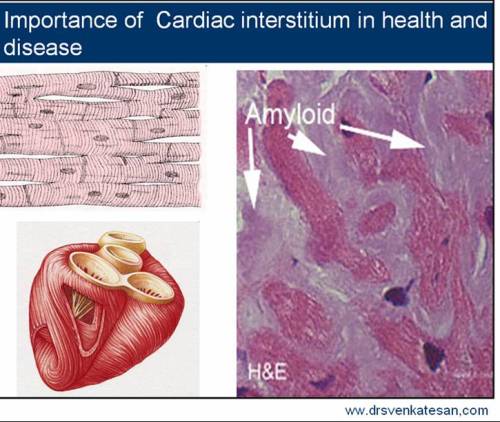
The interstitial  fibrosis  is also a feature of  dilated and restrictive cardiomyopathies. (Classical amyloid heart disease ) .Initially  these fibrosis do not affect the  contractile  function of  myocyte .In later stages it encroach  upon the contractile  cells and impair the EF. This explains  the natural  history of many of the RCMs which   go for dilatation and contractile dysfucntion in terminal state.

What is the difference  between myocyte relaxtion and  cardiac  relaxation ?

  • It is now recognised , cardiac  interstitium has a big  role in relaxation .
  • Cardiac relaxation is not synonymous with myocardial or myocyte relaxation .
  • For  myocyte to  relax ,  it has to eject back the calcium from the actin myosin complex  into the  sarcoplasmic reticulum where the calcium uptake protein   phospholamban holds it till the next systole.
  • As the myocyte relaxes  it has the additional  burden of stretching &  relaxing the adjoining  non myocytic cells  , unfortunately this   weighs 70% more than it’s own weight .One can imagine how much the heart is stressed during  even diastole ! So as  the sheets of myocytes feel the diastolic interstial stress the whole LV struggles to relax and LVED raises and diastolic dysfunction begins to set in.
  • The interstitial l plasticity and elasticity is vital for cardiac chamber to  reach it’s pre contractile  state . It is now recognised the rate of LV relaxation  (Negative dp/dt )  is directly proportional  to the interstitial  agility and turgor .

How to overcome interstitial  fibrosis and stiffness ? Anti fibrotic drugs ? .

We are in search for such a universal anitifibrotic drug that can work in liver fibrosis ( Cirrhosis ) lung  and myocardial fibrois. D penicillamine has  showed some promise. How to make the interstitial interface more flexible ? Collagenolytic agents , elastase MMP inhibitors etc may become the   future targets.  A much established  way to regress myocardial fibrotic process is ,  with ACEI and aldosternoe antogonists. (EPESUS, RALES study) .Some of the   anti myocardial remodelling  action of  ACEI is attributable to it’s  anti  growth factor properties and can  the resultant regression of  interstitial fibrosis.

Apart from the look out for sophisticated drugs ,  applying common sense can do  a “great deal of good “for the myocardium in  diastolic cardiac failure  . A stiff  skeletal muscle need physiotherapy. A stiff cardiac muscle will also   need exactly this. For  cardiac muscle physiotherpy can not be administered by a therapist  ! , we have to do it  , regular  exercises   to make it contract  and   relax  fast . So ,  it is important to recognise  exercise   prescription and training  could be the  most  important modality  for preventing progression of diastolic heart failure.

Clinical situations  where   cardiac interstitial pathology is  relevant

  1. All forms of cardiac failure
  2. Some forms  of myocarditis
  3. Myocardial interstitial  edema ,Post MI/Reperusion
  4. Myocardial interstitial edema mediated no reflow following primary PCI
  5. Acute and cardiac transplant rejection
  6. Drug induced adrimycin carditis .
  7. Cardiac interstitium arrhythmias : Many of the cardiac arrhythmias are due to re entry circuits mediated by cardiac interstitial fibrotic substrates.
  • Atrial fibrillation
  • Post MI ventricular  tachycardias

Final messge

Deep dissections  of  pathological hearts   in pursuit of   culprit cells has surprisingly ,  lead us  not into myocytes and conducting  cells but into inter cellular spaces” . There is  big secret  world over there within the cardiac interstitum.Young scientists and students  argued to   explore and unravel the mysteries !

Reference

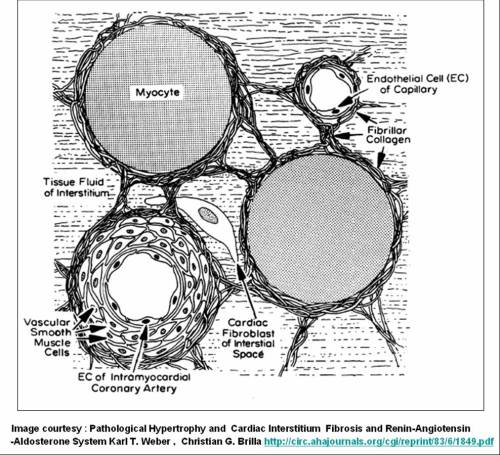
A landmark article in Circulation 1991

Pathological Hypertrophy and  Cardiac Interstitium  Fibrosis and Renin-Angiotensin-Aldosterone System
Karl T. Weber, MD, and Christian G. Brilla, MD, PhD

http://circ.ahajournals.org/cgi/reprint/83/6/1849.pdf

Read Full Post »

ST segment depression is the classical response to stress during  excercise stress testing. (EST)Not all types of ST segment are  pathological.The ST segment should depress  atleast 1 mm below the  isoelectric segment and it should be depressed for 80msec from the  J point.

It must  satisfy   two criteria .

  1. The quantum of ST depression should be >   1mm at 80msec from  J point.
  2. Slope of ST segment

Always pathological slopes

  • Horizontal
  • Down sloping

Most often pathological

  • Slow up sloping

Non pathological slope

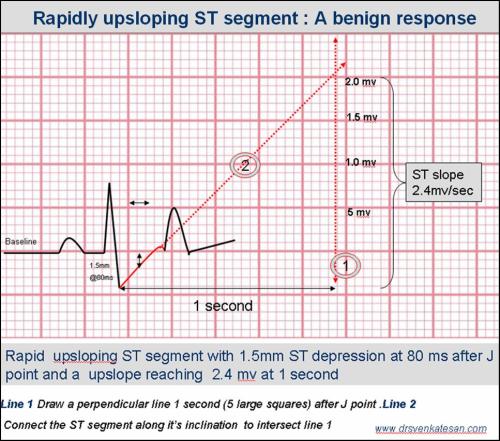
  • Rapid up sloping with ST depression
  • Rapid Up sloping  depression of  only the J point( The classical  normal physiological response to excercise )

Horizontal or down sloping ST segment is easily recognised .When there is  junctional ST depression with a ST segment that is  climbing upwards , it is some times difficult to interpret.

How do you measure the slope of ST segment ?

We don’t have the trouble of measuring it as the computer does this job automatically. But a cardiology fellow  need to know how it is measured !


slow upsloping st depression st segment ecg

A slow upsloping ST segment( <1.5mv.sec )can be a significant marker of ischemia.This is especially true in established CAD or individuals at high risk . For  so slow up sloping a .5mm allowance is given to filter out false positive (ie to improve sensitivity) . So for slow up sloping ST segment , to be reported as positive it should depress atleast 1.5mm or some times  2mm.

upsloping st segment tmt st slope ecg

Available evidence suggest a rapidly upsloping ST segment (> 1.5mv /Sec)  is a non ischemic response irrespective of the quantum of ST  depression  at 80msec. However ,  a rapidly upsloping ST  is rarely depressed beyond 2mm .( This is because , the geometric hyperbolic curve  of ST segment does not allow a situation of  3mm ST depression at 80msec with rapid upsloping )

What is the  angiographic correlation of  slow upsloping ST segment depression?

Few studies are availbale  to address the issue. It is believed  slow up sloping  of  ST depression is often associated with CAD but it is very rare to find a critical and proximally located CAD.Left main disease is almost never manifest with slow upsloping ST depression.

What is the significance of slow upsloping  ST in clinical situations like unstable angina ?

It is rare for cardiologist to diagnose or “even look for” slow or  rapid up sloping ECGs in coronary care units. But , a  patient with stable  CAD ,  sinus tachycardia ,  angina can exactly mimic a stress test  situation .

Some of the low risk UA , mainly secondary UA due to increase demand situations manifest with slow upsloping ST depression , while classical thrombotic occlusions produce the typical horizontal or downsloping ST segment depression.

Read Full Post »

Primary ventricular fibrillation is the number one killer in STEMI.It is  believed to occur  ( Rather it occurs really !) in up to 25 % of all patients with STEMI before they reach the hospital and another 4% after reaching the hospital.

What triggers this primary VF  ?

Easily answered : It is the  acute ischemia in majority.

Why it triggers in only in some patients? The  rest reach the ER safely and  some  casually walk in to the  OPD  few days  after a STEMI

This can never be answered with our current knowledge base. Some call this as fate !

Scientists should work hard on this issue, if we know the answer we could  possibly prevent the number one killer of the mankind at bay.

ventricular fibrillation ecg

Many factors are being analysed  to find the reasons for primary VF

  • Extent of infarct
  • Area of infarct
  • Intensity of pain
  • Adrenergic drive
  • Gender
  • Myocardial critical mass
  • Is it the  left main STEMI ?
  • Is it a bifurcation STEMI ?

If nothing  explains the VF it is always safe to blame it on susceptibility and inherited risk for primary VF , which of course is very much likely as the K+ channel  activity and it’s response to ischemia  is largely inherited

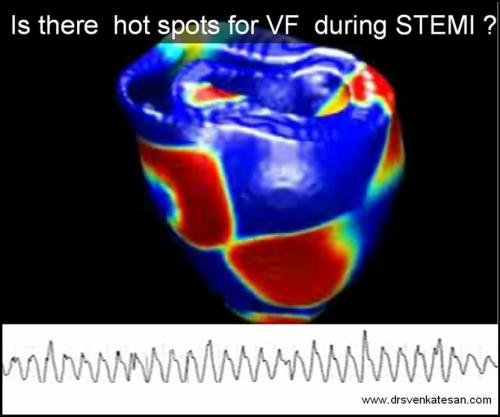
Is there any hot spots in the heart that are hypersensitive to ischemia ?

Some studies have clearly documented increased incidence of primary VF in infero posterior MI , and RV MI

than anterior MI .   J Am Coll Cardiol 2001; 37: 37-43

Why  ischemia of a certain location of heart should be more prone for  primary VF ?

The answer is any body’s guess.

Some intriguing possibilities are ,

  • RV is a anterior chamber , when infero posterior MI occur in association with RV MI  the ischemic zone encircles a almost 50% of heart like a band .This could be one explanation for more incidence of VF in infero postero RVMI.
  • Any MI which involves a  antero -posterior axis  of heart is likely to trigger a VF
  • Some of our patients  who survived a primary VF had a short left main  and early bifurcation with a large diagonal branch.The lesion was noted in the bifurcation.This raises a possibility ,  if a STEMI occur at a bifurcation with two divergent areas of  acute ischemia it has a high chance for precipitating a VF.

Related video by the author

Ignorance based cardiology -You tube

Potential research areas

Genetic susceptibility

Environmental Energy flows and primary VF

Some believe  a role for astrological  forces and  VF

Read Full Post »

« Newer Posts - Older Posts »