Feeds:
Posts
Comments

Archive for the ‘Cardiology – Clinical’ Category

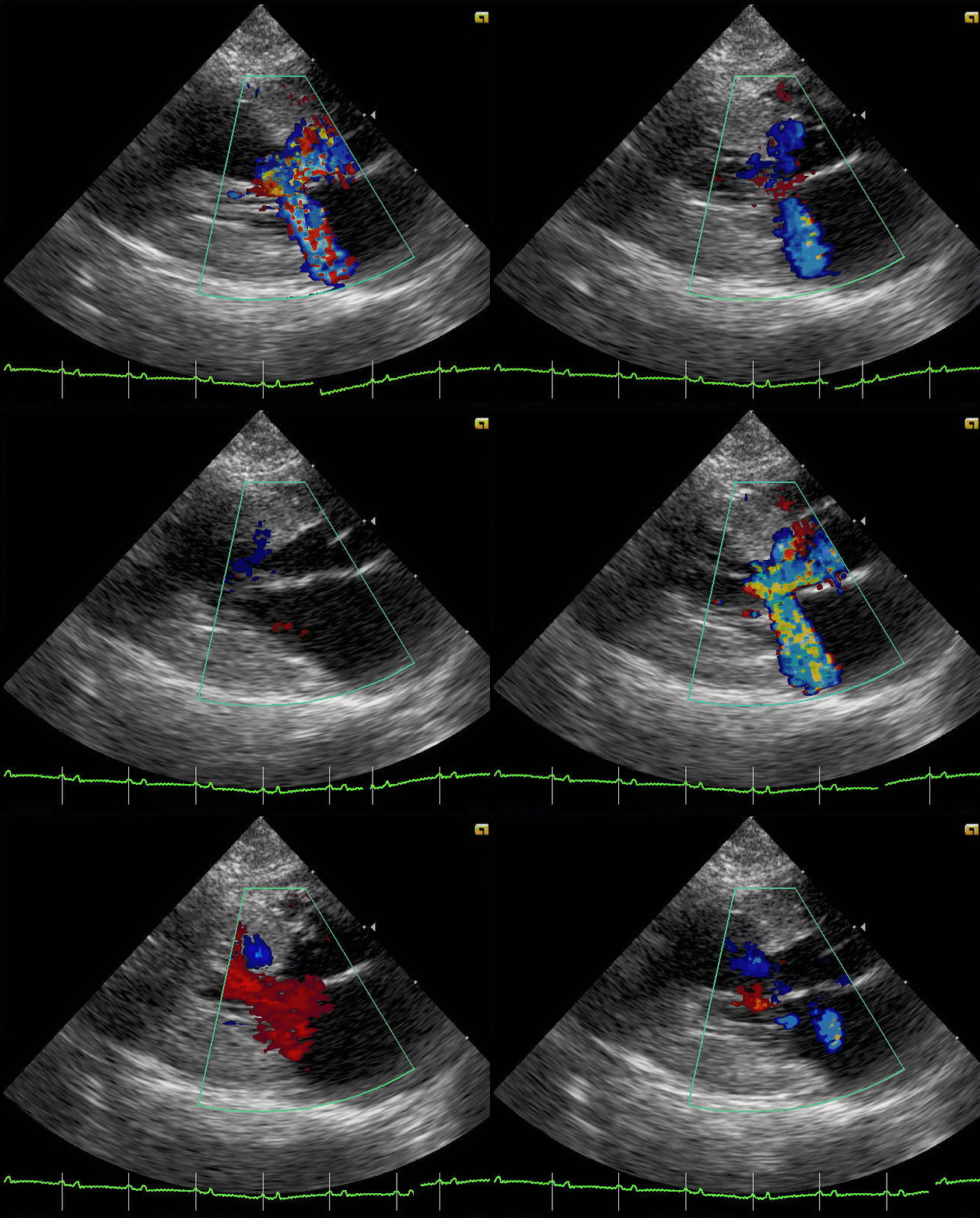
Cardiac myxomas are rare tumors. But they present in a dramatic way. It can have  severe  systemic symptoms and present even as  fever of unknown origin ! While , physicians  of  previous era were struggling to make a ante-mortem diagnosis we are blessed  to make a instant  diagnosis with echocardiography !

Want answers  for all these  from the original researchers ?

  • What is the pathology  myxoma ?
  • What  are the  classical Locations ?
  • Difference between Sessile Vs pedunculated
  • Soft vs Hard
  • Benign vs malignant / Locally invasive
  • Recurrent myxomas
  • Vascularity  of myxoma
  • Calcification (RA myxoma> La Myxoma)
  • Non atrial  myxomas(Valvular  papillary myxoma)
  • The  Cell of origin (Stellate , polyhydral )

You  will not get a better reference than the following article , including extensive illustrations . An 1980 article from  Mayo clinic published in American journal of pathology

http://www.ncbi.nlm.nih.gov/pmc/articles/PMC1903582/pdf/amjpathol00223-0227.pdf

LA myxoma  : A Video

A case reported from my hospital Hosted as Video presentation  Follow the link

http://www.youtube.com/watch?v=SD2LrK1mdic&feature=related

Read Full Post »

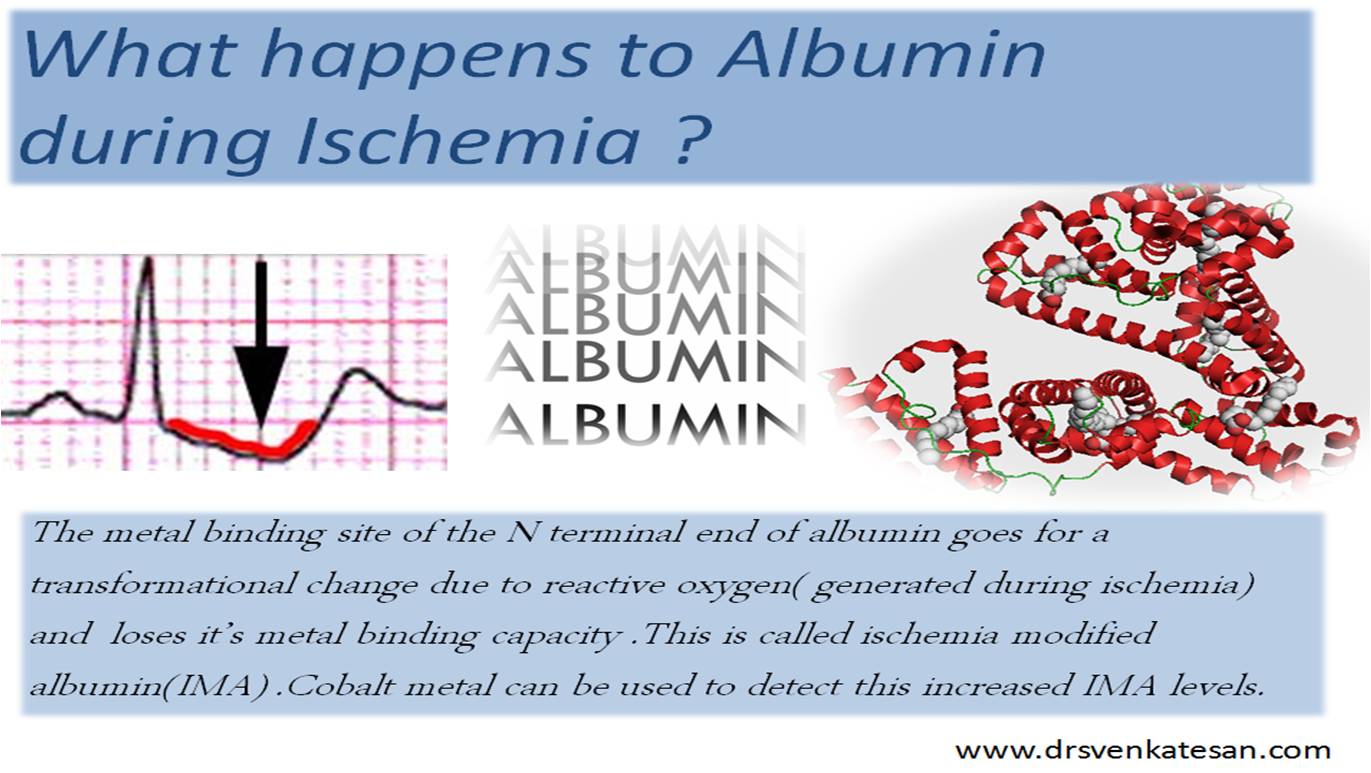
In the diagnosis of ACS, we have definite bio  markers for acute MI . Further, ECG  has a good  spcecificity  for STEMI . While ,clinical and ECG features of ischemia are not perfect. A bio marker for ischemia is the ultimate dream of cardiologists  and  emergency room physicians. . In this context , the IMA -ischemia modifed albumin  has come  with   great expectation .

Ischemia modifies what ?

Normal albumin moleule has  a metal binding site (Copper ) .There are few free binding sites available .During ischemia this metal binding capacity  reduces .  A cobalt containing  reagent when added to ischemic blood  finds binding sites scarce , and hence  excess free  cobalt  will color the sample  and a  posiitve test for  ischemia is diagnosed.

*Normal human albumin  may contain  2%  of ischmia modifed albumin which is expected to increase up to 6% during ischemia

IMA raises not only during ischemia it can also  raise during oxidative stress

  1. Stroke, 
  2. Chronic kidney disease 
  3. liver disease,
  4. Maligancy

It can also  be elevated following

  • Routine coronary angiogram
  • PCI
  • DC shock

Increased lactic acid for example in sepsis may reduce the IMA level and can miss an episode of true ischemia

Final message

IMA can be a useful tool to identify  ischemia early .But lacks senstiivty . New improved immunoassays may be more sensitive and specific

Reference

1 .Medscape review  

2. Circulation article

3. PRIMA study which  was done in ER in risk stratifying ACS proved IMA is not vey useful  http://emj.bmj.com/content/23/10/764.abstract

Read Full Post »

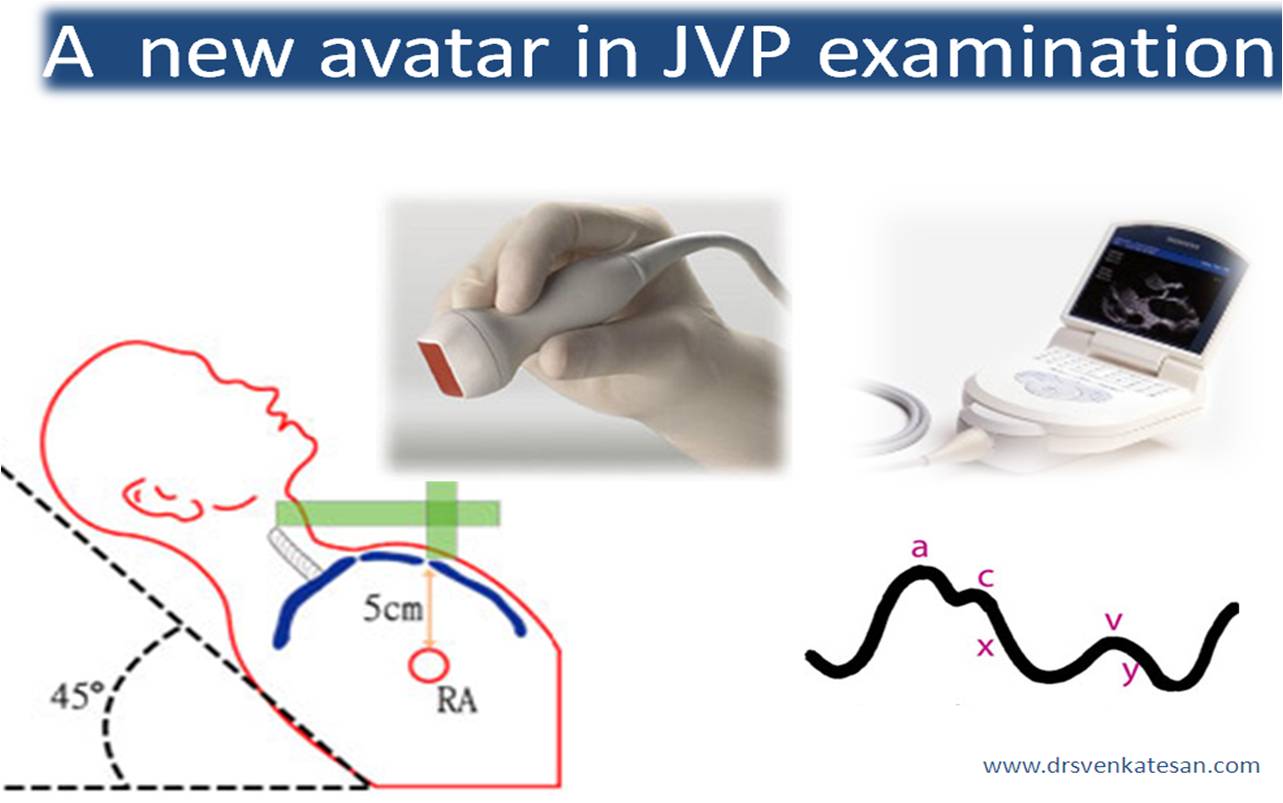
Looking at the neck veins for hours  together  has been a favorite pastime of our cardiology ancestors.Thanks to those sharp intellect , that has led us to this height of cardiovascular revolution. Measuring JV pressure by itself was considered a big science. Putting a patient in 45 degrees , marking the sternal angle, identify the  oscillating venous column,  measuring   the vertical distance  etc . . .

Now in 2010 , with bedside hand-held echo one can rapidly  rule out an elevated  central venous pressure by imaging the jugular vein directly . Here is an article from American heart  journal

http://www.ncbi.nlm.nih.gov/pubmed/20211304

Simon MA, Kliner DE, Girod JP, et al. Detection of elevated right atrial pressure
using a simple bedside ultrasound measure. Am Heart J 2010; 159:421–427.

Soon , your mobile will double up as ultra-portable  echocardiogram

Read this related article in this blog .

Coronary care in your pocket

Read Full Post »

Hypertrophic cardiomyopathy (HCM) manifests   with or without obstruction. Obstructive HCM ,  (ie HOCM)  is more often symptomatic .However , the risk of arrhythmias, sudden death, and some degree of diastolic dysfunction are common in both.

ECG, clinical examination are generally  not sensitive to identify obstruction in HCM  .Echocardiogram is the easiest  way to identify  the obstruction (gradients> 3o mmhg across LVOT are considered significant ).LV angiogram ,MRI, CT scans are rarely necessary today.

However , the following clinical clues will help us  to suspect significant obstruction in HCM

History

  • Class  2 or  3 dyspnea.
  • Exertional syncope
  • Exertional angina

Pulse

  • Pulsus bisferiens (Two peaks in systole )

LV apex

  • Sustained , double apical impulse  often indicate obstruction.
  • Presence of Mitral regurgitation ( 20% can have  MR without obstruction due to intrinsic abnormalities of  mitral valve )

* It should  be realised , valsalva induced MR /LVOTO  may occur in many of the non obstructive HCM.

What happens to  clinical signs of obstruction with medical therapy(Beta blockers etc)

One would expect these signs to regress or disappear, but it rarely happens. The pulse , the  murmur show  little change .  This implies , the main mechanism of beneficial effect could be in  heart rate  reduction , and  improvement in the   diastolic properties of left ventricle.

Read Full Post »

The commonest cause of syncope is the neuro-cardiogenic or vasovagal syncope .

The following is  the possible neural  circuit  of this syncope . In fact . it is a  “Neuro -vascular circuit”

The afferent* (Two components  are present  -Both trigger sympathetic signal )

  1. Sympathetic (Prodrome /Anxiety /fear )
  2. Cardiac mechano /stetch receptors  located mainly in LV .(Can be in Aorta/Carotid )

* In some cases sensors  and afferent can be same entities.

The centre – Medullary Nucleus ambiguous /Tractus solitarius

The efferent -Strong parasympathetic overshoot and sympathetic withdrawal

Parasympathetic excess lead to bradycardia primarily, while sympathetic  withdrawal lead to

hypotension

Syncope recovery

As patient recumbent posture ; LV gets filled and  LV mechanoreceptors are passified .

Final message

The exact pathophysiologic basis of this syncope  still  not elucidated.But one thing is clear , the syncope is due to sympatho- parasympatho signal mismatch( and sort of a rivalry reaction)  !In this neural game , heart’s behavior is all the more funny , it initiates the reflex  while  the brain stem  “Boomerangs” it back to heart and vascular system ,  with a vagal onslaught .

To call this  simply as vasovagal  is not proper , that is why neuro -cardiogenic syncope was used.

Ideal terminology  would be  to call it as  cardio -neuro -cardiac syncope   as the cardiac component form the afferent limb as well as the efferent (target organ )

Reference

Read Full Post »

LVH is one of the commonest ECG abnormality . We know the hall mark  of LVH is increased QRS voltage .We also know , ECG is not a fool proof method to detect LVH .It has very good specificity , but little sensitivity , meaning that increase in  QRS voltage is  fairly accurate in predicting LVH  but absence of  which cannot exclude LVH.

Why Increased QRS voltage does not occur in many with LVH ?

Even though we think myocardial mass  is  the  sole determinant of QRS  voltage  , in reality  it   is determined by many other factors.

  • Distance between the ECG lead , and the myocardium is an important factor. In classical concentric LVH , the LV  cavity is not enlarged ,in fact it may shrink a little as the hypertrophy grow inwards and obliterate the LV cavity.(We do not know yet , how much of LVH grow out and how much  muscle grow in ! )
  • The blood volume within LV is a very good conductor of electricity.A good volumed LV may augment a QRS voltage.
  • This can be observed in some of the patients with DCM , where high voltage QRS  is recorded mimicking LVH.

But ,what really matters is the fine balance of blood volume and myocardial mass that determine the incidence and magnitude of LVH pattern in ECG.

QRS voltage as a tool to differentiate pathological from physiological  LVH

We know QRS current is generated from within the myocytes .If the myocytes  are  uniformly hypertrophy without altering the  basic mechanical and electrical architecture QRS complex will be amplified in a sm0oth manner and result in  classical high voltage  QRS  of LVH.

If the hypertrophy occurs in a disorganised fashion, where in myocardial fibres slips out of plane  with adjacent muscle bundles, the QRS  voltage may not increase and even be slurred or notched as we see in many cases of LVH with non specific intravascular conduction defects

The classical disarray of myocardial fibers that occur in HCM causes  pathological q waves.

* Other factors that determine LVH include bundle branch conduction delay or blocks which is not discussed here.(Ex: An incomplete LBBB can amplify the qrs without any LVH )

LVH with fibrosis

Fibrosis is not a standard feature of LVH. It occurs in few who are genetically predisposed , and  mediated by heightened sensitivity to circulating growth factors.

  • Fibrosis can have wide impact on the electrical as well as mechanical function of heart.
  • Fibrotic heart has a  potential to  blunt the  high voltage  QRS complex.
  • It  may even cause  pathological q waves .It predispose to ventricular arrhythmia
  • It prevents regression of LVH , even after the loading conditions corrected.

Other conditions that  attenuate LVH features in ECG

  • Diabetic hypertensive show less ECG voltage than isolated HT .
  • CKD patients often do not show ECG features of LVH inspite of LVH

Final message

Diagnosis  of  LVH by ECG is a  simple clinical exercise , but we realise now , the underlying mechanisms are too complex .

A simple question , ie  Why  every one  with LVH  do not increase  their  QRS voltage  ?  . . . exposes  our ignorance on the subject!

But one thing is clear, physiological LVH (Meaning LVH ,  purely due to loading conditions including SHT/Aortic stenosis)  more often result in high voltage , while  in true pathological LVH(infested with fibrosis ) the  increase in voltage is not consistent .

Read Full Post »

We have conquered  CAD with coronary  stents !  really ?  atleast , that is  what ,  many  of us  are made to  believe !

But , the fact is , modern cardiac science  with all those fancy intra coronary  devices has shifted the CAD population into  cardiac  failure population. We have extended the life of humans by at least few years and make them suffer recurrent coronary events and ultimately LV dysfunction  and cardiac failure .

We know , cardiac  failure  can not be  conquered with medicines and surgery . Cardiac  transplant  has been very successful ,  but it needs one human death to give one  life to other , and “deaths” can not be bought in stores or  donated at will !

So , the only alternative for  terminal heart failure  is total artificial   heart.(Organ farming or cloning not included ) The research is going on for the past 50 years. We are definitely on  the right track. By 2050 , my guess is  no human being  should die of heart failure .

Meanwhile , number of partial answers for  failing hearts  which are  popularly referred to  as LV assist devices are coming up.

In many cases the failing native heart supports the device  in a mutual fashion thus extending the life of the device as well .This is important because in case of total artificial heart there  is no back  up available.

These axial LV pumps just augment the overall circulation status and in the process unloads the native heart and prolongs it’s running time.

In the future one may think about  number of serial pumps in the circulatory  system rather than a single bulky artificial heart which is fraught with serious maintenance issues.

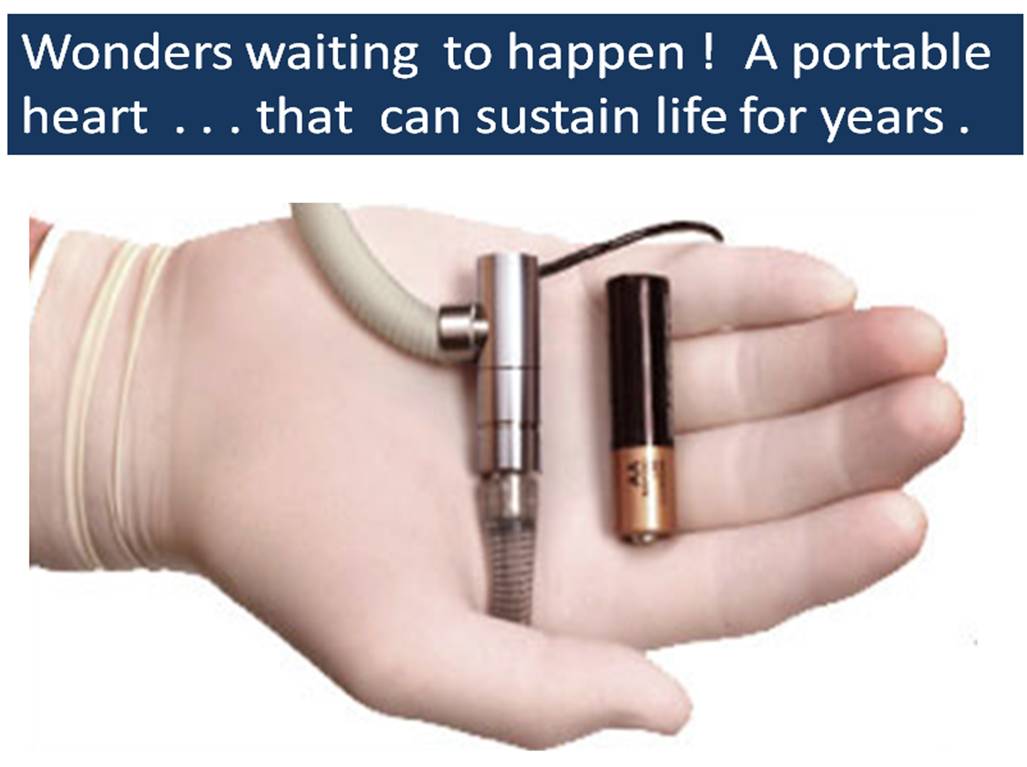
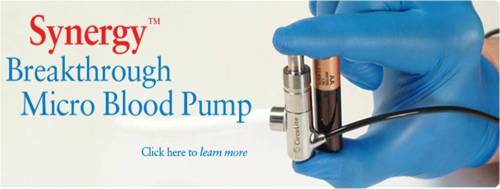
The most promising one such device is from Germany

  • A small AA battery sized tubular pump
  • Weighs 25 grams
  • Receives blood from  left atrium  pushes it into subcalvian artery
  • Can have a stroke volume of 10-15cc /beat*
  • Capacity to pump  a cardiac output of 3l/mt (This amounts to 100% augmentation in most terminal heart failure patients)
  • Can be implanted like a pacemaker

* There is little  end diastolic  residual blood in this pump .

Picutre courtesey  www.medgadget.com

Link to  http://www.circulite.net

Read Full Post »

How  central cyanosis occurs  in primary pulmonary hypertension ?

While , peripheal cyanosis*  is easily explained in PPH ,the mechanism of central cyanosis is not straight forward.

The following explanations are offered

  1. PFO**  getting  opened due to high mean RA pressure
  2. Pulmonary arterio venous channels.(Neogeneis or dormant channels activated )
  3. Altered QP/QS .This effectively means lung shunts some blood without oxygenation(A right to left to shunt within lungs )
  4. Associated lung pathology -like pneumonia resulting in pathological right to left shunt across the alveolar circulation.

* Peripheral cyanosis can occur in PPH with cardiac failure

**PFOs are often anatomically patent in 20 % of normal population , which gets functionally patent  when exposed to high RA pressure

Cyanosis -A brief  description .

Cyanosis occurs when the arterial saturation goes below 85 % . Cyanosis  manifests in two ways . Central and peripheral.The term peripheral  does not  denote  peripheral parts of the body  rather it is  peripheral  circulation.(Capillary) The mechanism of peripheral cyanosis is somewhat  different from central cyanosis . It is generally due to sluggish circulation ,  more  oxygen extraction and resultant bluish discoloration .

Peripheral cyanosis is seen in finger tips, lips etc . Peripheral cyanosis can not occur in warm areas of the body for the  simple reason warmth  causes vasodilatation , better tissue perfusion  which prevents stagnation of  deoxygenated blood.

Central oxygenation defect alone can not result in  classical central cyanosis .

For central cyanosis  to occur ,  there need to be mixing of  deoxygented and oxygenated blood somewhere in the  circulation.(Right to left shunt in the heart or lungs )

Since it is a defect in central  oxygenation it  manifests  in both warm mucous membranes as well as cold extremities.

Read Full Post »

It is a well known  cardiac auscultatory  sign,   S 1  becomes  variable in intensity with the onset of atrial fibrillation.

In physiology , the intensity of S 1 is determined by many factors.

  1. The valve morphology(Thickness, Calcium , Rigidity )
  2. Valve mobility
  3. PR interval
  4. Force of LV contraction
  5. Preceding RR interval (4 and 5 are inter related)
  6. Insulation and auditory factors (Thick chest wall  etc)

How does atrial fibrillation modify the intensity of  S1 ?

It is to be noted , atrial fibrillation alters only one  of the above factors, namely the RR interval which becomes irregular.

The mix of short and long RR intervals  occurs at random  . A short RR interval, results in a relatively softer S1  and vice versa . The mechanism is directly attributable  to the degree of LV filling and subsequent change in force of contraction .

Many times , at fast ventricular  rates (Say >150) the distinction between short- long cycles is  negligible in terms of net cardiac cycle.

If  the RR interval , is too prolonged there can be an  inverse relationship  with s 1 intensity .It gets  muffled as the  mitral valve floats back  to it’s  orifice and a partial or even complete  closure occurs , making  force of LV contraction irrelevant in the genesis of S1 .

The vanishing act of PR interval  in atrial fibrillation.

It does not require great brains  to  understand ,  if P waves are absent ,  PR interval must also be absent !

If PR interval is absent ,  there  can be no  influence of it on the first heart sound. Logic demands  absence of PR interval must have some sort of  influence on the intensity of S1. As far as i know cardiology  literature has not answered this query.

What are the two types of S 1 variation ?

Experince  has shown us , the variation of S1 can be of two types*.

Sequence 1 : Varying between , Loud -Louder- Loudest -pounding

Sequence 2: Varying between , Loud -Normal – soft -Muffled

* Applicable only for those with shrewed ears !

S 1 intensity with reference to underlying pathology : Valvular vs Non valvular atrial fibrillation

It is obvious the impact of  varying RR interval on  the intensity of S1 will directly depend upon the underlying pathology. The  intensity of   S1  in  non valvular AF (Like , lone AF, Thyrotoxic AF, Hypoxic  AF ,Ischemic AF etc)  are  more vulnerable to  changing   RR interval .

In rheumatic heart disease , the influence of valve morphology , rigidness, calcification and presence  of MR  generally prevail over the  impact  of changing RR interval .So,  in a case of tight mitral stenosis  and AF  it  is expected the sequence 1 is more common .

In lone AF or AF due to CAD , sequence  2 is more likely *  Associated LV dysfunction , and ischemic   MR may further dampen the intensity of  S1 .

Clinical implication

Hearing  few occasional  loud  S1 in AF , is an indirect indication that underlying LV function is good,  as it reflects the force of  LV contraction .

Silent AF

Some hearts are notoriously silent even in the midst of AF. If  the silence is not  due to obesity  or  other insulation defects,  it suggests a sinister diagnosis ,  like severely  dysfunctional ventricle  like  DCM etc.

As a corollary, it is often noticed ,  palpitations* are , often not  felt  by patients with dysfunctional  ventricles  in spite of atrial fibrillation. (As loud S 1 is rare with dysfunctional ventricle)

*Palpitation is a symptom that equates to Dp/Dt of ventricles.

What  happens to mid diastolic murmur in AF ?

The murmur length  varies  linearly with reference  to RR interval. The pre systolic  accentuation disappears ,but   pre-systolic component may persist .

Final message

Simple, bed side auscultation during atrial fibrillation can give us vital clues about the etiology, and the  underlying LV function .  Let us not be ashamed to talk about clinical cardiology  . . .at least in the bed side !

Read Full Post »
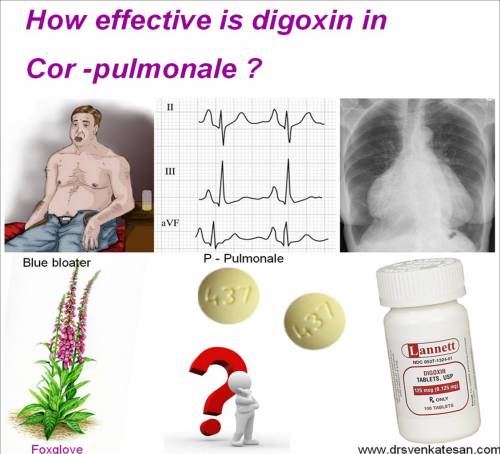
Digoxin is a wonder cardiology drug used for more than a century.We know the pioneering efforts  of  William withering  in detecting the potential  of the unknown  herb  Foxglove.

Mechanism of action

The beneficial effects of Digoxin is attributable  to

  • Positive inotropic  action
  • Vagal action

Digoxin blocks the sodium potassium ATPase in the  myocyte cell membrane .

This cause accumulation of NA + ions within the cells. The excess  Na , then   facilitates  the Na -Ca exchange port .

This pumps in more calcium   into the myocyte.

Increased  calcium means more forceful contraction and that is positive inotropism* .

* This is a  highly simplified version of   Digoxin’s action . It should  be remembered  simple availability of excess calcium can not guarantee  contractility,   as it requires adequate number  of receptors.

Digoxin  is used in which type of cardiac failure  ?

Digoxin is used for both for LV and  biventricular  failure .

Digoxins is still  often  in isolated RV failure  of any cause (Cor pumonale, PPH, Eisenmenger etc)


Digoxin and RV dysfunction

Digoxin  has a tendency  to  hit the atrial muscles  at random causing  multiple short circuiting (Micro reentry )   forming  a perfect nidus  for complex atrial arrhythmias  including MAT .The coexisting    hypoxia  (which is all the more common here )  aggravates the problem .

Inotropism of RV : Does it really exist ?

It is often quoted , RV is a passive pump. It does not mean inotrpism is an exclusive property of LV.

RV has to generate about 30mmhg to pump the blood into  the lungs.

In cor-pulmonale the RV works against an afterload of around 50-70 mmhg  , making  RV inotropism  much more important  concept.

Rate control in atrial fibrillation Digoxin lowers the heart rate by vago mimetic action ,  primarily in  AV node  and to a  certain  extent in SA node .Ventricular rate reduction  is the prime requirement  in the management  atrial fibrillation and this property  is still the crowing  glory of  Digoxin.

Though beta blockers and  verapamil  can be used as rate controlling agent ,  lack of negative  inotropism makes  digoxin    prevail   over , especially in severely dysfunctional  ventricle .

But , one disadvantage of Digoxin is , since it requires  a vagal traffic to mediate it ‘ s rate controlling effect , it  is less effective ,  when there is  high sympathetic activity as during exercise.

What is the action of digoxin on interventricular  septal contraction ?

Digoxin , simply does not know where it acts when administered in cor pulmonale  ! We believe in cor-pulmonale the maximum action would be the area of maximum dysfunction .This is purely  an assumption. In cor -pulmonale septum shifts it’s loyalty from LV to RV as the later is the distressed chamber.So , logic would be there  is a theoretical  compromise of LV function in  patients with cor -pulmonale. These factors make  the   inter ventricular  interaction and dependence a complex one.

Some believe  the improvement of sub clinical LV dysfunction in cor pulmonale may be more important factor in giving relief  to  the patient’s  symptom.

What are the other RV inotropes ?

Doubtamine has some RV inotropy  .This again may be due to a spill over effect from LV rather than a primary RV inotropism .

As such , there is no great breakthrough  in creating a powerful isolated RV  isolated RV inotropic dug.

Probably  the best way to  give relief to RV is to reduce the pulmonary artery pressure as invariably sever PAH  is the predominate  accompaniment

(Nitric oxide ,  Epo prostenol etc)

Final message

  • Digoxin , indeed has  some useful  role in cor- pulmonale .
  • But ,the benefits are more pronounced in late stages of RV failure.
  • Since the dose required to get an optimal RV inotropy is high the safety margin  is reduced.
  • Since there is a propensity   for complex atrial  arrhythmias  ,  it has to be used very cautiously in management  of   atrial fibrillation due to cor pulmonale .(Than in other forms of AF)

Read Full Post »

« Newer Posts - Older Posts »