Feeds:
Posts
Comments

Archive for the ‘Cardiology-Coronary artery disese’ Category

Angina is the classical clinical counterpart   of  myocardial Ischemia.

True  Ischemia , by electro- physiological rules  must elicit some sort of  ST segment shift .(Usually  ST depression rarely Elevation  )

But  . . .  we know Ischemia and ST depression do not always go together !  Dissociation can occur in both ways.

ST depression without angina is more prevalent  (often referred to as silent ischemia)  , while angina without ST depression is  less common but by no means rare .

We observe both these  phenomenon  during EST.  The  critical issue  here is ,  any pain without ST depression during a EST , the physician is likely to reject it as  non cardiac.

How wise  it is ,  to ignore such chest pain  ?

If a patient  complaints  true  compressive , squeezing  pain  it should be taken as angina  and EST should be  stopped and labelled as positive   even without  ECG changes .

According to the much   famed (De ) theory on ischemic cascade chest pain is supposed to come last. Time and again the rule of ischemic cascade  goes awry in the bed side. Clandestine angina without any ECG evidence be more important clinical entity than we realize.

                                      The argument against this ,  “If you start believing  patient’s  word  more than  ST depression  then the very purpose of EST documentation is lost  !

According to the now  de-famed theory on ischemic cascade ,  chest pain is supposed to come last. Time and again the rule of ischemic cascade  is found to go awry in the bed side .Clandestine angina without any ECG evidence be more important clinical entity than we realize.

Another clinical situation where we  encounter  ST segment  : Angina dissociation is ,  during balloon inflation of PTCA.

Two  explanations can be offered  for Angina in the absence of ECG changes .

1 .Cancellation of ST vectors  due to ischemia of two diagonally opposite areas of ischemia.

2. Electrical  blind spots  in 12 lead ECG. This  is especially common with LCX ischemia  where most of the electrical events are directed to back of the chest.Conventional leads can easily miss .

Read Full Post »

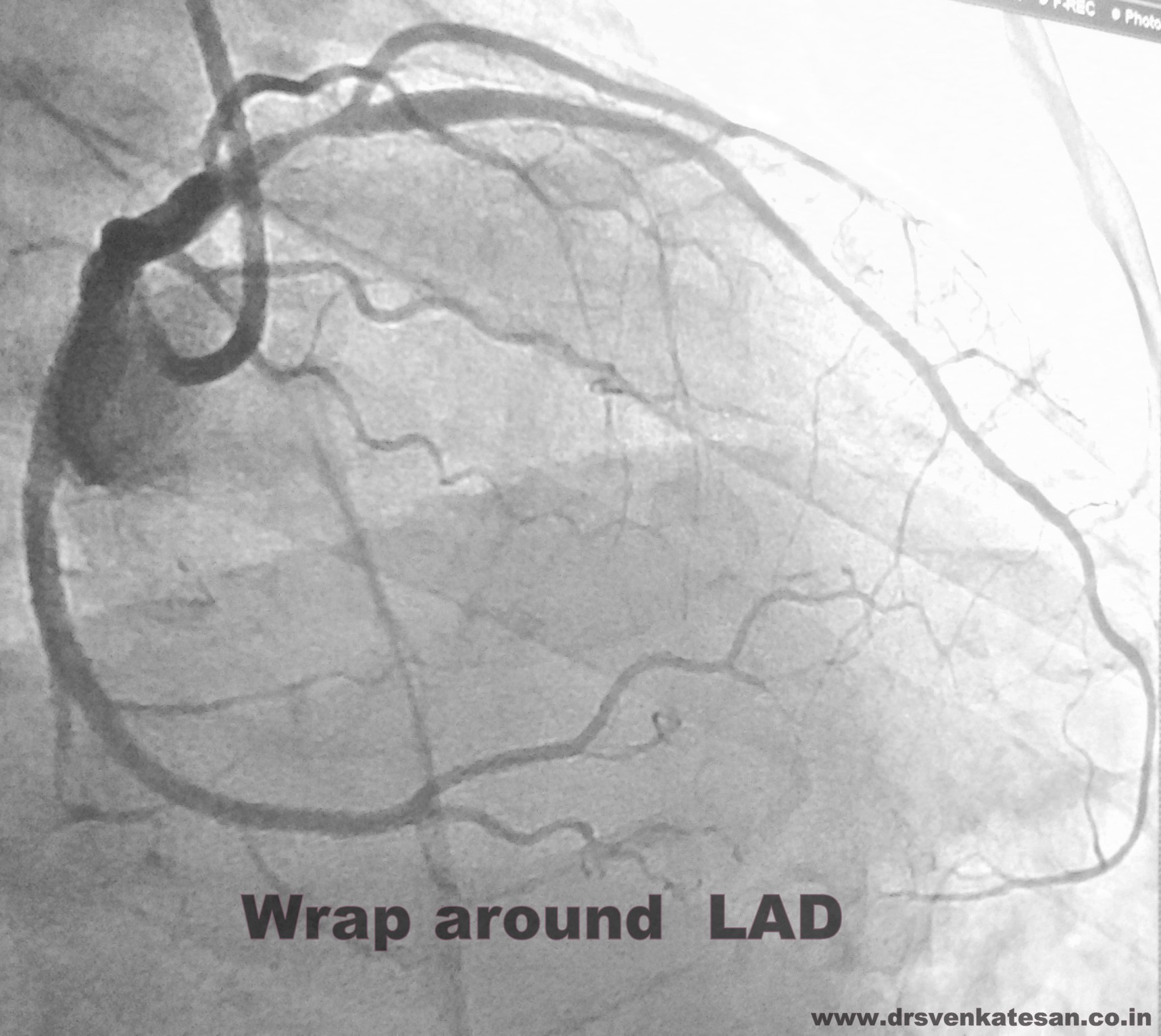
LAD is  graded into three types according to

Type 1  :  Falls short  of Apex

Type 2 :   Reach up to the LV apex

Type 3 : Wraps around LV apex and travels some distance in the posterior Inter-ventricular groove.

Clinical  Importance of Wrap around LAD

As the name implies , LAD   should descend only in anterior aspect  in about 15 %  population it can take a posterior descending course as well .

When LAD  wants to conquer more areas of heart is it a clinical advantage  ?

When LAD wraps around the LV apex,  anterior MI due to LAD occlusions can show changes in inferior leads. (Antero Inferior MI )

In ideal anatomic /Physiologic conditions  LAD  should nearly  meet the  PDA   to prevent any water shed  area.

There is usually a trade off between the  terminal LAD and  length of PDA ( whether it arises from LCX or RCA.)

There is some evidence to  suggest the site of ventricular rupture in anterior MI is related to the gap  in the LAD/PDA drainage zones.

Patients with Type  1 LAD  are at risk of   LV apical  ischemia if the  dominant LCX /RCA is  not supportive .

Final message

A long LAD is definitely a  hemo-dynamic  advantage   in physiology ,   Of course  it goes  without saying    . . .   when  it’s   likely  to get  obstructed it is always better to have a Type 1 !

Read Full Post »

Stress related wall motion defect  is a well-known entity . It is referred to as Takotsubo cardiomyopathy .

These stress are often

  • Emotional
  • Neurological
  • General systemic stress

The culprit seems to be pooling of adrenaline and nor adrenaline in myocardium .These remote  neurogenic stress can cause significant wall motion defect due to adrenergic  downpour

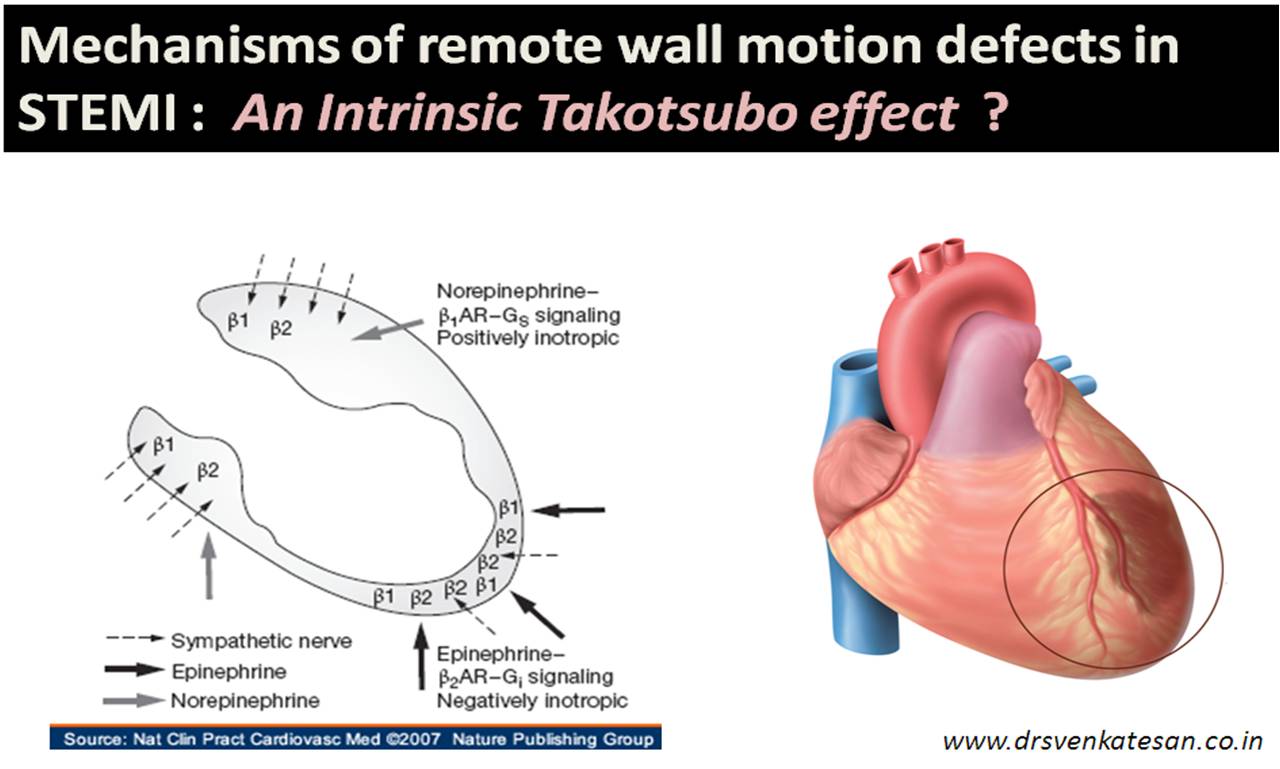
The image depicts the wide variation in the density of beta receptors in heart.The stress of MI can result in varying degrees of wall motion defect .It is important to realise the wall motion defect in STEMI has two components .One is related to ischemia and other is due to excess catecholamines. This explains many of the unexplained remote wall motion defects during STEMI .This  may be referred to as Intrinsic Takosubo effect !

Then   . . . the following    questions arise

When systemic stress can have a profound  effect on myocardium , what   about local stress ?

Acute STEMI  is  a huge stress for the heart   . . .   isn’t  . If  so , can it   alter  the wall motion defect in adjacent  or remote myocardial segments  independent of ischemia ?

With the distribution  of adrenergic receptors  showing  huge variation ,  we do not know how an acutely ischemic heart  spills the adrenaline all over .  Is there a pattern to it  ?  or it happens at random ?  Further , the  response to  accumulated  catecholamines  is  not  going to be  uniform. This will explain why certain patients  go into ischemic  LVF  , very early in the course of STEMI  even before the myocardium is necrosed. It will  also explain  the  benefits that accrue in selected patients  who receive early IV beta  blockade  ( Which is  of course currently not popular after COMET study ! )

Final message

We  have seen at least  two patients  with severe  transient ballooning  wall  motion defect in LAD region  (LV apex)  with isolated RCA lesion and inferior Infarct .

The question raised is this 

Can  the  stress of  Inferior  STEMI   . . . result in  apical Takatsubo  like  effect ?

Reference

http://www.medscape.org/viewarticle/567069_4

http://www.takotsubo.com/

Read Full Post »

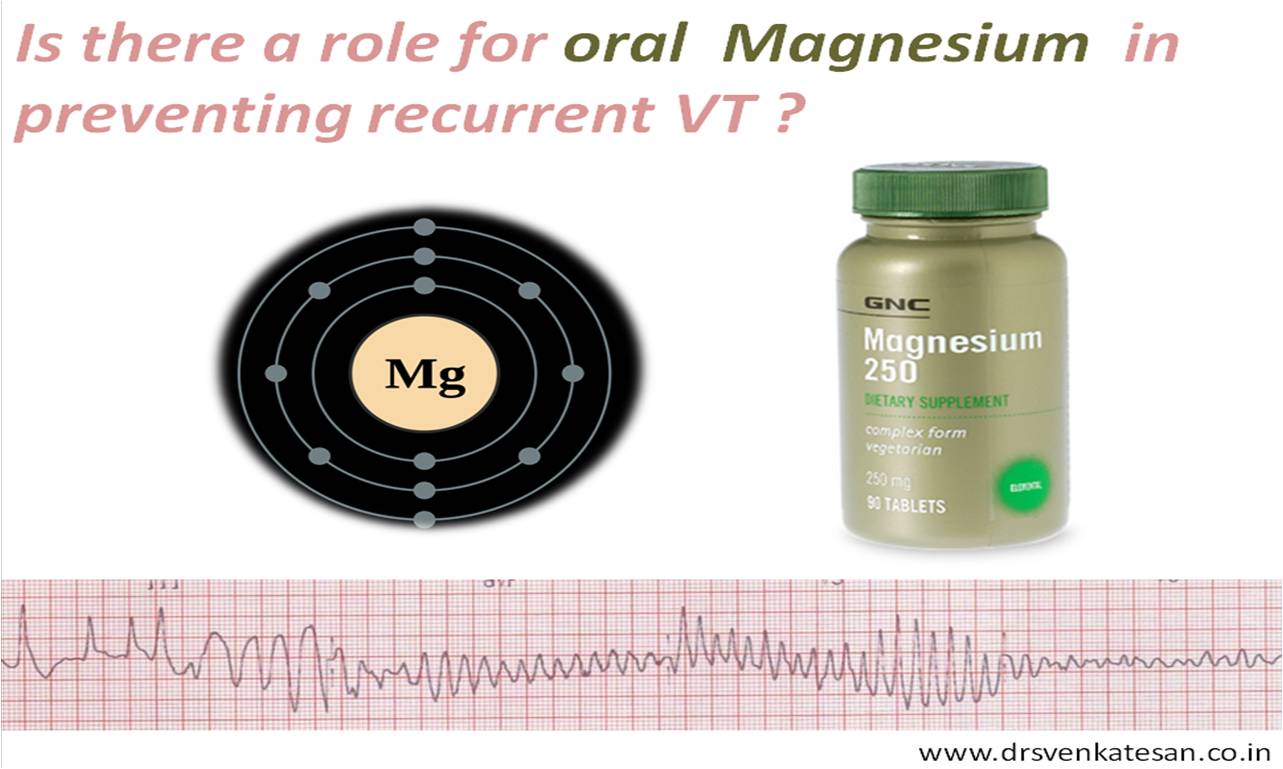
Magnesium   is a powerful anti-arrhythmic drug . It has a well  established role in controlling VT when administered  Intravenously   especially in polymorphic VT .

Mechanism of action

  • It acts at the cell membrane.
  • It has a unique action of blocking calcium channels  that reduces the number of oscillations of  both  early and late  after potentials

Link for more  on mechanism  of action

https://drsvenkatesan.wordpress.com/2010/01/13/how-does-magnesium-acts-as-an-antiarrhythmic-drug/

How often cardiologists administer oral magnesium for long-term control of VT ?

As for as I know ,  no one uses it ! but dietary  supplements are used for general well  being .

Why ? Is it because

  1. Magnesium does not get absorbed in the gut
  2. Magnesium levels are un- predictable in plasma if administered orally

Answer : No one has really tried  it as a  chronic therapy in VT  yet  !

Final Message

Tablet Magnesium can give a tough fight to Amiodarone and Flecanaide in refractory VT at a fraction of the cost !

Who has the audacity  to  compare Magnesium  with Amiodarone head on ?

Reference

Magnesium as health supplement . 

Magnesium is available  in tablet form as  Malate , Stearate, Taurate and Aspartate  along with calcium and Zinc etc .

Read Full Post »

The entity of stress cardiomyopathy ,  other wise referred to as  Takotsubo  cardiomyopathy is a popular clinical entity in recent decades.The heart and mind are closely linked entities even though they are  situated apart physically . Extensive neural and hormonal control  mechanisms  exist.

In extreme stress ,the hyper- sympathetic  drive triggers a rush of adrenaline ,  which some how makes the  left ventricle  to bulge out !

The clinical features  are varied .

  • It can exactly mimic an acute coronary syndrome .
  • ECG may  show ST elevation and mimic an anterior STEMI
  • Echo shows a wall motion abnormality  classically  described  as the apex alone dilates /Bulges or elongates
  • LV  may acquire a shape of a  banana. (See below )

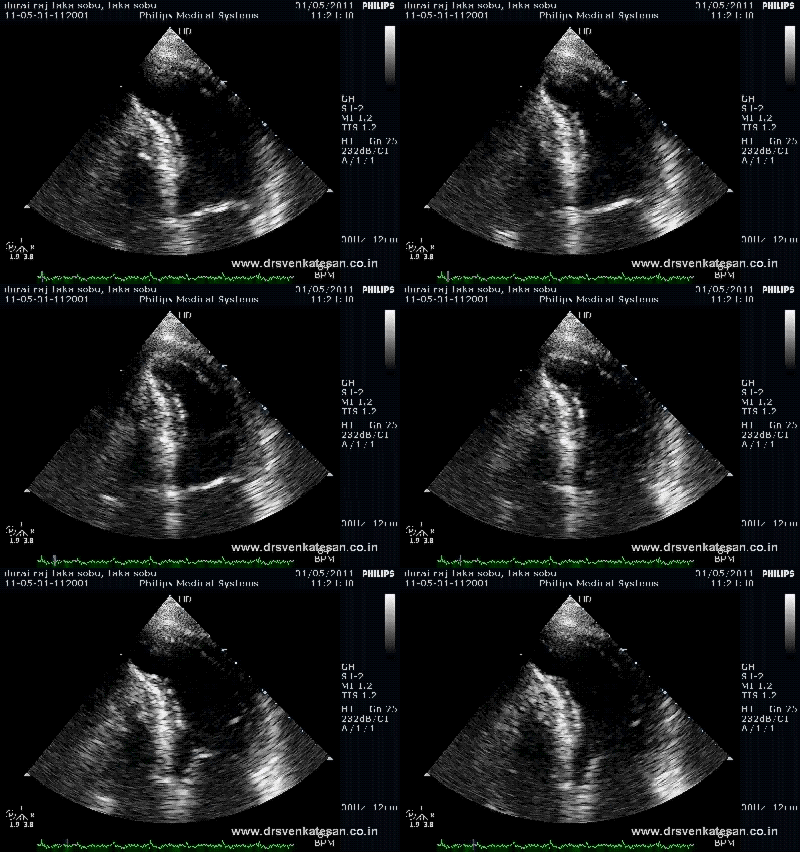
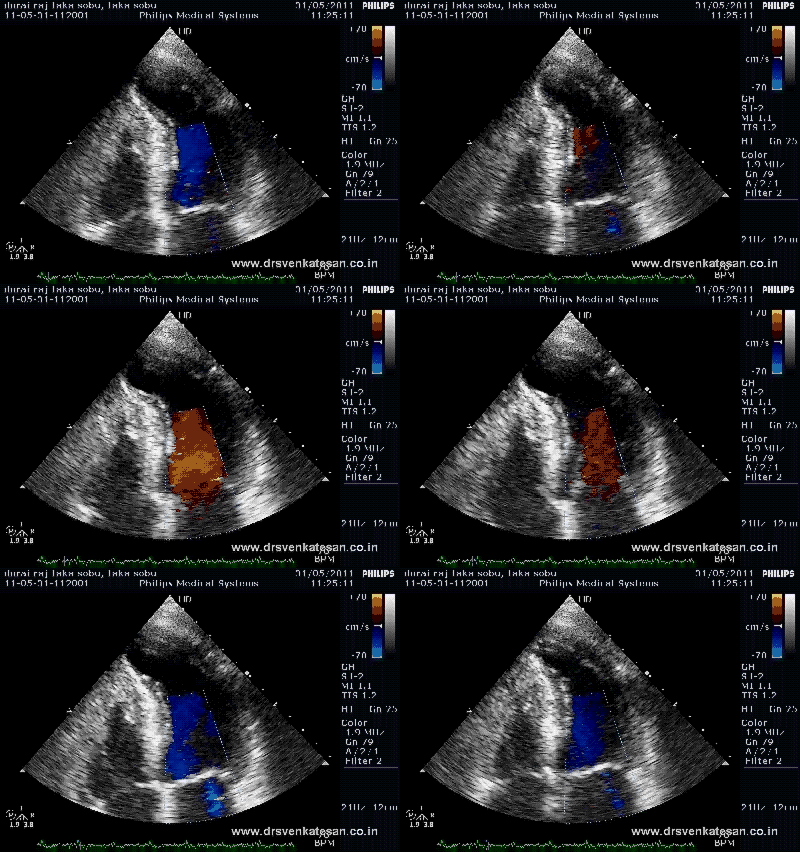
A 45 year old man came to the ER with severe chest pain , dyspnea and minimal ST elevation in anterior leads. He  was a smoker and was experiencing  recent major office stress  . Echo showed an elongated LV apex with some thinning .We made a diagnosis of stress cardiomyopathy .( It was disputed by my professor as the LV  apex was contracting well   ! but we  learnt later there are many varieties of Takatsubo )

Echo showed an elongated LV apex with some thinning . Note the LV apex goes  out of plane  with RV apex.

Color  Doppler revealed Trivial Mitral regurgitation

Follow up

He underwent coronary angiogram.  Had  no significant lesions ,   in 48 hours time the wall motion defect disappeared and was discharged with beta blockers.

Incidence

Up to 2 % of ACS could be related to Takatsubo . More common in women especially post menopausal  , with stressful/emotional background like loss of loved ones.

Synonyms

Apical ballooning , Broken heart syndrome ,  Stress cardiomyopathy.

Mechanism

Not clear . Microvascular spasm , excessive catecholamines  ,  are thought to be major culprits.

Echocardiography

Hyperkinetic base and akinetic or dyskinetic LV apex .

Lots of variations are reported .

Shimizu described 4 types

Courtesy : Shimizu et al J Cardiol. 2006 Jan;47(1):31-7.

  1. Apical akinesia and basal hyperkinesia,
  2. Reverse  Takotsubo  (Basal akinesia and apical hyperkinesia)
  3. Mid-ventricular ballooning   with  basal and apical hyperkinesia
  4. Localised  to any one segment

*The Banana type which  is described here (Elongation  of LV apex > Widening )

Histopathology

Focal myocytolysis are described. (Broken heart)   Monocytic infiltrations are common.These are  believed  to be transient .

How to differentiate it between a STEMI ?

  • Enzymes are only mildly elevated.
  • Wall motion defect do not confine to a specific arterial territory.
  • Most importantly coronary angiogram do not reveal any significant obstructions.

Prognosis and outcome

  • Generally good
  • The initial presentation may be turbulent in few with cardiac failure or arrhythmia .Other wise these patients do well

Treatment

  • Mainly supportive
  • Major principle is to avoid inotropic agents as they  are already  heavily expose to it
  • Beta blockers  could be the mainstay therapy .

Final messge

Think about  Takatsubo  whenever an acute coronary syndrome presents atypically . Not surprisingly few of them land in the cath lab !

Reference

http://www.cardiologyrounds.org/crus/cardus1206.pdf

Read Full Post »

We know prompt reperfusion of infarct related artery( IRA) by any means  constitute the specific management of  STEMI .However, It needs  to be emphasized ,  treatment process of STEMI  is not over after  primary  PCI or thrombolysis .Early hours after a PCI or thrombolysis  is vital as well .The ill-fated coronary arteries are as  vulnerable as before.  In the setting of multi-vessel CAD  (Which usually is the case) the unpredictability is still more.

Image courtesy New york times , January 5 , 2009

When a patient complaints of chest pain  24 hours after a STEMI . Think about any of the possibilities and act accordingly.

  1. Infarct related pain ( Dull aching pain from residual neural signals from infarct zone,  till type C  un-medullated  nerve endings  die of hypoxia )
  2. Post infarct angina –From IRA zone (Residual ischemia)
  3. Post infarct angina-From Non IRA zone(New Remote ischemia)
  4. Re-Infarction
  5. Infarct expansion/ Extension /mechanical stretch
  6. Pericarditis
  7. Intra coronary dissection adjoining  a plaque (Plaque fissures  are same as dissections if they extend into media ! But plaque fissures are painless since they lack nerve endings  )
  8. Myocardial tear /Rupture (Generates  severe pain , usually transmit to back , patient often become violent and poorly respond  even to narcotics)
  9. Post resuscitation/DC shock / chest wall contusion . ( I know at least one patient  who was rushed to cath lab for a  suspected  acute stent thrombosis  ,  it was indeed   a rib fracture during an  earlier resuscitation at ER  on his arrival !)
  10. Finally ,when the  pain is refractory and atypical   non cardiac chest pain which might have been pre existing to be considered as remote possibility .

Read Full Post »

A 55  year old man came with a BP of  1o0/70 with vague symptoms of back  pain to our ER.

Troponin T  was positive

Can we thrombolyse ?

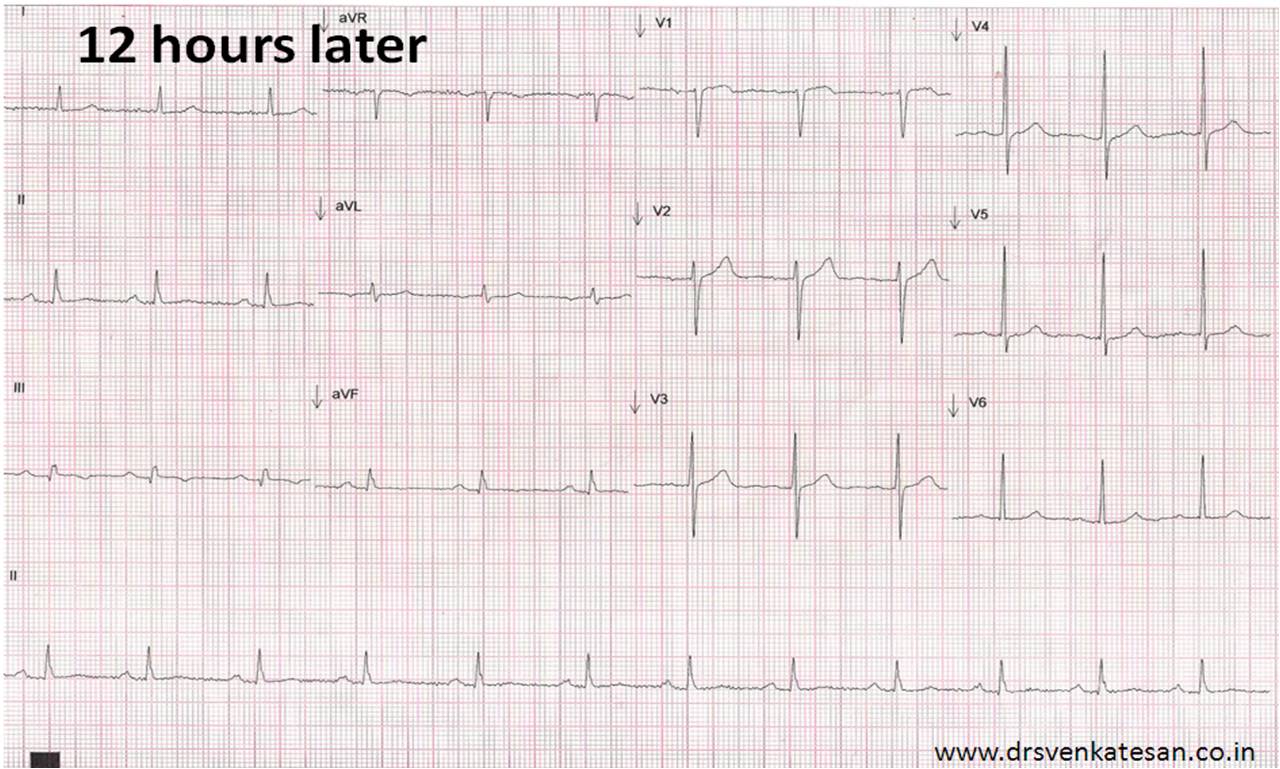
There is a minimal ST elevation in inferior leads  but not amounting to  the required criteria 1 mm

Technically No , Academically yes , scientifically No , logically  yes

*I wont thromolyse but i will take him to cath lab maybe the modern answer

 What we did ?

We did neither !

Just observed in CCU with heparin infusion , Aspirin and clopidogrel .

Note: The ECG becomes almost normal .The initial suggestion of inferior MI is stands questionable

Serial ECGs  were taken .

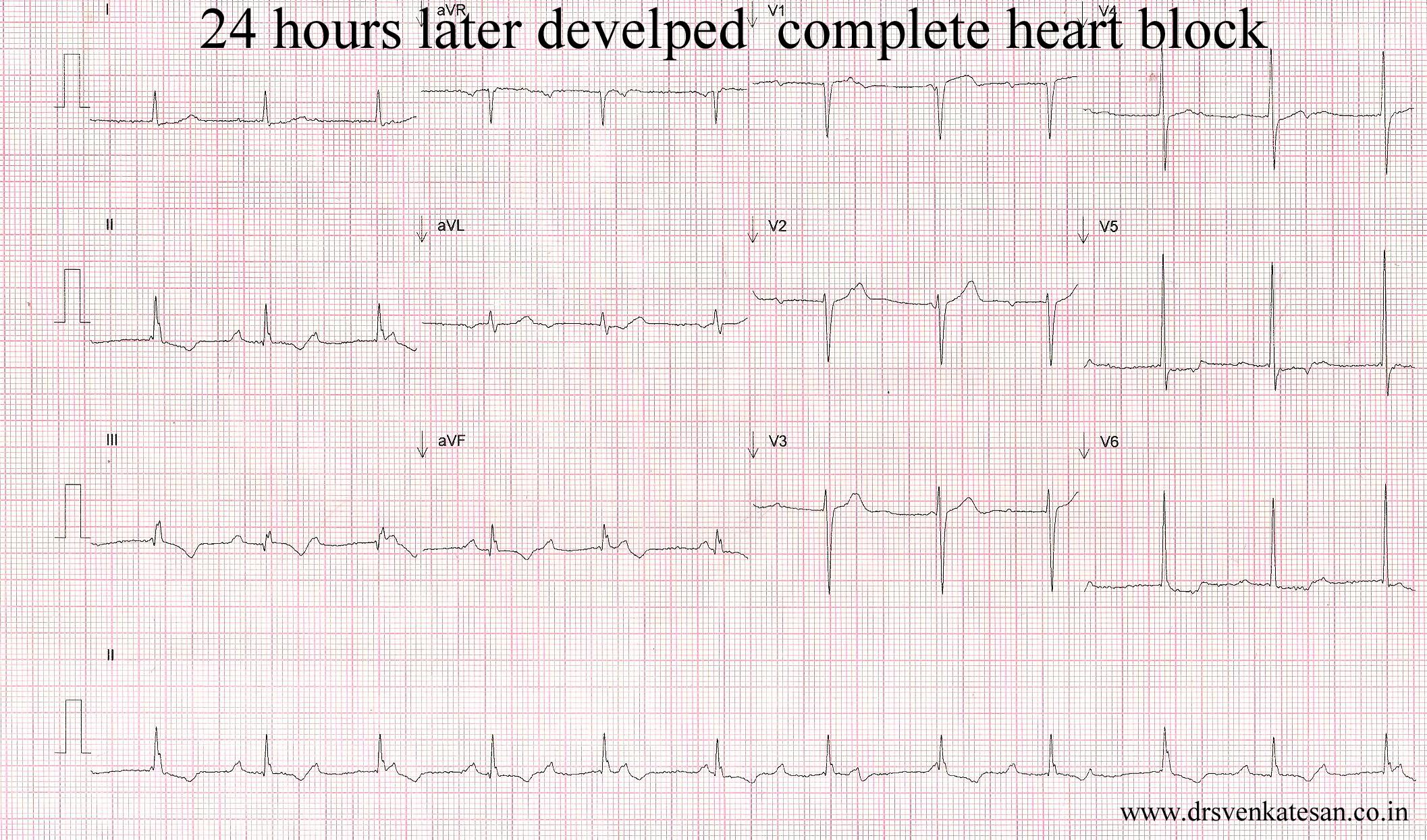
And now . . . after 24 hours a new complete heart block appear with classical evolved pattern of inferior MI.The most interesting feature is patient has been comfortable all along even as his posterior aspect of heart is experiencing terrible electrical earth quakes.

Is troponin Guided thrombolyis  an accepted  concept  ?

Yes ,  only in few situations like , posterior MI ,   LBBB  , pacemaker rhythm, re infarction .(Note , true posterior MI do not elevate the ST segment but depress it ) .

One may be surprised why we shouldn’t lyse a patient  whenever  troponin is elevated in acute coronary syndrome  (After all it denotes myocardial necrosis and infarct !)  The point here  is ,  troponin can raise in all forms of MI (NSTEMI, even in some cases of chronic stable angina )  Read in this link Why thrombolysis is contrindicated in UA/NSTEMI

The benefits of thrombolysis  is not proven in small and micro infarcts.  ECG  ST  eelvation   remain the  sole criteria for thromolysis for STEMI because  of  high degree of  correlation with total coronary occlusion .

In this era of rapid interventions the treatment concepts has blurred as we tend to do PCI and stenting  most cases of ACS including UA/Unstable angina

OK , what happened to this patient ?

Temporary pacer  was kept stand by with a sheath and catheter in situ.

Next day  morning  AV block disappeared .Patient was comfortable .

To our surprise , in the same  evening his ECG showed a complete heart block with AV dissociation . Still the heart rate was good . The demand temporary pacemaker didn’t take over .

On the third day , every conduction disturbance disappeared and  patient was sent to the wards. He is being discharged in a  stable condition with std drugs .there was  a minimal wall motion defect in infero-posterior segments with an ejection fraction of 50 % . He is  scheduled for coronary angiogram  2 weeks later.

What is the pathology ?

Pathologicallyit could be a small focal area of Infarct  incidenataly invloving the AV node .(This is alss refered to as vital area Infarct”  )It is hard to differentiate whether AV block is due to revrible ischemia or necrosis  , simple tissue edema ,  high vagal tone . or combination of above .If the block recovers it can be concluded necrosis is not the dominant theme.


Final message

STEMI presenting  primarily as heart block is less common .  When such a presentation occurs extra caution is required.

Many  of these patients  may not show a classical ST elevation  and hence do not permit us to thrombolyse   as per criteria.

It is  the  individual physician’s discretion to do so ( or not to do  ! ) . No body is going to fault. After  all  5 % of thrombolyis world over is for  benign early  repolarisation syndromes.

The above description is  an example of complicated inferior MI  . . .  still managed effectively by conventional methods.

Further reading

Why inferior MI is considered Inferior ?


Read Full Post »

Read Full Post »

Left main coronary artery is  considered as the sanctum sanatorium  for  the cardiologists .

One would wish  to rule out  disease of left main  in any given  patient with CAD.

Though there are strong clinical predictors of  LMD, this  segment of the coronary artery  tends to  throw   surprises.

A  strongly positive stress test,  ST elevation in AVR  , fall in blood pressure with exertion  are good markers of left main disease.

Still,  in the era of  optical coherence tomography (OCT )  and IVUS  , we do  have a simple tool that can image the left main coronary artery fairly accurately .

We know the  resolution power of  routine trans thoracic echo  is 3mm and above  . (It can detect vegetation of that size easily !)

So , it can easily accomplish  the task of  imaging the  left main ostium .(which is a minimum of  4-5mm diameter )

How to image left main by echo ?

  • Parasteranal long axis  or short axis  the ideal view. Short axis would also  help.
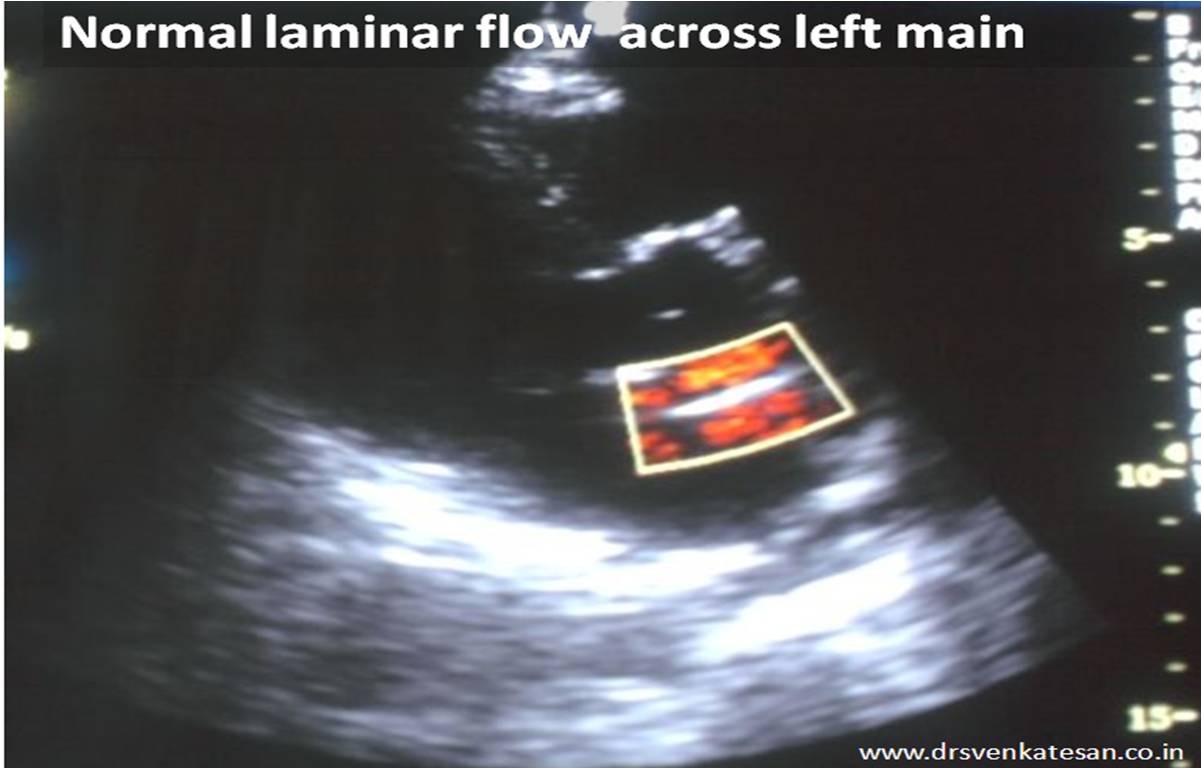
  • Normal left main is easily diagnosed  by two parallel  lines . ( See above picture )
  • Plaques are  diagnosed when this line is  distorted  and filled by haziness.
  • Significant ostio proximal  lesion must never be missed by TTE .However distal left main can not be assessed in most .
  • Doppler assessment may not be possible in all as pulse doppler sample volume can not be placed in left main.
  • Trans esophageal echo would increase the yield.

Final message

Processing power of echo machines  and  their image quality has improved  vastly over the years. The existing literature about left main imaging  by echo are based on old generation machines. The data are as obsolete as those  machines . This has to be kept in mind.

I wonder why most cardiologist are averse ( rather feel guilty ) to report  the  status of  left  main  artery  by  echo cardiography .

Every patient with  a  positive TMT must undergo a  focused echocardiogram  of  left main . You will be rewarded with a  good glimpse of the sacred segment  of coronary artery 9 out of 10 times  !

So , can we shoot the Left main  at the bed side  ?

Yes definitely  . . . if only we wish to !

* A correction

The left coronary visualised in this parasternal Long axis view is in fact exceptional. The ostium and shaft often better seen in short axis in around 3-4 O clock position.

Read Full Post »

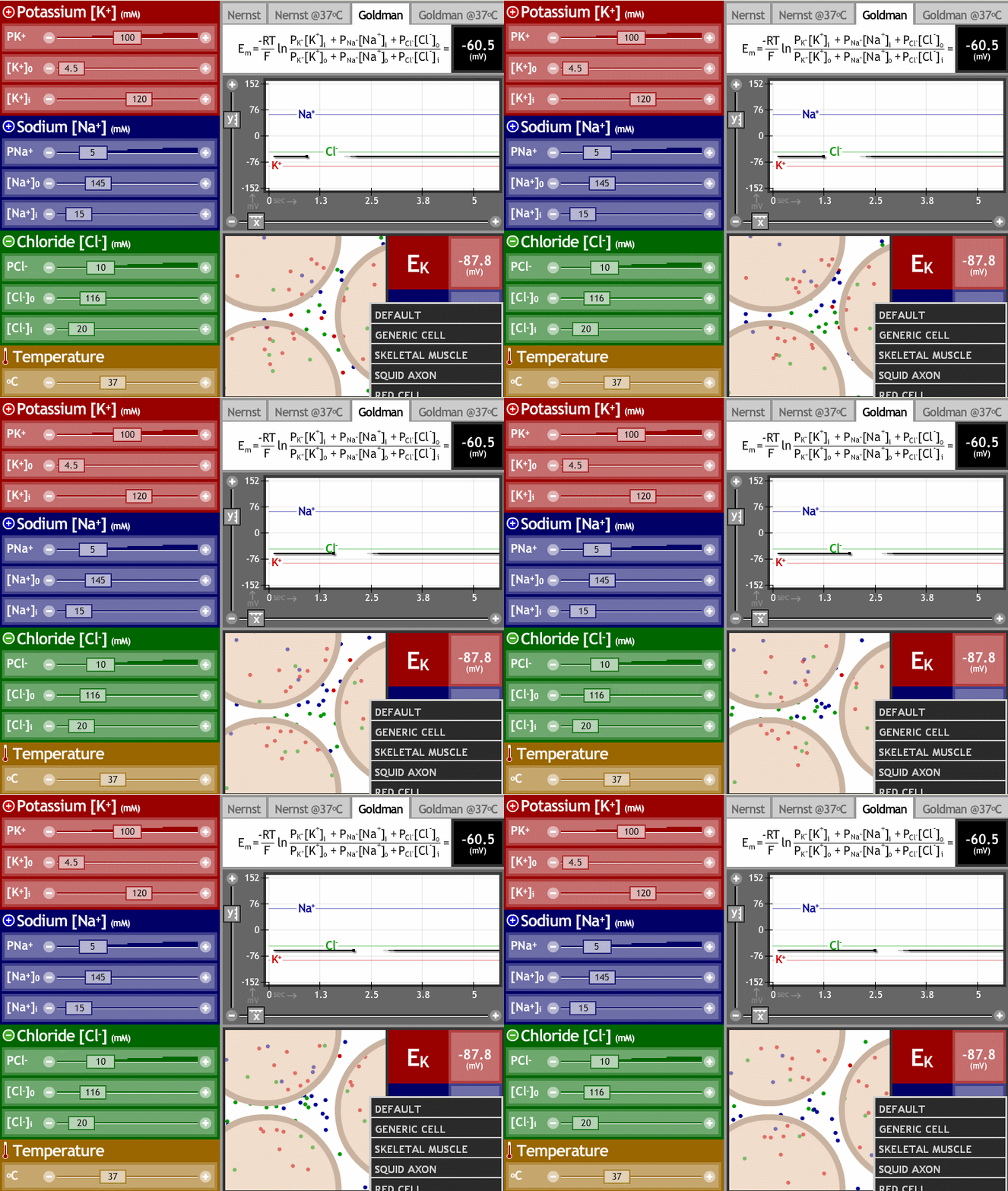
Human life is a bundle of energy orchestrated by ions coming  in and  going out  of  every cell . Potassium is the life sustaining ion which  determines the  resting membrane potential  of our cells.

When the  heart  suffers a massive necrotic attack  what  would  happen to the potassium dynamics  inside the  myocytes ?

K  + is the dominant  intracellular cation  ,  when  about  100 million myocytes   die  suddenly ,  a chaos in the  potassium  metabolism  is expected  is it not ? .

When skeletal  muscles dies  it  releases  potassium  . We  know   this  from typical crush injuries and rabdomyolyis.

It is  more of a  common sense  to expect this   . . . from myocardium as well .


Which ion is responsible for the current of injury ?

We know a  strong and continuous  negative current that  emanates from the necrotic zone after STEMI  .  (It is so powerful it  shifts the baseline  itself  !), We do not know yet what exactly  is causing this current of injury .  It goes without saying sodium should sustain the depolarisation wave but  potassium will  also have a major role in the  propagation  of this injury current.

Do dying myocytes   excrete the potassium into the circulation   ?

Is    k+  a marker of extent of MI  ?

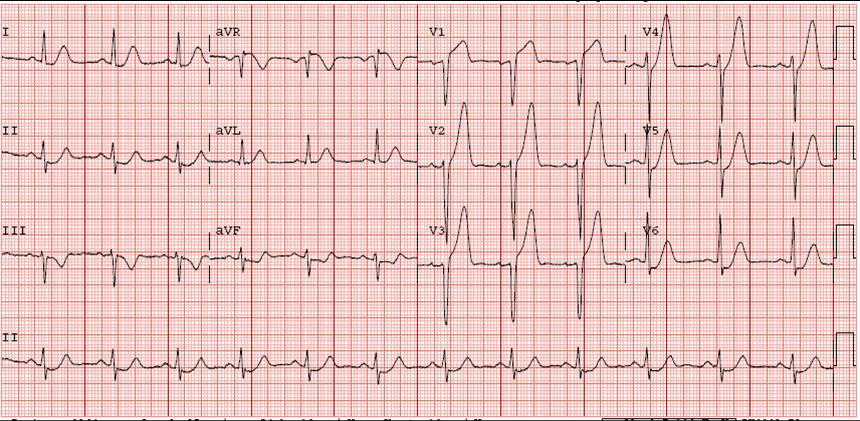
What is the mechanism of hyper acute tall T waves in  MI ?

Questions  galore  . . . Answers struggle !

When a  large  area of  cardiac muscle goes for necrosis  it  leads to  leaking   of   K +    . If it is true  , it  is expected to be a marker for extent of  infarct. In reality it is not . Why ?  This is because cardiac  potassium pool is much  small . A  leak from  an organ which weighs   400 grams   do not elevate the ECF  potassium .  Still , there is ample evidence  for   K + to accumulate  in the local  intracellular milieu. (Myocardial hyper-kalemia ) In fact ,  one of  the mechanisms  suggested  for tall T waves in  hyper-acute MI phase   potassium excess .
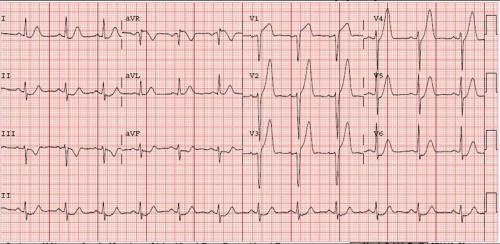
Image courtesey hqmeded-ecg.blogspot.in/2009/02/hyperacute-t-waves.html

http://hqmeded-ecg.blogspot.in/2009/02/hyperacute-t-waves.html

Potassium levels and incidence of  ventricular tachycardia.

Many of the primary ventricular arrhythmias  are  due to acute ischemia .  We  have conflicting evidence  for  the effect of ischemia on QT interval. How does ischemia trigger VT  ?
The answer to this question  remain as a missing link !  . Grossly simplifying ,  one could suggest it is  due to   ischemic cell membrane damage that alters the ion channel function  , resulting  in intracellular accumulation of calcium and triggered  activity  .

What is the effect of potassium  on cardiac contractility  ?

Myocardial paralysis.  (Please note  it is the  hypokalemia  that primarily  causes paralysis in skeletal muscles !)

It causes  myocardial  stunning  a manifestation of local potassium  leak ! A temporary myocardial paralysis.

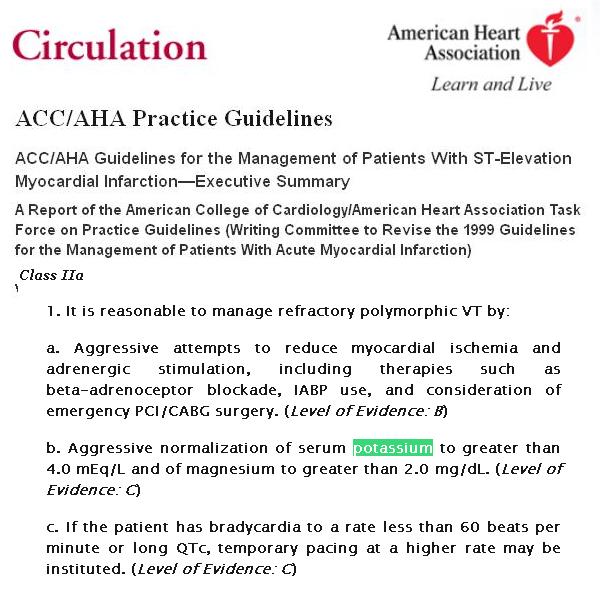
What does the current guidelines of ACC/AHA state about potassium hemostasis  in STEMI ?

It suggests   a fairly aggressive  maintenance of potassium levels  to  upper normal levels. Traditionally we are worried more about hypokalemia than the hyper. It is  surprising   we had the facts wrong . . .  for so long !
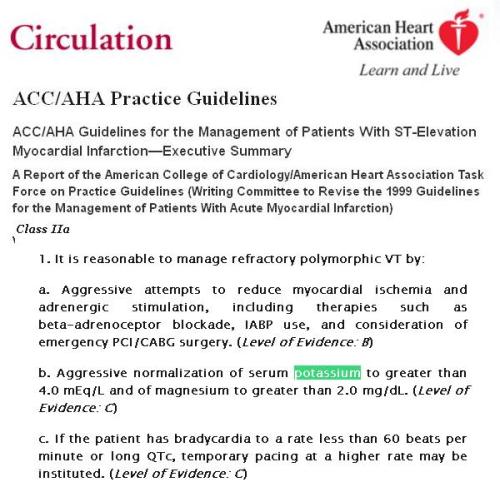
What is new in the regulation of potassium level during STEMI ?

This landmark paper from JAMA seeks  to set right the misconceptions about potassium during STEMI. It suggests  K + levels  has a U shaped  morbidity curve in STEMI . One need to be cautious in  correcting borderline hypokalemia .  Serum   K +   is   absolutely useless  surrogate marker for myocardial K +   . We do not know how  K  +  behaves in the vicinity of MI  zone . So  extreme caution is required  when giving IV  K +  supplements in coronary care units .
Watch out :  Beta blockers /ACEI   may worsen  hyperkalemia

Early introduction of ACEI and ARBs   is a strong risk factor for systemic as well as myocardial  hyperkalemia . This  is  especially true  in diabetic individuals  who have  low rennin  levels due to diabetic micro circulation defect in kidneys .(Hypo-reninic  hypo-aldosternosim )

Beta blockers are also known to raise potassium by two mechanism

1.Blocking rennin

2.Reduced uptake of K + in to  the cells.

http://medicineforresidents.blogspot.in/2010/09/hyperkalemia-with-beta-blockers.html

Final message

In the management of STEMI  ,   revascularization  of  the myocardium    is  considered as  the only  therapeutic aim . We  need to realise it   is  much more than that .  There are some subtle but important ways of resuscitating and  protecting  myocardium .  Over  indulgence in electrolytic management  in coronary care  is to be avoided.

Reference

Importance of sympathetic drive and  potassium levels
http://www.nejm.org/doi/full/10.1056/NEJM198002213020803

http://ccn.aacnjournals.org/content/23/6/14.full.pdf+html

Read Full Post »
« Newer Posts - Older Posts »