Feeds:
Posts
Comments

Archive for the ‘cardiology -ECG’ Category

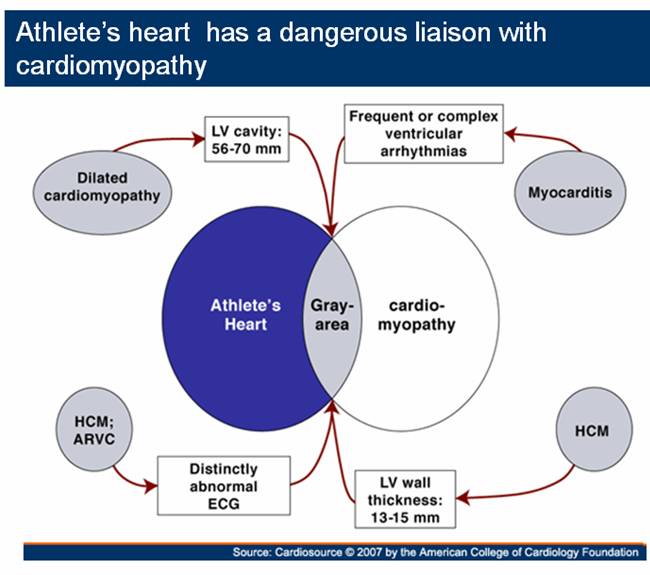
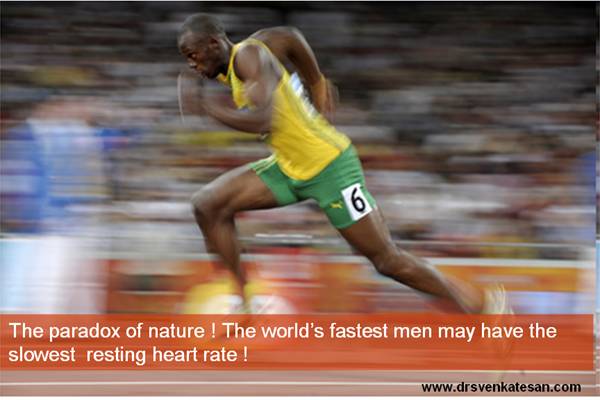
ECG of an athlete is many times difficult to interpret. The influence of autonomic tone in  athlete’s heart is an complex one.Contrary to our expectations the parasympathetic tone is higher in well trained athletes. The resting heart rate can be as low as 30/mt which is 99.9 times pathological in non athletes.This happens due to a concept called accentuated antagonism.The athletes who have episodic surge of high catecholamines keep stimulating the para sympathetic neurones in a constant fashion.

LVH is the most common feature.Here there is simple myocyte hypertrophy, without pathological fibrosis.This differentiates athlete’s, heart from HOCM .

Many ECG abnormalities are reported in athletes.

Excerpts from the ACC recommendation

1. Electrocardiographic findings that are common and training-related and that do not require additional evaluation are sinus bradycardia, 1° atrioventricular block (AVB), incomplete right bundle branch block (BBB), early repolarization, and isolated voltage criteria for left ventricular hypertrophy (LVH).

2. Uncommon and training unrelated electrocardiographic findings that mandate further evaluation include T-wave inversion, ST-segment depression, pathological Q waves, atrial enlargement, a hemiblock, right ventricular hypertrophy, a BBB, or a Brugada-pattern of ST-segment elevation.

3. Training-related electrocardiographic findings are more common in men than women, athletes of African descent, and high-endurance athletes such as cyclists.

4. Sinus rates <30 bpm and sinus pauses >2 seconds are common in highly trained athletes, particularly during sleep.

5. A normal chronotropic response to exertion and the absence of bradycardia-related symptoms distinguishes training-related sinus bradycardia from sinus node dysfunction.

6. 1° AVB and Mobitz I 2° AVB are common, but Mobitz II 2° AVB or 3° AVB should not be assumed to be training-related and require evaluation.

7. Early repolarization in Caucasian athletes most commonly consists of upwardly concave ST-segments and tall and peaked T waves; in black athletes, there often is convex ST-segment elevation and negative T waves, mimicking a Brugada pattern.

8. In the presence of voltage criteria for LVH, pathological hypertrophy should be suspected if there is left atrial enlargement, left-axis deviation, repolarization abnormalities, or pathological Q waves.

9. T-wave inversion ≥2 mm in ≥2 adjacent leads should prompt evaluation for structural heart disease.

10. Electrophysiological testing for risk stratification with possible catheter ablation is appropriate in athletes with ventricular pre-excitation.

Source :  Fred Morady, M.D., F.A.C.C.

http://www.ncbi.nlm.nih.gov/pubmed/19933514?dopt=Abstract

For an excellent article on the topic click here

Read Full Post »

Acute MI is a major medical emergency encountered in ER . Prompt adminstration of thrombolytic agents or rapid   triaging for a  primary PCI   may be required . The whole concept of management of STEMI  revolves around time as a therapeutic   target .Every minute counts . The beneficial effects of  reperfusion   and the resultant  myocardial salvage  rapidly declines over time . Hence ,  the symptom to door time  remains the ultimate determinant of  outcome in most situations.

So , estimating the  time window of  “Symptom to door time ” becomes an all important parameter. This is often done by paramedics .

The apparently  simple  job  measurement of time window  can be  misleading at times especially in elderly, diabetic and alcohol abusers .

When  a patient  says he has chest pain since yesterday straightaway he is excluded from reperfusion strategies as 12 hours  would have elapsed

When a patient  describes  chest  pain since two days , but  more intense  only since today morning what does it imply ?

  • The first episode of pain could  either  preinfarction angina or infarct
  • The second episode of pain could again be the continuation of same  angina or conversion of that angina into infarct

So ,  calculating the time window  when a  patient has recurrent episodes of angina prior to an MI is a real difficult issue.For the benefit of doubt, we have to take the last episode of chest pain  which was continuous and more severe as the infarct pain.

How does ECG help to time STEMI ?

When it is difficult  , to differentiate pre infarction angina from infarct pain, the ECG may give  useful clues to time the STEMI.

  • Degree  ST elevation
  • T wave inversion
  • Q waves

Among the  above three ,T wave inversion is most useful to time an infarct. If T wave begins to invert, it can generally assumed the acute  infarct process is  almost complete . Q waves are less reliable  to time a acute MI as ischemic stunning can in the  very early phase of STEMI   inscribe a q wave over the infarct territory.

How will you time a STEMI in silent MI ?

There is no symptom to door time in patients with silent MI . Many do not even reach the door , for the simple reason there is no symptom that drives them to hospital. Those who are refered  have vague non cardiac symptoms and incidental ECG  which shows STEMI like changes. Here , the decision to thrombolyse is taken entirely on the basis of ECG *finding .

Note : Cardiac enzymes are can also be  used  to  diagnose  to estimate the time window .

Read Full Post »

Looks very much a infarct of  infero posterior territory is it not ?

Have a look at her 2D echo still picture . . .

Are you convinced ?

This women had normal LV systolic and diastolic function with no evidence of constriction.

The explanation for the asymptomatic pericardial thickening is due to a healed  chronic pericarditis .This sort of localised thickening in the posterior aspect is all the more likely following a loculated pericardial effusion.Tuberculosis is a very likely etiology.But this women do not have any markers for tuberculosis.Since she is symptomatic no treatment was offered.She is being followed up.

Discussion .

Q waves are not ” sacred waves” to diagnose myocardial infarction.It simply indicates the  direction of current flow is away from the  recording lead of the ECG .Any thing  electrically inert , that come in the interface between the heart and the recording electrode   can record a q waveWhat are the pathological entities that can produce q waves other than infarct ?

  • Fibrotic myocardium(DCM-Cardiomyopathy)
  • Myocardial Scars
  • Myocyte dis array(LVH, HCM)
  • Air,fluid in pericardium /pleural space
  • Pericardial thickening (As in this patient)
  • Electrical shortcircuits (WPW syndrome)
  • Rarely pure ischemia without necrosis can produce q waves (Electrically stuned myocardium)

Final message

Localised pericardial thickening is  a rare  (?unrecognised) cause for pathological q waves , that may mimic a MI.

Read Full Post »

Cardiac rhythm disorder remains  as a  fascinating  clinical cardiac  problem  to  the physicians for many decades. The joy of decoding cardiac arrhythmias and categorizing into supra ventricular , junctional, ventricular tachycardias is unique ,  even as  many of these patients are struggling for life !

Initially the tachycardias were labeled with reference to their origin .Later as we recognised the locating the  origin is not an easy exercise , we introduced a practical classification  : Narrow and wide qrs tachycardia  emphasizing the fact that , both SVT & VT  can be either narrow or wide !

Traditionally there is much more  confusion in labeling the  narrow qrs tachycardias than the wide  qrs tachycardia.

Is the term junctional tachycardia still relevant ?

To answer this question we need to know what exactly we mean by the term Junction.

  • Is it a particular anatomical spot  called AV node ?
  • Is it a diffuse area in the vicinity of AV node ?
  • Is the early part of the his bundle included in the junction ?
  • Or  Is it formed by  the entire rim  of both  AV groove formed by the fibroskeleton  that form a electrical  barrier between atrium and ventricle ?

Answer:

The answer to the above question is very simple “we don’t know yet !”

The nearest fact is , for the electrophysiologist,  AV junction refers to the electrical  junction box of  that connects the specialised wires coming down from the atria and from there it connects  to the specialised his purkinje fibres of the ventricle .

Is AV node  anatomically distinct structure?

No .It is not. It is a collection of different conducting cells with varying properties.The term AV node need to be abandoned by the cardiology community for the simple reason there is no such entity.

In fact the AV junctional cells are are now called as pure atrial,atrial approach CELS ,  junctional approach cells, junctional cells,transitional cells,  ventricular approach cells.These cells interdigitate with each other , and has unique cell to cell communication.The cells that are above the AV junction share atrial electrical properties while the cells that touch the his purkinje  acquire some of the properties of specialized ventricular conducting properties.

What is the function of AV junction ?

One should realize  it is the AV junction does a  a very unique job of great importance  for human   survival ! Even though SA node is the pacemaker of the heart , the AV junction does the extraordinary it receives the impulse and delays it for about 200 millisecond and then hand over it to the ventricle.

The rules that govern the  nature is so fascinating  , this delay is vital for the venous return to enter the ventricle from atrium other wise , the ventricle is under filled and cardiac output falls.The bulk of the PR interval is contributed by the AVconduction delay (also called as AH interval )

What is the clinical relevance of this new found physiology of AV junction ?

It is to be understood the electrical properties of the AV junction is determined by neural innervation the ionic currents.Much of AV junction is under the dominant control of vagal fibres, while the ventricles get more innervation from sympathetic neurones. There is considerable overlap in the AV junction area.

The classical dual nodal physiology of AVNRT is nothing but longitudinal physiological splitting of AV junction  .Strands of slow conducting cells and fast conducting cells are arranged in such a way to create a reentrant circuit.The atrial approaches in the posterior aspect contain mainly slow pathway. and anterior aspect near his contain the fast pathway.

Some times  clusters of AV junctional cells are scattered around the upper septal area giving a slow conducting properties to ventricle.These cells can be site for reentrant septal or fascicular VT.

The overlap of  these AV junctional cells explains the verapamil sensitivity of some of the VTs  arising in the vicinity.

What are the tachycardias that can be termed  as junctional tachycardias ?(JT)

By logic and realism  any tachycardia that originates in the AV junction either by reentry or ectopic activity shall be called as JT

By tradition , we have been illogical.

AVNRT is never referred to as JT  in spite of the fact that,   it is initiated by a pathological reentry right  in the middle of AV junctional tissue.

So currently we are authorised to call only few arrhythmias as true junctional tachycardia  .

  • Non paroxysmal junctional tachycardia( NPJT)
  • Incessant junctional tachycardia
  • Permanent  junctional reciprocating  tachycardia(PJRT)
  • Accelerated junctional  rhythm

NPJT

This occurs in following situations

  • Digoxin toxicity(Classical description)
  • Post operative hearts
  • Occasionally during acute MIR
  • It may be observed during AV nodal ablation in EP LAB

NPJT is an automatic tachycardia .arising focally from AV junctional tissue . Ideal terminology should be focal junctional tachycardia(FJT) .The rate is between 70 -140. Accelerated junctional rhythm can be termed as a benign form of JT.DC shock has no role.

Incessant junctional  tachycardia

This was first described in infants .Thought to be congenital in origin.Now adult forms also recognised.Very malignant arrhythmiaRate is between 150-300. AV dissociation is the norm.May mimic atypical atrial flutter or ectopic atrial tachycardia .High risk for tachycardic cardiomyopathy. Amiodarone may be effective.Surprisingly ,verapamil may worsen it .There is a overlap between adult postoperative NPJT and Incessant JT.DC shock is not effective may worsen . RF ablation rarely effective.

Permanent form of junctional tachycardia

It is not clear what the  term permanent denotes ! May be because   these tachycardias occur with fixed anatomical substrates.In fact this can be called as a type of AVRT. But the difference is the retrograde ventricular circuit does not travel in any free wall but within the septal his bundle   . PJRT,  infact  may be labeled as AHRT -Atrio hisian  recipocrating tacycardia

It is a reciprocating tachycardia with antegrade condction through AV node and retrograde through a slow conducting accessory pathway in posteroseptal location.

The rate is between 90-150. Mimics long RP tachycardia like AT or fast slow AVNRT.Some believe , In fact a fast slow AVNRT can be  nothing but a variant of PJRT.

DC shock may be effective only to recur again.RF ablation is very effective .

Final  message

Junctional tachycardias are a unique group of narrow qrs  tachycardias  with differet mechanisms.It is diagnosed in specific clinical settings. They are generally difficult to treat,as the mechanism is often ectopic in nature (Except PJRT).Accelerated junctional rhythm can be termed as a benign form of JT. AVNRT need not be confused with JT , even though it may considered as a junctional reentrant tachycardia.


Reference

Rosen Circulation 1973

Read Full Post »
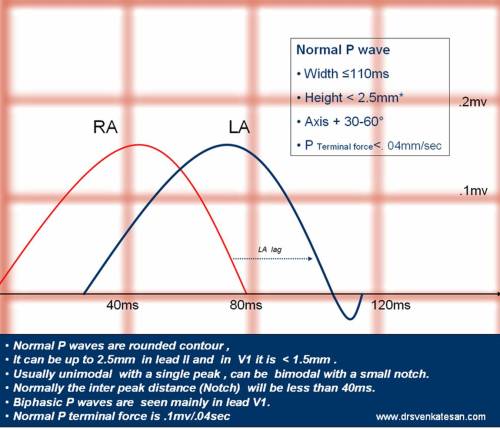
Normal P waves

normal p wave ecg rae lae

What are the components of Pwave ?

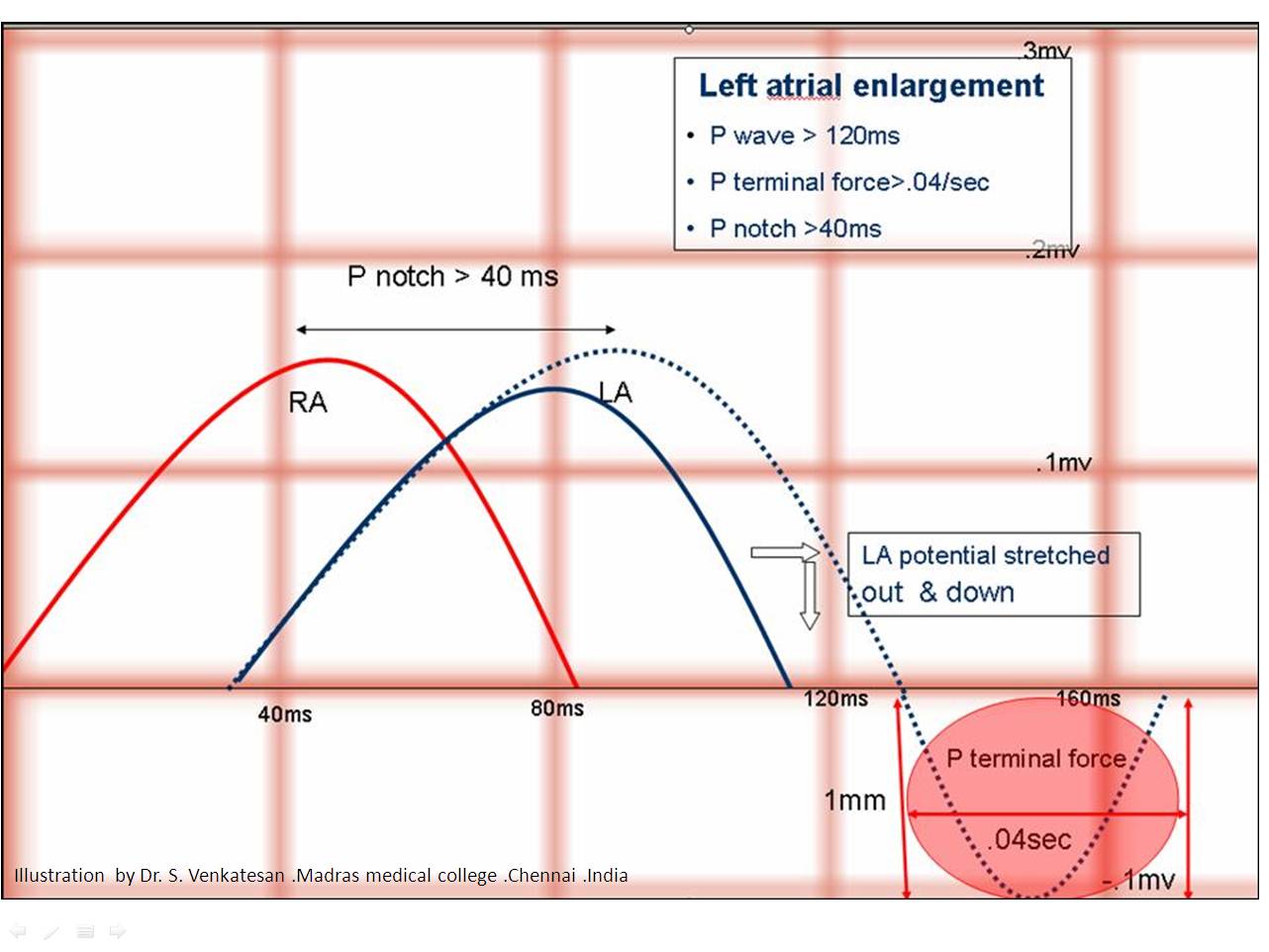
RA component : The SA node depolarises the RA first  , so the initial part of  P wave represents  RA  current .After about 40msec  the wave front reaches LA and it begins it’s depolarisation .LA component :By the time LA is maximally depolarised the RA  already starts its repolarisation.So there is  overlap and also a short time lag between these two wave forms . This is very important to recognise as , even if the RA conduction is prolonged in pathology the RA component of P Wave still falls within the LA wave .Hence it is not shown in the ECG and P wave is not widened in RA enlargement. This is in contrast to LA enlargement , when the terminal half of P vector delayed it stretches the P wave wide beyond the normal 110ms .Hence LAE widens the Pwave.

Why P wave becomes taller in RA enlargement ?

In classical P pulmonale , the P waves are  tall >2.5mm. It is easy to explain why it not getting wide than  why it is getting taller ! The atrial vector has two components .The initial RA vector  is directed  anteriorly .The main reason for tall p with RAE is  due to the anatomical proximity of RA to the chest wall Further ,the  Initial atrial  electrical dp/dt is steep . Any RA voltage increase is easily picked up by the chest leads and P wave voltage increase and becomes tall. We need to realise LA is not only left of RA its equally posterior of RA. Hence LA enlargement rarely brings (Never ?)  it closer to chest wall ,and hence high voltage tall P is almost unheard of with LA . Note , deep negative late P wave activity is typical of LAE , consistent with its posterior location as well its late depolarisation compared to RA)

rae right atrial enlargement ecg tall p p pulmonale p tricuspidaleright and left atrial enlargement how to differentiate lae rae

Why LAE can not produce tall P wave ?

The Left atrial vector which  follows RA vector  is mainly directed posteriorly and hence inscribe a  descending  limb of   P wave . This causes the P terminal force .  So  the direction of vector forces  and the anatomical locality  make a  tall & positive P  deflection highly improbable in   LAE .

*Of  course  when LAE is   huge , where a antero -supero vector from  roof of LA may inscribe a positive wave .

What happens in bi atrial enlargement ?

It can have features of both . Tall & wide P waves .

Can RA generate a Q wave ?

Yes . When RA assumes a huge  size  , especially if the RV is also at high pressure as  in severe PHT or valvular PS   a  q wave is generated in the lead V1 .This q wave is nothing but the intra cavitary potential of the enlarged RA.

What is the difference between atrial enlargement, atrial dilatation, atrial hypertrophy, intra atrial block and inter atrial  block  ?

The p wave morphology has no  specificity to identify the various entities. In any pathology of atrium the first thing that happens is a conduction delay ! It is now realised the bulk of the changes we see in atrial enlargement especially in LAE is due to intra and inter atrial  blocks or more subtly conduction delay.

It is  obvious , a wide P wave can occur either  due to LAE or simple conduction delay .In elderly  hypertensive patients atrial fibrosis is more common , one can not confirm LAE  without echocardiogram .

A notched P wave  can be a very specific sign of   inter atrial block .Which is more common in severely diseased left atrium. A notch , slurred p wave is a good marker for impending AF or atrial flutter.

//

Read Full Post »

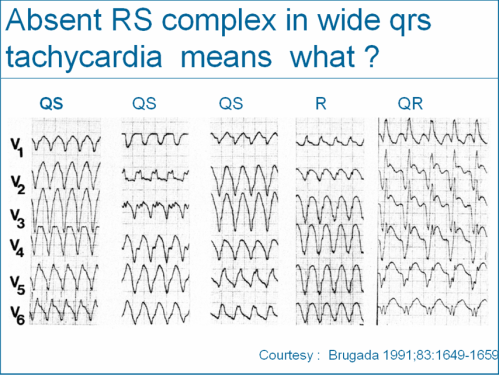
The most popular criteria to differentiate VT from SVT aberrancy is  formulated by Brugada in 1991.

The greatness of  this  criteria is that  a single question asked  is able to confirm VT in vast majority of cases.

Is RS complex absent all  of the pericardial leads ? If  the answer is  yes  it is VT 100%

How is that,  we have been struggling for so long , a single question is able to solve the issue quite easily ?

wide qrs tachycardia vt svt aberrancy brugada

This is because , the term  “Absent RS complex ” actually means

Presence of  one of the  following three typical complexes Of VT.

  1. QS
  2. QR
  3. Monophasic R

Two of them  actually imply ,  q waves throughout   V 1-V6 .This  means a badly damaged ventricle and  with  little electrical activity coming towards the chest wall .This situation  almost always occur in VT.*

The third complex is Monophasic R .

A  monophasic , wide  QRS  complex  again indicate VT  as monophasic aberrancy is very rare as the supraventricular  impulse invariably conducts with  RSr’  (The right bundle  refractory period sees to that  at least a small r’ is inscribed however fast the SVT is !  )

So if there is no RS complex  it must be VT !

What  are the  difficulties  faced in applying this   first step of Brugada criteria ?

It is funny to note , in medicine criterias  often work perfectly in  text books only !

Is there a RS complex seems to be a very easy question ? There lies the catch !  .Even though this criteria may be 100% specific , differentiating RS from QS complex even by an experienced cardiologist may be difficult in a significant number of VT tracings.This  realistically ,  reduces    supposedly  100% specificity  of this criteria !

In fact we expect Brugada to develop an  another limb  to his now famous algorithm

Is there  absence  RS complex in precardial leads  ?  Yes / No / May be ,  not sure !

Read Full Post »

CHB and AV dissociation are often confused with one another . While CHB is an important cause for AVD , there are distinct differences  which have clinical implications. This table is an attempt to simpify the understanding of the two. Corections and suggestions welcome.

This is a high resolution image , to read better  right click on the table  copy image and open in any image viewer

complete-heart-block-chb-av-dissociation-avd-va-associationn-va-block-sinus-node-dysfunction-ecg-ep-study-interfernce-avd-aivr

Read Full Post »

AV dissociation is  common clinical situation that can occur  during both    bradyarrhythmias  and tachyarrhythmias .

Bradycardias

  • Complete heart block
  • During pacemaker rhythms

Tachycardias

  • Accelerated junctional  rhythm
  • Idioventricular  rhythm
  • Ventricular  tachycardia

AV dissociation is essentially an  ECG diagnosis. But it is associated with some  clinical  signs   ,which can be detected by an astute physician in the bedside. At rapid heart rates  it may be really difficult at times to recognise theses findings, but a  cardiology fellow should look for these whenever they encounter AV dissociation  in ECG.

  1. Varying pulse volume
  2. Varying korotkoff  sounds during BP measurement.
  3. Cannon a waves in JVP
  4. Varying intensity of first heart sound on auscultation
  5. Mitral regurtitant murmur may be heard
  6. Hypotension in compromised hearts

What is the mechanism of clinical signs of AV dissociation ?

During AV dissociation , the atrial and ventricular contractions occur  out of phase  and the sequential contraction  is lost. So atrial contractions  might  occur with a closed AV valves .  This result in reflux of blood into the neck resulting in cannon waves . It may be visible only in few beats as the retrograde conduction VA conduction , is highly variable.

Further , only some atrial beats contribute for ventricular filling some do not.This results  in varying LV volumes and this  could result in changing pulse volume.Occasionally the ventricular and atrial   contraction occur simultaneously  .When this happens ,  some amount of blood  reguritates through the open tricuspid valve and mitral valve  which result in MR or TR .

Clinical utility

This could be important , in differentiating  the perennial  issue   of decoding the   wide qrs  VT from  SVT with  aberrancy .A rapid clinical assessment  here could  aid in the diagnosis  of VT  by  identifying  AV dissociation  . An experienced cardiologists will realise even in a given  ECG  with VT  identifying or ruling out  AV dissociation is not always a  pleasant excercise !

In this era of  high tech gadget  oriented cardiology is it not too much  to call for clinical   recognition of  this  entity ?

Definitely not , if  we know Wencke bach  recognised  the classical type 1 2nd degree  AV block in late 19th century even before the ECG machine was  invented ,

Simply by looking at the neck , by carefully observing progressive prolongation of  distance between a and c waves and subsequent dropping of c waves . Amazing isn’t it ?

Read Full Post »

The   failing heart  enlarges progressively and  attain a globular shape . What  looks  for the  naked eye  as a simple global hypokinesia of LV  , when  analysed  ,  reveal multiple  forms regional desynchronisation .This is especially true if the QRS complex is wide.

It is generally divided into three groups

  • Intraventricular desynchrony (IV)
  • Ventriculo-Ventriculo desynchrony(VV)
  • Atrio ventriculo  desynchrony(AV)

In our search for improving CHF mortality and morbidity  ,  we have  stumbled upon this concept of restoring the lost synchrony of the heart. Cardiac resynchronisation therapy  has become ( Rather projected to become !)  a  great modality for patients  with cardiac failure.It was   initially advocated only   for severe forms of cardiac failure  , now  advised even for class 1 CHF. (CRT-MADIT 2009)

Restoring  the lost  synchrony  by rewiring the cardiac conducting system with multiple leads and optimally timed pacing increases the effectiveness of cardiac contractility.It can improve EF, and also regress mitral regurgitation.

The above concept was perfect on paper , but was very difficult to replicate on real patients. CRT was ineffective in 30% of patients.   Many had partial  effect. Few had adverse effect .

The reason for the poor efficacy  is  technical in many .  Identifying the optimal  sites for  positioning  the leads  and the futility of such an  exercise as the LV epicardial  lead is pre- selected by the patients coronary venous anatomy are the major issues.An electrically ideal site for pacing  can  contain a  mechanically dysfunctional scar.   While these  technical issues may  be addressed  in due course  what worries us is the conceptual flaws.

Emerging  facts indicate timing of asynchrony could be vitally important.

  • Systolic   synchrony
  • Diastolic synchrony

What is the incidence desynchrony with reference to the cardiac cycle ?

CRT resynchronisation

One major reason that was overlooked totally was the presumption cardiac dysynchrony occur only during systole. It is a less recognised fact is the ventricular relaxation is not uniform and synchronous.A  failing ventricle can not be expected to relax  systematically and coherently  for the simple reason the myocytic calcium reuptake into the sarcoplasmic reticulum  is grossly impaired. This  is directly responsible for the diastolic dysfunction observed in dilated cardiomyopathy . If this impairment occur uniformly throughout the  left ventricle it can be termed global diastolic dysfunction which is little easier to correct .But what really happens is  the  defect in calcium reuptake occurs in a random fashion with lot of regional variation. This is called regional diastolic wall motion defect or regional diastolic dysfunction.The above mechanisms result in the typical restrictive filling pattern of many of the advanced  patients with DCM . CRT as a concept should need to address this issue.

How to diagnose Diastolic WMD?

The  fact  is  ,we have not  mastered the quantification of systolic WMD as yet. It may take years before decoding the  nuances  of diastolic wall motion defects. At least we need to know such a thing exists.Tissue  doppler strain rates ,  velocity vector imaging could be useful tools. As such they are not clinical tools.

Final message

crt cardiac resynchronisation asynchrony echocardiography

Cardiac resynchronisation as a concept is good on paper . Heart need to be synchronous both during systole and diastole .This becomes especially important in an advanced stages of  heart failure. Without proper follow up  and potential adverse effects of CRT on diastolic WMD ,   CRT concept    has  miles to travel !  . Some  pessimistic thinking   cardiologists ( Me . . . !)   would even argue  it as a case of prematurely released device into the  patient domain. Of course there is  lot of  scientifc data that  will vouch for its beneficial effects .(The latest being from the prestigious NEJM ,  CRT-MADIT) but it has to prove it’s worth in individual patients. Physicians must exercise caution  before embarking on heroic  attempts to provide resynchrony of failing hearts .

Reference

This study from France published in JACC 2005  by Iris Schuster,

http://www.journals.elsevierhealth.com/periodicals/jac/article/PIIS0735109705021005/fulltext

Coming soon

ICDs are better bet than CRT

Read Full Post »

The quantum of electrical energy reaching the surface of the chest wall varies widely .It depends upon myocardial mass, proximity to the chest wall  and the thickness of chest wall.

Apart from this ,  the amount of blood within the left ventricle also determine the QRS voltage of ECG.

In dilated LV due to a regurgitant lesion , the LVEDV is increased . Since  blood is a very good conductor of  electricity , it amplifies the transmural  activation front and results  in high voltage QRS complex.This is referred to as Brody’s effect.

Where else , we  can  visualise the Brody effect  ?

During excercise stress testing , when  the heart rate and   the  LV diastolic volume increases .There is  a significant increase in QRS  voltage in leads facing LV, especially V5 and V6.

This is  usually a benign response in healthy individuals. However in patients  with preexisting CAD and LV dysfunction an  increase in R wave amplitude may  be a marker of  exercise induced LV dilatation  which  could  predict an adverse outcome .

Is there  a reversed Brody effect , where Q waves get deepened on exercise ?

This has not been described in literature , but it is seen often in patients with post MI stress testing .Q gets deepened .If the q gets minimised* it could indicate presence of significant viable tissue  , as it gets recruited during the excercise induced positive inotrpism mediated by   catecholamine .Lengthening or deepening of Q indicate less viable tissue.

*Study in progress : Will  be referenced shortly .

Brody effect is a complex phenomenon.

Advanced readers follow the link for illustration on Brody effect

http://www.bem.fi/book/18/18.htm

Read Full Post »

« Newer Posts - Older Posts »