Feeds:
Posts
Comments

Archive for the ‘Cardiology -Interventional -PCI’ Category

  1. The concept of  FFR is based on pressure gradient  alone.In any hydraulic model (Both biological and non biological systems ) pressure difference  is the least   important parameter  that determines flow.
  2. FFR  is unphysiological  as hyperemia   is  artificially induced one .(Adenosine  is not the only parameter that determines it !)
  3. Serial obstructions and branch point hemodynamics are  conveniently ignored.
  4. Reproducibility  remains a big question mark .
  5. On safety  issues  FFR  is a suspect.( Often times , it  requires expertise comparable to  that of a  complex  PCI !) .Beware , the FFR unit has stiff catheter system and is an additional health hazard .  I have witnessed   atleast two cases  where  insignificant lesions were  made significant by  FFR related Injury .
  6. And  now the  knock out punch ,  ! Probably the most vital  issue for which FFR should be banished * , it is not taking into account of vulnerabilty of a plaque .( An FFR > .9 with a hanging , eccentric , mid LAD lesion was left alone by one of the  academically up to date ,  evidence  based interventional cardiologist!  )
           (*If perfomed  in isolation without IVUS/OCT  )
I am still wondering how this concept came into cardiologist domain and into the cath lab .It should have  never been let out of theoretical physics labs !
Final message
The best way to assess physiological significance of an anatomical obstruction is  to  do  exercise  stress test .
If  the lesion is  able to sustain good exercise capacity , it  can be deemed physiological unimportant.
While , this is an explicit  proof  in single vessel disease  ,  even  in   multivessel  CAD ,   EST  is   a  collective  measure of  coronary  reserve flow .( Something like instantaneous equivalent of virtual  multivessel  FFR  )
Moderated After thought
FFR is a highly specialized theoretical  tool , that has very limited role in cath lab .
The two major practical (Non academic)  use of FFR   is to shun away  those   internet fed ,  annoying, pseudo  intellectual patients ,  who constantly ask for  angioplasty  for  obliviously insignificant lesions !
FFR comes very handy  to  bail out  cardiologists at  times of distress   ! (To escape  from the wrath of our patients   after a sub optimal &  technically inferior   PCIs   and   in  the  long term confabulations  in   restenosis  after stenting !  )

//
Read Full Post »

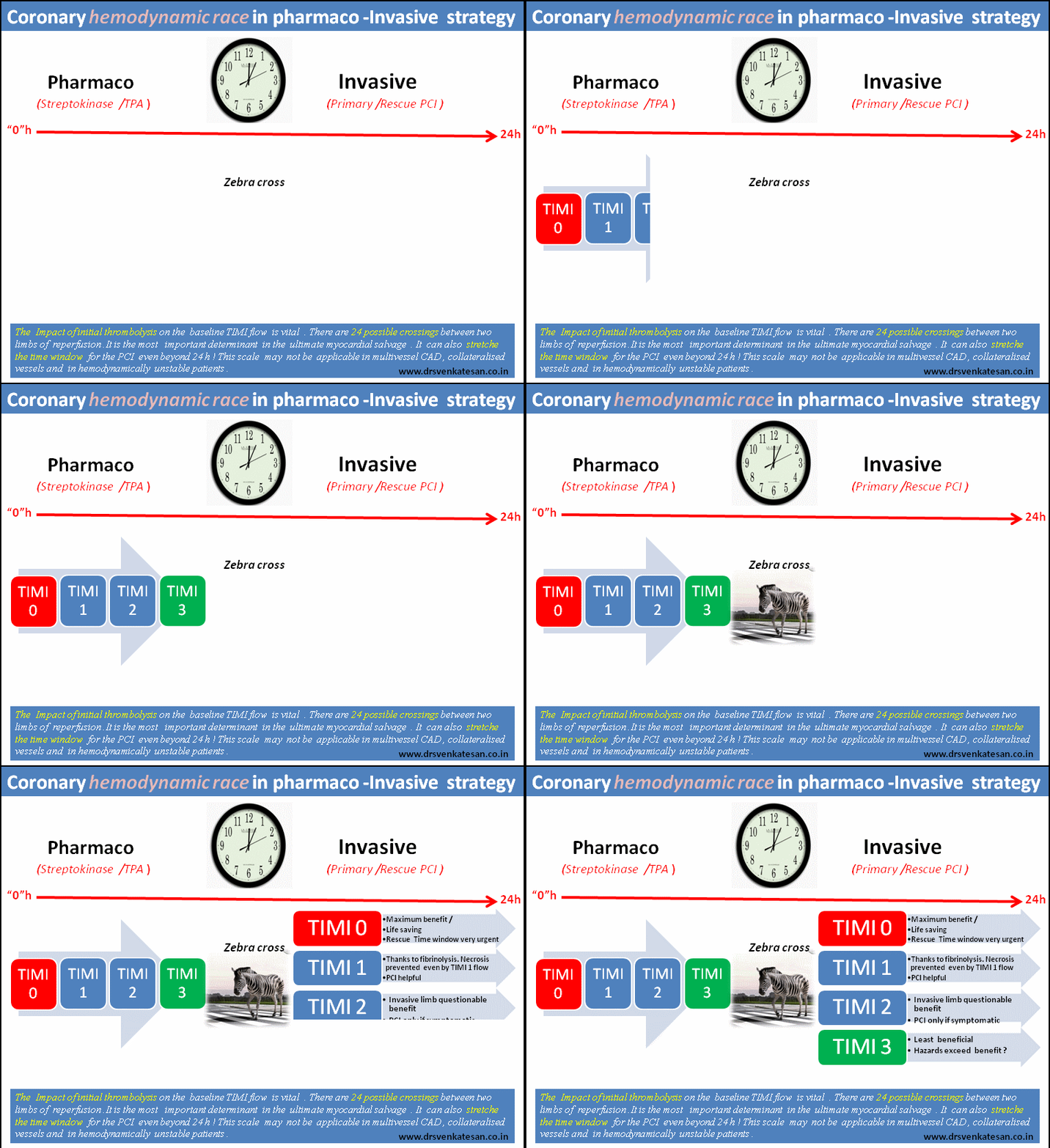
           Do not ever under estimate  the importance of  TIMI 1 flow .  It can save a  major chunk of myocardium !   A late TIMI 3  flow   . . . is far inferior . . .  to  an early TIMI 1 flow . * Even a trickle  of  flow (Ooze )   can keep the myocardium  alive .  This point we have realised very late. Thus came the   pharmaco Invasive strategy for  all STEMI  who have no immediate access to cath lab ! (please note 90 % of STEMI belong to this group )

pharmaco invasive strategy for stemi002

For a high resolution Image  click below

pharmaco invasive strategy in stemi

* Even a trickle (Ooze )   blood flow can keep the myocardium  alive .

Read Full Post »

pci  powerpoint presentation ptca follow upFile1-PCI 5

Click  on the file   to download  the presentation

Note : The contents are prepared in 2006 .Recent input are to be added .

//

Read Full Post »

Thrombus laden plaque  is sine qua-non of UA/NSTEMI . That’s what we  have been taught  !  right ?  It may be  true in many  situations , but please remember there is another concept  called  demand ischemia , where in there is  no active thrombus ,  still resting  angina may occur due to  increasing heart rate etc.

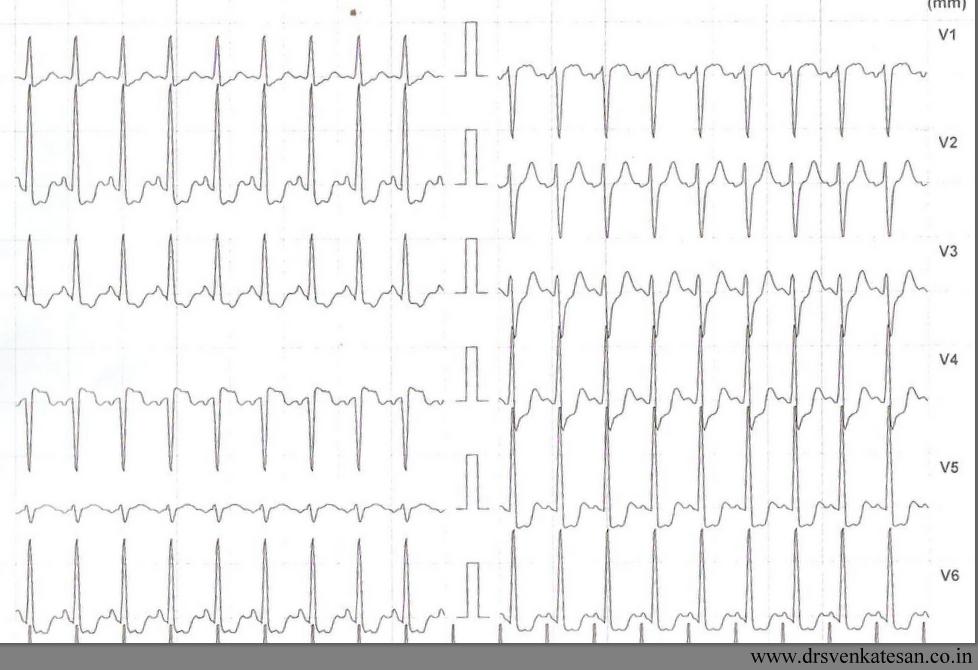
I just wanted to test how far this concept is understood ,  by the  fellows in our coronary care unit . Following  is  story of a patient who arrived at CCU with  angina  at rest .  I showed  this   ECG asked them the  management .

positive est and unstable angina

History was  purposefully blinded . 5/6 cardiologists wanted to admit the patient either in CCU or rush to cath lab.  Heparin/ Fondaparuinux was prescribed by all. Tirofiabn was suggested by few.It is a  high risk UA with left main disease some one  mumbled .

I silently listened to them and  revealed the history . This patient  has just finished the  exercise stress test , it was terminated as he had angina at peak exercise. and was  reported as  positive . A date was fixed for elective   coronary angiogram. 10 minutes later ECG totally normalised  , and the patient went home (Boarding a crowded Chennai  city bus )

The fellows realised the importance of history . In fact no body asked for it ?  I felt  bad  as  all my fellows failed in this test That reflects bad teaching on my part !

What is the mechanism of ST depression here ?

  • Fresh thrombus ?
  • Mechanical occlusion ?
  • High  heart rate ?
  • Combination of high rate and probable flow limiting lesion .

(Severe forms of  stable angina can occur at rest . So do not equate all rest angina as true  unstable angina !)

Final message

Do not label an ECG straightaway  as acute coronary syndrome when there  is  baseline  tachycardia and ST depression . Spare few minutes and apply your mind !

If  a combination of ST depression  and angina  can be taken  synonyms with UA  every EST positive fellow should be labeled as UA and admitted in CCU. Please remember any tachycardia with a fixed tight lesion will  mimic UA . Further ,  since there is no thrombus here  and there is absolutely  no role for heparin.

Read Full Post »

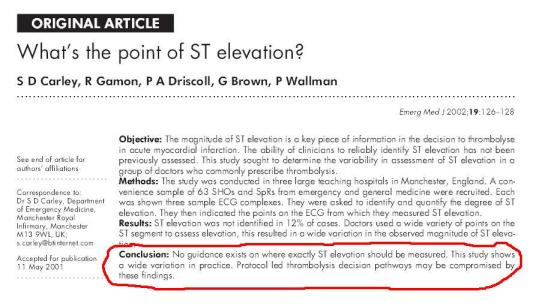
ST segment elevation is the key parameter on which the fate of millions of infarct patients are recognised and managed. It is ironical we do not have standardised reference point for measuring the quantum of SR elevation .

This is especially difficult when ST segment blends with forward limb of T waves.

While we have reference point for measuring  ST depression  (Like during EST ). . . why we do not have one for ST elevation ?

Now we have adopted a rough criteria .Read below .

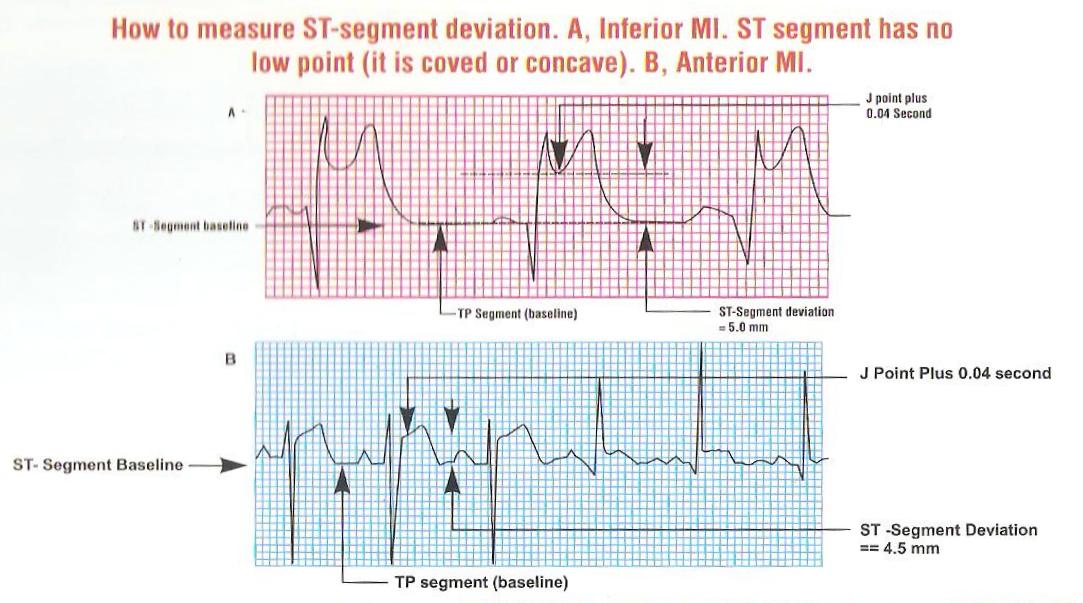
where will you measure st segment

How to measure ST elevation in ECG
How to measure ?
Measure The ST segment 40 ms from J point.
how to measure ST  elevation in STEMI 2
                        I lost track the source of this Image .(STEMI hand book 2012 ?)
Final message
ST segment  elevation  is  the key parameter in ACS.  Quantifying  it becomes  important in  assessing  the efficacy of reperfusion strategies and risk stratification. Fresh ST elevation can represent pericarditis, reinfarction or an early dyskinetic  segment . Unless we have  proper reference point there is  a room  for  error in this simple parameter.

Read Full Post »

Heart disease was  once considered as   rich man’s disease  . . .  It’s no longer  true .  We in India ,  are witnessing an epidemic of CAD . The reasons are  varied  . Apart from  conventional factors ,   social   factors  like changing demographic pattern  ,  life style , ethnic  risk  like  south  Asian metabolic profile are responsible .

While  Rheumatic heart disease (RHD ) continues to be a huge burden , CAD  is  the number one  cause for cardiovascular morbidity and mortality .

CAD affect the poor and rich with equal vengeance . The later is better equipped financially to tackle it . Of course ,  it has resulted in maximum inappropriate interventions. The poor (or borderline poor ) have  no  other  option  but  to knock the doors of Government  hospitals. It is heartening to note, various state  Governments   are  gradually involving insurance schemes.

Still , many struggle to find the required  finance for  a major cardiac intervention. It roughly costs 100,000 rupees  for PTCA  .While  PCI is required in all symptomatic ,  critical coronary occlusions , still . . .  majority of the  CAD in general population  do not require it . There are 675 cath labs in India performing 180000 angioplasties every year  on an average of   15000  PCI per month ( 500 /day )  This is grossly inadequate . We  have huge potential

What is the hurdle ?

  • Expertise ?
  • Hard ware ?
  • Awareness ?

No  . . . it is all about  financial resources

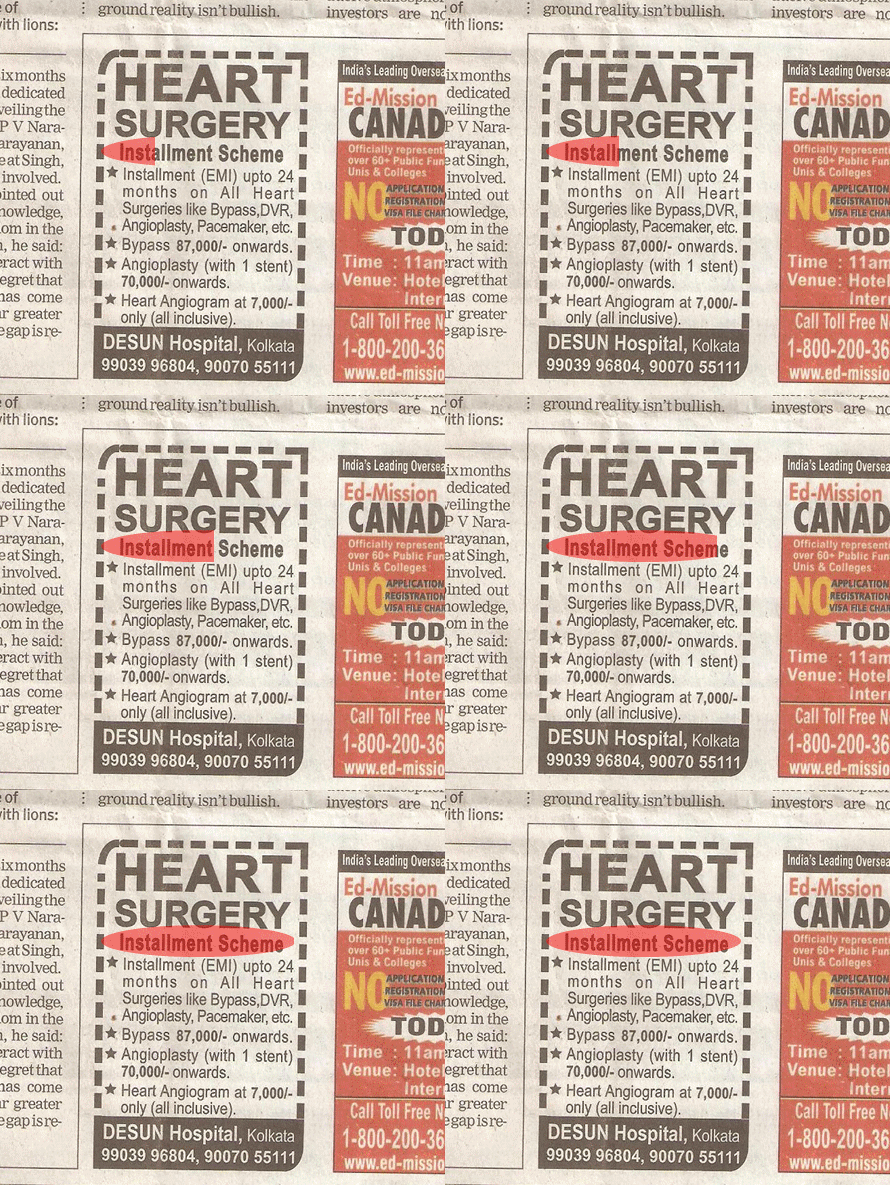
Recently I stumbled upon an  advertisement on Times of India

cardiology ad ptca

Disclaimer: This article does not in any way defame any hospital that offers the scheme.It just want to debate the concept.

Hospitals  want  to  market the procedure . Convert angiograms  to angioplasties . That’s   corporate boardroom mantra  . And one fine day ,  bankers and medical doctor sat together and brought a brilliant idea.

Why not do the procedure  on credit and  push the patient  life long  into a financial debt !

Wonderful idea  . . . many thought .Thus came the financing scheme for  cardiac procedures.

Final message

Financing a poor patient  with good intention is welcome. But, there is big caveat .In a vast country   with high  illiteracy , inappropriate  procedures   may be thrusted upon  on   the  poor  souls.

After thought

Now ,  our patients   have  one more  risk parameter to  assess   ” Number of remaining EMI( Equal monthly instalment )  and incidence of stent thrombosis”   “Accumulated  interest  and angina”   What a wonderful way to provide cardiac care !

I can recall a  patient who sold his livestock  (his sole income source ) for undergoing a open heart surgery and lost his life as well in the process  leaving the family stranded !

Solution

The only solution is  to  provide  a strictly regulated Govt sponsored  insurance scheme.  High tech procedures should be  continuously and meticulously  audited for cost effectiveness .


Read Full Post »

Multivessel PCI during acute STEMI is forbidden except in cardiogenic  shock . (or in some very unstable patients without cardiogenic shock)

The reason

  • During acute MI   hemodynamics  are precariously balanced.We do not know yet how  emergency multivessel plasty alters this .
  • Our  initial aim should be   confined to myocardial salvage in the IRA . Total myocardial revascularization is niether  the  priority nor its desirable.
  • The more  time  you spend  within the inflamed coronary artery , more its  hazardous.
  • Multiple stenting  is prone for thrombus   and  migration  into side branch .
  • Stent opposition is sub optimal in many thrombus infested lesions.

Still  . . .  in real world it is extremely difficult to curtail the urge to stent  all eligible lesion during primary PCI !

multivessel angioplasy during stemi

How to avoid it ? 

If the patient is poor or the insurance limit is low , the issue  of multi vessel stenting does not arise at all  !

Always  ignore  complex  non IRA lesions  during primary  PCI. Be happy if a non IRA has a bifurcation lesion !

Still , some lovely looking lesions in non IRA  would be  tempting  and inviting .  Indulge at your own risk !

* Please remember if  the proximal  LAD  has a non IRA lesion , it may be sensible to attempt  simultaneous revascularisation even if the patient is stable !

Other unrealistic advice

  • Keep the professional fee and other benefits   fixed whether  we do a single or multiple   vessel stenting (Realise  . . .  surgeons do not charge more for a  4  vessel by-pass graft  than a single  ! )
  • Keep the current AHA/ACC/ESC guidelines pasted right next to the fluroscopy monitor .
  • Ask your subordinates to repeatedly caution   you  about the possible  excesses and ask them to wave a red flag !
  • You may  empower the   senior staff nurse   with a veto power  to shut off the cath lab once IRA plasty is  completed and the patient  is stable.
  • In extreme  situations , keep a cath  marshal ready to manually evacuate  the primary operator  from cath lab !

Reference

multivessel angioplasty during stemi

ACC GUIDELINES FOR STEMI 2013

Read Full Post »

The link between brain and the  hand  starts right from fetus .  It is a well known fact  vertebral artery   competes with hand blood flow  . In the right side , there  is one more  vascular issue !  .Bracho cephalic  artery  arises  directly  from aorta and supplies the  right  hand and  right half of brain.

It remains a mystery  why left brain  is   blessed with a  separate  origin ,  while right has to share it with blood meant for hand  .It is beyond science  . . . isn’t

It is possible the left hemisphere  of brain   has more   purpose   to be alive  ,  with bulk of the cognition work to do . Hence   God created a  separate  supply to it !  Of course , he  would   have never  thought ,  the  possibility of  his ” mean” creations   adventuring  within the   arterial tree  !

Click over the Image for animation

right radial artery coronary angiogram  pci  risk of stroke 002

Please remember  whenever  we   play with   catheters and wires  through   radial route , we  are  hugging  and scraping   the artery meant  for cerebral circulation !

Final message

Femoral Interventions  enjoys a proven  track record. Currently ,  radial route has virtually taken over with  few  advantages . However , the  overall stroke risk in the two approaches  remain  low but genuine (.4 %) .It may be true , arch manipulation is more  with  femoral but  the threat to  vertebral and brachiocephalic circulation  is more with radial .  When the available evidence are  not conclusive  and  new ones are not forth coming  . . . it is wiser to rely on common sense !

Reference

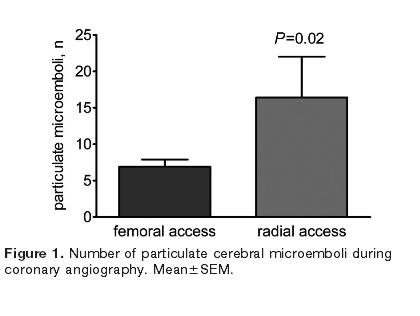
I think  this 2011  study  from the  prestigious stroke journal  has convincingly answered the issue

cholesterol and ateromatous emboli following coroanry intervention 2

cholesterol and ateromatous emboli following coroanry intervention  radial vs  femoral 2

It concludes , the right radial approach  is indeed risky  to develop cerebral  micro embolism   when compared to right femoral

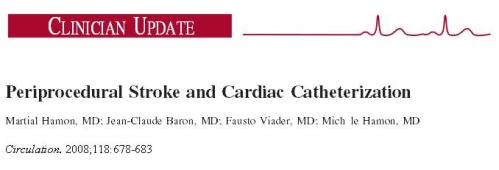
A Review article in  Circulation

cholesterol and ateromatous emboli following coroanry intervention 2  radial vs  femoral 2

Other references

1.http://stroke.ahajournals.org/content/38/7/2176.full.pdf+html

2.Transient Cortical Blindness after Coronary Angiography Journal of International Medical Research. 2009;37:12461251,

3. Stroke and Cardiac Catheterization Circulation. 2008;118:678683,

Read Full Post »

For STEMI management there are  6 management protocols available

  1. Thrombolysis
  2. Primary PCI
  3. Rescue PCI
  4. Facilitated PCI
  5. Pharmaco -Invasive approach
  6. CABG

*CABG is rarely used except in  severe mechanical complication.

There is some  issues in differentiating  facilitated PCI and  Pharmaco Invasive Approach.

What do we facilitate ? How we do it ?

PCI in acute STEMI is done in a thrombotic milleu. So we get sub optimal results .Hence to facilitate it we try using

either 2B-3A antagonists, Newer Heparins, or even thrombolytic agents before submitting them for PCI

Where is this facilitation done ?

Facilitated PCI is done in small hospitals where  there  is no cath lab or cath lab is available only during office hours.

Facilitation can be done in either in same hospital or on the way to big hospital

Is there a time window to start  this ?

The main aim was to was to facilitate the PCI .Hence time window was not considered vital in few studies (Wrongly though !) ideally it should be started as early as the first contact . Since facilitation can be started earlier the time window is 0-24 hours .

What happened to the concept of f-PCI ?

It died a premature death  and  last rites were  completed when the FINNESE trial was out .

But it left behind a daughter concept ie in selected patients if the facilitation is done early , especially in those patients who are going to get the subsequent PCI late ,or in high risk individuals  , the initial  pharmacological facilitation* was indeed useful.)

*If  facilitation was with   fibrinolytic agents (Not 2a/2b )  .It is very important the benefits of facilitation is mainly  attributed to the time gain in achieving partial opening of IRA  making it more complete salvage of the subsequent PCI .

This aspect later on named as PIA .

Pharmaco- invasive approach(PIA)

We know p PCI is a race against time .We also  know fibrinolytic therapy  fares well in this race  but   pPCI  beats in   effectiveness  .

So what prevents us to combine the swiftness the fibrinolysis and the robustness of pPCI ?  That is  like getting the best of both world .( It is not that easy thing accomplish after all 1+1 in medicine is rarely 2 !)

In it’s core principle it  is same as f-PCI . But facilitation is done only with fibrinolytic agent (Not 2B-3A) . Pharmaco Invasive strategy can be started in any small hospital/ In the ambulance /. It  is routinely followed by PCI whether the initial thrombolysis is successful or not . PIA should not be done before 3 hours window if  a timely pPCI is feasible.  Hence PIA has a typical time window of 3-24 hours .

Summary

f-PCI is combining  various anti-platelet and fibrinlytic strategy prior to PCI . It was found  to be useless if it is used routinely in all cases of pPCI. (Rather 2B-3A  was useful  if  only the facilitation was done within the cath lab to prevent procedure related issues) .Time window can be between 0-24h .

Pharmaco Invasive approach (PIA)   is actually a type of f-PCI where  fibrinolytic agents are used routinely which is followed by mandatory angiogram and PCI in all deserving cases.Many still  believe the facilitation in PIA is primarily accured in  shortening the   time to reperfusion  rather than altering the thrombus load and morphology  ! Time window is usually between 3-24 hours.

Read Full Post »


Those who answered  “Yes” ,  can leave this article . Those who answered  “No” read further .

* Logic would tell us myocardial revascularisation should correct  stress induced ischemia and it  should disappear promptly  . This does not happen in all cases  real world  ! That is  why medicine is  different  from mathematical science .

Some of the  reasons for  persistence of stress positivity even after an apparently successful PCI are  . . .

  1. Incomplete  correction of ischemia. (Ideally  to be referred as failed PCI )
  2. Error in Identifying culprit 9Angina related artery ) .Common feature of poorly worked up  multivessel CAD.
  3. Re-stenosis /Re-occlusion
  4. Doing very early stress test without giving time for revascularisation to work *
  5. Rapid progression of non culprit lesions .(Sub -optimal medical management )
  6. Chronic N0-Reflow phenomenon  surrounding  area of infarct .(Especially in  PCI of CTOs)
  7. Dyskinetic  or grossly remodeled ventricular segments  can result in non ischemic positive EST response (ST drag **)
  8. Associated systemic conditions especially  Anemia/ SHT & LVH -(False positive )
  9. Many diabetic patients may  continue to show stress ischemia due to  small vessel disease.
  10. A  patient with  syndrome X  characters  can have incidental  epicardial lesion as well . In such a patient EST will always be positive .

* Optimal time to do  EST  for assessing the  efficacy of  PCI/CABG is not established .Six months may be the reasonable point .If done within 2- 3 months it may  end  up  in embarrassment for the Interventionist . (So only it is kept at 6 months , this also help us  greatly  as  we can always blame it on poor life style control and progression of  the disease !)

** No reference  for this  , a  personal observation .We know  Q leads following MI ,  will show ST elevation during stress test especially if the segments are dyskinetic  . In leads diagonally opposite to q leads ,  ST depression is observed . This may not be  a evidence for true  ischemia . It probably represents   ST drag due to mechanical stretch .

Read Full Post »

« Newer Posts - Older Posts »