Feeds:
Posts
Comments

Archive for the ‘cardiology -Therapeutics’ Category

The mechanism of pedal edema in Amlodipine

Note : I lost track , the source of this Image .I thank with courtesy whoever has created this Image .

It is primarily a  local phenomenon . The calcium channels  are primarily  arteriolar dilators . Since the  venules  lack much muscle they  are not much affected by the Amlodipine   .  This  facilitates flooding of  venules and leaks into the peri venular interstitial space. It may be apt to call Amlodipine induced edema  as a form of   local venous edema .

This results in near permanent  collection of fluid  especially  near  the ankle . Systemic fluid retention has no major role . However few patients may  show an  augmented   RASS  response due to sudden arteriolar dilatation  .  In these patients   addition of ACEI or ARB may help relieve  edema legs .The Amlodipine  induced edema is  dose  and  time dependent .(Cumulative)  . It is mostly benign in nature ,  rarely warrants withdrawal of the drug.  The edema can  occasionally be generalised   and weight  gain is  possible .

Other factors that increase the chance of edema is age , women  , obesity. They have loose  interstitial  tissues.Many especailly women complain tingling feeling in the edematous zone.

The calcium blocker induced edema is  an  exclusive feature of dihydrpyridine group  .(For some reason  , Verapamil and Diltiazem do not  share  this side effect  as  theya balanced Arteriolar and venous dilator . )

Can we use diuretics to treat Amlodipine induced edema legs ?

Hydrochorthiazide  is rarely useful as the primary problem is not in the renal  retention.

How to  treat Amlodipine induced edema ?

Unfortunately the popular combination with diuretics do not work . Angiotensin  inhibitors which has some veno dilatation is shown to reduce this edema  . ( COACH study . Olmesartan / Telmisartan combination  is an option ) .It defies logic ,  to  add  another anti HT drug for the sole  purpose of reducing  the side effect of the initial  anti HT drug . Ideally if  your patient is not tolerating  Amlodipine due to edema ,  switch to  an another group of  anti HT drugs.

Reference

http://www.isdbweb.org/documents/file/1664_2.pdf

Read Full Post »

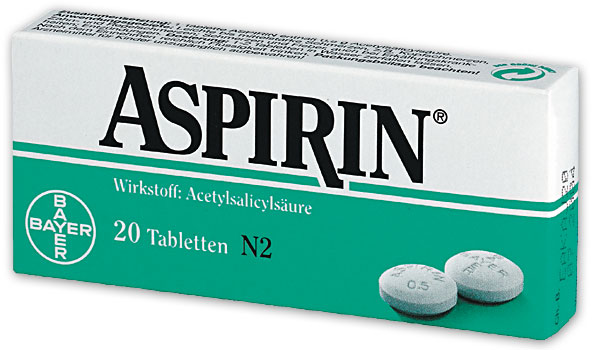
Aspirin under attack  . . . not by  Gastro-enterologists  this time ,  but by cardiologists themself  !

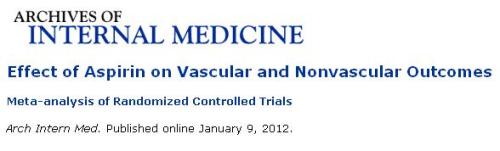
Aspirin , after all may not be safe ,  as a primary prevention drug against CAD . It  seems ,  it considerably increases  the risk of   bleeding . The  new meta analysis just published in Archives of internal medicine  says so !

Be cautious it concludes  !  Since the  track record of evidence  based  medical science  ( and its reproducibility  )   looks   pathetic  in recent times  ,  we may expect another  stunning  study  very soon , with an exactly opposite conclusion  !

After thought

So , we have a  “vacancy  in  the top slot”  for primary prevention of CAD . Mind you ,  makers of  Prasugrel and  Ticagrelor  are already  fastening their seat belts !

Read Full Post »

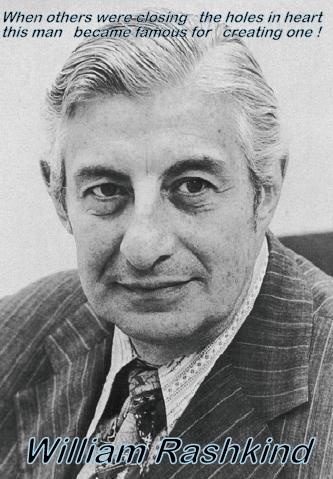
Who is the father of interventional cardiology ?

William Rashkind a cardiologist from Children’s hospital, Philadelphia in 1966  probably is the first person who thought it was indeed possible to use a wire and balloon as cardiac therapeutic intervention .When surgeons were groping in dark with  sick cyanotic new borns with dTGV , He along with Miller executed their idea.

It was published in JAMA

How the Rashkind  has revolutionized  our approach to congenital  heart disease  is evident from the current guidelines in 2011.

The procedure has since evolved with improving hardware and we are able to ferry a blade into the IAS for cutting .

Current  recommendations for Atrial  septostomy

It is primarily useful

1. Atrial septostomy  to enhance atrial  mixing (eg, transposition of the great vessels with restrictive/intact atrial communication) or to decompress the left atrium
2.During Extra corporeal membrane oxygenation (ECMO)   to decompression   of left atrial hypertension

3.If there is poor cardiac return from ECMO  circuit  low venous saturations  (Class 1 Evidence  C)
It may also be tried in  (Class 2 )
1.  Hypoplastic left heart syndrome  with  restrictive atrial communication.

2.  Static balloon dilation of  l synthetic / bioprosthetic  IAS  (eg, Gore-Tex)

3. Tricuspid atresia with restrictive atrial  communication

4 .Pulmonary atresia with intact IVS

5. TAPVC with  restrictive atrial communication.

6. Primary pulmonary hypertension / Eisenmneger VSD/PDA .(Occasionally useful )

Reference

http://circ.ahajournals.org/content/123/22/2607.full.pdf+html

Read Full Post »

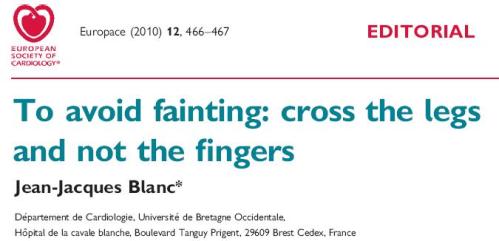
A strong willed  person rarely develop syncope.  We know  weak hearted (Or is it weak brained ?)   men and women may  faint  when  the emotions swing unexpectedly  .The  commonest cause of syncope is  neuro-cardiogenic  syncope (NCS) . (Formerly  called as  vaso-vagal syncope  VVS ). Few facts need to be  emphasized  here . There are  many  critical  circuits  and components to  common syncope.

  1. Trigger
  2. Afferent
  3. Center
  4. Efferent
  5. Fall /Near fall
  6. Prompt recovery after the fall.

Trigger can be emotional or mechanical (Prolonged standing ,  dehydration , etc )  . It occurs generally  in an emotionally  charged  environment with a high  basal sympathetic tone .

Afferent for  NCS   is  mostly sympathetic but it can be  para- sympathetic also (Sensitive GI tract ,  Micturition etc )

* Many times a  trigger and afferent pathway can overlap with each other.It is still unclear what exactly constitutes the afferent , since  triggers can be either sympathetic or para- sympathetic .  ( Pain, GI stimuli, vascular puncture etc) .  Further , afferent  can be be same as the trigger and reach the brain  stem directly  or touch  the heart en route .  ( Cardiac axis  in classical NCS)

The  center is  in the medulla  . Both vagal and sympathetic centers  are involved with potential  spill over on either side.

Final efferent  pathway is the strong  vagal surge resulting in bradycardia and peripheral vasodilatation , cerebral hypo-perfusion  and the person usually falls .( Near fall or aborted NCS  is also a common theme )
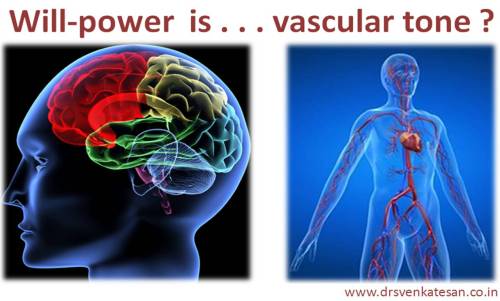
                                        If stress increases the blood pressure , absence  of stress  will have to  lower the blood pressure . If anxiety cause hypertension  ,  depression is expected to   cause hypo-tension.

These  inferences  may  appear  correct by logic . As  is always in medicine ,  such   logic works only partially ! ( We are told  the  Sadhus of Himalayas rarely record  blood pressure  beyond 100mmhg systolic  !)

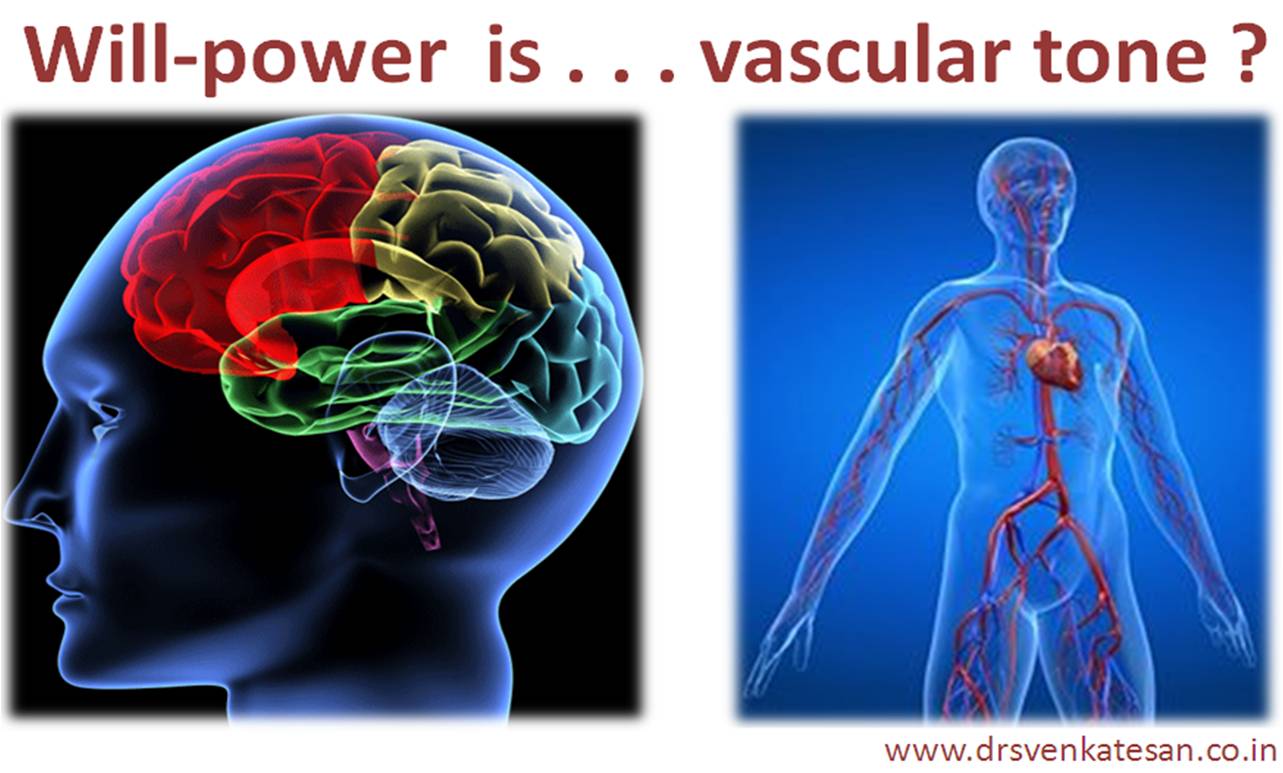
There are strong reasons to believe common syncope (NCS)  is primarily related to the state  of mind and  the neural regulation. Dizziness ,  giddiness  near syncope  are closely related  to  psycho-somatic disorders. Strong willed men and women rarely develop   syncope.Their vascular   tone is well in control even in critical times .This fact has been  well observed  in  the setting of   traumatic  and hemorrhagic   shock  in critical care units  ,  where  some  hold their blood pressure well  even in   adverse circumstances  and few sink without any fight .

Is psychogenic , situational , pain syncope  same as NCS ?

Technically it may not be same. But all of  them  share at least 50 % 0f the  circuits of  NCS.  .However  there is no consensus  to call  psychogenic and   pain syncope  as  types of  NCS.

One critical aspect of  the debate is ,  we do not know whether the  cardiac axis is involved in these  syncope or not. It is preferable to call these types of syncope  as neural syncope (NS)

While in the classical NCS  heart has a  central role in generating hyper active sympathetic afferent from  myocardial stretch receptors. In psychogenic and pain syncope cardiac stretch receptors  are not much stimulated instead ,  the  spillover occur  directly from sympathetic to parasympathetic  nucleus in medulla.

In pain induced syncope parasympathetic limb  gets vigorously stimulated in isolation  to cause a severe  vaso-dilatation  . But once the syncope sets in we often observe bradycardia  and cardiac  limb may get activated as well.

* Presence or absence of cardiac limb in NCS and NS is critical with reference to efficacy of  beta blockers in NCS. The current guideline of NCS  management(  ESC 2010) is strongly biased against beta blocker (Class 3 -level A)  which we feel is  incorrect . Bulk of the patients with NCS respond well to long term beta blockers  .

Please realise , beta blocker  is the only drug which  can break the  NCS  circuit at multiple levels .(Sympathetic trigger, sympathetic afferent, cardiac stretch !

So what is the message ?

It doesn’t require great brains  to realise  vascular  and neural system are  intimately linked  . We know today,  NCS  is primarily a neural phenomenon  hence the  mental status has a  dominant  control over the vascular system especially at times of stress .

The confusion between classical  NCS and psychogenic  / situational  syncope can be largely avoided  , if  only  we call these entities  as simply neurogenic / neural syncope (NS ) ( Omitting the word cardiac is helpful ,   as cardiac axis is not vital  here  ? Non existent  )

Clarity is still  elusive  in defining the  trigger  and afferent limb for the NCS  , fortunately  the final common  efferent pathway that makes the patient fall is indisputably   vagal  !   .  Medullary  vagal nucleus  though fires independently  , also gets  powerful central  parasympathetic flow  from  cortical areas  . Paradoxically ,   controlling sympathetic outflow (Anxiety ) is often an easier  way to reduce parasympathetic flow. This is referred  to as competitive , accentuated  antagonism.

One can prevent recurrent  syncope  by vigorous  mind  control at times of  extreme stress. This is  confirmed  indirectly , by the fact  reassurance is the key to successful  management  in vast majority of  patients with NCS .We learnt this  simple fact  after trying exotic methods like DDDR pacing  and so on .

Final message

Power of  the mind can never be under estimated even in cardio- vascular hemodynamics .  When  pathologically high,   it can spike the blood pressure and break  few vessels in brain , while  if it  is inappropriately  low ,  may induce a syncope or result in persistent  hypo-tension .

Let us learn to use  our  mind over  body  properly .Yogis do it style  and live for 100 years !

Reference
http://europace.oxfordjournals.org/content/12/4/567.full.pdf+html

http://europace.oxfordjournals.org/content/12/4/466.full.pdf+html


Iam surprised why this post has been looked so negative by the readees. Almost all  rated it  as very poor.

Iam still pondering over it. Realised to lable patients as weak minded could be one of the reasons.

I think what I wanted to convey was there is link between mind and vascular system.

Please let me what is seen as offensive, let me learn and correct in future.


Read Full Post »

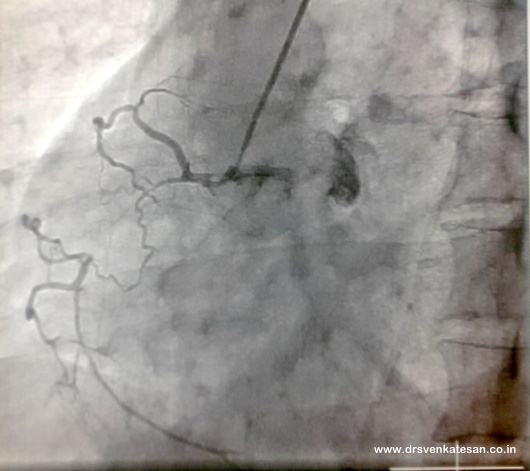
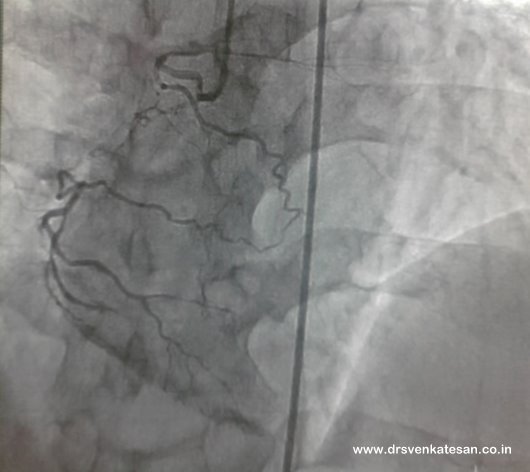
A middle aged man who owns a petty shop in a small  town of south India   came to us for stable angina .His RCA looked like this.

Normally if one coronary artery is obstructed the other comes to the rescue .It seems , this RCA do not trust it’s sibling LAD . See how it  self supports  its own  territory .(The most fascinating and mysterious aspect of coronary circulation is the collateral circulation. LAD  has big brother attitude  . . . it hesitates to help others while   RCA is more philanthropic , we know  it sends prompt  collateral to  LAD  whenever it is  distressed !)

However , there is one advantage of  such   self-sustenance of RCA  (Intra coronary/homo-collaterals ) . If  the  RCA  has to live  at the mercy of LAD  it  runs a risk of   neglect  at times of  distant LAD ischemia as well  !

Management

Single vessel disease , total occlusion , long segment lesion , still  the  PDA  is protected and the vital postero- basal area of heart perfused well ! What to do ?

Scientific  cardiologists  would like to meddle this  RCA with  multi-pronged guide-wires and other weapons  . Non -scientific cardiologists would  send him  home with medicines  . This patient preferred the later ! In the process  he  saved a  lakh ,  which  I  believe was meant for his daughter’s  education . He profusely thanked me for not hijacking his hard earned money for  frivolous  reasons . I said he should thank  his collaterals  and not me , for getting his money back  !

Read Full Post »

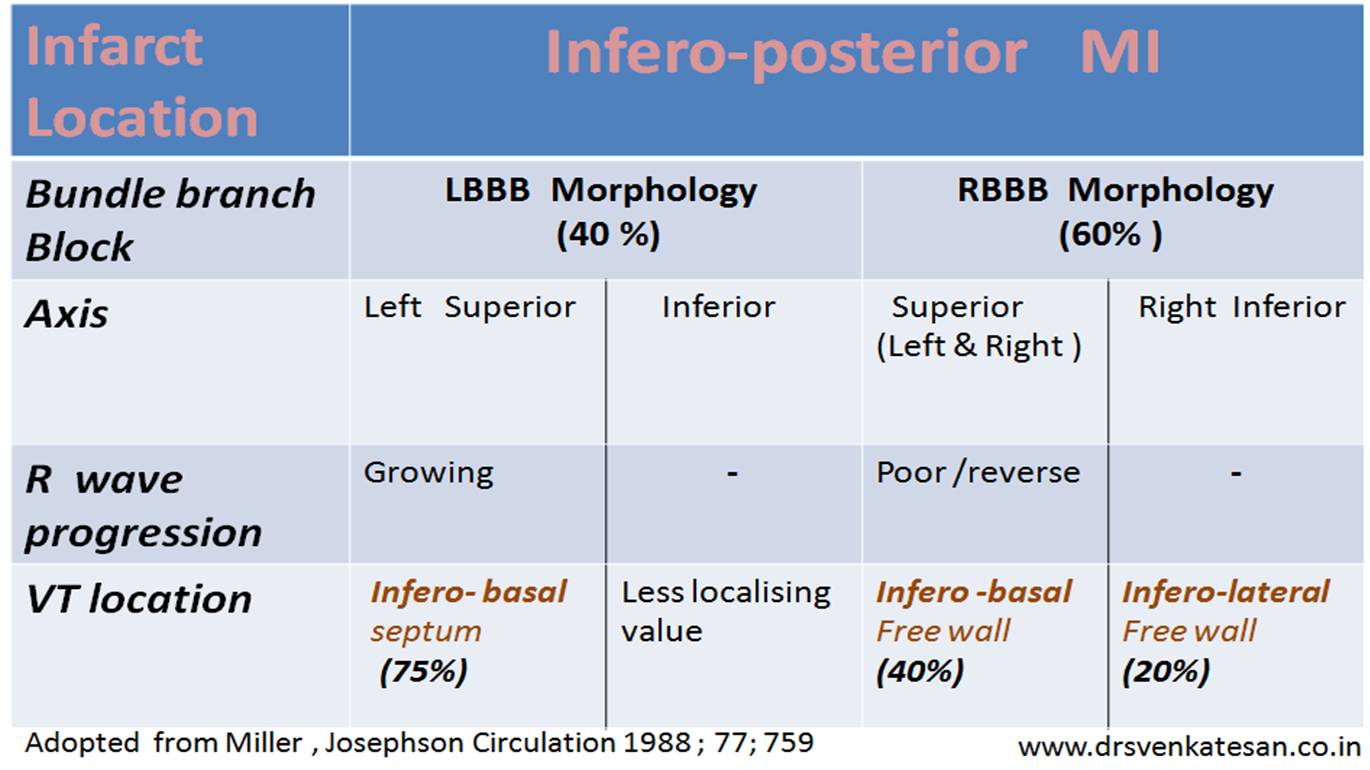
Mark E Jospehson  is the man who single-handedly carried  the burden of teaching  generations  of electro-physiologists  from  Harvard  Thorndike electro physiology services , Boston USA. Today , whatever  we know  about the mechanisms of VT , it is because of such great men who  spent thousands of hours  in the  first generation EP labs in early 1970s and 80s  , meticulously analysing   the data emanating  from  over  600   scar mediated VT with complex circuitry .

He along with  Miller published this seminal paper  in circulation 1988 , which gave us  the  algorithm  that localises  Post MI VTs.

Following table summarises their finding.

VT localisation in Infero-posterior MI

The general principles  of localisation of VT  

  • Localising VT following myocardial infarction  is difficult but distinctly  possible with  about 60 % accuracy.
  • Whenever we locate a focus we generally refer to epicardial site of exit not the focus of  origin.
  • Ischemic VTs with complex scars are difficult to locate .
  • The rule  that RBBB VT arise from  LV and LBBB VT from RV is too simplistic  in scar mediated VT.
  • The fact  that IVS is common to both RV and LV confounds the issue .Further, in a given  clinical VT  the origin  , course   and exit points of VT can considerably vary .For example  septal VT can exit  on  either side and  result in  either RBBB or LBBB morphology (Epicardial break thorough )
  • Multiple exit points are also possible.
  • VT induced in EP lab may not be reproducing the same clinical VT. So we have to be careful in what  we ablate and claim success !
  • VT with  structurally normal heart  has   more predictable behavior  , for  example RVOT VT  almost always have LBBB morphology.

Other important rules of thumb are

  • LBBB VT has more localising value .
  • Superior  axis is the most common  axis.
  • Bulk of the ischemic VT are located within the septum either in the apical or basal region .(75%)
  • Infero posterior MI has more complex scars , hence VT morphology is heterogeneous.

The purpose of localising VT is important  only with reference to  ablation.(Of course for academic reasons  as well )   With advent of electro anatomic imaging (Carto ) it is becoming   easier  to locate and track them . Still only a minority of VTs are amenable for RF ablation .

Please note ,  the most common modalities we use  in the management of VT  ,   Amiodarone  and ICDs   simply do not   bother  about   focus of origin  for it’s action !  That makes our job easy !

Reference

http://circ.ahajournals.org/content/77/4/759.full.pdf

Read Full Post »

WPW syndrome is the prototype of cardiac pre- excitation . The accessory  AV pathway short circuits the ventricle .Since  there are two options  available   for the  incoming  atrial  impulse  to reach ventricle ,  often  times  the qrs is contributed by both .Hence a  fusion  occurs  within qrs complex and stretches it wide   ,  it also  generates a delta wave and short PR interval .

The complexities of  conduction   properties and refractionaries of AV node and  accessory  pathways determine the degree of pre- excitation. When an optimally timed  APD  gate crashes  into the  accessary pathway it gets blocked ,  only to recover little late ,  unfortunately  invites AV nodal impulse  from below  . This facilitates a  re- entry circuit from ventricle to atria and result in classical AV reciprocating tachycardia .

Antegrade conduction through AV node is  physiological and  benign as it inherently checks the heart  rate . Antegrade conduction  occurring through the  accessory pathway  (which  constitutes the pathological  component  ), is   potentially  dangerous  as it lacks the  electrical breaks (Technically called decremental conduction )

What  is the  specific  ECG evidence for  antegrade conduction thorough accessory pathway  in ECG ?

Delta  waves

So,  what does it mean if there is absent delta waves  in WPW syndrome ?

It can mean three things

  1. Concealed pathway
  2. Manifest pathway , but intermittently  blocked pathway.
  3. It is not WPW syndrome at all .

We know concealed  pathways are  safe* as it allows only retrograde conduction. ( Safe  regarding   risk  of  sudden cardiac death ,  still unsafe for AVRT !)

Intermittent WPW

Intermittent pathways are equally  safe  as intermittent absence of  pre-excitation   indicate  the  presence   of naturally occurring     breaking system within accessory pathway . Are these  accessory pathways blessed with some AV nodal cells ?  May be !  . Histological studies do suggest that .This explains   intermittent missing of delta waves  which is  electro-physiologically a good sign

(We also know   there are exclusive slowly conducting accessory pathways like  Mahim and variants  )

If  one is lucky to observe this phenomenon in ECG  it can be termed as  a poor man’s  EP study  . ( Which requires specialized methods to document the refractory period of accessory pathway  to be   < 250 msec)

Techniques to  screen for or / unmask this concept.

Whenever  we  diagnose  WPW one has to look   ,  whether the patient  harbors  this phenomenon .

  • Holter monitoring has a useful role in this regard .
  • If there is nocturnal   disappearance of pre- excitation it would  suggest a safe  accessory pathway.
  • Similarly , if pre- excitation disappear during exercise  stress  testing it  would indicate a  type of intermittent WPW syndrome.

Final message

An astute cardiologist shall  look for this intermittent nature of delta waves  and  help avoid a costly and  potentially harmful EP study !

Read Full Post »

How early one can shift a patient for rescue PCI after failed thrombolysis ?

  1.  Wait for at-least 24  hours.
  2. A minimum  cool off period of 2 hours is required.
  3. It is never an issue . Rush the patient  immediately to cath lab
  4. The question does not arise  . Often times ,  rescue PCI is a dead concept  as  sufficient damage has happened !

Answer

The irony of  medical science  lies in our belief that every medical query  has a specific answer ! In reality it is rarely true.   In this instance , any of  the above can be a correct response.

A patient with  failed thrombolysis can belong to any of the  64 possible combinations*  based on  time of  thrombolysis , extent of  MI,  associated complications, co- morbid conditions , presence of symptoms . (For example there is  a sub groups of patient with  failed thrombolysis still  asymptomatic  and comfortable )

The issues for rescue PCI  do not  arise  in a   sinking STEMI (Cardiogenic shock ) , or  STEMI with persistent angina. There  is  no  management issues in  these patients  .They need to be rushed to cath lab. Unfortunately  in  impending  LVF or manifest LVF (But not in shock )  decision making is tough , as doing a PCI in patients  with basal crackles  and hypoxia is a real challenge .These are the patients who are likely  to hit hard  from the hazards of the procedure .Extreme caution is required.

I have seen  significant cohort  of  asymptomatic hypotensive patients getting converted into   drug resistant, IABP dependent refractory shock after PCI  ,  making every one look  pathetic  !  The  only solace for the interventionist  is  the gratification  of  stenting the  IRA !

This  happens  , in spite  of having  multi national trained  in house critical care anesthetics and  dual core processing IABP  . Realise  what we need is delicate decision making ,  So use extreme diligence in selecting patients with impeding shock .

Your medical management can  provide  more teeth to stabilise your patient than a PCI .If you are doubt discuss with your learned colleagues .  ( If you  do not  ask for evidence for  this statement , probably  it would confirm  you  as  an  experienced   cardiologist  !)

Real issues pushed to the sidelines ?

While the real issue  in the timing of rescue PCI  may be  different , the discussion traditionally  revolves around   hemo-rheological aspects . We know  the lytics and PCI do not combine well for two reasons.

  • Pro-coagulant nature of lytic state .
  • Excess bleeding risk at puncture site.

Now ,  we have evidence to say fibrin specific lytics  TPA, TNKTPA has less of this issue . ( NORDISTEMI)

Patients who receive  fibrin specific lytics  can  safely  be  taken for rescue PCI  in case it is needed without any increased risk .

Bleeding complication  has dramatically reduced as radial procedures are done often even in emergency setting.

Vascular occlusive devices  have added to our comfort.

* The definition of failed  thrombolysis by  itself is not standardized . Is it symptom guided ?  or ECG / enzyme / echo guided  ? A patient with  infarct  related chest pain (dull aching )  after thromolysis can be labeled as post infarct refractory angina and rushed for emergency angiogram .(This is due to our ignorance  about  the  residual pain signals  through  type c pain fibres  for up to 24 hours )

Final message

The indication and  timing of rescue PCI is  primarily  related   to the  overall   patient profile  rather than the bleeding or pro-coagulant issues .

Although   pro-coagulant  lytic state is based on weak scientific  foundation , it  is a blessing in disguise  as it  can  act  as a deterrent  in restricting  inappropriate rescue PCI !

Read Full Post »

What is a coronary risk factor ?

Right from the days of  Framingham study we have conferred a privileged   place   to  few  cardiac  risk factors.

they are

  • Diabetes mellites
  • Hypertension
  • Hyperlipidemia
  • Smoking
  • Obesity

They are referred to as conventional risk factors .  What is the convention ?  Do they deserve  the  cult  status they enjoy ?

Today we also have a  cluster  of non conventional risk factors like , Lip (a) , low HDL, Homocystenemia , CRP , Apo B etc . Currently ,  in any large cohort of CAD  up to 30 %  do not exhibit even a single conventional risk factor  . This is a huge number .Hence   we tend to give more importance to genetic make up and mental stress etc  .The search is still  on for newer risk factors .

Why some research  findings are difficult to comprehend ?

It is because we are yet to  decode the  intricacies  of  human biology  fully . Our knowledge is so superficial  , as we chase  a pseudo scientific  proofs   for  a  presumed  hypothesis.  The classical example is the concept called good cholesterol (HDL) and reverse cholesterol transport which  is never based on solid scientific foundations.

Take the sorry story of  Torcetrapib

Many consider  low HDL  as an independent CAD risk factor to be a  myth  or else why should we miserably fail  to have any positive effect of  increasing the HDL  levels by pharmacological means . (One argument is physiological  and natural elevation of  HDL  would still be beneficial  . But the issue is still wrapped in a statistical mystery

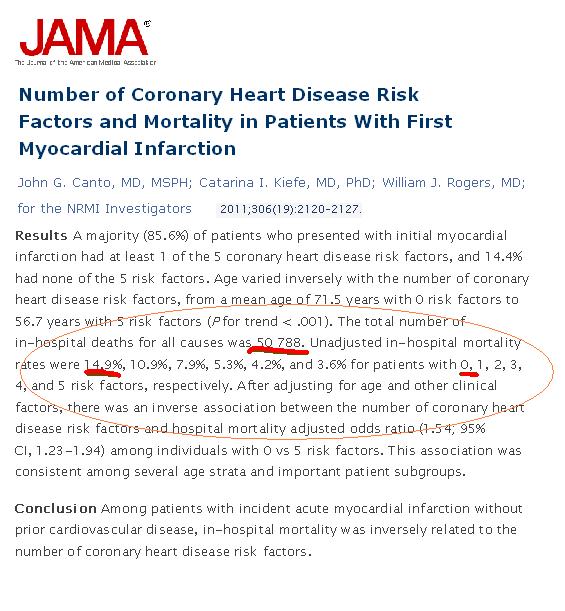
This  paper from  JAMA   adds further insight into our ignorance about  the  genesis of CAD .

The data is from  NRMI registry.

The statistics  reveal  a stunning fact .In  the overall CAD cohort ,  patients  with no major risk factors  experience  highest mortality and the ones with maximum   risk factors have least mortality ! What a shocker of a study ?

http://jama.ama-assn.org/content/306/19/2120

This  paper  would bring  jitters to the population ,  but in the real sense it sends an important message .

A significant population develop CAD without any  known risk factors.(14.5% in NRMI registry )

If a person develops  a CAD without any major risk factor  ,  it seems  . . . it is not at all a  good news   !  rather we need to introspect , why  without any risk factor he or she has suffered CAD ,

One inference is  their vascular system is more vulnerable ! Some hidden factors are operating . How to manage such  patients  without any target to intervene ?   A diabetic dyslipidemic smoker has a   definite  therapeutic target  .

What about these   lesser  humans  who   develop   CAD without any known risk factors  ? They  tend to suffer more !

Is  CAD  due to DM/SHT  is better than  others  ? This study seems to say so ” Known devils are better than unknown ones ”

Final message

Unlearning is an   “essential and fundamental”  component of   scientific learning .  In this progressive scientific world , this applies  most to   medical profession  than any other field !

Read Full Post »

Exertion and  acute coronary syndrome (ACS) has a tricky relationship. On the one  hand, it  would  appear they are not related at all  as only a miniscule of patients   give history of recent severe exertion prior to ACS   , while  few others  tell us  a clear- tale of   unaccustomed  exertion ,  just prior to the onset of chest pain.

Here is case history  of a  man  who was rushed to our  ER from  Madras central station ( Our hospital is located just opposite to it !  )

A  48 year bank officer  was  about to board  a train to Patna   . It was a rainy  November  evening ,  his car got struck in traffic .He along with  his family members were rushing to catch the rain  .He had  to run fast with his heavy luggage  .Even as they boarded  the train successfully and occupied their  seats  ,   within minutes  he  developed intense chest pain and sweating . The distressed family de-boarded the train and was rushed to our hospital  . Yes  you guessed it right   . . . he  was showing an extensive ST elevation  in anterior leads on arrival.

So what  has  happened ?  What is the coronary hemo-dynamics during heavy unusual physical exertion ?

The above patient did  not have any obvious risk factor . He vaguely recalled ,   one if his family doctors telling him ,  he had borderline high BP and was never prescribed a  drug . His wife told us  he has been a emotionally  liable individual .

It is well  known  , sudden exertion in an  emotional  milieu   would  result  in  intense  adrenergic drive  . (Here the emotion was anxiety/ fear of missing the train )  Adrenergic drive was  amplified with the  isometric exercise (heavy suitcases ) ,   shoots the intra  coronary blood pressure (normal 45-60mmhg)  into  dangerous spikes . (By the way , what happened to  coronary auto regulation  ?) . We also  realise simple raise  of  intra coronary pressure alone is not sufficient  .These patient  will  harbor at least some degree of  atherosclerosis  which face a  shearing stress and give way /tear  or fissure resulting in  a sudden substrate for intra coronary  thrombosis.  Some of them may manifest  only  as coronary vasospasm  .When sustained  it can also result in a full-blown acute coronary syndrome.

The concept of trigger vs risk factor

One should remember  both physical and mental exertion   act  mainly as a  trigger (They are not  major risk factors  like DM/HT/Smoking /Dyslipedemia) . All that is required ,  for  this   vulnerable population  to fire  is a trigger.  Physical exertion ( especially  isometric)  when  associated with  emotionally charged  brain  sends a  perfect  invitation  for an impending  ACS !

Another example  for untoward  effects of  exertion

A middle aged man who had  impaired glucose intolerance and dyslipdemia  was referred for an  EST.He did complete  12 minutes of  Bruce  protocol  comfortably . But  on the same day evening  ,  he felt  uneasy  and came to our ER ,   only to record a full blown STEMI .

These events may be rare but if properly understood   these  patients can teach  us  few   lessons in the genesis of ACS and coronary hemodynamics .

Special  issues  about   exertion in post PCI patients

One of the purpose of doing  PCI  for CAD  is to improve the  functional  capacity  (and possibly to prevent future ACS) . Paradoxically ,  we  continue  to have  some apprehension about subjecting post PCI  patients  into early stress testing . (I remember reading some guidelines that advice us to  avoid stress testing strictly for 6 months post PCI  ! Is it true ?)

If a  cardioloigst  is  not too comfortable  putting their  patients  into a  treadmill  post PCI ,  it only implies they doubt their efficacy ! It   would  also imply  these  patients   should  not be allowed to exert to their full capacity in day to day  life events as well .(Attention  cardiologists   . . . Yeh  . . . we have a  fundematal problem on our hand !)

Read Full Post »

« Newer Posts - Older Posts »