Feeds:
Posts
Comments

Archive for the ‘Cardiology -unresolved questions’ Category

Hypertrophic cardiomyopathy (HCM) manifests   with or without obstruction. Obstructive HCM ,  (ie HOCM)  is more often symptomatic .However , the risk of arrhythmias, sudden death, and some degree of diastolic dysfunction are common in both.

ECG, clinical examination are generally  not sensitive to identify obstruction in HCM  .Echocardiogram is the easiest  way to identify  the obstruction (gradients> 3o mmhg across LVOT are considered significant ).LV angiogram ,MRI, CT scans are rarely necessary today.

However , the following clinical clues will help us  to suspect significant obstruction in HCM

History

  • Class  2 or  3 dyspnea.
  • Exertional syncope
  • Exertional angina

Pulse

  • Pulsus bisferiens (Two peaks in systole )

LV apex

  • Sustained , double apical impulse  often indicate obstruction.
  • Presence of Mitral regurgitation ( 20% can have  MR without obstruction due to intrinsic abnormalities of  mitral valve )

* It should  be realised , valsalva induced MR /LVOTO  may occur in many of the non obstructive HCM.

What happens to  clinical signs of obstruction with medical therapy(Beta blockers etc)

One would expect these signs to regress or disappear, but it rarely happens. The pulse , the  murmur show  little change .  This implies , the main mechanism of beneficial effect could be in  heart rate  reduction , and  improvement in the   diastolic properties of left ventricle.

Read Full Post »

Acute MI and ventricular tachycardia are closely related entities.In fact ,  the earliest response to ischemia could be a VT .But what  is peculiar about this VT is,  it  almost always degenerates into VF  within a minute or so.(Unlike idiopathic VTs /RVOT/LVOT VTs)

This arrhythmia in  every sense  can be called as  “primary VT which is the cause for “primary VF”

It is strongly  believed VF cannot occur without  a  brief episode of VT preceding it .Logic would also suggest  the ischemic myocardium  can not suddenly  become chaotic  “with the first  beat  “. There is little documentation available to unprove this presumption.

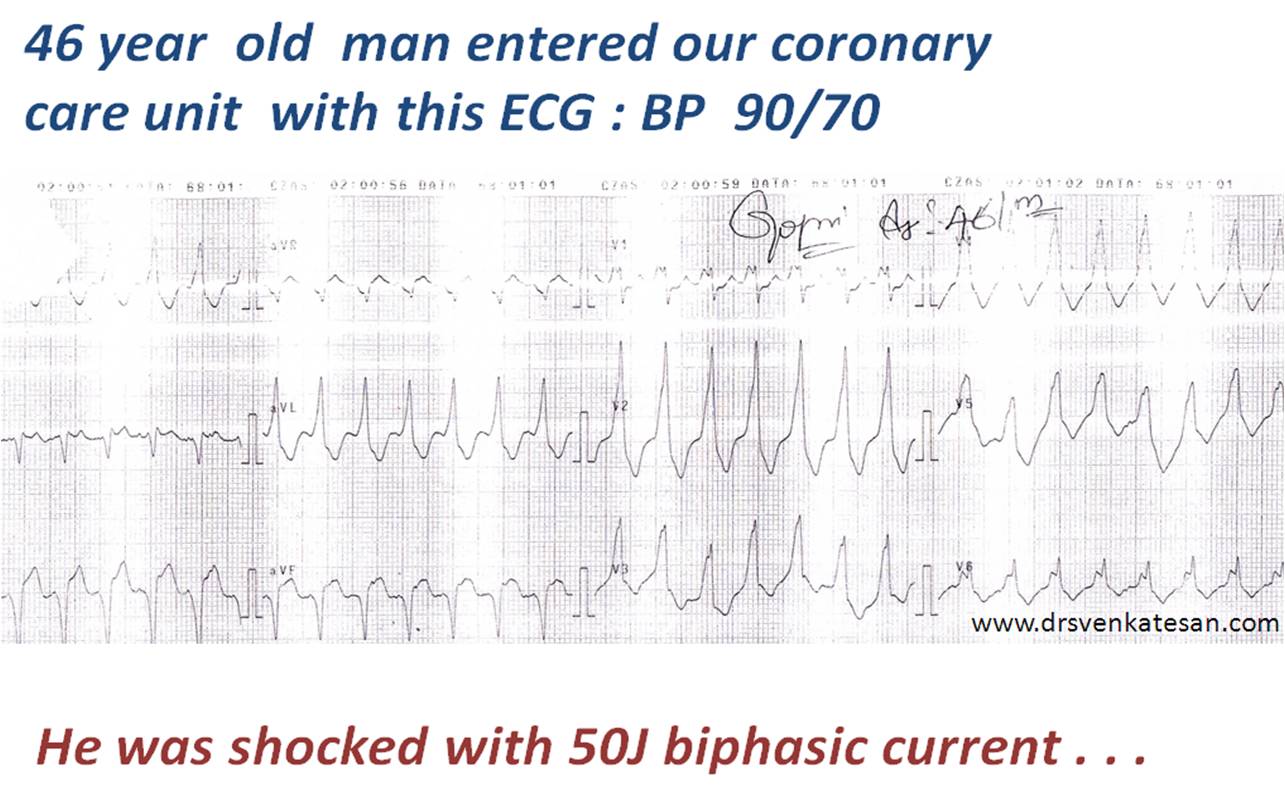
In spite of  this intimate relationship between VT and STEMI ,  it is very rare for a STEMI patient   to enter  ER with a sustained stable  ventricular tachycardia .  While  many VTs are known for it is hemodyanmic stability and immunity against degeneration   into  VF  , it is extremely rare  for  VT to remain as VT  in acute STEMI.

*Note : NSVT can be common   in  hospitalised patient in the coronary care unit . In our experience a sustained  VT in STEMI  will enter the VF mode within 60 seconds .If not , it is a highly  unusual phenomenon .

“But surprise is the other name of medicine ”

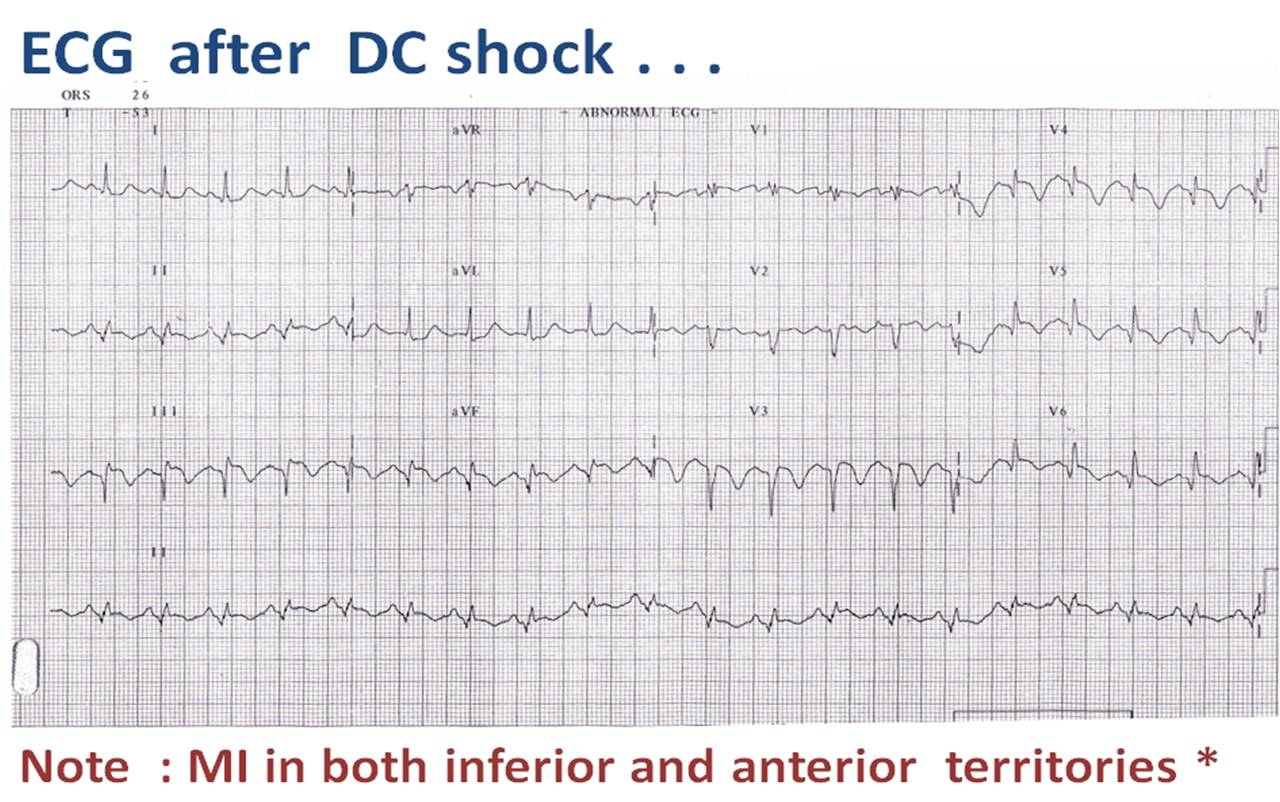
Here is  case report, a patient walked into coronary care unit with sustained( relatively stable) VT with LBBB morphology .We thought  it was   a  non- ischemic VT  (cardiomyopathy  , RVOT etc) .As we were examining him,  he became  unstable  and  was shocked 50 J biphasic .To our surprise a classical STEMI was unmasked and he was immediately  thrombolysed.

* It is possible ,  the patient had  suffered a  old MI  which got infarcted again and the VT  was scar mediated .

But it is still uncommon  for  it  not to degenerate into VF  with fresh  STEMI

Final message

Nearly all episodes of  ventricular tachycardia , that occur in the early minutes/ hours of  STEMI would degenerate into VF.This includes  VTs  that  occur within the CCU . Most  of the times , the CCU physicians and staffs  revert this VT  promptly and deny the  ventricles  from performing the dance of death !

It is extremely rare for an acute ischemic VT associated with STEMI to walk in to the hospital,  which our patient did !

Further reading and unanswered questions

  • What determines a VT to degenerate into VF ?
  • Why macro-reentrant , scar dependent VTs  often  are well tolerated ? ( In spite of LV dysfunction !)

Read Full Post »

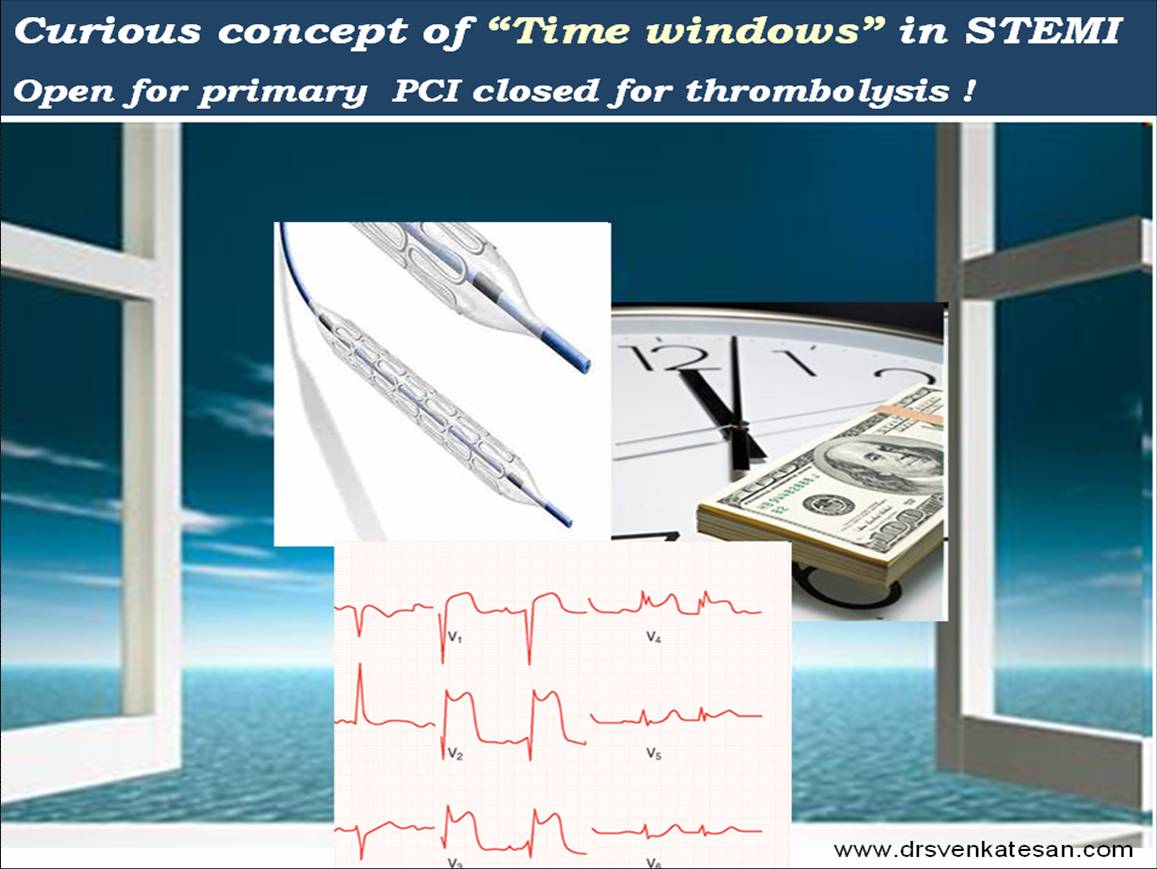
This article is in response to the prevalent belief  about  primary PCI for STEMI   endorsed by world cardiology forums. (Caution: A highly personalized version)

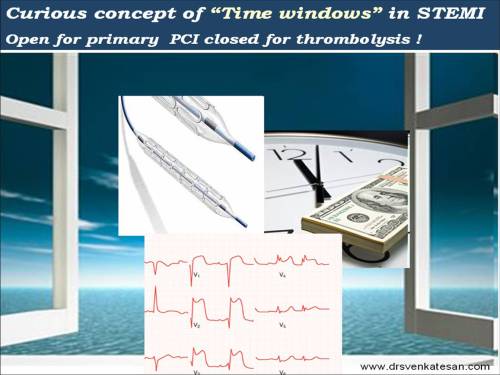
Time window in STEMI

  • Is the window half-opened  or half closed ?
  • Is it open at all ?
  • Or ,does it open only for primary PCI  ,and tend to close down  bluntly for thrombolysis

Modern medicine   grew faster than our thoughts .We have witnessed the audacity of advising  arm-chair treatment  for MI  till later half of   last century . Now we are talking about  air dropping of patients   over the  cath lab  roofs  for primary PCI.

Still ,we have not conquered the STEMI. While ,  we have learnt to “defy  deathin many patients  with cardiogenic shock , we continue to lose patients(“Invite death “)  in  some innocuous forms  of ACS due to procedural  complications  and inappropriate ( rather ignorant !) case selection.

Note : The ignorance  is not in   individual physician mind ,   it is prevalent in the whole cardiology knowledge pool.

The  crux of the issue for modern medicine is ,  how to reduce risk  in patients who are at  high risk and how not to convert a low risk patient into a high risk patient by the frightening medical gadgets.

In other  words ,  arm chair treatment for STEMI was  not (Still it is not !) a dustbin management . It has a potential to save  70 lives  out of 100. What many would  consider it as  ,  nothing but  the natural history of MI .

Medical management of STEMI is ridiculous !

That’s what a section of  cardiologists try to project by distorting the already flawed evidence base in cardiology. Some think it is equal  to no treatment. Here we fail to realise, even doing none has potential to save 70 lifes out of 100 in STEMI who reach the hospital.

Out of the  remaining , 10 lives   are saved by aspirin heparin (ISIS 2) and the concept of coronary  care . Another  7  lives are saved by thrombolysis (GUSTO,GISSI) . PCI  is shown to save saves one more life (PAMI).The remaining 6-7 % will die in CCU  irrespective of what we do .

Of course , now medical management has vastly improved since those days  .  A  thrombolysed ,  heparinsed ,  aspirinised ,  stanised  with adequately antagonized   adrenergic ,  angiotensin system   and   a proper coronary care ( That takes care electrical  short-circuiting  of heart)   will score  over interventional approach in vast majority of STEMI patients.

Now comes the real challenge . . .

When those 70 patients who are likely to survive  , “even a arm-chair treatment“, and the 20 other patients  who will  do a wonderful recovery with CCU care ,  enter  the cath lab  some times in wee hours of morning  . . .what happens  ?

What are the chances  of   a patient  who would otherwise be saved by an arm-chair treatment be  killed by vagaries of  cath lab  violence  ?(With due apologies ,statistics reveal  for every competent cath-lab   there are at least  10  incompetent  ones  world over !)

In the parlance of criminology , a hard core criminal may escape from  legal or illegal shoot out  but an innocent should  not die in cross fire , similarly ,  a cardiogenic shock patient with recurrent  VF  is  afford to lose his  life , but it is  a major medical crime to  lose a simple branch vessel  STEMI (PDA,OM,RCA )  to die in the cath lab,  whom in all probability  would have survived  the arm chair treatment.

Why this pessimistic view against primary PCI  ?

Yes, because  it  has potential to save  many lives  !

Time and again ,  we have  witnessed  lose of   many lifes  in many  popular hospitals in  India ,  where a   low risk MI  was  immediately  converted  to a high risk MI  after an primary  PCI with number of complications .

I strongly believe I have saved 100s of patients  with  low risk MIs by not  doing  for primary  PCI in the last  two decades.

*The argument that PCI confers better LV function and longterm  beneficial effect is also not very convincing for low risk MIs .This will be addressed separately
The demise of comparative efficacy research.

Primary PCI is superior to thrombolysis  : It is agreed , it may be  fact in academic sense .

Experience has taught us , academics rarely succeeds in the bed side.

“superiority studies can never be equated  with comparable efficacy”

Only the  questions remain . . .

  • Where  is comparative efficacy  studies in STEMI ?(Read NEJM article )
  • Why we have not developed a risk based model  when formulating guidelines for   primary PCI ?
  • Is primary PCI for a PDA /D1/OM infarct worth same as PCI for left main ?
  • Is high volume center guarantee  best outcomes ?

Who is preventing comparative efficacy studies ?

Primary PCI : Still  struggling !

This study from the archives  of internal medicine tells   us , we are still scratching  the tips  of  iceberg (Iceberg  ? or Is it something else ?)  of  primary  PCI
Even a  pessimistic approach can be  more scientific  than a optimistic  !

When WHO can be influenzed and make a pseudo emergency pandemic  and pharma companies  make a quick 10 billion bucks  ,  Realise how easy  it is  for the   smaller ,  mainstream cardiology literature  to be  hijacked and contaminated .

Final message

Why we reverently follow the time window for thrombolysis,  while  we rarely apply it for PCI ?   This is  triumph of glamor over truth . The open artery hypothesis remains   in a  hypothetical state with no solid proof  for over 2o years since it was proposed.

Apply your mind in every  patient , do a conscious decision  to either thrombolyse  ,  PCI or none . All the three are  equally powerful approaches in tackling a STEMI , depending upon the time they present .Remember , the third modality of therapy comes free of cost !

Never think ,   just because  some one  has  an access to a sophisticated cath lab 24/7   , has a iberty to overlook the  concept of time window  !

Remember  you can’t  resuscitate   dead myocytes , however advanced your enthusiasm and   interventions are !

Realise , common sense is the most uncommon sense in this hyped up human infested planet.

Read Full Post »
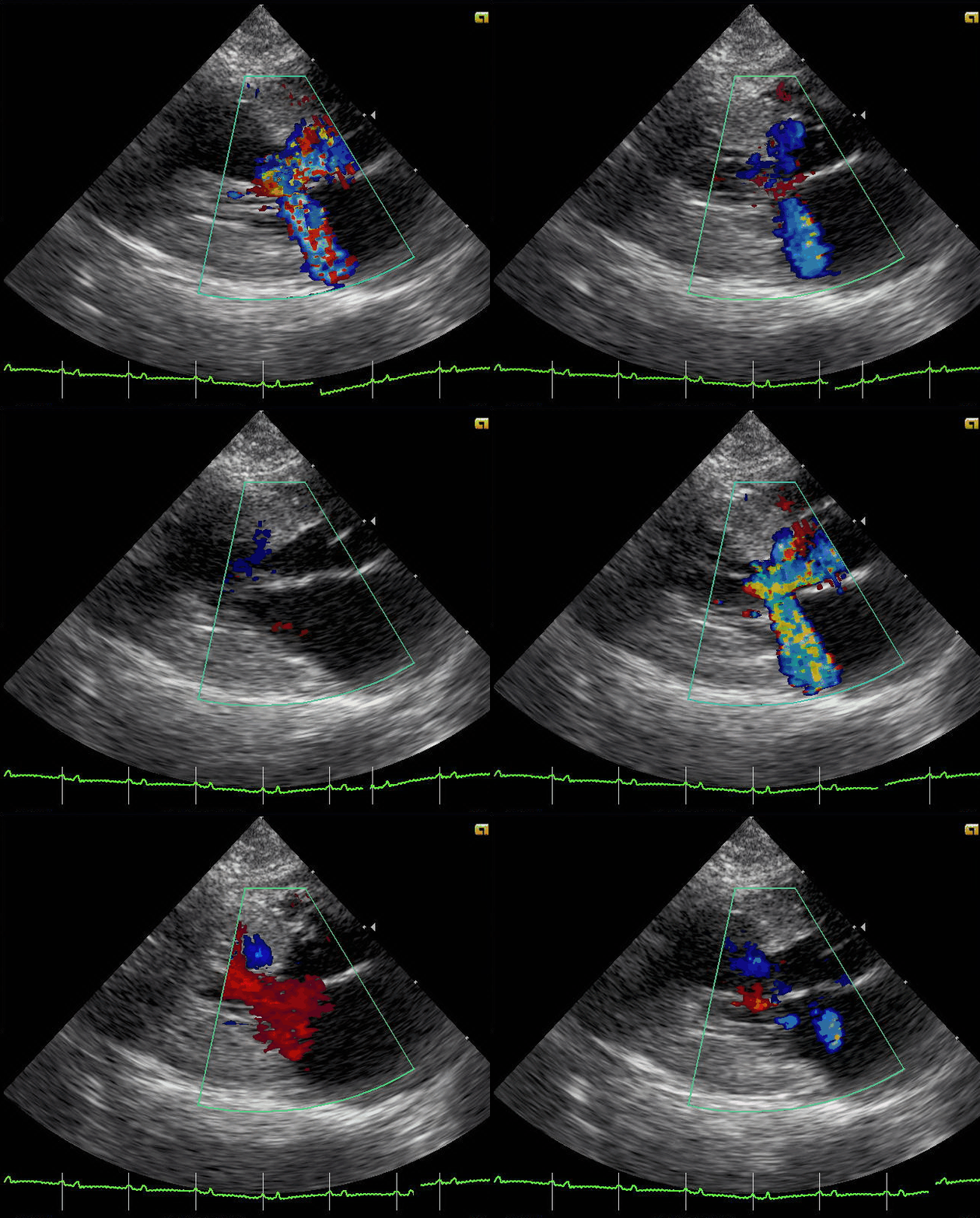
Regional wall motion defect( WMD) is the hall-mark of myocardial infarction.It can vary between complete akinseia to mild hypokinesia.

The wall motion defect is a gross terminology which is used  to describe any abnormal motion of the ventricular   segments.Technically,  hypo,   hyper , dyskinetic , akinetic  ,  even any vigorous  movement of LV segments will also come under the general category of  wall motion  defects. For example in extensive  anterior MI   the posterior segments show vigorous  contraction.Though . this compensatory motion  benefits many , it has a potential to adversely stretch the  scarred myocardium and promote aneurysm formation

What causes the regional wall motion defect ?

  • Infarcted segment
  • Ischemic segment
  • Adjacent normal segment behavior (Piggy pack effect, )
  • Loading conditions
  • Heart rate

Finally ,  and  most  importantly the timing and arrival electrical signal to these ill-fated segments determine the sequential activation fronts. Wall motion defect is a more complex phenomenon than we would tend to believe.

What are the  the classical examples of electrical wall motion defect ?

  • LBBB
  • Pre excitation
  • Some forms of VPD

*LBBB causes a paradoxical septal motion with  reference to lateral fee wall contraction.It is still a mystery ,  this paradoxical motion does not cause any  mechanical  disadvantage in structurally normal hearts  .

WMD  in combination  of  LBBB  and  STEMI

We know ,   LBBB   due to ischemia or infarct carry a  sinister prognosis .

Here , there  is  “Double wall motion defect”  . One electrical and two ischemic .  We do not know , how LBBB influences the ischemia/Infarct related wall motion defect and vice versa. .  This is the reason ,  there is a large chunk of  poor or non responders  for cardiac resynchronisation therapy.

Can peri infarction  blocks and other non specific   intra  ventricular  conduction defects alter the sequence of  ventricular  contraction ?

We do not know .It is distinctly possible.Tissue doppler studeis have indicated this.

What is the influence  of  heart rate on the  of Wall  motion defect ?

An  otherwise insignificant regional wall motion defect  could be  amplified with tachycardia . Paradoxically , (as in a biphasic response to dobutamine stress test )  a significant WMD may be attenuated at a particular heart rate.  So, the influence of  HR on  WMD is  as simple as  it could be  ! ! !

Which  is the best time to assess  LV  function  after  MI ?

Considering these issues , LV function  assessed  at discharge ,  may not give us the exact quantum of  muscle damage.  4 weeks may a  reasonable  time frame . This is important in the current era  as presence of  significant  LV dysfunction  becomes an indication for revascularisation  .We  can’t be offered,  to err on this vital LV functional parameter.

Final message

WMD  is a combination of  electrical, mechanical , structural,  alteration in response to variety of myocardial insults.It is very hard to assess  individual components contributing to the net WMA. The easiest and surest way to  quantify  WMD  due to  muscle damage is to  do a deferred echocardiography , when all time related WMD ( Ischemic  stunning , perinfacion block )  disappear.

Coming soon

Diastolic wall motion defects .Is wall motion defects exclusive phenomenon of  ventricular systole ?

No , definitely not. Regional relaxation abnormalities are quiet common .it is poorly recognised .

Read Full Post »

 Excercise physiology has been studied most extensively in the last century.The hemodynamic impact of excercise in various disorders of heart has been well established.
Dyspnea on exertion is the commonest symptom in clinical cardiology practice. It is well-known pulmonary stretch receptors located in pulmonary vasculature is one of the  major mechanism of dyspnea.

Excercise increases the cardiac output manyfold.Transporting  up to 10-12 litres of blood every minute across the lungs with a narrow pressure  head (about 10 mmhg ) is not an easy job . It needs lot of lung discipline .

It is surprising to note, there is little data on excercise induced pulmonary hypertension in the evaluation of patients with unexplained dyspnea.

We know, excercise increases the systemic blood pressure ,we  presume it should not raise the PAP (however severe the exertion is 1 )as pulmonary circulation  is a  high compliant low pressure system. 

Is our presumption correct ?

Exercise induced PAH can occur in both   health and disease 

In patients with preexisting disease

  • Stress induced LV dysfunction and resultant raise in LVEDP-PCWP-PAP .This is the most common mechanism in valvular and myocardial  disease.

Apparently healthy population

  • Excercise  induced PAH as a  marker for silent CAD .
  • Transient Hyperkinetic PAH* (Note :Here PCWP is usually normal )

This is similar  to hypertensive response to EST in systemic circulation.Existence  of this entity , is controversial, But this may reflect  reduced pulmonary vascular reserve  or reduced pulmonary nitric oxide secretion.

*The main difference here is the PAH is more often an  isolated systolic PAH. While LV dysfunction induced PAH is  a combined diastolic and systolic PAH .
How to assess excercise induced  PAH ?
It is not an easy job. Invasive catheter derived pressure measurements have been done ,but it is not practical .

The simplest way is to look for the TR /PR jet in echo in both pre and post excercise phase.

Final message

Excercise induced PAH is an inadequately studied entity in cardiology , in spite  it’s great significance .
This phenomenon is observed  in both diseased and normal heart.

The quantum of excercise induced PAH  is  widely variable depending upon the cardiac  status especially  LV function and the  functional integrity of pulmonary microvasculature .

Read Full Post »

Echocardiography is an imaging tool . Can it  be used as a non invasive  EP lab ?

Heart is an  electromechanical organ . For every mechanical activity there must be a electrical event preceding it . So, when we analyse the cardiac contraction and relaxation it indirectly provide us clues how the electrical activity spreads across the heart.

The concept of using echocardiography for diagnosing cardiac arrhythmias have never been popular for the simple reason we have a cheap and best modality : The ECG.  But, it  does not give us the temporal relationship with the cardiac contraction. When these two are combined it can be a really powerful tool to analyse many cardiac arrhythmia.

  • In fact ,  for every brady and tachyarrhythmia there has to be an unique pattern of IVS motion and mitral , tricuspid valve movement.
  • Almost all bradycadias can be diagnosed with echocardiogram by virtue of analysing the timing of  atrial vs  ventricular  contraction.
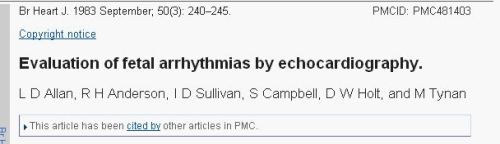
  • We know echocardiogaphy is the only modality available to diagnose fetal cadiac arrhythmias.* (How can  this modality becomes useless when the baby comes out of the mother’s womb  !)
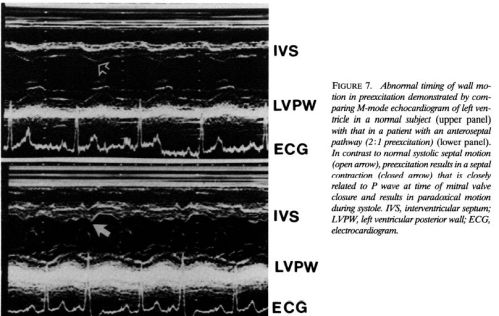
  • Apart from this there is an  unique use for echocardiography to locate accessory pathway in WPW syndrome

The premature contraction of LV can be seen in few as  an early systolic dip in IVS movement -Type B WPW.

Image courtesy :  Helmut F. Kuecherer Circulation 1992;85:130-142

Abnormal jerky movement of LVPW indicate left accessory pathway -Type A WPW

Newer modes of echo like tissue doppler will improve the phase analysis of tissue motion and may provide us accurate information about preexcitation

Final message

The future looks bright . Time is not  far off . . .  where ,  we shall  use ultrasound as an adjunct  EP  study .

Reference

*Fetal Echo  =  to  Fetal electro cardiogram

WPW syndrome

http://circ.ahajournals.org/cgi/reprint/85/1/130.pdf

http://content.onlinejacc.org/cgi/content/full/33/3/782

http://www.heartjnl.com/cgi/content/full/82/6/731

Read Full Post »

It is  over a century old dictum , that  edema legs and elevated JVP is the hallmark of cardiac failure.In fact , these two  constitute  major criteria of Framingham  cardiac failure score.When these criterias were formulated the concept of diastolic heart failure was not in vogue. So we  do not know whether the same would apply for diastolic heart failure also.

In all probability these  conventional criteria may not apply to diastolic heart failure  .

But why not ?

We know diastolic heart failure  of the left ventricle  is less likely raise the  systemic  venous pressure  to cause the edema and raised JVP. But still ,  isolated LV diastolic dysfunction can increase the PCWP and PAP and RVP . Remember diastolic  septal dysfunction , may compromise RV relaxation also.(Reverend Bernheim like  effect)

We should  also realise , raised  venous pressure is not the only mechanism for edema legs.

Diastolic dysfunction can trigger  ACE genes  .IT can get activated and hence renal conservation of sodium.This neurohormonal activation can be dominant  mechanism of edema in few. This  prevails over  the hydrostatic forces. And  hence edema can result in isolated diastolic dysfunction.

What about RV diastolic dysfunction as a cause for right sided failure ?

This is a poorly  understood entity.Logic suggests  it may have clinical significance. Since  morphologically and developmentally LV  and RV share a common  sheet of muscle  , LV diastolic dysfunction can have it’s impact t on the RV as well.

Final message

Edema legs and raised JVP is a hall-mark of  isolated  systolic heart failure or combined systolic and diastolic failure   .It is not rare to find an occasional patient isolated diastolic dysfunction*  to present  symptoms of  systemic congestion .

*Of course ,  in this era of hi tech cardiology practice  it may be  inappropriate  to  depend on these  primitive clincal criterias  to diagnose CHF . (These  manifest very late in the course of CHF!)

Read also

Why  some patients with cardiac failure never develop edema ?

Read Full Post »

LBBB is probably the most important  conduction defect of the heart .When we say LBBB , we visualize a  strikingly  wide bizarre qrs complex .

Left bundle even though is considered  a discrete structure , the fascicles  make it a diffusely spread structure. Many varieties of LBBB with various degrees of involvement occur.

Talking about the basics of  LBBB  electrophysiology  is out of place for the current generation cardiologists,  who  have little spare time as  they sweat it out inside the cathlabs.

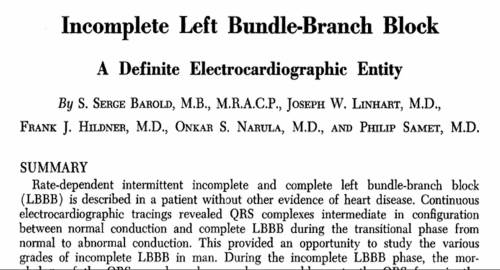
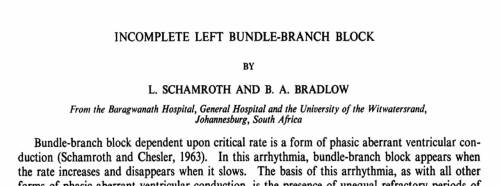
In early 1960s and 70s great articles came from pioneers regarding these defects. If we want get a good insight  read  this  articles from  Sodi palleres .Who  says LBBB is a dynamic process, where it can occur from mild functional  delay to a total block .

The conduction  properties of left bundle is very much influenced by heart rate.

Law of statistics would  suggest  for every complete LBBB  at least three to 4 times incidence of incomplete  LBBB

Then . . .

Why we are not diagnosing ILBBB often ?

  • We miss it
  • Mistake it with LVH
  • We know it  is there , but we do not  want  to diagnose it .

How to diagnose ILBBB?

See  Sodi palleres criteria*

What is the relationship between qrs width and completeness of LBBB ?

Surprisingly and contrary to the belief , the width of the qrs has no linear correlation between severity of LBBB. In fact incomplete  LBBB can occur with even 150ms qrs !

Then ,  what  exactly determine the completeness of LBBB ?

What  matters is , whether the down coming impulse gets blocked  and split in the  left side of the IVS or not ? This causes the  the septal vector to  change  it’s direction ( ie  right to left instead of the normal left to right) It  removes the initial small r wave in v1  and q in v6  in complete LBBB. In  incomplete LBBB these  r and q are  often retained .

What is the differential diagnosis of ILBBB ?

Type B WPW may mimic LBBB and vice versa.

LV hypertrophy .

Differences : See table in  the Barold’s article  linked above .

Unanswered questions

  1. How common is ILBBB in STEMI ?
  2. How often ILBBB progress to LBBB ?
  3. ILBBB in dilated cardiomyopathy : Is desynchrony an issue ? (Normal QRS CHF !)
  4. Is functional  rate dependent  LBBB in cornary care units  same as transient  ischemic LBBB ?
  5. Intermittent LBBB and Incomplete LBBB  aren’t they  synonymous ?

Final message

ILBBB is not that uncommon as one would  tend to perceive.

Reference

My humble tributes to  Barold, Sodi -palleres , and Leo  Schamroth . Probably  one of the best  article on ILBBB is linked below. Reviewed    in 1963 !  Not much data has been added  in the next 47 years as on 2010

Read Full Post »

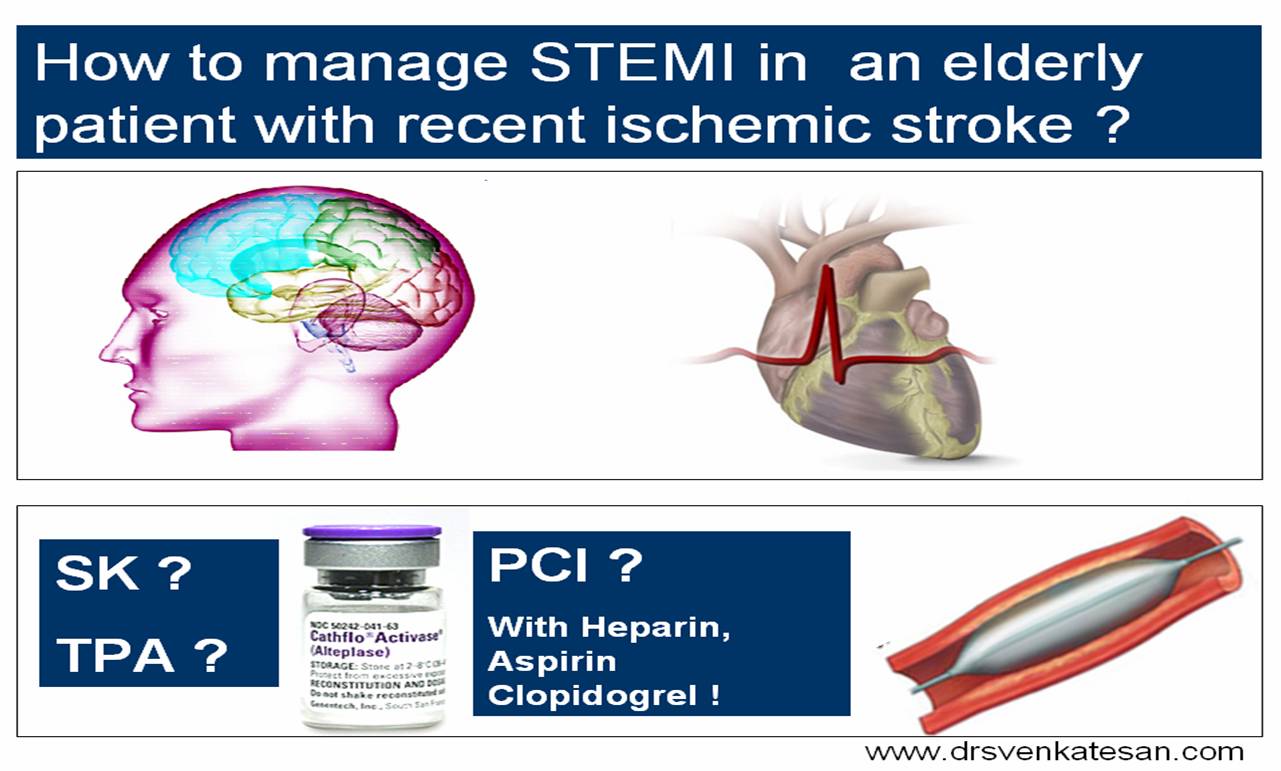
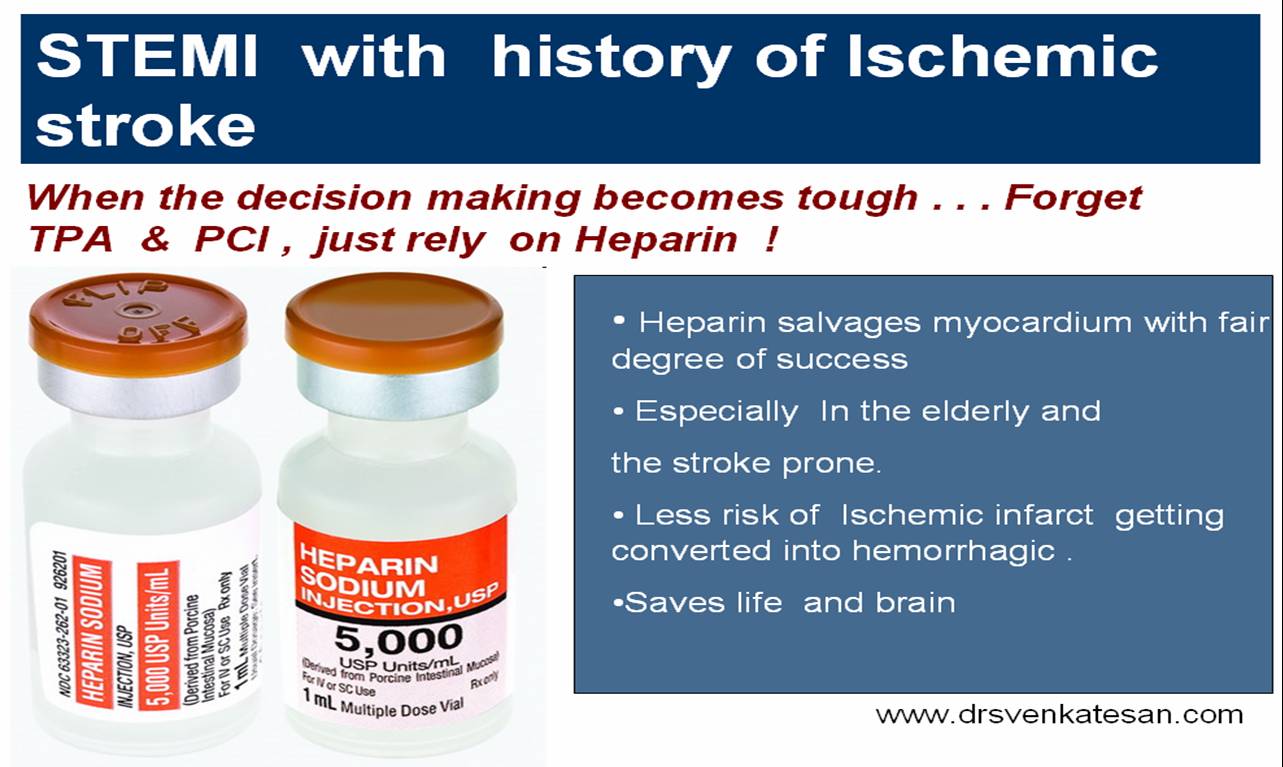
Thrombolytic therapy  is the specific  therapy  for Ischemic stroke ,  when administered in less than 3 hours ( Now 6 h ?)  and has proven to  save lives and brain .The only issue is , we need a 100% exclusion of hemorrhagic  stroke by a CT/MRI. The mechanism of action of thrombolytic agent is simple .It lyses cerebral thrombosis and makes way for sustained reperfusion and arrest or even  reverse  the  ischemic damage to  neurones .

And now ,   let us see ,  how we perceive the same therapy in a patient  with a  history of  recent ischemic stroke  with an  acute STEMI .

The issue is two fold.

  • He needs urgent myocardial salvage in the form of thrombolysis or PCI .
  • The thrombolysis or PCI should not worsen the  cerebral infarct.

According to  most standard literature thrombolytic therapy is an absolute contraindication in a patient with STEMI and recent history of ischemic stroke (<3 months )

The  term absolute means ‘it is medical  crime” to give TPA or Streptokinase.

How  is it possible when the same drug  is  projected a savior in acute ischemic   neurological  emergencies  and  be dangerous when administered  few months later in an evolved ischemic stroke ?

The major  reasoning  against thrombolysis in recent stroke is  the  potential concern for  converting an  indolent ischemic  infarct into hemorrhagic  infarct in  a  patient who may start  bleeding  into brain.

This is  highly conjectural  , as  a previous history of  ischemic   stroke in no way increases the bleeding risk .Conversion of ischemic to hemorrhagic   infarct tend to  occur  in the very early  hours  of acute stroke (not weeks later) .This could be part of calcium induced  reperfusion injury .

Unanswered questions

The issue become further  complicated with our  skewed  thinking pattern.

If thrombolysis  is contraindicated  in STEMI , does  it any way imply a automatic indication for  primary PCI ?

It seems so , for most of us !

How safe is PCI in a patient  with a previous  history of ischemic stroke ?

  • An emergency PCI in a patient  who is expected to have   widespread  cerebral  carotid , and peripheral vascular  disease  is fraught with added hazard.
  • Aortic arch manipulation  and aortic  valve  atherosclerotic  changes  might  increase a risk  of another stroke.
  • The drug we administer  during PCI  are  not innocuous ones  . Aspirin ,  Heparin, clopidogrel (sometimes  even 2b 3a!) will  keep the  risk  of converting the ischemic infarct into  hemorrhagic infarct remain  at  dangerous  levels . This ridicules  the  very  logic  of   PCI being preferred over thrombolysis in such situations .
  • So it is not an  easy decision to do  primary  PCI in an elderly  patient  with STEMI and a recent CVA. It is only a mirage of  medical  intellectualism  and  the blind following  of unscrutinized  scientific  literature   that   determine  many of the decision  making  in cardiology .

The argument here is ,  in a patient  with evolved ,  uncomplicated ischemic  stroke thrombolysis can safely be administered  irrespective of the age of stroke.  .This is contrary to the published literature.Let us not make unethical practice against scientific literature  but let us also understand   it is unethical  not to realise  many of the so-called scientific  evidence  are  merely speculative.I  request  the  neurologists  and cardiologists give their   input on  the issue

As far as  I have searched  the superiority or inferiority  of thrombolysis   vs PCI in  recent  ischemic CVA has never been compared one to one. The fact may be ,  such a study is never possible in the future .But  it seems PCI has won the   trial  without  a trial .

Unanswered  questions

How  many deaths have happened due to worsening of stroke after thrombolysis ?

How safe is a  combination of aspirin, heparin and clopidogrel in a patient with recent stroke ?

How shall we decide about thrombolysis  in these situations  of STEMI and recent CVA) depending upon the

  • Age of  CVA
  • Location of cerebral infarct
  • Size of the infarct
  • Residual neurological deficit

It may be prudent to redefine  the indication for thrombolysis and PCI in a patient  with history of recent or remote stroke.

  • It is logical to assess the potential   risk of   converting the ischemic cerebral infarct   into hemorrhagic infarct.
  • It is expected only large infarct in vital locations need to be feared upon for this complication
  • All small healed cerebral infarct need not be worried about reactivation.

How to asses the healing of cerebral  infarct?

The healing  and gliosis  is highly dependent  on individual response to inflammation. Some heal  within weeks. Neo vascularisation within the necrtoic area may get hyperpermiable .These are very speculative concerns. In all probability   the risk of converting an ischemic necrosis into hemorrhagic  necrosis  is less than a  percentage .The 3 months time for  fixed for infarct healing  is an arbitrary one

How good is MRI to predict a healed infarct from nonhealed infarct ?

As of now,  we have no good tools to identify the  safe infarcts that can withstand intensive  anticoagulation or even thrombolysis .If the imaging techniques improve we may able to predict complete gliosis and the vascularisation  of cerebral scars.

Post blog query

How to manage an elderly man with STEMI in a patient with recent ischemic stroke ?

A.Take him to cath lab and do primary PCI
B.Thrombolyse with TPA or Streptokinase
C.Just observe and  manage  with Heparin*

Answer : Any of the above can be correct answer .

If  we  still think  the answer is only   “A”  great reforms need to be done in  medical science  . . .

*Another important option for STEMI and recent stroke (Perceived  as inferior form of management of STEMI !)


An important option is ,  neither thrombolysis nor PCI just simple heparin for STEMI in these high risk individuals .This simple treatment has saved many lives .

See A Related video  from you tube : Forgotten hero  in cardiology

Final message

In this world of gross approximation  and perceived fears ,  it may be reasonable to  shift  the  indication of   thrombolysis for STEMI( with h/o recent stroke ) from absolute to relative contraindication.

Many of the  junior  physicians  in the learning curve may take it as granted  in the management of STEMI  “If thrombolysis is contraindicated  , then primary PCI must be indicated ” This again  is absolutely not true  !

//

Read Full Post »

Management of  atrial fibrillation has been a  big puzzle for cardiologists  for many  decades  till  it became a corporate game , and  now in the era of recession it has become  medicare’s  night mare !

So , we  were  made to dance to the tunes of the so called evidence based cardiology . . .

  • From only rhythm control to . . . in 1990s
  • Either rhythm or rate control  . . .       in early  late 1990s
  • Then cost control  was found  more important than rate control  . . .
  • . . . So rate control became superior to rhythm control in early 2000s

In 2010 , even the  rate control  became  a luxury ,  here comes the  real ace !   ” Casual rate control may be  suffice in most cases of AF “

Read this article  from  NEJM , which tries to  make  sense out of nonsense  and judge for yourself

Probably the most influential  article  in electrophysiology over  the  next decade

Click  below to reach Nejm article

http://content.nejm.org/cgi/content/full/NEJMoa1001337?query=TOC

http://content.nejm.org/cgi/content/full/NEJMe1002301?query=TOC

Gist of the trial

Technically and literally it  means a  “Take it easy attitude” as long as patient is comfortable , even a rate  of  more than 100 is allowed . Few years back the above concept could be termed a “non sense”

Final message

In this  perennial  management issue  of AF  ,  Whether ,   we were successful in  restoring   sinus rhythm or not , we have restored  the common sense*  Thanks to RACE 2 investigators.

* Do not unnecessarily trouble a  asymptomatic  patient with those powerful  and costly  antiarrhythmic drugs .

Read Full Post »

« Newer Posts - Older Posts »