Feeds:
Posts
Comments

Archive for the ‘cardiomyopathy’ Category

It was 2006

Allow me to recount an unassuming piece of a PowerPoint presentation from my institute, Madras Medical College, at the annual Cardiological Society meeting in New Delhi. The paper was categorized under miscellaneous sessions. I vividly remember the day. I have to admit, It was a nearly empty hall E, located in the basement of Hotel Ashoka. After the talk, I looked up to find that neither the chairman nor the handful of kind academic souls had any questions or comments to make. Pausing for a few moments, I quietly walked down the podium with an inexplicable silent pain.

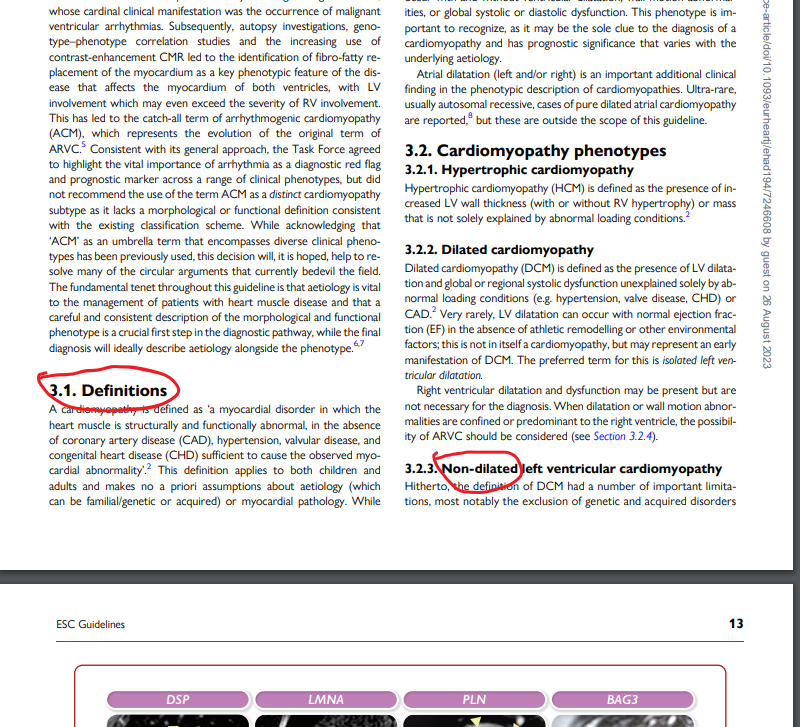
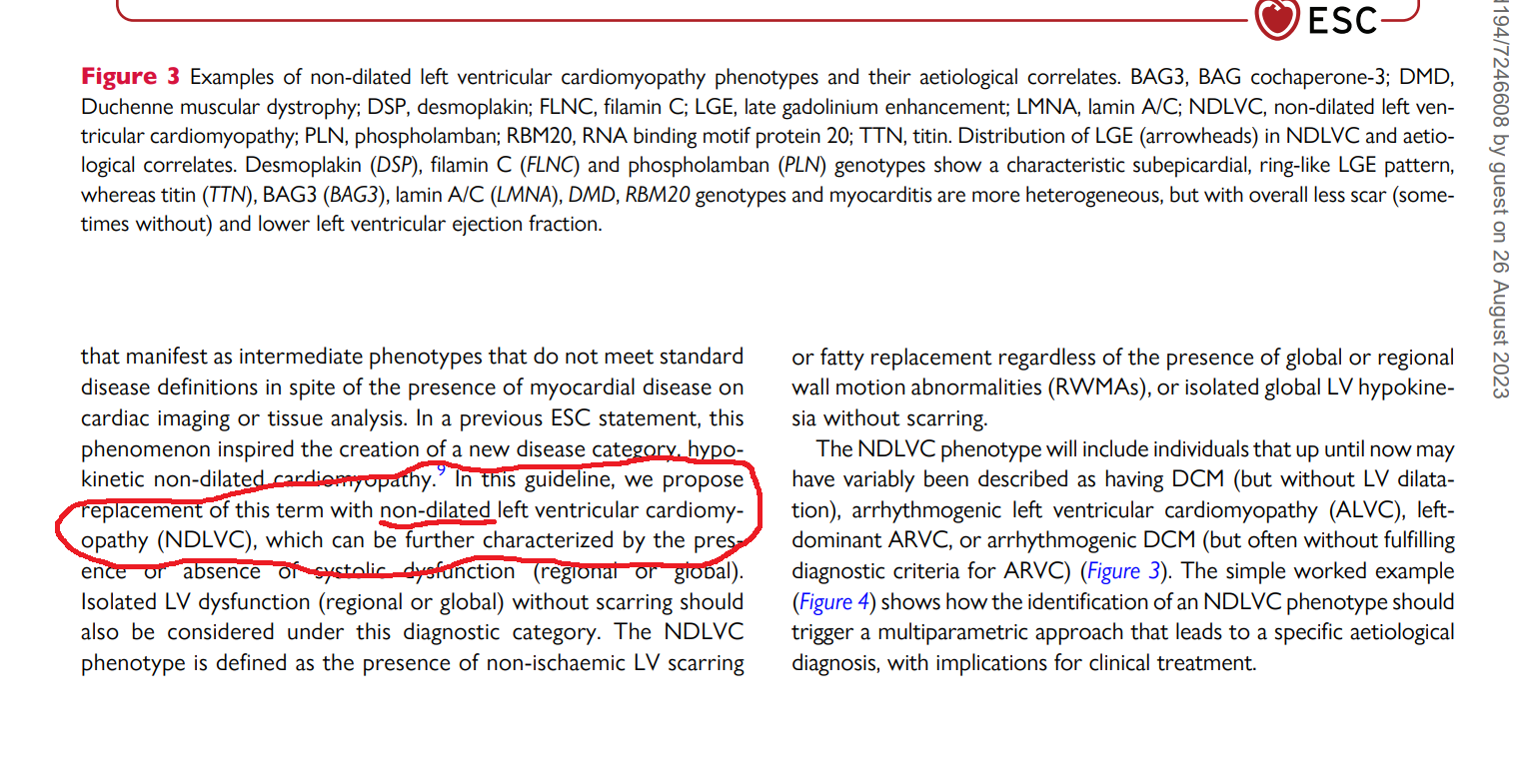
The title of the presentation was “Non-dilated cardiomyopathy”

Welcome to ESC Congress Amsterdam August 2023

ESC, has come out with this new update on cardiomyopathy. It is a pleasant surprise to find the term “Non dilated cardiomyopathy” entered the cardiology academia, authenticated by the ESC.

I must confess, it is difficult to conceal the joy and a little bit of self-pride.
Some observations from this document

1. Despite our tremendous knowledge base, we are yet to hang up our boots, in pursuit of an Ideal cardiomyopathy definition. Genotypic or phenotypic ? Phenotype is closer to reality, while genotype is largely imaginary. It looks like, The newer guidelines are moving towards a phenotype-based approach in all aspects except in risk prediction. Fair enough.

2. All cardiomyopathies, whatever way we segregate, ultimately end up in the common clinical syndrome of heart failure. So. it is better to spend some quality time here and concentrate on HF therapeutics.

3. Cardiologists are expected to critically fine-tune their general medical knowledge, which will help recognize and treat systemic disorders like Amyloidosis, and other metabolic infiltrates.

4..Almost all RCMs have non-dilated ventricles, so why a new term NDLVC? Anyone wants to ask this question ?. Further, there can be significant overlap between RCM & NDLVC as well. Definitely, there is a lot to understand beyond this 2023 document.

5. Why do some ventricles refuse to dilate even in the face of adverse hemodynamic and pathological conditions. Is it an advantage or disadvantage? If ventricles are adamantly stiff and decide not to dilate, there is no other option, the atria will proxy dilate, creating more problems in the lung circuits. This also raises a fundamental question Is NDCM a better stress buster (think Laplace law ) than DCM? or vive versa , the accomodative nature of LV passify & blunt the slope of LVEDP at times of exertion.

6. One more reality is, NDLVC is also an Important subset in the now fashionable HF entity HFpEF

Final message

The message to youngsters is this. Discuss, debate, and document your thoughts in whatever forum, that is available. Don’t wait for all those big brother journals and their recognition. If there is truth in your writing, someday it will be revealed to the world.

Reference
1.Robert A Byrne and others, 2023 ESC Guidelines for the management of acute coronary syndromes: Developed by the task force on the management of acute coronary syndromes of the European Society of Cardiology (ESC), European Heart Journal, 2023;, ehad191, https://doi.org/10.1093/eurheartj/ehad191

Read Full Post »

Check out these two posters* for are a quick reference on HOCM with current updated evidence. The first one details about  Echo evaluation. The second one illustrates the genetic screening flow chart of the HOCM families.

Some of the queries, you will find the answers from these posters are,

1. How to recognize Intrinsic mitral valve defect by MR jet morphology?

2. How to cross-check the true LVOT gradient from MR jet?

3. When to do a provocative test to document the LVOT gradient?

4. What are the standard pre-myectomy measurements by Echo?

5. How to screen a family member of HCM?  Pros and cons of  Phenotypic vs Genotyping screening 

*Reference 

 
The poster is created by: Karan Kapoor, MD; Allison G Hays, MD, FASE. Design and illustration by medmovie.com.


Read Full Post »

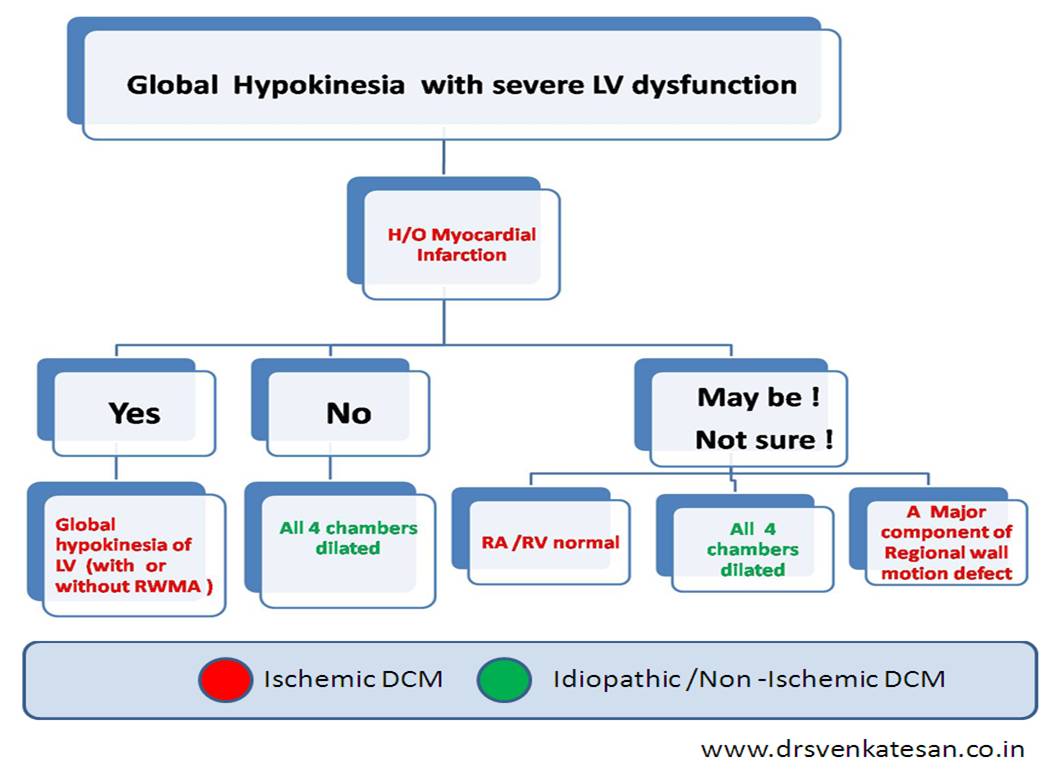
Even though cardiologists consider themselves master of ischemic heart disease , their collective clinical acumen is  put into  acute stress test   when they  confront  a patient with dilated LV and severe  LV dysfunction.This is not  a  rare situation  in clinical cardiology we stumble upon such instances often .Most of them are conferred a  tag  of DCM .

The differentiation from ischemic  vs idiopathic or primary muscular is not a  wasted academic exercise  , since   ischemic  DCM  may get reversed with revascularisation .We have  various  tests to differentiate  ischemic from idiopathic like CAG,MRI, 3D RTE, etc . Still common sense would tell us   95 % of times we can  differentiate ischemic DCM from non ischemic by asking  two critical questions  in the  bed side  echocardiogram

  1. Is there a regional wall motion defect ?
  2. Does all 4 chambers of the heart is enlarged ?

Idiopathic DCM is primary disease of muscle hence  the cardiac   muscle as a  whole  fails  ( We know they are a single  folded  muscle sheet )

Since  Ischemic DCM  primarily affect left ventricle and left atrium  RV,RA enlargement  are terminal events.

* Please note the traditional dependence on CAG to  diagnose  ischemic DCM is fraught with a risk of missing small vessels  induced  DCM,

*** If atrial fibrillation is present longstanding it can dilate both atrium but still RV will be normal  in sized in  ischemic DCM until very late stages

Here is a  20  second flow  chart  to differentiate ischemic  DCM  from idiopathic

ischemic verses idiopathic dcm

Read Full Post »

The principles of pre-discharge EST  

This concept came about 20 years ago (1980s) to risk stratify patients following  ACS to triage early coronary angiogram and revascualrisation. Generally patients are discharged by 5-7 days after an MI  (May be  3-5 days in some hospitals)  . Doing an exercise stress test  early within  2 weeks has not been very popular with many cardiologist even though it was recommended by many guidelines.The type of stress recommended  here  , is heart rate limited sub maximal 70% of  THR (Usually around  140 /mt )  is performed . This is due fear of precipitation another ACS.

Still,  there are definite  advantages for  pre-discharge EST .It help us  identify  high risk  subsets of  STEMI and reduce the  intermediate term mortality .More importantly it  gives  us an opportunity  to  exclude  inappropriate  revascualriations  even without an angiogram . (The well known coronary dogma  ie  if a post STEMI patient performs > 10  METS ,  his  heart carries little  risk  for  future events  still holds good  !)

With the advent of liberal usage of CAG and improved techniques of revascularistion ,  most  patients  directly undergo pre-discharge CAG rather than EST !

Further reading

Does any cardiologist have guts to do a pre- discharge EST after  a successful primary PCI ?

Read a related article in this blog .

Read Full Post »

The entity of stress cardiomyopathy ,  other wise referred to as  Takotsubo  cardiomyopathy is a popular clinical entity in recent decades.The heart and mind are closely linked entities even though they are  situated apart physically . Extensive neural and hormonal control  mechanisms  exist.

In extreme stress ,the hyper- sympathetic  drive triggers a rush of adrenaline ,  which some how makes the  left ventricle  to bulge out !

The clinical features  are varied .

  • It can exactly mimic an acute coronary syndrome .
  • ECG may  show ST elevation and mimic an anterior STEMI
  • Echo shows a wall motion abnormality  classically  described  as the apex alone dilates /Bulges or elongates
  • LV  may acquire a shape of a  banana. (See below )

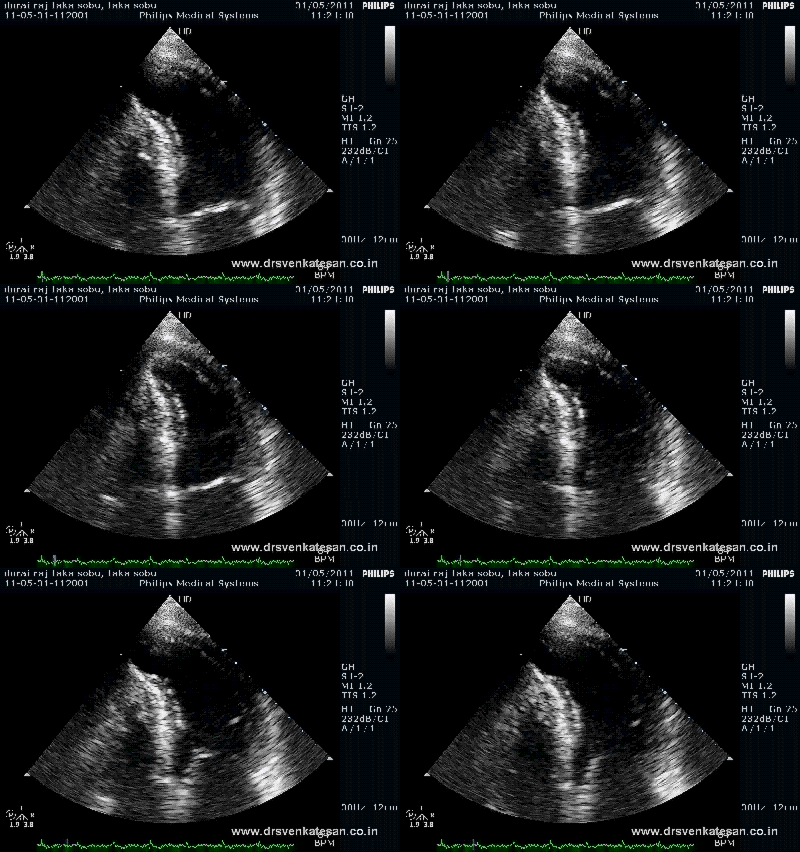
A 45 year old man came to the ER with severe chest pain , dyspnea and minimal ST elevation in anterior leads. He  was a smoker and was experiencing  recent major office stress  . Echo showed an elongated LV apex with some thinning .We made a diagnosis of stress cardiomyopathy .( It was disputed by my professor as the LV  apex was contracting well   ! but we  learnt later there are many varieties of Takatsubo )

Echo showed an elongated LV apex with some thinning . Note the LV apex goes  out of plane  with RV apex.

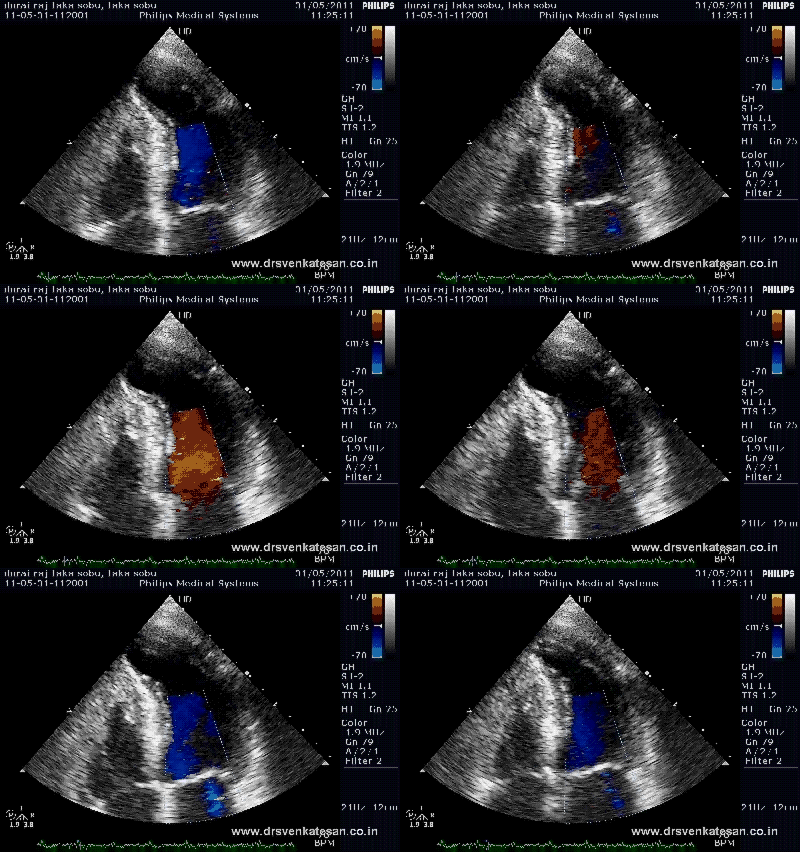
Color  Doppler revealed Trivial Mitral regurgitation

Follow up

He underwent coronary angiogram.  Had  no significant lesions ,   in 48 hours time the wall motion defect disappeared and was discharged with beta blockers.

Incidence

Up to 2 % of ACS could be related to Takatsubo . More common in women especially post menopausal  , with stressful/emotional background like loss of loved ones.

Synonyms

Apical ballooning , Broken heart syndrome ,  Stress cardiomyopathy.

Mechanism

Not clear . Microvascular spasm , excessive catecholamines  ,  are thought to be major culprits.

Echocardiography

Hyperkinetic base and akinetic or dyskinetic LV apex .

Lots of variations are reported .

Shimizu described 4 types

Courtesy : Shimizu et al J Cardiol. 2006 Jan;47(1):31-7.

  1. Apical akinesia and basal hyperkinesia,
  2. Reverse  Takotsubo  (Basal akinesia and apical hyperkinesia)
  3. Mid-ventricular ballooning   with  basal and apical hyperkinesia
  4. Localised  to any one segment

*The Banana type which  is described here (Elongation  of LV apex > Widening )

Histopathology

Focal myocytolysis are described. (Broken heart)   Monocytic infiltrations are common.These are  believed  to be transient .

How to differentiate it between a STEMI ?

  • Enzymes are only mildly elevated.
  • Wall motion defect do not confine to a specific arterial territory.
  • Most importantly coronary angiogram do not reveal any significant obstructions.

Prognosis and outcome

  • Generally good
  • The initial presentation may be turbulent in few with cardiac failure or arrhythmia .Other wise these patients do well

Treatment

  • Mainly supportive
  • Major principle is to avoid inotropic agents as they  are already  heavily expose to it
  • Beta blockers  could be the mainstay therapy .

Final messge

Think about  Takatsubo  whenever an acute coronary syndrome presents atypically . Not surprisingly few of them land in the cath lab !

Reference

http://www.cardiologyrounds.org/crus/cardus1206.pdf

Read Full Post »