Feeds:
Posts
Comments

Archive for the ‘echocardiography’ Category

We have read extensively  about LV pressure volume loops . What about Left atrial pressure volume relationship ?

This could be vitally important to  understand left atrial failure . While, it is often taught that , LA comes to the rescue of  left ventricle  at time of stress , we rarely talk about left  atrial failure !

Where  will the LA look  for help  when it is stressed ?

Pulmonary veins ?  , No , the LA  simply succumb and patient deteriorates.The only way it can react  is by a  panic response and starts fibrillating !. This is what happens in many  cases of dilated cardiomyopathy  and late stages of aortic valve disease . This AF is very poorly tolerated . ( Of course , we do not understand fully ,  why AF is relatively well  tolerated in severe  mitral stenosis  , inspite of very high  LA pressures Often >40mmHg?)

The  importance of left atrium as a mechanical chamber   is well  recognised .It is supposed to empty the blood  it receives  from pulmonary veins  within a narrow  pressure zone of  8-12mmhg within a  fraction of a second. Even a slight increase in LA pressure may result in pulmonary venous regurgitation and  the incoming venous tides are reversed(“a” reversal in pulmonary vein echo )  that results in the so called pulmonary congestion /Pulmonary venous hypertension.

If only god has created  additional pulmonary venous  valves** at it’s  entry , LA can perhaps a  relax a little bit  . But it is not the case  . So,  LA function becomes as  vital  as LV.

(**Can we create pulmonary venous check valves  ?  . . . will it be  an answer for preventing recurrent LVF in cardiomyopathies etc)

Here is an  article from European heart journal , which gives  great insight into Left atrial function.

The one that has fascinated me is the  LA  pressure volume loop.
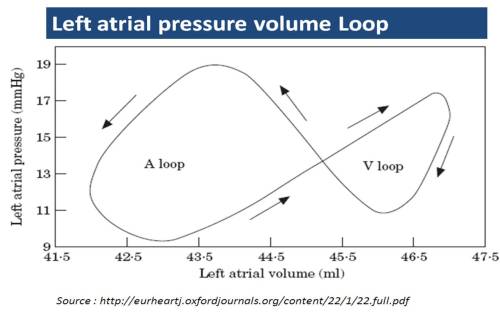
The two pressure waves in left atrium reflect distinct  properties . “v” wave  is a  volume dependent wave and  “a” wave a pressure generated wave . Surprisingly the volume dependent wave generates more pressure than the atrial contraction wave.(Note in LA  v > a while in RA a>v)

http://eurheartj.oxfordjournals.org/content/22/1/22.full.pdf
Read Full Post »

This is a 15 year old post, written in 2010 , just when, now famous TAPSE was introduced for RV function assessment.


Throughout the  history  of  echocardiography Right ventricular functional assessment  has received  less attention and suffered a  step motherly concern. There are innumerable parameters to assess LV function  , but we have  very few for RV !

LV ejection fraction continue  to reign supreme  in spite of the inaccuracies  and fallacies.RV ejection fraction by echo ,  never got into the main stream   cardiology literature as a tool for  RV function  assessment.

(The major reason for this  is ,  lack of  a “mathematical shape” for RV !)

RV is  formed by , a  horizontal inflow , an elongated and  wedged apex ,( in)conspicuous  body and an  ubiquitous RV outflow .No one  really knows , how  much  these  parts contribute  individually to the conductive  and contractile function of the low pressure venous ventricle.

(Of course, MRI and radionuclide derived RV EF can be accurate but doing these tests solely to measure  RV EF defies clinical sense !)

In this scenario,

Two parameter can be considered simple and accurate to estimate the RV function.

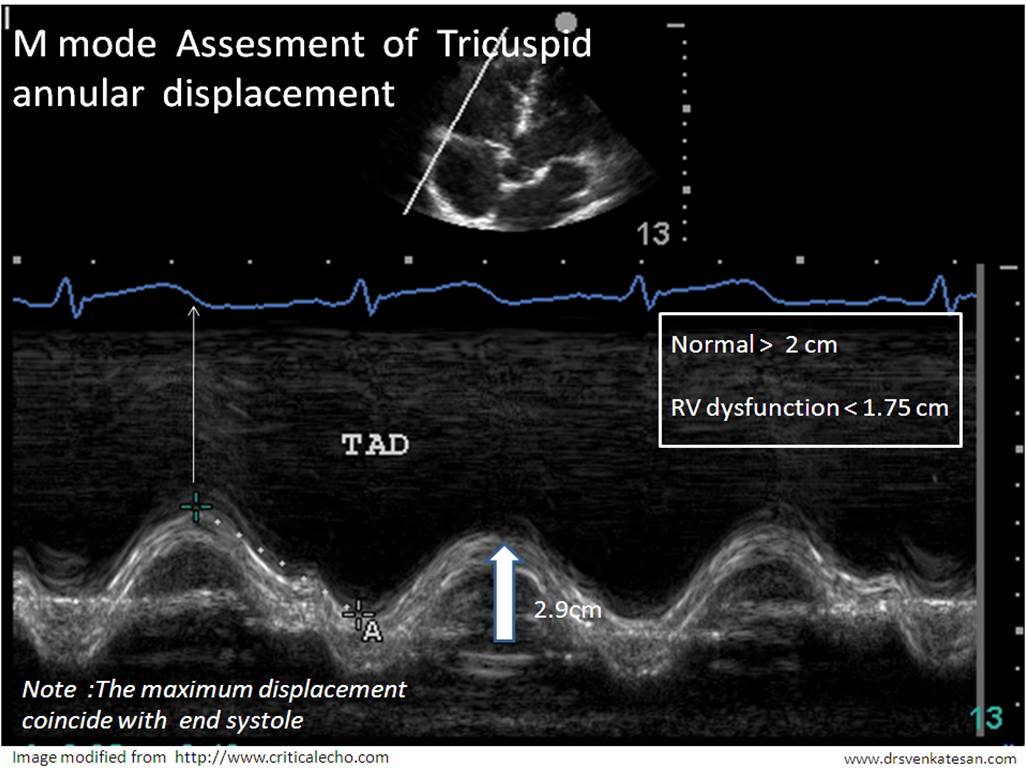
Tricuspid annular displacement (TAD)


This is a simple m-mode derived  parameter ( much ridiculed by  modern  day echo-cardiographer !)

M-mode echo in apical  4  chamber   view across lateral tricuspid annulus .

  • Normal displacement  >2 cm
  • RV dysfunction < 1.5cm
  • Borderline  RVD between    1.5 to 1.75 cm

The other parameter to measure tricuspid  motion is

Tricuspid Annulus peak Systolic velocity (TAPSV)*

  • This , in-fact linearly correlate with TAD.
  • Normal TAPSV is > 10cm/sec
  • Anything less than 8cm/sec is usually associated with RV dysfunction.

TAPSV – http://onlinelibrary.wiley.com/doi/10.1111/j.1540-8175.2006.00305.x/abstract

* One need not be  depressed if  tissue Doppler  is not availablein their  echo machine  , TVD by M mode is good enough in most situations.

Situations where RV function is impaired include

  • Severe forms of  dilated cardiomyopathy.
  • Primary (or secondary ) pulmonary hypertension
  • RV infarction
  • COPD -terminal stages
  • ARVD
  • RV dysfunction with VVI pacing
  • Following CRT

Final message

It is often  said there will  always be a simple solution for any  complex problem .  But,  it is  recognised late.

In our quest for ideal RV functional  parameter , we were entangled in the complexities for decades ,  only to realise  an obscure  M -mode  parameter in apical 4 chamber ,  could be   an  accurate way to exclude significant RV dysfunction.

Read Full Post »

Echocardiography is about 50 years old tool.It has evolved from simple M mode to sophisticated tissue Doppler and 4D imaging. Color Doppler imaging was a great revolution ( One  can  consider it  as big as invention of ultrasound itself  !)

Even though , we could code the pulse Doppler samples into color coded pixels (Called auto correlation computed by Fourier algorithm) the full potential of color Doppler is yet to be explored. Accurate assessment of regurgitation  lesion severity continue to trouble  us  .

The PISA concept fizzled out due it’s complexity and   inaccuracy.It  exhausted  thousands of  cardiology man  hours  and  precious  academic time ! (Not really waste . . .it stimulated our intellect !)

I wonder we have a method to predict  early  “The would be failed concepts”  in medicine !

Vena contracta* Who named it     http://en.wikipedia.org/wiki/Vena_contracta

Suddenly common sense struck us . . .  simplicity replaced complexity . The concept of vena contracta came in to vogue.

It is a  simple estimate of the  narrowest part of a regurgitant  jet.It  is good enough to assess the severity of regurgitation .The diameter is measured  in the   zoomed up view of  the  leaky valve  aided by color flow. If it is > 6mm it is severe regurgitation .(Both AR/MR)

Please note ,it is  one of the measurement  we  take in the  dimensional regurgitant  shell of (blood dome )  in the PISA method . The harrowing exercise of calculating ERO  with all those radius and velocity etc  may be fresh in many  minds !

Can’t we extend the simplicity of  the concept of vena contracta further ?

As usual ,  we assume  many things in medicine .

Here the concept of Vena contracta(VC)  requires

  • The orifice is near circular. (Very unlikely , considering the complex shape of mitral valve especially in diseased state)
  • The vena contracta applies only to single jet MR
  • Central jet (Eccenticity increase the chances altering the shape of ERO )

but, the major advantage is VC is not much  influenced by loading conditions .And the parameter used as such without amplifying the error.

Why vena contracta  is not used to  assess mitral stenosis  severity ?

I wonder why it shoudn’t ?  The same principles apply, the flow through  narrowest point of mitral  valve  will reflect the degree  of narrowing. In fact ,the inter-leaflet distance  could be   same as  vena contracta  in mitral stenosis.

If we assume !   the orifice as a circle,  then  50 %  the vena contracta is   the radius  the orifice  and ERO  can be easily arrived .

Logically yes. We need to validate the data ,comparing with a gold standard .When there is no gold standard , and what  we are testing is  better than gold standard what shall we do ?

Final message

Complex  measurements  lead to  complex errors (Lesson learnt from PISA) , with simple parameters  errors do not get amplified.

Do not ditch any investigation just because it is simple  . . .

Read Full Post »

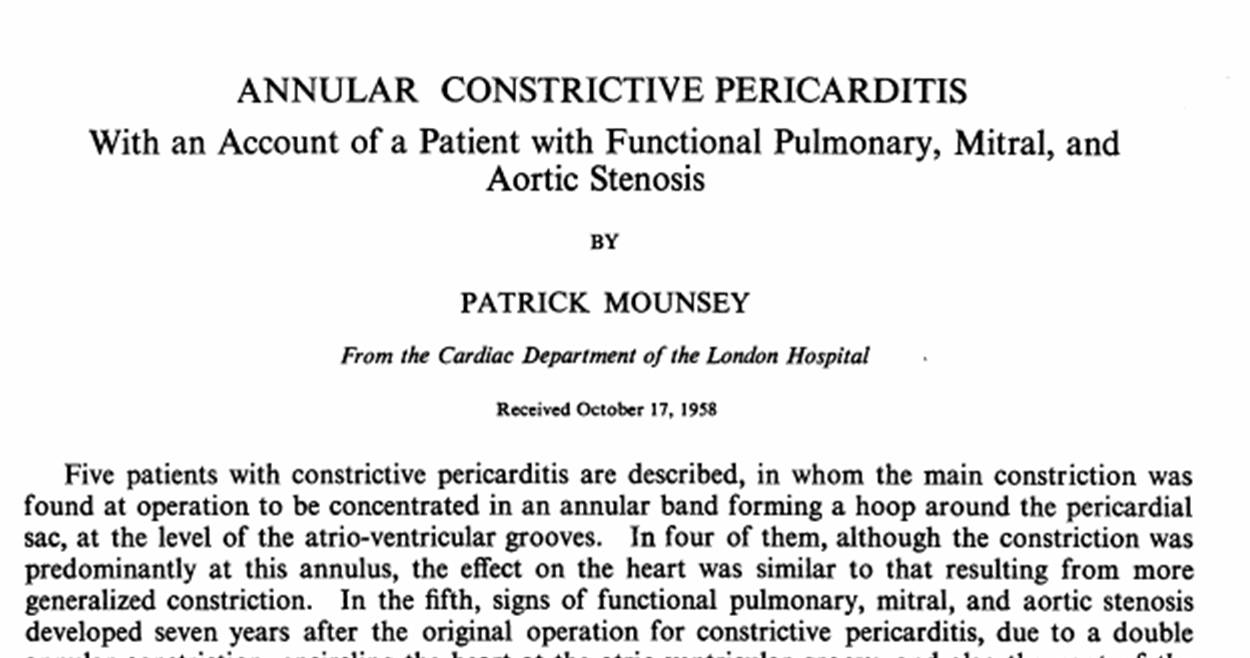
Constrictive pericarditis(CP)  has been a fascinating disease   for the cardiologists  for many decades .  (Of course , not  so fascinating for  our  patients!) The reason why clinicians were thrilled to diagnose this entity is due to the unique clinical and echocardiographic and hemodynamic features. Further , it is  one of the few  curable forms of cardiac failure.
It is also about the  philosophy  , pericardium an inert  membrane  which is supposed to protect the heart , becomes a  villain  . When this innocuous layer  is insulted by  chronic   infection (Tuberculosis most common) , radiation injury or post cardiac surgery  it takes a dangerous avatar and  start invading   the organ which  it  guards .
The pericardium becomes thickened , (often > 5mm -2cm) calcified , behaves like a “shell of tortoise‘ and begin to constrict the heart . Once the process of constriction sets in it becomes relentless . It only   requires   , a 10 -15mmhg of constrictive  pressure to make  the poor heart  struggle to relax .(The maximum intracardiac  diastolic pressure ,12mmhg(LV)   .For the right side of the heart it is very low (0-5mmhg) .
So it is obvious the right side of the heart RA, RV gets compressed first .This is why the classical features of constriction with edema , ascites elevated JVP occur.The associated hepatomegaly some times mimic a chronic liver disease.  Of course  relying only  on the  classical findings to diagnose CP would be a crime now .
There are many atypical varieties of CP
  • Localised constriction
  • LV>RV constriction
  • RV>LV constriction
  • Transient constriction
  • Effusive constrictive

* Rarely  constriction is confined to AV groove .  This article  is about this entity.

It is difficult to imagine how a pericardium constrict a rigid fibrous skeleton of the heart namely the AV groove.
But what happens is ,  there  are some gaps in the ring  . The  posterior mitral annulus which  has a deficient  rim  and forms  the most vulnerable  zone for pericardial constriction
Further , AV groove  is located  in a relatively  gravity dependant portion  of the heart  . It facilitates  stasis of inflammatory exudate  in this groove .This may be  the reason  why the  AV groove  shows high incidence of   calcification.
Clinical features of AV groove constriction
It mimics  a presentation of valvular heart disease.
A mid diastolic murmur across mitral valve may occur mimicking valvular MS.
Synonym : Mounsey’s pericarditis
This type of pericarditis should ideally  be called as Mounsey’s constrictive pericarditis   for his
elegant description of this entity 5o yearts ago  even before    Echocardiography was invented.
(These are the days , we struggle to diagnose Mitral stenosis without echo is a different story !)

Read Full Post »

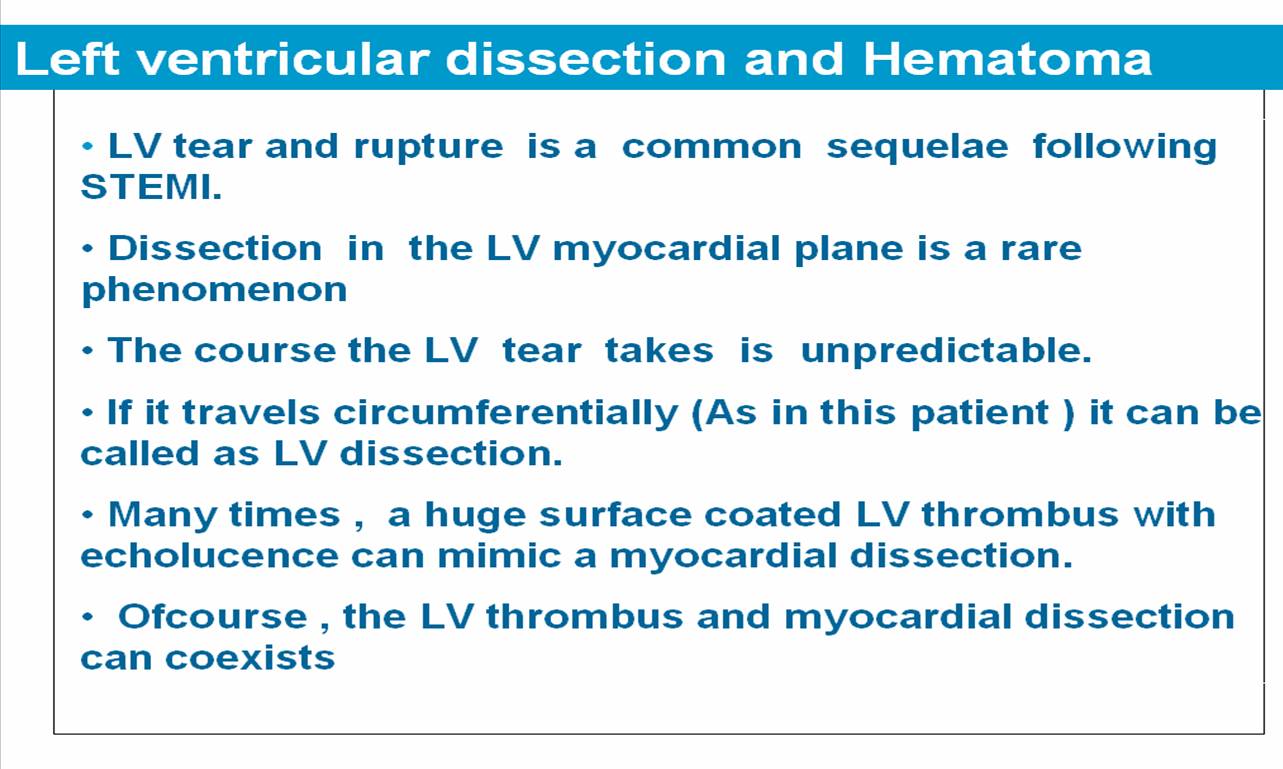
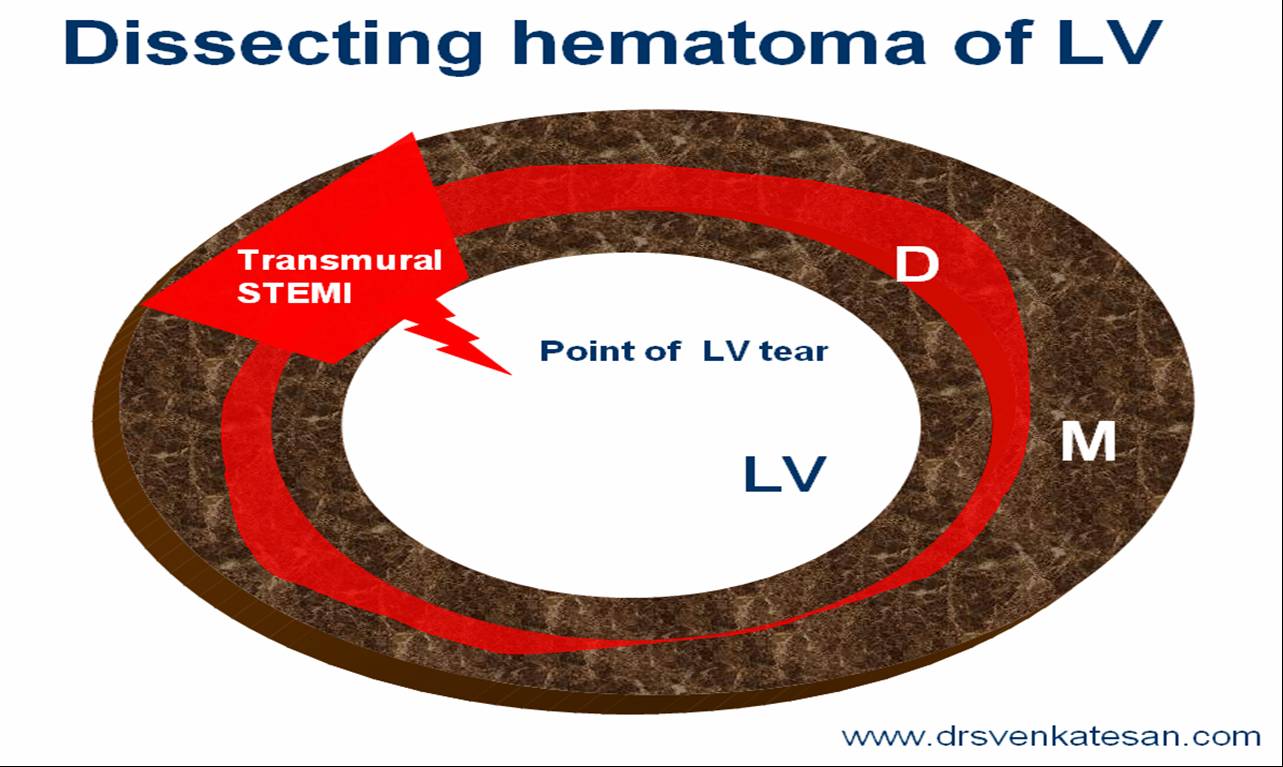
Left ventricular dissection is a rare complication of STEMI .A case report

Click on the slide to see the video  hosted in  youtube

Slide 1

Slide 2

Reference

http://www.ingentaconnect.com/content/bsc/echo/2009/00000026/00000003/art00006

http://resources.metapress.com/pdf-preview.axd?code=g4kqby7wnkjepetx&size=largest

Read Full Post »

The LV ejection fraction ,  is  the most revered medical parameter for both physicians and cardiologists.There are anesthetists and surgeons , who  do not  operate  a  cardiac patient  without knowing it.There are  physicians  who  do monthly assessment of EF in their patients  with dilated  cardiomyopathy.

Now ,every one is interested to know what is their EF ?  Thanks to the global  information highway .We witness ,   patients who are extremely delighted when their  EF increases from 45% to 48% . Similarly , they get depressed when it falls by 2% .

Why this hoopla around the LV EF ?

Every one knows EF is nothing but a LV contractile force at a particular  beat of the heart . It is possibly a crudest possible way to screen for   LV function.( Of course it can still be useful  in patients  with established myocardial disease to follow up  LV dysfunction)

The  most important caveat in  EF is it’s dependence on the loading conditions  of heart .It is   also  heavily influenced by the  heart rate.We now, even a severely dysfunctional LV can contract vigorously with inotropic stimulation  like dobutamine  or whenever local catecholamines.

Our obsession with EF is complete and it is not expected to get cured in the near future.

There are many hundreds of articles in cardiology literature  which  ridicules the EF as sole parameter for assessing LV function. Still ,  it is the number one parameter to asses LV function  in real world as well as in  vast number of land mark clinical  trials .  Are all those trial  results to be doomed ?

Even as  the  LV EF is   being labeled as  futile index  ,   we  also  realise we have not traveled  far from our great clinical   ancestors . Thousands of  years ago   the Chinese  yellow  emperor  of medicine  found  the cardiac contractility  by pulse volume  and predicted death accurately  ,  probably  better  than the live 3d echocardiography   derived EF   guided by LV volume rendering algorithm !

The purpose of this article is to tell the current generation physicians  there are some simple and probably  accurate  clinical tips  to rule out significant LV dysfunction.

One can confidentially tell  the LV  EF  would  be > 50%  in 99% of population if they have the following !

  • A brisk upstroke of carotid pulse.*
  • A well palpated tapping apical impulse**
  • A Loud  first heart sound(S1)
  • A  totally normal ECG (Even a normal QRS complex  is suffice !) ***
  • Normal CT ratio in Xray chest
  • A  comfortable brisk walk of  at 6 km/hour for 10 m .

* A brisk central arterial pulse is nothing but the reflection of LV DP/DT a sophisticated echo parameter assessed  with much hype ! A good thumb with an   alert brain can accurately tell a given patients dp/dt is within normal range.

** A loud S1 and tapping apical impulse indicate the velocity of closure of  anterior mitral leaflet.Which is in turn reflect the force of contraction of the antero lateral  papillary muscle of LV .So what you hear a loud s1 is nothing but the contractile function of the most important  part of LV namely the pap muscle of LV.

*** A normal ECG ,  generally tells us  all is  well with LV myocardium . Finally,  it makes  immense sense to correlate the functional capacity to EF. (90% correlation)

Final message

Mind you ,  all the above modalities come either  free of cost or a fraction of  echocardiography  . It is estimated up to 90% echocardiography scans to R/O LV dysfunction can be avoided . The global health care costs can be saved and be utilised for some better purpose like protecting our atmospheric shell  from the  hazardous   gases

Note of caution

While ,one can rule out signficant LV dysfunction by above mode  ,  it can miss  other forms of LV dysfunction like relaxation defect etc . (ofcourse the EF also misses it !) .Judicious use of functional  imaging modalities are adviced in those who require it.

Read Full Post »

The most famous and popular view in clinical echocardiography is para sternal long axis view.It gives us an instant information about the status of left atrium , left ventricle and aorta.Left atrium appears to be seen in full. Still , one should realise it is far from truth.There is a huge blind spot  for left atrium in this view .

For a complete imaging of LA one need to do a short axis view at aortic level, and of course a 4 chamber view . All these three views put together , can at best give a 80%  exploration of LA .The rest of the  20%(  some times vital !) can be seen only be transesophageal echo .

Why para sternal long axis fail to give even glimpse of the 4 pulmonary veins ?

  • Pulmonary veins are probably ,  the most vital structure  in LA . There are 4 veins , generally  arranged in 2 pairs
  • Unfortunately all these 4 veins does  not  interrupt the ultrasound beam in this view .The beam in para sternal view crosses  the anterior and lateral surfaces and to a  very small area of inter atiral septum(  IAS )
  • These enter  the posterior surface of the LA in an oblique angle . The angle of entry is widely variable .Some times they need to run a parallel course with LA posterior wall . This makes recognition and delineation  of PV from LA very difficult ..
  • Since all   4 pulmonary veins are located in the posterior aspect of LA ,  they  are best visualized either in apical 4 chamber (Right pulmonary veins) or short axis views(Left pulmonary veins)

When can pulmonary veins visible in PS- LAX view ?

When PVs take an abnormal course like in TAPVC or when they enter coronary sinus etc .

Rarely ,  huge LA enlargement may pull or push the PVs and make them visible in LAX view.

See the link

Read Full Post »

Even though it is a great vein , often the imaging pulmonary veins by echocardiography is a not a pleasant excercise.

This is due to the following facts

  • The pulmonary veins are posterior structures
  • They occupy the far field of echocardiographic window
  • The pulmonary veins often enter obliquely into the LA
  • The course of PVs are highly variable ( Like RCA origin !) especially in ASDs ,where identifying PVs becomes all the more important

Hence no fixed imaging angle can be advised . But generally a pattern is observed.

  • Right pulmonary veins are best viewed in apical 4 chamber or 5 chamber or in between (Especially RUPV is  seen best in 4.5 chamber view !)
  • Left pulmonary vein , can be seen in apical 4 chamber but best visualised in  Para sternal short axis view.

Other modalities for imaging pulmonary veins

TEE : Can be  very useful since it is brings the vein closer to the probe .But needs more expertice.

Contrast echo :Probably a simple and best modality often underutilised.

Very useful to clinch the diagnosis when PVs take abnormal course as in PAPVC .

MDCT , Spiral CT, MRI  are the new age modalities that can provide us  with dramatic  3d images of PVs.

The  echocardiogram will always prevail over these sophisticated gadgets for its simplicity and also it’s ability to give us the physiology of pulmonary venous flow which is vital in many diseases(Constriction, Diastolic function etc)

The following illustration is a gross attempt to simplify the imaging of PVs.Please note the rules may not be applicable in all.

Left upper and lower pulmonary veins in short axis view will be posted shortly .

Reference

The images are  based on  personal observations and  an  excellent insight  on the topic from  Department of Cardiovascular Medicine, Guangdong Provincial People’s Hospital, Guangzhou , China

http://ejechocard.oxfordjournals.org/content/9/5/655.full

Read Full Post »

Internet is  a  wonderful gift for  for mankind   but  only  occasionally we find great resources .

Hats off to Dr .Pybus from Australia for his efforts

A must read for  all cardiologists rather  everyone involved with echocardiography

Click on the Image to reach the site

http://www.manbit.com/ERS/ERSAZ.asp

Read Full Post »

As the name suggests   dilated cardiomyopathy  would imply  cardiac chambers will dilate , at least some time in the course of the disease .It can be minimal, mild or massive. A new entity called  non dilated cardiomyopathy is also gaining wider acceptance . (That will be dealt seperately )

Logic would suggest , the first chamber to dilate in DCM  should be the left ventricle because it is  facing the direct load of systemic blood. But we also know , whenever  LV is stressed , left atrium comes to it’s assistance .

Left atrium does this    by total self sacrifice ( by all  means!)  increases  it’s  force of contraction, elevating it’s  mean pressure or even increasing it’s rate (AF) .

Like most  other critical questions in cardiology  ,  the factors that determine LV dilatation in DCM ,  is  also poorly understood !

  1. Is it the after load ?
  2. Is it the  muscle mass ? or it’s turgid  or flabbiness ?
  3. Is it the interstitial integrity?
  4. Is it the blood volume ?(LVEDV ,  LV residual volume )

When the issue is complex , it is  usual  to  make the   the unknown  genetic defects  ,  the scapegoat !

As of now the most important determinant of LV dilatation  could be  the behavior of the desmins, the gap junctions and myosins the titins etc

If  the LV of a DCM patient  refuses  or  resists  dilatation what  might happen ? Is it good or bad for the patient ?

Here is a catch .  A  LV  that does not dilate  obviously should be  be good for the patient  is in’t ? Medicine is not that simple.

When   LV  fails to  dilate  it means it has become  too  stiff and rigid    and pass on the  burden to  to LA which  faces the music. And in the process it dilates.This is the reason , we  observe  diastolic dysfunction in vast number of DCM patients.( Currently it is estimated > 75% DCM will have significant diastolic dysfunction )

So , now we can imagine how complex the sequence of hemodynamic stress in DCM that determine the chamber enlargement.( RA, RV  dimension in DCM is a separate issue !)

So now answer this question :  Which chamber dilates first in DCM ?

  1. Left ventricle
  2. Left Atrium
  3. Any of the above
  4. Both of the above dilate simultaneously

The answer must be 3 .

Why  recognising this sequence of  chamber enlargement  in DCM   is important ?

  • It gives us an opportunity to assess the dominant mechanism of LV dysfunction.There are reports , where some  DCMs  have more diastolic dysfunction than systolic dysfunction  .This will have important therapeutic implication.Further , many of the infiltrative   disorders of LV can have features of both DCM & RCM .
  • When a RCM begins to dilate it is usually  a harbinger of terminal heart failure. But,  it need not be always true .  A small restrictive LV  , when  dilates ,   may acquire a  slightly improved diastolic properties , as the  LV becomes more placid . And ,  if it happens the LA size may regress.
  • The role of LV restriction devices like, Acron mesh, Dor procedure, plication  in refractory  DCM is not well defined. All these   modalities actually  adds  a small dose of diastolic dysfunction in these patients who have grossly dilated ventricles. This fact is  very important  , as presence of any preexisting  significant diastolic dysfunction in DCM makes  the role of LV restrictive devices and surgery a big question mark !

Read Full Post »

« Newer Posts - Older Posts »