Feeds:
Posts
Comments

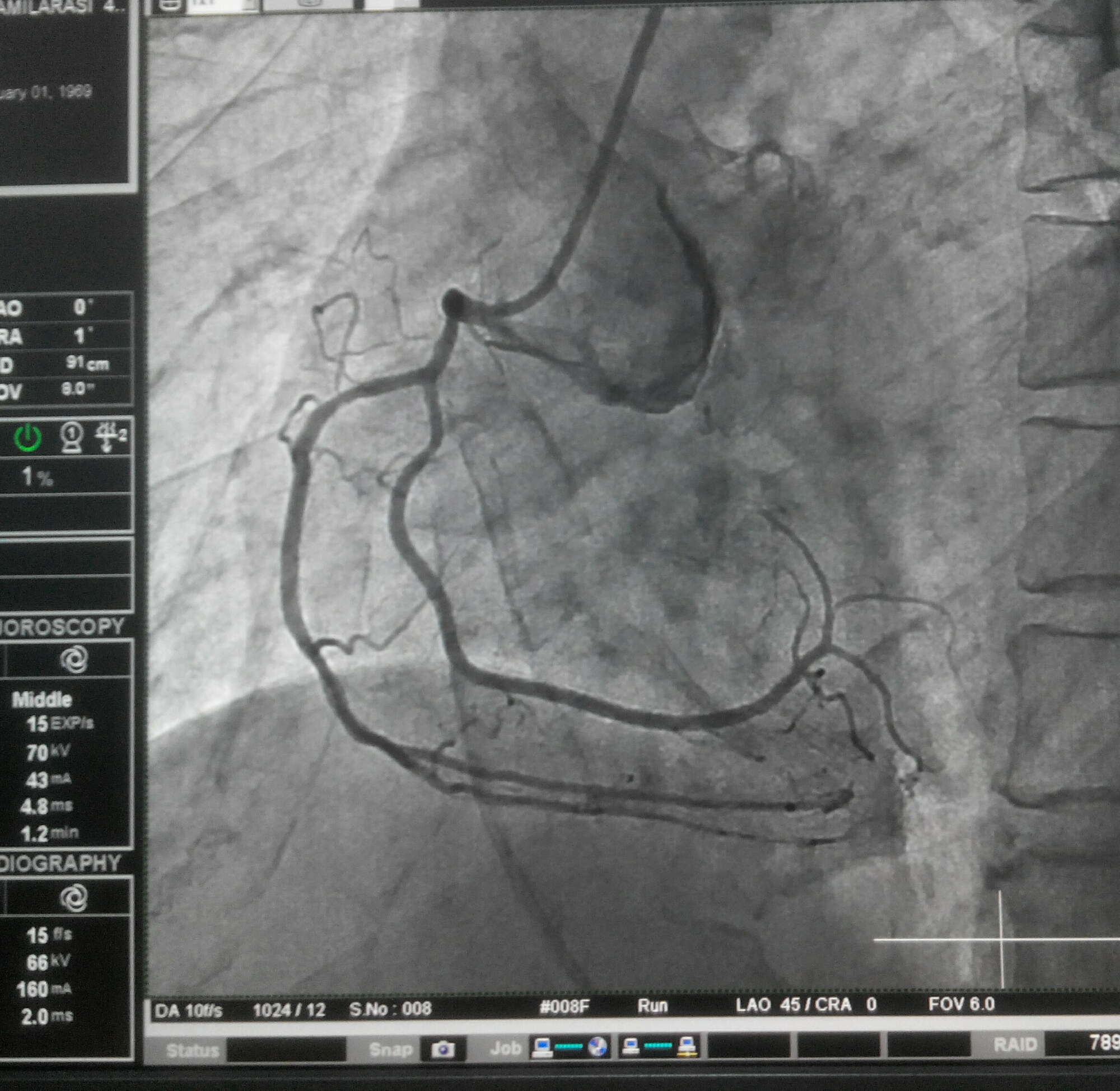
RCA is known for unusual variants.Here is a right main trunk which divides into two major branches, both taking a surprisingly similar course.Shall we refer it to as Dual RCA  or is it an early RV branch ? But how can both run posterior and parallel ?

PS: His LAD and LCX  were  normal.

Aspirin for primary prevention of CVD is an ongoing controversy for more than 2 decades. Please note, the controversy is not in the competence of Aspirin to prevent cardiovascular  event, but in the potential risk of GI bleed and whether that risk is worth taking. Secondary prevention has no such issues as the benefits easily outweigh the potential bleeding risk .

Male vs female

There is a “gender” and “age” difference  in the ability of Aspirin to prevent vascular events.Aspirin primarily prevents MI in men(>45)  and stroke in women(>55)  (Funny it may look,  that’s what data says!)

Age

Hence, the target age group  for aspirin is between 45/55  to 80 years. (Up to 45 and beyond 80 it has no role .Beyond 80 ,  risk of hemorrhagic stroke is significant )

Diabetic vs non diabetic

Many believe  all diabetics should straightway  get Aspirin as it was considered  CAD equivalent.Its not acceptable to all. . American diabetic association  has risk stratified DM and advice Aspirin only in high / Intermediate risk.Look for Key word ie “Net benefit (Ref 2)

Why so much confusion  ?  and What can be  the conclusion ?

The confusion is because each scientific body like AHA, ESC, ACCP, ADA ,USPSTF have  their own inference and the presence of too many risk assessment tools adds further dizziness .(SCORE /FRAMINGHAM, etc). It tempts me to say ignore all these and use  cortical sense !

Fortunately ,we do have some clarity as there is a common theme in all these advisories .Aspirin is indeed a wonder drug and able to block the platelets to prevent acute thrombus formation in the critical circulations.(FDA doesn’t seem to agree with this , How can a cheap generic do that job so effectively  ? Let the Bayer fight ! ) 

It seems reasonable to conclude

All men and women  between 45/55  to 80 years should get Aspirin (81mg /day or 325mg alternate days ) if there is at least one or two CVD risk factors provided there is no major bleeding risk .

Ongoing  studies on primary prevention with Aspirin 

ASCEND: A Study of Cardiovascular Events in Diabetes; or with diabetes taking a statin 

ENVIS-ion (Aspirin for the Prevention of Cognitive Decline in the Elderly )

ASPREE (Aspirin in Reducing Events in the Elderly) 

These  studies are  expected to  bring more data (and be ready for more confusion!)

Can we use Clopidogrel  for primary prevention if a person is intolerant to Aspirin ?

Logic may say yes.As of now it can not be advised for primary prevention.

Reference

1.A elegant advisory is hosted in Healthcare Research and Quality (AHRQ) website with supportive data from U.S. Preventive Services Task Force.

primary prevention of cad by aspirin

2.Pignone  M., Alberts  M.J., Colwell  J.A., et al; Aspirin for primary prevention of cardiovascular events in people with diabetes: a position statement of the American Diabetes Association, a scientific statement of the American Heart Association, and an expert consensus document of the American College of Cardiology Foundation. Circulation. 2010;121:2694-2701

3.Sigrun Halvorsen,Felicita Andreotti,  Jurriën M., Aspirin Therapy in Primary Cardiovascular Disease PreventionA Position Paper of the European Society of Cardiology Working Group on Thrombosis  J Am Coll Cardiol. 2014;64(3):319-327.


2016 Update by USPSTF in Annals of Internal medicine has a Major revision.

It raises concern over bleeding risk, and ask for restricted use of Aspirin

within the age group of 50 -69 for both male and female.(Who are at risk of CAD)

Link to the Annals of Internal Medicine Article  Aspirin primary prevention 2016
 

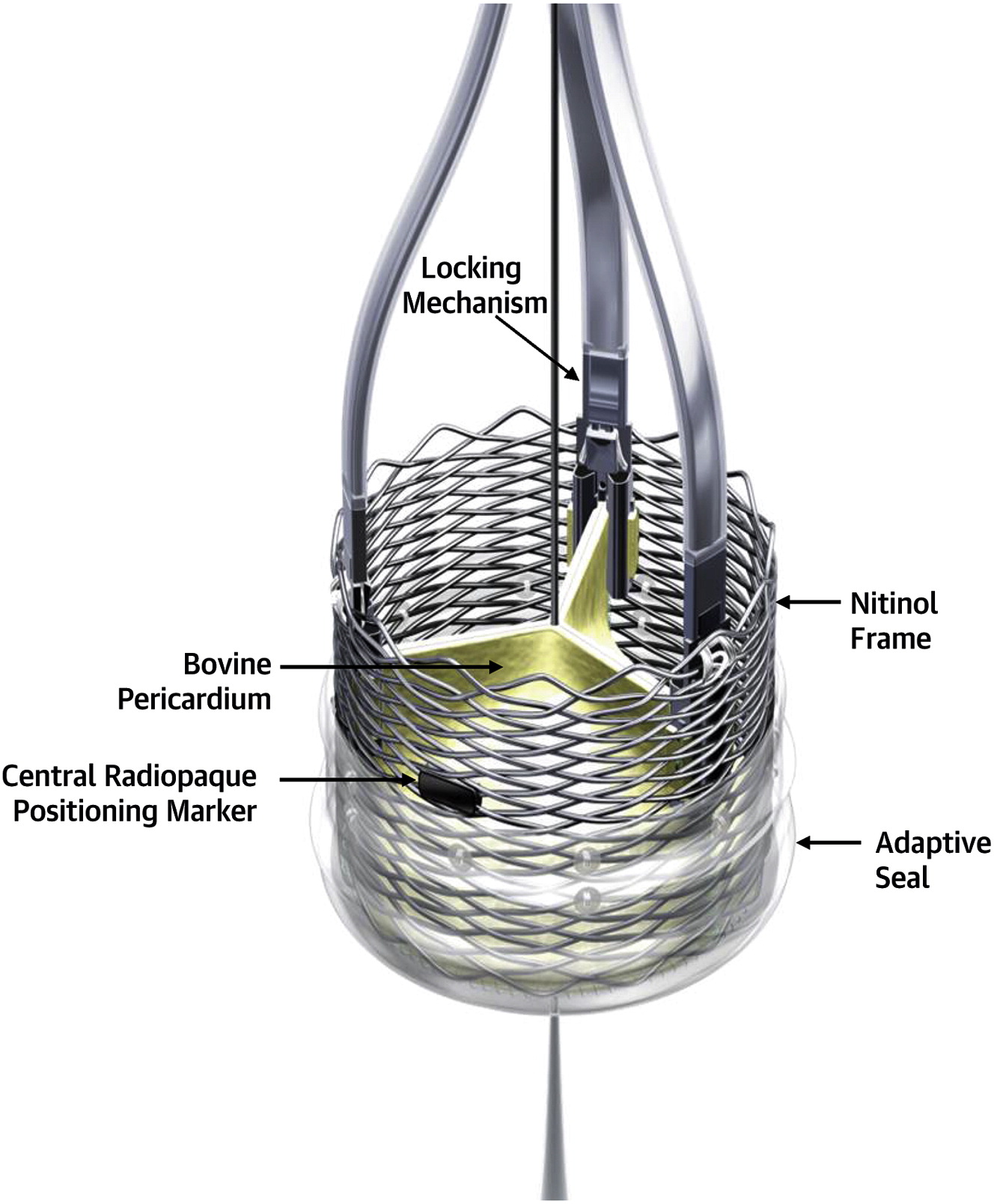
The concept of TAVR(Trancutaneous aortic valve replacement ) is trying hard  to prevail over surgical aortic valve replacement .Two companies Medtronic and Edwards life have their products (Core and Sapiens)  tested and used with varying success.Meanwhile, Boston scientific has come out with a new one , Lotus valve made with stainless steel and bovine pericardium.


lotus valve tavr

Lotus valve  seems to have a distinct  advantage* (over the Core and Sapiens ) in terms of easy delivery and adjustment (or retrieval ) of valve till  final position and efficient adoptive steel technology in preventing para-valvular leak.

* Outcome awaited.

Human  trials has started with lotus valve in USA 2014.The REPRISE III trial would compare  one to one Lotus vs core valve . Results will be out by 2017.Unlike many interventions the utility value and long-term outcome of  TAVR  seem to be genuine and patients  waiting for aortic valve surgery can look forward to this as a genuine non surgical alternative.

Responding to this , Medtronic and Edwards are  improving upon core valve with Evolute R /Engager and SAPIEN3 , expected  to give a tough time for LOTUS.

Reference

1.RESPOND registry , REPRISE 1, 2 and 3 trials

2.A review article on TAVR 

medical ethics stastistics www.drsvenkatesan.com

One casual question in my class led to this search for an anatomical mystery. When we were discussing why left atrial oxygen saturation never reaches 100 % ? , it was attributed to desaturated bronchial venous blood draining into pulmonary vein.

How does this bronchial vein enter pulmonary venous circulation ? How many bronchial veins are there ? What anatomical plane it runs ?

Surprisingly, even in this hi-tech era of academic excess, literature is sparse for this basic anatomical question. It is reported (In Greys anatomy ? ) Bronchial veins are two in number and both drain to Azygos and Hemiazygos veins (systemic) rather than pulmonary veins.

So is our assumption wrong ?

May not be.We realise these are only two visible and named bronchial veins .It is learnt they probably carry only about 13 % of bronchial venous blood to systemic venous circuit.

bronchial venous drainage bronchial circulation

Image showing right and left bronchial veins draining to Azygos and hemiazygos veins.

It is assumed , remaining 87 % of bronchial venous blood drains to pulmonary venous circuit in an invisible fashion (By unnamed twigs ?) desaturating the LA blood by about one percent from 100 to 99 %. This is our current understanding. I haven’t come across any specific human research that quantifies the bronchial venous channels and it saturation . It’s gratifying to find one study specifically looked answer this question in sheep study .(Charan H.B et all Reference 1 )

where does bronchial vein drain drainage circulation pulmonary vein saturation

True physiological bronchial venous drainage seems to be different from anatomical bronchial venous circuits .

Clinical implication of bronchial venous circulation.

In physiology it may not be important . However bronchial circulation (both arterial and venous) can take many anatomical tracts when pulmonary micro vascular bed is structurally and functionally altered as in COPD, , pulmonary atresia with aorto-pulmonary collaterals , congenital left to right shunts,post Fontan circulation pulmonary AV malformations,lung tumors etc .

Hemoptysis in acute pulmonary venous hypertension is thought to be due to rupture of these bronchial veins as elevated pulmonary venous pressure reflect into bronchial veins (As in mitral stenois and other conditions. ) This again would vouch for bronchial veins draining to pulmonary veins.

Final message

As on today , it can be concluded bronchial vein drainage goes both systemic and pulmonary venous circuit.Bulk of them appear to end in pulmonary veins though clear anatomical evidence is lacking.

Postamble

Exploring human anatomy appear a grossly unfinished agenda even today, especially the micro and histo-anatomy. Teachers of basic sciences should impress upon youngsters entering the medical school to pursue translational research relevant to specific clinical problems.

Students may contact <drsvenkatesans@yahoo.co.in> for specific areas of clinical cardiac anatomy topics that still requires answers.

Reference

Scientific cardiology has forced us to believe ACS management must be catheter based and all others are inferior  and  those who pursue the later , carry a risk of  being labelled as unethical in near future. However ,experienced cardiologists will know  where the truth lies.

Now,in the interventional cardiology board rooms  there is a big  debate going on regarding the value of early total revascualrisation in STEMI with multivessel CAD.Suddenly , every lesion looks suspect ( Ex,current or future culprit ! ) and all stentable lesion are stented  either in an emergency or semi emergency fashion (The new age post PCI dialogue goes something like this “I have tackled one culprit , other one seems to hide in LAD ,  we will arrest it  next 48 hours or so* ? ( This is the concept of  deferred or staged  non-IRA stenting )

*Ironically it brings   one more dubious therapeutic time window in ACS !

ptca ira non ira multivesssel pci

The recent  studies like  PRAMI, PRIMULTY ,CvLPRIT are trying to find out an answer to this issue  and suggest acute multivessel PCI may be  good strategy. Some of them advocate a FFR guided non IRA intervention , knowing fully well micro-circulatory bed is completely altered by the index acute thrombotic event.( Mind you , for FFR,  we need to induce maximum hyperemia with Adenosine in a highly varying local autonomic milleu within the thrombus clogged capillary network)

Final message ( Intentionally biased !)

Till we learn or unlearn  it is vital to go with conventional wisdom.Don’t pursue a random hunt for coronary culprits in acute phase of  STEMI.Many of them are innocents and likely to suffer in cross fire.Tender coronary arteries need some rest,peace and time to heal thyself  . Just keep away , they will definitely say big  thanks with folded hands !

Reference

1.Gershlick AH, Khan J, Kelly DJ, et al. Randomized Trial of Complete Versus Lesion-Only Revascularization in Patients Undergoing Primary Percutaneous Coronary Intervention for STEMI and Multivessel Disease: The CvLPRIT Trial. J Am Coll Cardiol. 2015;65(10):963-972.

The ECG changes in ACS can be  “as dynamic as”  an occluding thrombus. The initial events include sudden total occlusion, early lysis, a trickle of flow, partial re-occlusion, reflow, no-flow, etc. The extent of transmural vs sub-endocardial ischemia, the competing force of re-perfusing vs necrotic wavefront, would define  ECG findings. This makes the ST segment labile in the early hours of ACS. This is also the basis of some cases of  STEMI evolving into NSTEMI and vice versa.

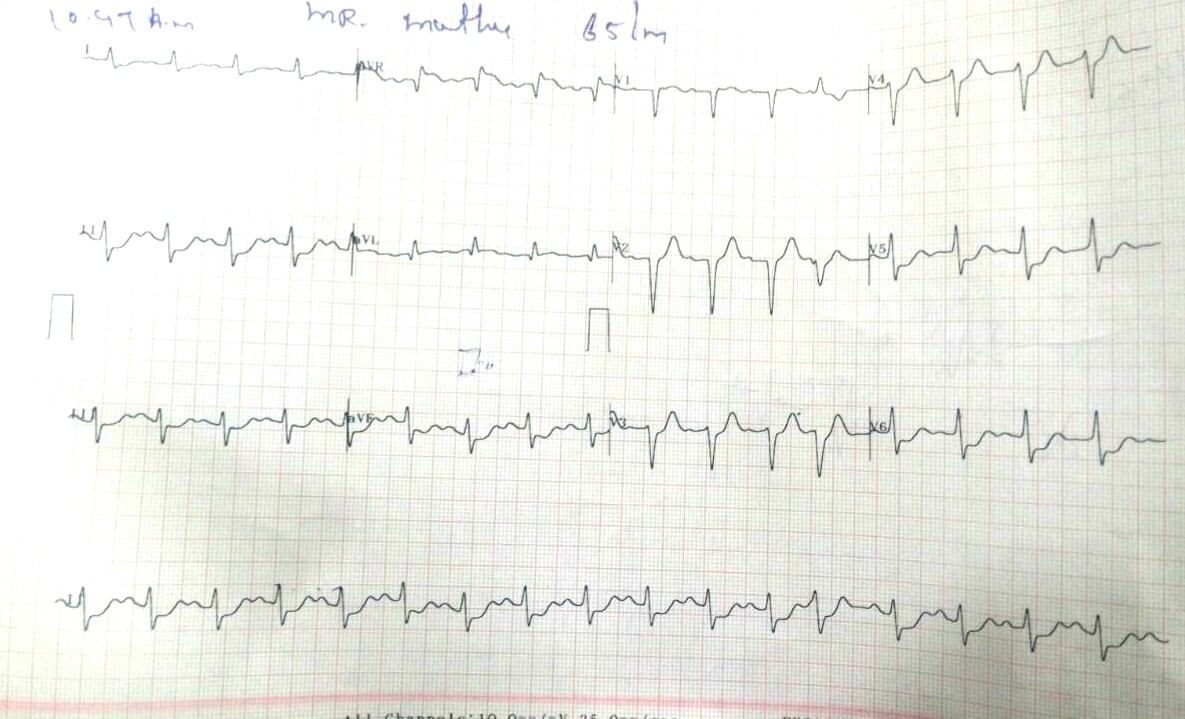
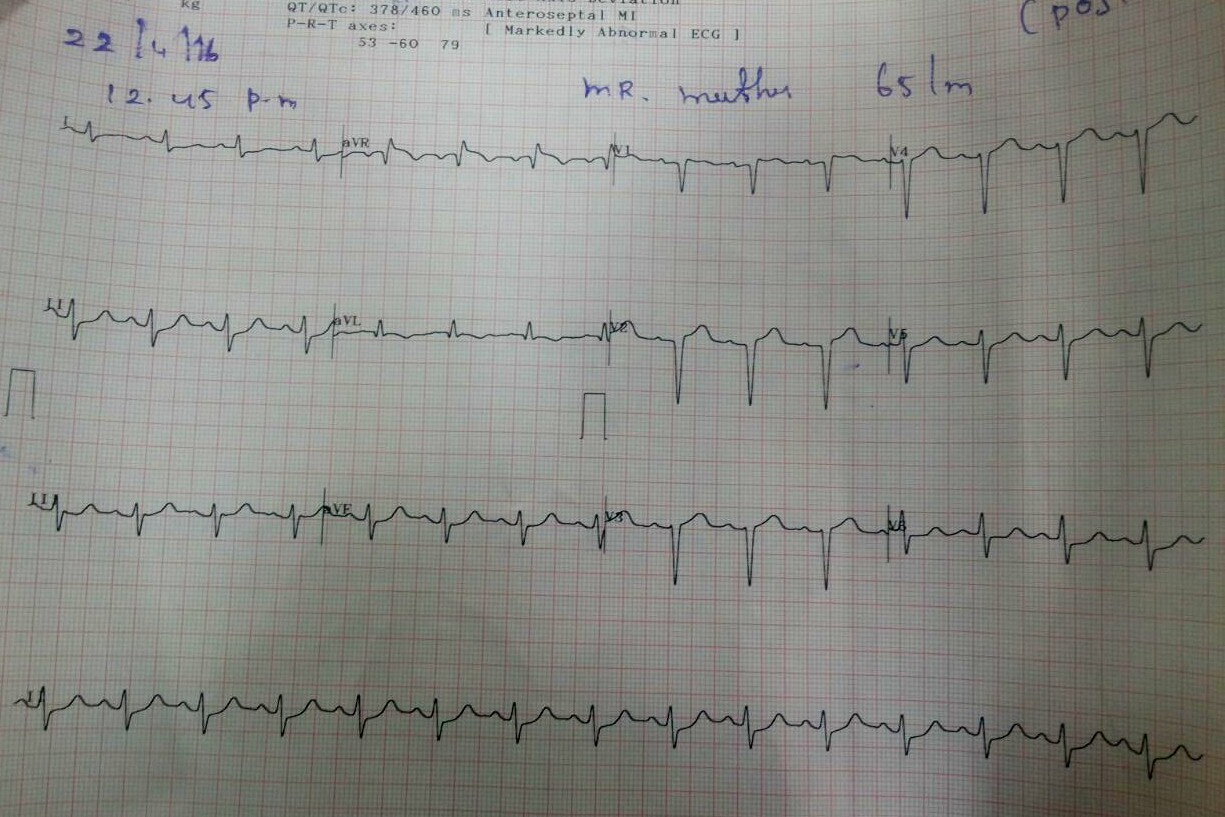
A 65-year-old man  presented to with this ECG,


img-20160423-wa0012_1.jpg

Does this ECG allow you to go ahead for thrombolysis? It actually looks like NSEACS with ST elevation in AVR suggesting left main lesion

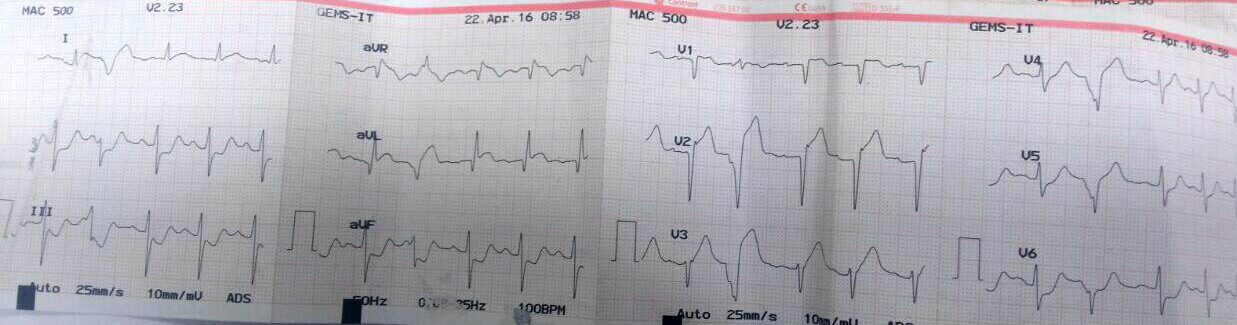
The initial diagnosis of  NSTEMI was made, and hence thrombolysis was not considered. Even as the fellows were mulling over the diagnosis, one of them could find one more ECG available taken a few hours ago in another hospital.

It had something on it ,

img-20160423-wa0009_1_1.jpg

This ECG taken a few hours ago, shows ST elevation in 1 and AVL, and few VPDS in the chest leads unmasks the anterior ST elevation.

The moment we saw this ECG it was decided to go ahead with thrombolysis.The final ECG after thrombolysis with (Streptokinase) showed further stabilization. The question of thrombolysis in NSTEMI though not indicated in general, in selected situations we need to Introspect!

img-20160423-wa0011_1.jpg

How to manage a patient who presents as NSTEMI but had STEMI a few hours ago?

Four ways to ponder!

  • This patient should not be lysed as we have to treat the current event, not the past.  ,(Its NSTEMI and no need for lysis) Just heparin, dual antiplatelets. That will do.
  • One can go ahead with lysis as there is evidence for STEMI in prior ECG.
  • There is ST elevation in AVR even in the second ECG and so you have to thrombolyse !
  • “Come on guys, . . . don’t live in the primitive era of managing ACS in CCU . Forget the ECG take him to the cath lab , suck out all thrombus and deploy a stent and come out”.

* The last one , though appear practical (and most of us would love that ) is an unprofessional way of practicing cardiology. Management of ACS requires sound principles of ECG and its correlation with the Intra-coronary and myocardial pathology.

What happened to this patient?

He did well, free of angina with minimal LV dysfunction. He was discharged. Will be reviewed later, for further evaluation. This is a typical example of a patient with ACS managed successfully without entering the cath lab.(A forbidden practice and a potential coronary blasphemy )

Final message

ECG changes are as dynamic as the Intra-coronary blood flow in ACS. Multiple factors determine ST elevation or depression. While thrombolysis is reserved for STEMI,  NSTEMI has little or no benefit to accrue with thrombolysis. However, this is applicable only for de-novo NSTEMI  and may not apply for  STEMI in transition into NSTEMI as in the above patient.


With TAVR (Transcutaneous aortic valve replacement ) threatening to take away the Aortic valve surgery atleast in high risk subsets from surgical domain ,a new development is taking place in aortic valve surgery. Minimally Invasive aortic valve replacement and implantation of low profile , bio prosthetic valve placed in aortic root without active suturing .This type of AVR  can be done without traditional  sternotomy  with minimal bypass time , less surgical morbidity and mortality.

It has some specific advantages over TAVR, as the native valve is removed , calcium is debrided and hence less stroke and para-valvular leak .In TAVR cardiologists are blinded ,do lot of guess work to place the valve in right position ,  struggle to handle the deformed and distorted native valve tissue .My belief is,surgery does a more precision job , since the valve is placed in  optimal position .One more issue is, complication of complete heart block and subsequent requirement of pacemaker , its prohibitively high for TAVR as on 2016.(up to 25% )

These new generation valve  are expected to  narrow the gap between AVR and  TAVR. Still. avoiding a surgery is the biggest advantage which drags most patients to TAVR. However, one should ensure quality shouldn’t be compromised for simplicity.

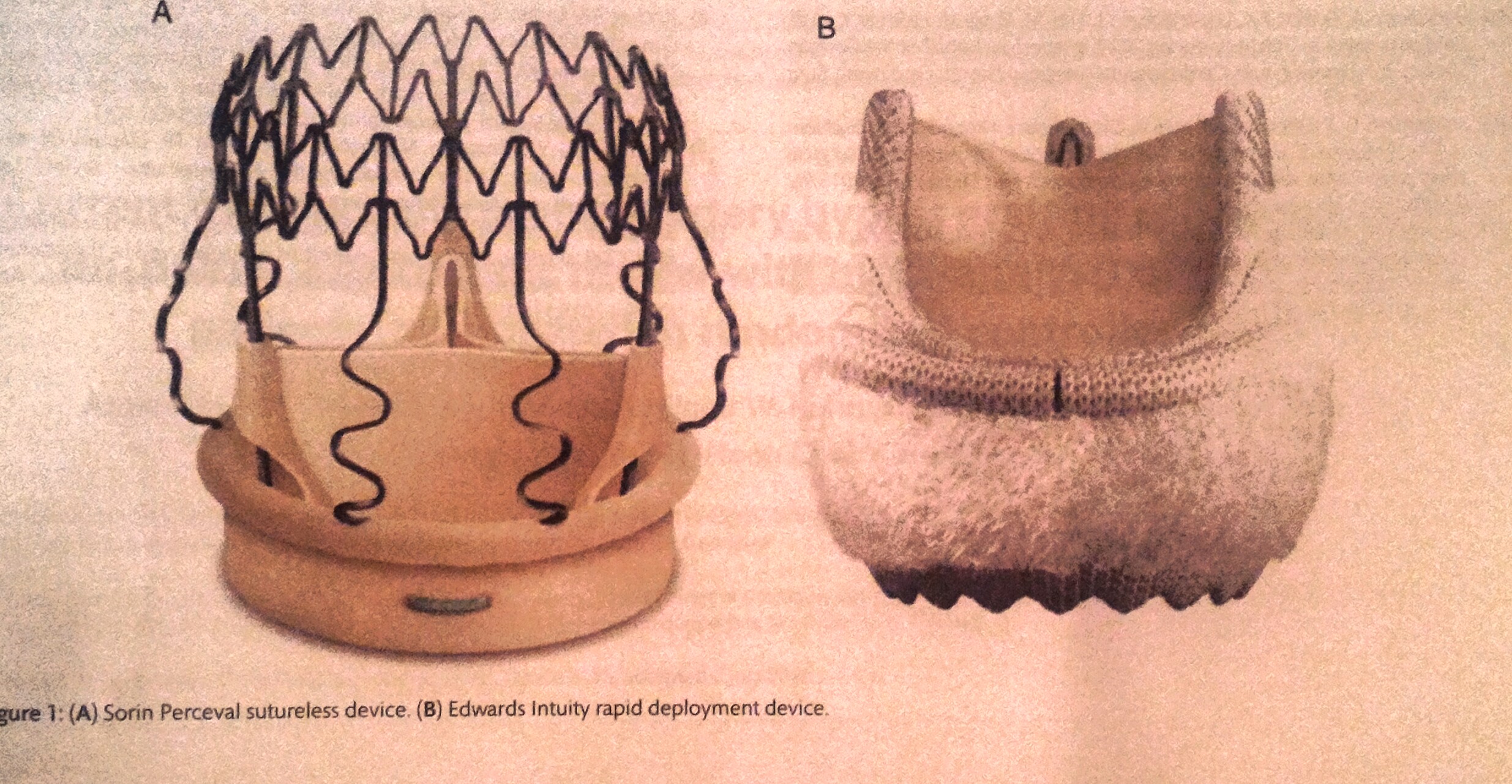
There are two valves available for suture less AVR  , both from Bovine pericardium.

1.Perceval (Psorin)

2.Intuity (Edwards)

p_20160415_174424_1.jpg

Evidence

CAVALIER and TRITON  (PERSIST -AVR forthcoming)

Message for the  patients

TAVR is a revolutionary  treatment modality, agreed .However , one need not blindly accept the  TAVR if offered especially in low and medium risk* situations just because it avoids a surgery.(*Of-course technology may evolve further ) Discuss with surgeons .Be well informed about all the intricacies.Currently  surgical risks seem to  overstated and TAVR risks are underplayed in spite of huge cost advantage in favor of surgical AVR.

A note of caution , for suture less AVR must be made .Basically , surgeons  tried to imitate the cardiologists, .Ironically , it has the same issues of TAVR for possible migration of valve.Conventional AVR  with active permanent fixation sutures will remain the 24 carrot gold standard for AVR and all others may  just glitter !

Please realise, medical decision making and consent forms are increasingly looking  similar to signing a  house mortgage loan which comes with  lots of known and unknown “conditions apply”!

Reference

tavr tavi avr surture less future of avr metaanalysis phan


Hypertrophic cardiomyopathy (HCM) is the most common primary cardiac muscle disorder.It is one of the  extensively studied medical  entity in terms of pathology, genetics, electrophysiology and treatment.Though it has dramatic myocardial  phenotypic expression , longevity  can be near normal  except in a minority who are prone for LV dysfunction and SCD due to the indirect electrical instability.These arrhythmia arise due to myocardial disarray , micro vascular disease or fibrosis.

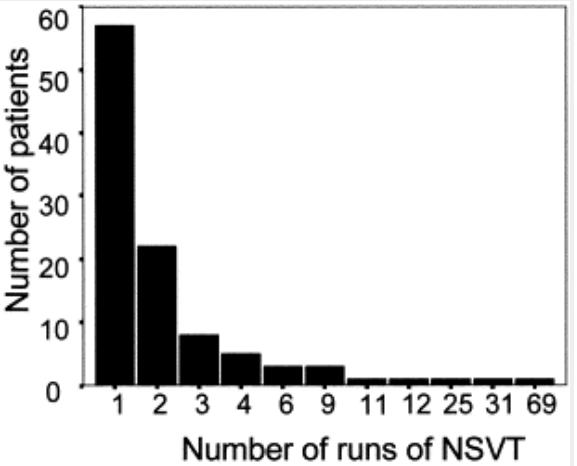
NSVT  by definition is runs of VT at a rate of > 100 /mt occurring less than 30 seconds.

How common is NSVT in HCM ?

On Holter study with  178  patients  with HOCM (Adabag  JACC 2005 ) 90 % showed VPDs

  • 12%  > 500 VPDs/24 h
  • 40% had couplets,
  • 30% had non-sustained ventricular tachycardia (NSVT).
  • Over a follow-up of 5.5  6% patients died suddenly (annual mortality rate, 1.1%)

For sudden death, NSVT on Holter ECG had negative and positive predictive values of 95% and 9%, and sensitivity and specificity of 45% and 69%, respectively.

nsvt incidence hocm

In this series from StGeorge hospital London from 630 patient incidence of NSVT was 19% and 4 episodes were observed in 48 hr in most .Monserrat L, JACC 2003

What is the duration , How fast  and  how frequent is the NSVT ?

It is expected the total burden of NSVT would have a definite impact on outcome.  Curiously the duration, fastness and frequency of NSVT  was  not related to prognosis in atleast one study (Monserrat L, JACC 2003)

Relationship between age and burden of NSVT ?

Aging has a sobering effect on these ventricular ectopic activity by probable conditioning and fibrotic interruption of electrical activity.

How often a episode of NSVT  convert to VT ?

Considering the day to day even it should be termed extremely rare . Even among person who survived an SCD the next episode of VT can be very rare.

What is the current Indication for ICD in HOCM ?

Secondary  prevention (Consensus > Controversy )

Primary prevention (Controversy > Consensus – Still evolving )

Questions galore  . . . answers struggle !

Does NSVT arising from single focus or multiple focus ?

What is the relationship between NSVT and degree of obstruction ?

What is the relationship between NSVT and MRI detected myocardial scars ?

How effective is beta blocker suppress NSVT ?

Can we implant ICD for only NSVT ?

Is it true  ICDs add more anxiety , distress and harm  than the index disease ?

How to program ICD to ignore  NSVT and fire only for VT ?

For further information , refer this most authentic knowledge base. esc guidelines hocm

Final message

Predicting which NSVT will go for SCD  in HOCM can be as difficult as predicting the next major earth quake  that would strike the pacific rim that  experiences unrecognized tremors  on everyday basis .We have learned to live with that right ? So it appears NSVT is more of a nuisance arrhythmia for both the patient and physician .

Still , science demands identification  individuals  with highest risk for arrhythmia . How to do it ?  Is it the  morphological features  , degree of obstruction  or  genetic finger prints. It is still not resolved . One thing is clear we can’t advice ICD for all those with runs of NSVT  for perceived fear or pressure from peers or industry !

 Referene


One of my fellows gave a discharge summary  for a 62 year old patient with stable diabetic  CAD  who had Triple vessel disease with a final advice reading as CABG / PCI/or OMT .

There was a near fury over his angiogram report in the cath meet. How can be  eligible for all the three Intervention at the same time ?.(PCI -Percutaneous coroanry Inervention ,CABG-Coroanry artery by-pass graft, OMT-Optimal medical therapy )

The lesion in question was , Triple vessel disease(Non critical LAD) and significant LCX and again a non critical RCA .Syntax was less than 22 for sure , however the patient  had class 2 angina (now reducing ) .When asked to explain  , the fellow  argued since the patient  is symptomatic , has DM with TVD  he is eligible for CABG , since  LCX lesion was discrete and PCI was distinctly possible , of course as all three  lesions would be  eligible for OMT on any given day  ! he inferred .

How can  a cardiologist be so casual and non-commital in an important medical decision where a life of a heart is at stake.There was a unanimous condemnation about the report. As a consultant he has to be specific , one can’t leave the decision to  your patient’s whims  . . . rather it’s our scientific whims  that should prevail  !


MEDICAL VS PCI VS CABG OMT COURAGE BARI 2D FREEDOM FAME STUDY MASS 2 CASS OPTOMAL MEDICAL MANAGEMENT SYNTAX ACC AHA ESC GUIDELINES PTCA STS EUROSCORE NEJM

The curiosity continued and looked amusing for many. I was the only one supporting  his argument ! After all , he is being frank and understood the futility of  applying  evolving knowledge base in critical decision making. But, I  asked him to grade the choices .In my opinion  OMT should be the first choice if it can be administered , but reality tells me  true OMT is rare as a modality  at-least in  this  part of world . However every one should insist for it.

Apart from poor  compliance for OMT , pressure  mounts for a procedure from peers and non peers . I am  sure  many  patients  will end up with an  invasive modality sooner or later  backed by a  second or  third opinion  driven by that elusive googled intellect !

Final message

When clinical decision making is debatable with available knowledge (Especially with futile and evolving knowledge base !) , please include your patient into the debate and you may even consider giving him the veto power.If Hippocrates is alive today , I am sure he will argue for medical  knowledge and ignorance should be equally shared with their  patients.

Counter thoughts

Don’t give the choice to your patient  . . . that would mean you lack  clarity, wisdom and confidence !

No, I don’t agree , I know there are  some  patients who are  well informed , rational , more focused than even a professional  !