Feeds:
Posts
Comments

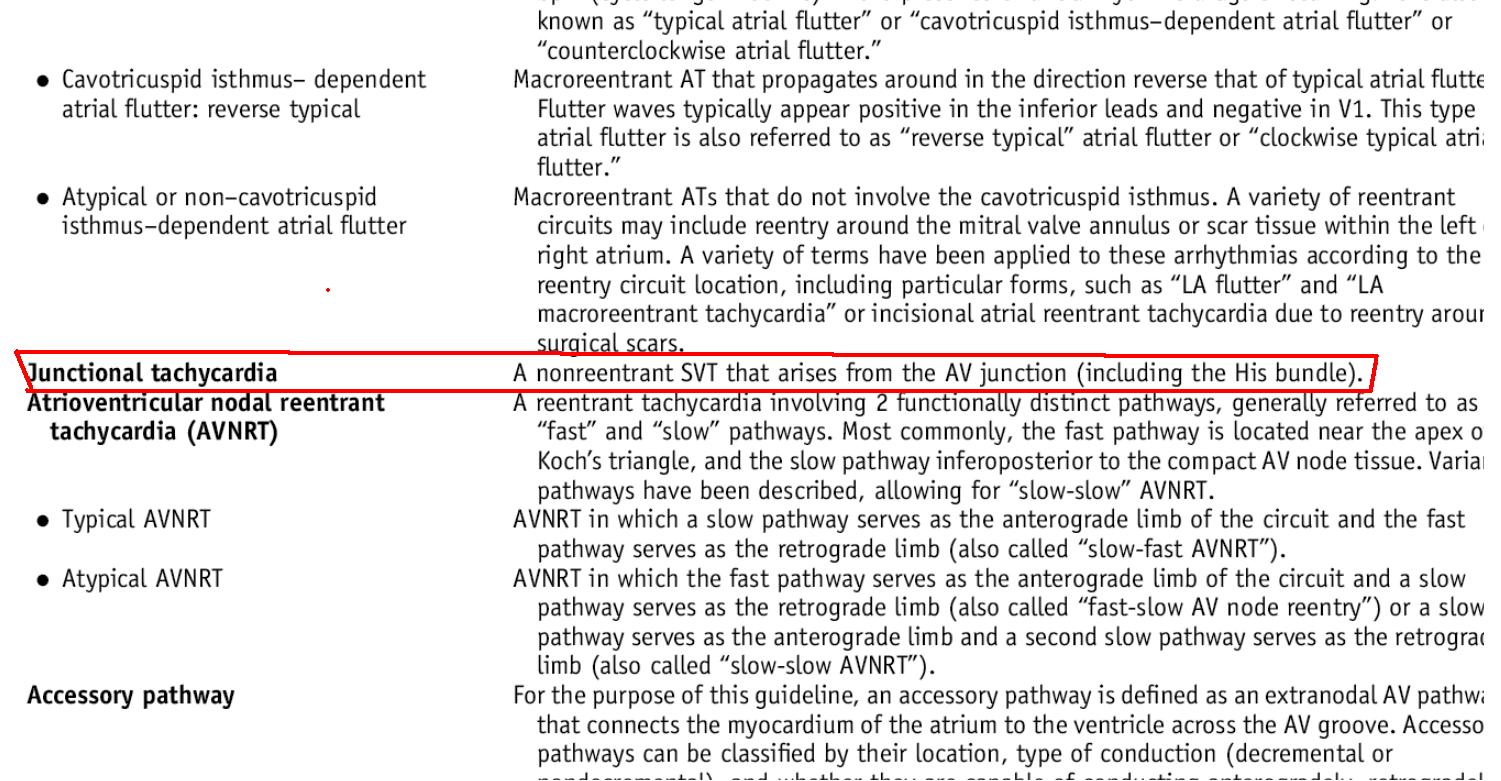
Junctional tachycardia(JT) is often a misunderstood arrhythmia. Technically,  any tachycardia arising from the AV junction could be termed as JT.Even AVNRT was considered as a form of Junctional tachycardia till recently.The crux of the issue is , true anatomical extent and borders of  so called AV junction is  yet to be clearly demarcated .The common perception that  AV node is a discrete  structure is  an anatomical illusion  , rather its collection of  condensed fibers with proximal  nodal approach and distal fanning .

Now , we have a  proper definition by the apex scientific bodies  ACC/AHA/HRS 2015)

definition of junctional tachycardia

Source :2015 ACC/AHA/HRS guideline for the management of adult patients with supraventricular tachycardia: Executive summary A Report of the American College of Cardiology/American Heart Association Task Force on Clinical Practice Guidelines and the Heart Rhythm Society April 2016Volume 13, Issue 4, Pages e92–e135

Please note :The key point is , JT by definition  should  be a focal  /automatic tachycardia either due to triggered activity or after depolarisation and the boundaries of  junctional tissue is liberally extended up to  His bundle.

Read  related post  :What does the term junctional tachycardia mean in current era?

Reference

http://www.heartrhythmjournal.com/article/S1547-5271%2815%2901188-1/pdf


100% occlusion of a coronary artery result in STEMI.This includes both thrombus and mechanical component .We are very much blinded till we touch , feel and see the lesion with a wire or IVUS to quantify the mechanical component’s  contribution in the genesis of  STEMI.It is generally believed (True as well ) thrombus is the chief culprit .It can even be 100 % thrombotic STEMI with  just a residual endothelial  erosion and hence
zero mechanical component .However , the point of contention that non flow limiting lesion is more likely to cause a thrombotic STEMI than a flow liming
lesion  seems to be biased and misunderstood scientific fact .

What happens once 100 % occlusion take place ?

Sudden occlusion , is expected to evoke a strong fire fighting response within the coronary artery.The immediate reaction is the activation of  tissue plasminogen system. In this aftermath  few succumb . ( Re-perfusion arrhythmia  generated as VF ) .The TPA system activates and tries to lyse the clot.The volume , morphology, attachment, content of thrombus ,  and the elasticity of fibrin mesh , location of  platelet core would determine the life and dissolvablity of thrombus. Even a trickle flow can keep the distal vessel patent .(Please note a timely TIMI 2 flow can be a greater achievement than a delayed TIMI 3  flow !)

thrombus propgation
What happens to the natural history of thrombus in STEMI ?
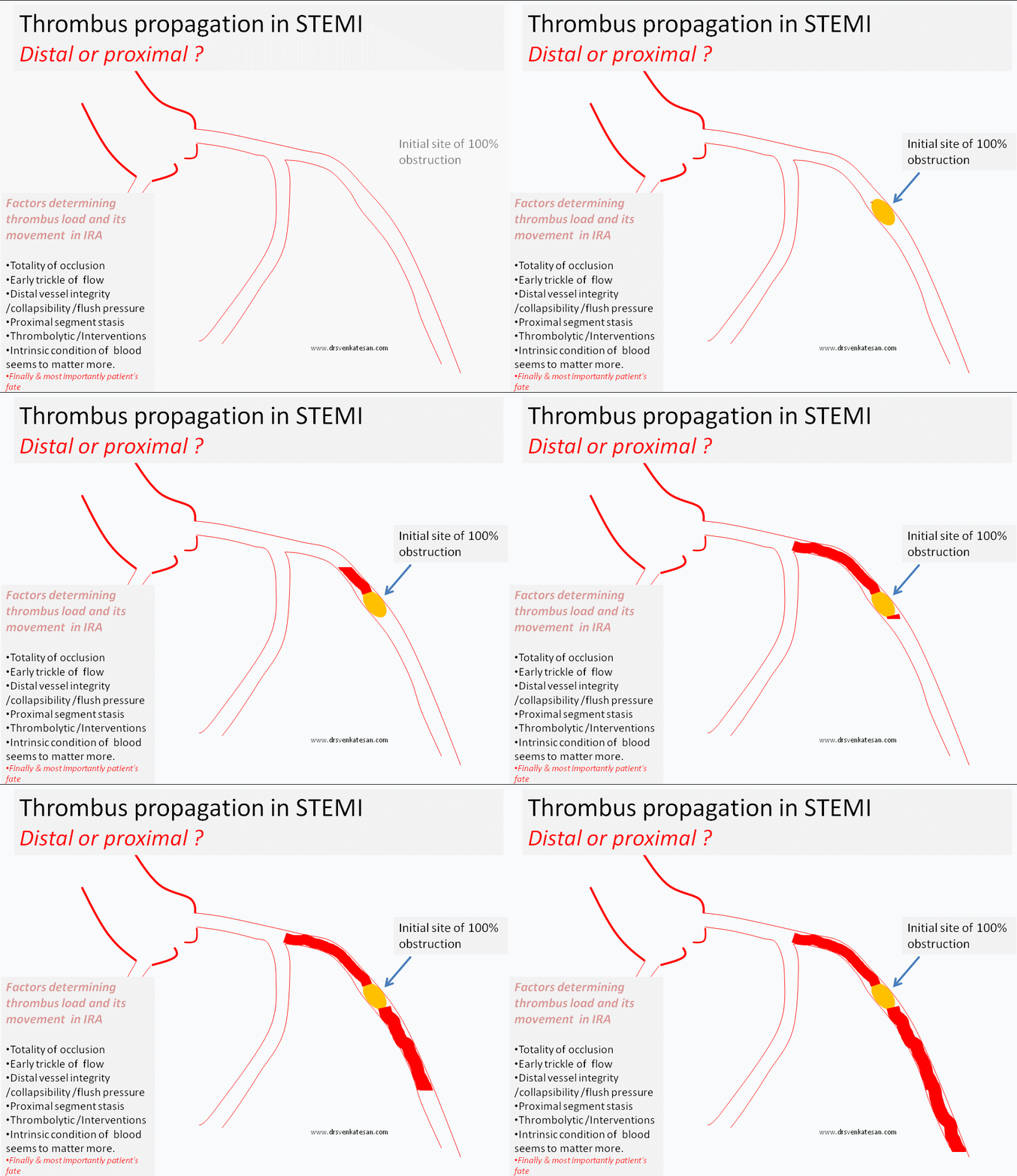
Thrombus formed over the culprit lesion can follow any of the following course

  •  Can remain static
  •  Get lysed by natural or pharmacological means
  •  Progress distally (By fragmentation or by moving en-mass )
  •  Grow proximal and and involve more serious proximal side branch obstruction
  • Organise and become a CTO

Factors determining thrombus migration

The interaction between the hemodynamic  forces that push a thrombus distally and hemo-rheological factors that promote fresh proximal thrombus formation are poorly understood. The altered intra-coronary milieu with a fissured plaque covered by  platelet vs RBC / fibrin core,  totally of obstruction,  reperfusing forces , re-exposure of raw areas and  the distal vessel integrity all matters.

While, logic would tell us,  thrombus more often migrates  distally  assisted by the direction of blood flow, an  opposite concept also seeks attention , ie since the blood flow is sluggish  in the proximal (to obstruction site )more thrombus forms in segments proximal to obstruction.

(In fact, its presumed  in any acute massive proximal LAD STEMI , it takes hardly few minutes for the thrombus to  queue up proximaly and  clog the bifurcation and spill over to LCX or even reach left main and result in instant mechanical death.)

What is the significance of length and longitudinal resistance of the thrombotic segment in STEMI ?

If thrombus is the culprit let us get rid of it , this concept looks nice on paper , but still  we don’t  know why thrombus aspiration in STEMI is not consistently useful. We also know little about  the length of the thrombotic  segment .When a guide wire is passed over a STEMI ATO it may cross smoothly like  “cutting a slice of  butter” in some , while in few we struggle and  end up with severe no-reflow inspite of great efforts .Why ?

What is the Impact of distal collateral flow in flushing fresh thrombus ?

The efficacy of collateral flow in salvaging myocardium is underestimated. Distal vessel flow if perfused partially by acute collaterals the thrombus load is not only less it’s soft and fail to get organised early that would help cross the lesion easily.

Answer  : I guess all mechanisms  contribute.Though E appears unlikely,  its backed by evidence (Ref 5)

Balloon pericardiotomy is done as a drainage procedure in recurrent pericardial effusion. It is actually a replication of surgical pericardial window by Interventional cardiologist.The window not only drains the effusion , it also act as a continuous drain. Though the  benefits are real (Pericardial fluid is shunted away from the pericardial space)  the exact mechanism of its benefit is not clear .

By concept , the catheter and  balloon should not cross the pleural space , (As pneumothorax may ensue) but still pleural effusion is a common consequence of this procedure .How is this possible ? One probable explanation is, the pleural space has some hidden communication with pericardial space .The other possibility is that, balloon creates virtual tissue channels  in the para-cardiac spaces of mediastinum .The extra-cardiac lymphatics does the drainage job without true shunting  pericardial space into the pleural space..

There is an article  from Annals of thoracic surgery which specifically   looked  into the  mechanism of benefit of  surgical pericardial window and came to a surprise conclusion, ie, it is not the continuous  drainage that keeps the space dry , rather it is likely the window  somehow obliterates the pericardial space permanently.(Sugimoto 1990,Annals of thoracic surgery )

Future  Innovation  : A technical add-on to  balloon pericarditomy  could be , delivering a covered stent across the pericardial space  into  peritoneal space like a VP shunt done by  Neurosurgeons.(If no body has done this , Can I claim the patency  for this  !)

The procedure


percutaneous balloon pericarditomy

Image used from Daniel A. Jones & Ajay K. Jain, Journal of thoracic Oncology , 2011

Risk of procedure

The procedure carries a definite risk especially  if done in an  emergency fashion. The aim of  procedure is two fold one to drain pericardial effusion second to prevent recurrence of effusion  .Since procedure carries  considerable risk  its to be performed  only in malignant effusion that are documented to be recurrent.

Surgical vs Balloon window  and other alternatives

Surgical window  creation is well known procedure , ever since Palacios (Ref 1) in 1991 described this per cutaneous approach as an alternative to surgery has become less popular. The risk of anesthesia and co-morbidity makes balloon pericardiotomy attractive. But surgical window creation still may have a role. A video  assisted pericardiotomy by thoracoscopy is also possible .Another option is injecting sclerosing agents into pericardial space .This time tested simple modality probably requires  more attention.

Need for subsequent pleural tapping

It should be realised this procedure may just  shift the  fluid from pericardium to pleural space. Some of them become significant effusion that requires pleural space drainage.

Concern of risk of dissemination of malignancy

Its a real issue , there has been instances of accelerated death after the procedure. Hence this procedure is a trade-of  between patient comfort and quality of life with a  potential risk of dissemination impacting  the longevity of life .

1.Palacios IF, Tuzcu EM, Ziskind AA, Younger J, Block PC. Percoutaneous balloon pericardial window for patients with malignant pericardial effusion and tamponade. Cathet Cardiovasc Diagn 1991: 22;244-249.

5.


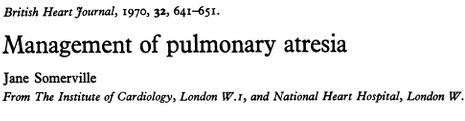
The field of cardiology has seen great men over the centuries. Few women have permanently stamped their presence  in that history .Jane Somerville can be termed mother of pediatric cardiology along with Maude Abbott She has a fascinating life history , having  worked  in Royal Brompton  , Imperial  and Guys London.She was mentored  by  pioneers like  Paul wood , Blalock and others .She is primarily interested in the pediatric cardiology especially congenital heart surgeries .The classification  of pulmonary atresia with VSD  goes with her name.

jane somerville

Dr. Jane Somerville : British cardiologist , (b-1933 )

She carries the credit  of  starting  the Pediatric cardiology world congress in 1990 ,is the founder of GUCH (Grown up children with congenital heart disease.) .

Here is a rare  interview  from he  to Dr Robert Califf  for Heart.org. For  those,who like to  have a glimpse of  cardiology in its vintage  times , don’t miss it.Dr Jane addresses the past treasures , explores specific issues of facing pediatric cardiology  and frank expression about the issues of women being a cardiologist  in a man’s world.


She has a foundation in her name that helps the children and adults with congenital heart disease.

somerville foundation

Reference

The landmark paper in BHJ 1970

pulmonary atresia


Men are from Mars , and Women are from Venus ” . . . Do you agree ?

Many probably witness the much talked differential behavior among the gender every day. Its argued , men take more risk in life ( often senseless !) , some go to the extreme to suggest Men are Idiots and decorate them with a provocative title MIT (Men Idiot Theory ) (Mcpherson 2011).Risk taking is important in life, but at what cost ? Does women (Who are caring by nature ) help themselves and the society by less risk taking behavior ?

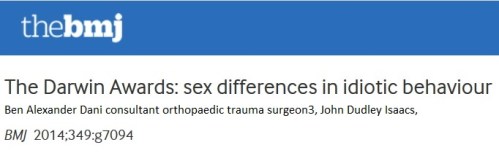
I stumbled upon this rare piece of writing from BMJ which would demand in depth analysis into this gender phenomenon based on evolutionary biology and genetics.

This article concludes, Yes, men . . . indeed tend to take some foolish risks in various life situations that result in potential harm.

Gender difference in medical outcome men are from mars women venus male idiotic theory darwin theory

What is the influence of MIT on medical profession and patient outcome ?

Now , Iam compelled to ask a hypothetical question .Does women medical professionals take less aggressive stance and low risk taking behavior ?

If it’s true, It may have some striking advantage too.

Reference

1.Harris CR, Jenkins M, Glaser D. Gender differences in risk assessment: why do women take fewer risks than men? Judgm Decis Mak2006;1(1): p. 48-63.

2.Eckel CC, Grossman PJ. Men, women and risk aversion: experimental evidence. In: Plott CR, Smith VL, eds. Handbook of experimental economics results. Vol 1. North-Holland, 2008:1061-73.

3.McPherson J. Women are from Venus, men are idiots. Andrews McMeel, 2011

4.Northcutt W. The Darwin Awards: The official Darwin Awards: 180 bizarre true stories of how dumb humans have met their maker. Orion, 2004.

Dizzines , giddiness , light headedness , fear of fall or true fall (Syncope) are the  most common symptoms beyond middle  age .They usually end up with consulting physicians , neurologists and cardiologists .Cervical disc is commonly blamed for this.While all these symptoms can be a manifestation of cervical disc , true syncope seems to be rare with cervical spinal disorder.

how common is suncope in cervical spondylosis Why true is  syncope rare with  cervical spinal narrowing ?

There is a fundamental ignorance here. We are not yet clear  whether giddiness /dizziness is neural or vascular .(Or combinations of both ) in cervical spinal disease.

Many of the patients experience momentary unsteadiness and feel like falling but very rarely end up in a fall or syncope.By definition syncope requires global transient hypoperfusion of brain to trigger a fall .

Cervical canal carries only the vertebral artery .Both internal carotids are no where near the spine. So, however severe the vascular compromise within the cervical canal , syncope is unlikely as anterior cerebral circulation compensates at the level of circle of Willis. Is that the correct way of reasoning ? Unilateral vertebral compromise rarely matters as other side takes care.It is very unlikely both vertebral artery get compromised by cervical spinal spurs simultaneously.

How many seconds of vascular compromise is  required to produce syncope ?

Brain seems to be a funny and sensitive organ .In erect posture it is very sensitive. It reacts  in a  fraction of time for any transient reduction of blood flow.The same cardiac events which can cause symptoms of impending syncope in erect posture is quiet comfortably tackled in recumbent posture .

In erect posture , blood pressure need to much higher to get it pumped above the heart against the gravity. Though , it seems absolute blood pressure and cerebral perfusion that matters, there is something more we are missing.  The brain-stem -vestibular system perceives differently when a recumbent person develop cerebral ischemia than when he is erect . The reflex circuit that activates on/off switch  for abrubt loss  generalised muscular tone is not yet been identified .

It is a biologically  heartening irony that syncope is a natural counter mechanism by which  the organism assumes instant recumbent position to maintain perfusion of brain .A fall promptly does this.(Ofcourse with a risk of Injury )

We think more than 3 second pause will initiate a  syncope circuit .But it is not a fixed number. Some can tolerate up to 5sec or even more especially in lying posture.

Final message

Syncope , as such in isolated cervical spondylosis is rare even though it can potentially interfere with  the vertebro basilar system .Why the vascular compromise almost always fall short of syncope and end up with just momentry unsteadiness is not clear.

Further queries to be addressed

Is dizziness, giddiness , presyncope  are vascular or neural  event?

Can vertigo occur with cervival spine disease ?

Every time , patients ask me  what diet he or she  should follow , Iam sort of  amused , as my understanding of diet and cardio vascular disease is at best primitive.I used  go with a standard single phrase  advice “Anything in moderate should be okay  “
What about going for a saturday night party doctor? One of  my shrewd looking  patient who was recently double stented with DES , asked.
Human body is a biological marvel.While medical professional divide it  into various systems  for our convenience. God doesn’t  think that way .He has no systems in mind when the body was designed . There is no wonder , the alimentary system and hematological system has to interact on a daily basis  with the help of circulatory system  to keep the  body alive. Platelets are unique blood cells that exist primarily to plug physiological bleeding if any  or for self-healing at sites of tissue injury.
 platelet lipid ldl tgl triglyceride ineraction 002
With human vascular system increasingly invaded by various metals and wires , platelet are a confused lot since their original biological functions are altered. They simply don’t know whether  fight these foreign body , aggregate over it , flush or simply pass over these .Adding to this  the powerful anti-platelet drugs targeting critical functional pathways .No wonder every other cardiovascular  patient  consumes at least one anti-platelet drug.
It seems diet  can have direct influence of platelet function
With human beings desire to add style to food consumption and eating habits  competing with  top slot of purpose of living , we often forget it is same prevent us from living a good life.
There has been numerous anecdotal and study population and experience  acute coronary events are more common after a heavy meal especially a fatty one .The immediate suspect has been high triglyceride and chilomicrons in blood stream shunted  intestines .
It is logical to expect , these high TGLs some how act a s trigger for pro-coagulant trigger .With the core thrombus  rich platelets it is assumed platelet stickiness is augmented and  maintained  by transient raise in triglyceride formation(Reference 1,4,5)
Glycerol component of  TGL is know for  its sickness and  making the companions wet.
The million dolor question is , at what level of TGL and which forms of TGL make the platelet cry and attract each other ?
Diet, anti platelet drug efficacy  ?
 Now , patients with coronary stents has to live at the mercy of these anti-platelet drugs. The drug resistance(Clopidgrel) is  threatening to be major issue.Like warfarin do we have real issue of dietary binge and acute neutralisation  of anti-platelet drug efficacy that can trigger acute stent thrombosis . This is potentially  important  area of study .
Final message
So does a fatty meal  a new trigger for ACS ? It may sound an alarmist statement .but as of now , its difficult to ignore this.So my advice for that  the that smart young man with soluble stent  was to avoid binge dinners that carries a definite risk of interfering with  stent maintenance .
Reference

What are the mechanisms of cyanosis in  cyanotic heart disease ?

Most of my fellows have difficulty in answering this question. (It is not the lack of knowledge though !)  In my view ,cyanosis can occur , by six  different  modes

  1. Reduced pulmonary blood flow  with some form of anatomical obstruction in RVOT with a communication between ventricles  (TOF physiology  ) , atria or both
  2. Reduced pulmonary flow with obstructive pulmonary vasculature (Eisenmenger physiology )
  3. Wrong way origin ( RV to Aorta/LV to Pulmonary artery ) : Transposition physiology
  4. Simple mixing of arterial  and venous  blood channels within the atria  ,ventricle or great vessel  without RVOT obstruction .This, in fact can causes increased  pulmonary blood flow (Technically left to right shunt ) and still there is cyanosis (These are called as Admixture lesions ) It is  also to be noted some of the admixture lesions  (Truncus, DORV,etc ) the mixing takes place only during systole  , while TAPVC,Common atrium, Tricuspid atresia*  admixture is more complete as it happens during  entire cardiac cycle.
  5. Isolated Right to left  shunt are  very rare ( Pulmonary AV fistula , SVC to LA )
  6. Complex combination of first 4 (Like bi-directional shunting , TGA combines ,  AV canal defect , with varying degree of pulmonary obstructive disease) Note : TOF and Eisenmenger are physiologically mimic each other , the  only difference is site of resistance to pulmonary flow. RVOT vs Lung vasculature )

* Essentially Atrial admixture is more complete than when it happens at ventricular or great vessel level

For advanced readers only

Now, is it possible for “Net” left to right shunt to  result in cyanosis ?

Yes*.Very much possible. The bulk of this group is referred to as admixture lesions with certain caveats.There should be an obligatory mixing without contribution from RVOT obstruction or raised PVR( *Please note theoretically  admixture can either be right to left  or  left to right shunt )

All pure admixture lesions are in fact net left to right shunts. (TAPVC, Single ventricle , Common atrium , Common AV canal ,Truncus, ) This is the group we have been traditionally calling cyanosis with increased pulmonary flow.

Its may also to be noted with  surprise some admixture lesions often  has less intense cyanosis than other forms as long as pulmonary blood flow is normal and the lung does its job perfectly .

*Please note Isolated classical left to right shunts , ASD, VSD, PDA can never cause significant cyanosis unless there is reversal of flow .However ,many Eisenmenger physiology  show net Left to right shunting only ( 1.2-1.5 : 1 or so ) but with a definite right to left component .What we call as typically bi-directional shunt .

How can cyanosis be minimal even in some cases of single ventricle ?

  • Even though there is single ventricle , there can be preferential (favorable)  streaming of right heart blood flow without gross mixing .
  • As discussed before good uninterrupted pulmonary blood flow will make the cyanosis less intense .

Is single ventricle with PS  admixture lesion or TOF physiology ?

Though single ventricle in isolation is an admixture lesion, when it has associated RVOT obstruction it ceases  to be admixture by definition  as mixing is augmented by the obstruction rather than by simple mixing.The complexity could be understood in certain situations  where admixture lesions  like common AV canal  go for raised PVR .Here the various quantum of contribution to cyanosis is mind boggling. (Original admixture, augmented by RVOT resistance, differential mixing at atrial and ventricular level  , hypoxia  at lung level due micro pulmonary AV fistulas in grade 4 heath Edwards etc )

Role of streaming in Admixture lesions

Streaming is selective flow of  venous blood into PA and arterial blood into Aorta even in the presence of  large septal defects. Favorable streaming implies good systemic saturation. Unfavorable streaming would mean PA saturation more than aorta.(It should be noted streaming and good admixture don’t go together. If good admixture has happened there can’t be any streaming and vice versa)

Streaming is common in which situations?

Inspite of absence of IVS, streaming has been noted in some cases of single ventricle with minimal cyanosis with good saturation in Aorta.

Streaming in TAPVC has some unique features.

Fetal circulation has certain preformed pathways. IVC blood deflects to LA through ASD/PFO .SVC blood preferentially enter RV-PA. In Infradiaphragmatic TAPVC where it  drains into IVC  highly saturated PV blood may stream  into LA  thorough ASD and reach LV nd result in  higher Aortic saturation.(This is in contrast the  classical type of TAPVC draining into RA  with little favorable streaming and hence  O2 saturation equilibrates between PA/Aorta.)

In Supra cardiac TAPVC that drains into SVC or coronary sinus  the streaming is unfavorable as it may preferentially cross tricuspid valve and enter PA making the saturation  higher than Aorta.

Streaming is less common in which lesions ?

In common atrium and TAPVC draining into  RA  streaming is less common.In tricuspid atresia streaming is almost impossible as TV is non existent and this ensures complete mixing in the atria and hence cyanosis is likely to be severe.

Can TOF behave  like an admixture lesions ?

Technically yes.If the RVOT obstruction is minimal ,(What was called then as pink Fallot ) We haven’t  understood this entity properly for so long. Atleast  I was baffled to read when J.K Perloff mentioned in his book  during my DM fellowship days, that TOF can manifest  with predominant left to right shunt with little or absent cyanosis.

The  aortic override in TOF facilitated by large malaligned VSD make it a sort of admixture  situation as  RVOT resistance is too little to offer any resistance, (rather it welcomes more blood from left side ! ) So , should we call it simple VSD physiology , admixture physiology or  just acyanotic forms of TOF ?)

Key points

Though admixure lesions are discussed separately , bulk of them  actually represent cyanosis with increased pulmonary blood flow situations.

The  net pulmonary blood flow is much more important than the quantum  of admixture in determining the degree cyanosis

Finally , one should appreciate  there can be combination admixture lesions with obstructive RVOT components . (Tricupid atresia+Pulmonary stenois )

Further reading

An excellent review article on this rare topic of  admixture physiology

  1. Jaganmohan A Tharakan Admixture lesions in congenital cyanotic heart disease Ann Pediatr Cardiol. 2011 Jan-Jun; 4(1): 53–59.
 

Metformin is one of most commonly used oral hypoglycemic drug listed by WHO as an essential anti diabetic drug. .It is a biguanide  which  blocks the hepatic gluoneogenesis . Since lactate is the major substrate for the process of gluco-neogenesis , excess of which  spills into blood .Lactate is swiftly cleared by the normally functioning  kidneys .Metformin is completely excreted by the kidney. Hence in patients  with compromised renal function (or when  contrast agents compete with Metformin in renal excretion ) high levels would not only cause lactic acidosis (> 5meq), it can also aggravate contrast induced renal injury resulting in a downward hepato -reno-metabolic spiral.

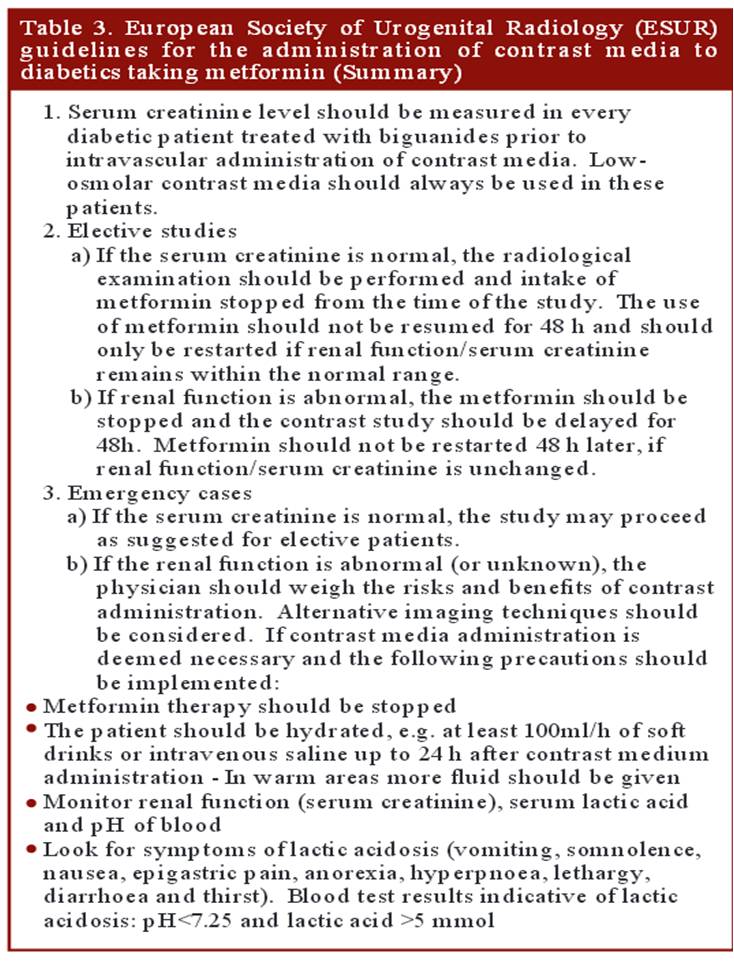
Though the incidence of Metformin induced Lactic acidoss  is low , the outcome can be bad , hence the concern. The European society of urogenital radiology  has provided clear cut guidelines regarding Metformin usage when contrast agents are being used.

metformin and contrast induced nephropathy guidelines cin european

What can be done in emergency situations 

  • Since the risk  of  lactic acidosis is very low , in case of emergency situations Metformin need not be discontinued prior to contrast usage.However it need to be stopped for 48 hours from the index procedure. (Fortunately Metformin is a dialysible drug that can be removed in case of toxic accumulation.)
  • Consider alternate mode of Imaging if renal function is really concerning


Reference

1.Pre admission metformin use and mortality among intensive care patients with diabetes: a cohort study.Christiansen C, Johansen M, Christensen SCrit Care. 2013 Sep 9;17(5):R192. doi: 10.1186/cc12886

2. http://ccforum.com/content/pdf/cc12886.pdf

contrast nephropathy

A good  article  from drug review Contrast induced nephropathy and metformin


Wall motion defect , in patients after CABG is fairly common.These  defects are difficult  to interpret  as the mechanisms can be multiple.Though the commonest wall motion defect appears to  involve the interventricular septum. it can occur anywhere in antero-lateral zone.

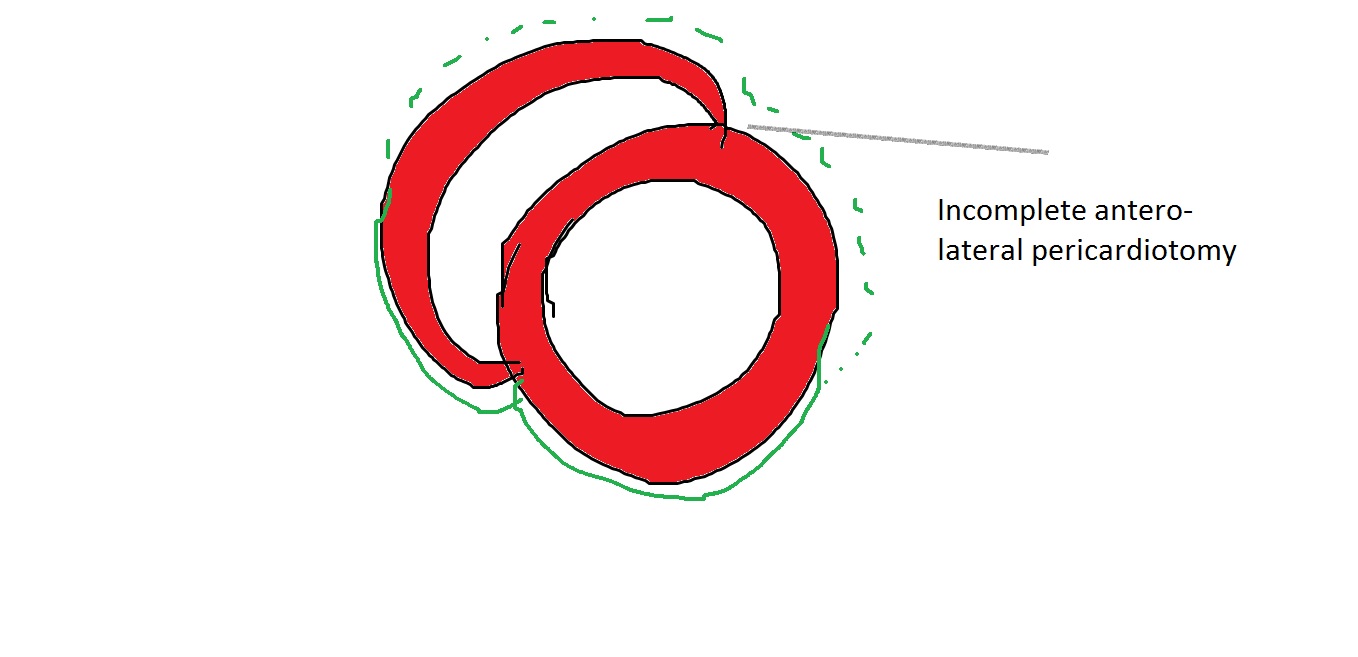
The mechanism attributed is  the effect of pericardiotomy , which surgeons as we understand leave it open after grafting  .This can cause lack of localised ventricular interdependence and results in a a brisk septal movement (bounce )It is an indirect effect .

post cabg wall motion defect

Note the, wall motion defects are confined to the exposed areas of the heart during cardiac surgery .In short axis echocardiography it correlates anywhere between 9 to 3 O clock position. Though interventricular septum is not covered by pericardium in the true sense , there is a indirect bounce effect over IVS due to interference with anterior ventricular interdependence .

More commonly a direct wall motion defect in the 12 to 3 O clock position in short axis is seen .This can closely mimic true wall motion defect as pericardial adhesions can tether these segments. Careful observation is warranted.Myocardial thickening is the key differentiating feature.

What is the physiological impact of these wall motion defects ?

It is generally considered benign (It is !) .Though in echo it looks awkward and suggest desynchrony. The real issue is , it can  mislead the echocardiographer to errors in calculation of that universally  sacred parameter called EF %

Importance of  knowing pre existing wall motion defect.

This has to be reviewed with old reports as it can wrongly create a new wall motion defect de-crediting the surgeons.

New pathological wall motion defect.

Of course it can happen due to peri-operative ischemic insult or infarct . However , It need to emphasised transient wall motion defects are common post CABG due to apparent hypoxia.This seems to be more pronounced with on pump surgeries than off pump .(Expected though) In my opinion, 2-4 weeks cooling off period is required before  a meaningful assessment of  wall motion post CABG.

Late pericardial reactions and localised constrictive features has been reported.

Disappearance of wall motion defect : How  common ?

Any disappearance of WMA is welcome . It happens rarely though . Some of the post ACS population (Both STEMI and UA/NSTEMI) can experience this ,  as they could harbor  zones of myocardial segments afflicted by  ischemic stunning rather than true  necrosis , that might  disappear.