Feeds:
Posts
Comments

DAPT -Dual anti-platelet therapy has become  a standard in many clinical situations of CAD.There has been significant confusion about ,Indications, best combination, duration of DAPT, withholding of DAPT, conversion to MAPT (mono) etc.The  JACC september 2016 issue  brings much needed clarity  on this issue.

Link to key summary from NEJM journal watch.

http://www.jwatch.org/na42407/2016/09/28/update-dual-antiplatelet-therapy-patients-with-coronary?

Full text guideline

How do you evaluate the success of thrombolysis or primary PCI  ?

If you say its coronary angiogram and the final snapshot  of  TIMI flow , you need to read further. If you thought its actually the quantum of ECG ST regression . . . great ,  you can exit this page  with credits.

CAG  may not be the gold standard in defining PCI success , it just tells you whether IRA is patent or not .Instead , the good old ECG tells you about whether  the myocardium is successfully reperfused or not .  TIMI flows are simply not good enough to identify  adequacy of  myocardial reperfusion .

By the way ,  who is telling this  ?

knowledge-2

It appears there is only a  narrow gap between Ignorance and Knowledge !

That’s what the simple message I got  from this landmark study  published in year the 2000 in JACC by Shah.A in the thrombolytic era.The Importance of this paper  has far reaching consequences (If and only if we are  willing to accept and  understand  the concept and apply  as a whole in PCI era )

While success of thrombolysis is faith fully subjected to  the acid tests  of myocardial perfusion , primary PCI is rarely ever assessed in terms of  ST segment regression.

What is the next logical step this study should lead  us to ?  

I think I am not provocating  , . . How to  get rid of the prevailing practice of jacking up the success rate of primary PCI  ? ( Conveniently,  Ignoring the echo detected significant LV dysfunction on follow up ) Mind you, this has resulted in  creating a new crop of patient sub group called  “Angiographic success and myocardial failure”

Reference.

Dear colleagues , please go thorough this article . Its from the thought leaders , Duke University ,North Carolina. I would argue the cardiology fellows to discuss this paper in detail in their  journal club as “classic paper”  till they  completely understand the conclusion .Though its  done with GUSTO 1 data  in primarily  lytic population,  its  conclusions are very much valid as an assessment tool  in reperfusion by any means.I am afraid, even 16  years after this paper  got published ,the truth has not penetrated to the targeted population within the cardiology community.

Prognostic implications of TIMI flow grade in the infarct related artery compared with continuous 12-lead ST-segment resolution analysis. Reexamining the “gold standard” for myocardial reperfusion assessment. Shah A1, Wagner GS, Granger CB, J Am Coll Cardiol. 2000 Mar 1;35(3):666-72.

Bedside wisdom

We have been  using unfractioned Heparin for long , and its  is better than any other anticoagulants  in ACS . . . 

Our observation shows that Streptokinase has distinct advanatge over Tenektepelase as it works longer duration  . . .

My experience  says Diuretic and beta blockers  are still good as first line therapy for Hypertension  . . .

Mind you , there are infinite  number of such wisdom in every sub specialty of medical field.

However , the typical response from any  modern scientific intellect would be . . .

Stop it . . . Its old  stuff folk  , What does the current data say ?

medical-data-ethics-futility

Common uttering  in scientific forums,

Is there data backing up your  treatment modality ?

Is there sufficient data ?

Come’on , grow up , don’t talk about experience in a scientific forum . . . come out with data man !

No one seem to care the quality of the data . Every one bothers  about the quality of the Author and Journal instead  .  if its X Y Z its ok If its A B C no its not acceptable data.

Probably , Data is most misused word in medical science.

In scientific world,  “unpublished sense” goes straightway to  dustbin ,while we have so many avenues for the  published nonsense to  be celebrated (Still, bulk of guidelines in cardiology is backed up by Level C evidence which means experience  of experts !)

By the way what do we mean by data ?

Its organised collection of genuine scientific information , that’s post processed ,  follow it up with sound inference and faithful questioning and debate that should ultimately end up as  “clinical  application” in patient domain for consumption.(No prizes for guessing , whats happening in real world !)

OMG, give us back that elusive Common sense . . . which  I  think we  lost some time  at the turn of this millennium  !

Wrong or useless data : Who will recall ?

Once applied to patient , these data is  to be scrutinized and monitored . If we find a study conclusion  and reality does not match , we  need to stall the data from adversely  exploding .Every stake holder should have the power to do it. There have been instances a treatment modality got banished in one country is legally permitted in other country knowing fully well the futility.

Final message 

Modern scientific Data* is not God sent. Its  created , synthesised and disseminated in various mind factories. All you require is , backing up with some pioneering journal publication with huge impact factor.It’s not really blasphemy to question things which doesn’t make sense .Unfortunately , wrong data can be tackled only with further data .(There is no other means I guess !)

When does “good common sense”  become hard data and evidence ?

Its the act of publication , so  please guys whenever you  find some contamination  in so-called scientific data  please post here.  To begin with I am registering a new Journal  “Commonsense journal in cardiology”

*Please note, data is not a bad word as this write-up  seem to suggest.Naturally occurring , epidemiological and  observational data about diseases are the foundations for medical science .The issue become murky when few motivated humans play brutal  games at the sensitive  interface between science and truth.

It should be acknowledged , there is a distinct risk  of  this fight against falsehood end up in blocking  true progress  of science . Still , Homo sapiens  are (believed to be !)  intelligent enough to differentiate good from bad , that’s the reason God gave us the sixth sense !

Link to Lown Institute (Started by Cardiologist and Nobel peace prize  Laurate Dr Lown who strives hard to pursue this goal)

Further reading :  Scientific Reversals in cardiology 

Hey , What’s that moving object over  AML ?  It looks odd,  it doesn’t look like a thrombus or a vegetation.

Yes, I agree , its moving  independently  but  I think , Its benign threads of fibrin attached to the valve .They are called as valvular strands.

Is it ?, I haven’t heard about it !  Can you please  tell me something about it.


Strands are  highly mobile, fine, filiform  threadlike excrescences that is seen arising from valvular structures. Synonym : Its same as Lambl’s excresceneces , the Czech physician who described  it over Aortic valve in 1860.

The following TEE clip shows strands attached to Aortic valve

Incidence

Reported Incidence of valvular strands  varies .Some reports suggested it may be up to 5-10 % .( SPARC study Mayo clinic 1999 its staggering 46 % !)The reason for  such high incidence  is,   many of us are still not clear what we refer to as strand.The imaging modality also has a say. With improving resolution of TTE and liberal TEE use more  strands are detected .A recent large study from Israel , suggest a good news , in large population based study (21,000) true strands are  observed in  just around  1 %.(Marina Leitman 2014 )

Is it Physiological or Pathological ?

The valve closure lines are physiologically stressed , some amount of denudation of endothelium is expected .This leads to a thrombus formation along with the exposed mucopolysacchride  layers of the valve form a filiform ,filamentous structure. .To call it physiological or pathological is left to our wisdom and  perception. The size however matters. It could be  the reason behind many  unexplained strokes.

What is the natural history of these strands ?

Its difficult to believe It may persist for lifetime.If its truely fibrinous strands it may have a life cycle and disappear.

Size

Should be less than 1 mm.

Length varies between  3 mm to 5 mm

Location 

Can be seen in any valve or even in aortic root.

Attachment : Atrial side of mitral valve and ventricular side of Aortic valve.

Strands over prosthetic valve is also reported.

Clinical significance 

It has three common issues.

One: Getting confused with other more pathological entities.

Two : Risk of stroke.

Three: Nidus for normal native valve endocarditis ?

Strands may closely mimic 

  • Vegetations
  • Bland thrombus
  • Redundant leaflet /Chrodae (Marfan and variants)
  • Disrupted chordae (After MVR)
  • Flail leaflet
  • Fibroelastomas

Risk of dislodgement and  stroke 

These strands are minute. It seems plausible dislodgement need not necessarily result in stroke or other organ ischemia.We don’t know whether it gets dissolved on transit.However the risk of stroke is increased in most reports except few studies(Roldan).

Management

First question to ask is , Should we inform our patients about  these ubiquitous accessory valve  tissues if detected incidentally ?

Largely benign and can be ignored in most.A follow up echo may be adviced once in a year or 2. (I have one anxious patient  after I reported such strands in Marfan syndrome )

In patients who has h/o stroke presence of these strands gains importance and  is an indication for anticoagulation.

Surgical excision of large strand is a dramatic option and is rarely performed.

Queries with no answers 

Is it accessory valvular (mesenchymal) tissue ?

Does Atheromatous plaque contribute to these strands in Aortic valve ?

Strands , if  disappears  by natural means , do they regrow from the same spot of raw surface  ?

Final message 

Fibrous strands detected  over the valves by routine echo are uncommon .However , It may give considerable  anxiety if  documented and reported to our patients and physicians .Though these have negligible clinical significance , the risk of stroke is increased in those with large strands.

Reference

Links

Great men dream , but they just do not sit idle. They do what they are passionate about .History just follows them or they create it.Here is a brief story of an ordinary man born in a small European country Lithuania in 1921  ,lived much of his  life in the east coast of USA ,transformed into a brilliant cardiologist  based in Brigham Hospital , Boston.

He is Dr Bernard Lown , best known as a founder of what is used in every coronary care unit and cardiac surgical theaters around the world . Yes, the DC cardioversion was invented by Lown in the year 1961.(Of course,  it was an Improvement  upon the  pioneering work of Zoll’s AC power line  for defibrillating   the heart  which was impractical and caused much injury )


drlown_history

Dr.Bernard Lown (Born 1921) ,With his Invention of DC Cardioversion machine Currently  working in  Harvard University


He was also the brain behind the  conversion of local anesthetic agent Lignocaine to cardiac anesthetic  which revolutionized the treatment of ventricular arrhythmia.(What a simple  but a path breaking  idea to use membrane stabilising action of local anesthesia to sedate the heart when it behaves erratically !)

We can also credit him for  rediscovering  Digoxin and found the secret that potassium supplementation can largely overcome  toxicity of this drug which was otherwise lifesaving in dilated , failing hearts  running amok with delirium tremors (Surname for Atrial fibillation in those days !)

While the Invention  of DC cardioversion had  a dramatic impact all over  world , he simultaneously popularized the concept of coronary care units along with Julian in London and Dr Day in Kansas city.

Its said great men’s mind  are perennially restless.Accordingly ,he was worried about the impending nuclear war with USSR and other global powers then. He collaborated with Russian cardiologist Dr. Eugene Chazov. It became a hugely popular peace organisation  International Physicians for the Prevention of Nuclear War (IPPN) for which he got ultimately the Noble prize for  in 1985.


bernard-lown-dc-cardioversion-lown-institute

During one of his Noble lectures (Linked to video)


It turned out to be “lovely Irony” for a man who probably should have got a Nobel prize for medicine for inventing DC cardioversion ,  ended up with Nobel peace prize for  his fight against a man made disease called  “Nuclear proliferation”.

Its heartening to note he has visited my country(India)  and was  awarded with Mahatma Gandhi peace prize  as well.He is now 95, active in Harvard   currently turned his vision towards eradicating Inappropriate medical treatment from the noble profession .I wonder , for a man who fought against a  nuclear war, what does this new Initiative mean ? Does he equate the medical profession in its current form and the direction in which travels to something that’s  grossly unacceptable ?

Whatever it is , I humbly endorse his views and has since dragged me to  his Institute.

lown-image

I just joined the institute and signed  a declaration . I wish every physician who take oath on Hippocrates should strengthen Dr Lown’s Doctrine .

Reference 

Link to Wikipedia

nobel-prize-in-medicine-cardiology-drsvenkatesan-venkatesan-madras-medical-college

Ventricular tachycardia is a regular wide qrs tachycardia.It can be monomorphic or polymorphic.

General diagnostic  rules In VT  (Gross though, with considerable overlap)

  • Polymorphic VT is more often Ischemic , drug induced, electrolytic, and includes many inherited VTs .Most primary  ischemic VT are polymorphic.
  • Monomorphic VT occurs  more common with structurally abnormal heart.(DCM, HOCM, ARVD etc .Please note late scar induced  VT are often monomorphic , which is also being referred to as Ischemic VT in literature )

*Its important to realise any  VT will transform to polymorphic just prior to degenerating into VF.

Management Issues.

The management of VT in acute setting is same irrespective of morphology of QRS complex.Either you DC shock or administer Amiodarone, Lignocaine , and other reserve drugs.

The issue comes only in stable VTs.In stable VT or if VT recurrence it’s advisable to bother about the ethology and choose a drug.Its believed , Amiodarone is contraindicated in true polymorphic VT that was precipitated by prolonged QT interval or Brugada syndrome.

In Ischemic  VT , lignocaine may be preferable over Amiodarone as the later may prolong the QT interval and VT could recur if the index VT was triggered by ischemia induced prolonged QT and subsequently  gets worsened by the drug Amiodarone.(please note, Lignocaine has neutral or even shorten the QT)

Let me conclude with a controversial observation, many of VT storms  we are witnessing only in the era of Amiodarone.Most episodes of VT Storm are polymorphic and often precipitated after blouses of Amiodarone punctuated with DC shock. With an explicit pro arrhythmic potential of this drug, I strongly believe some of the episodes of VT Storm  is iatrogenic and it tends to disappear as the drug effect of Amiodarone weans off.

Final message

In  monomorphic VTs, drug choice and selection may not be that important , polymorphic it could make a big difference !

Always ask a query  whether the VT you are tackling  (in any setting )is likely to have precipitated by prolonged  Action potential duration (Read as QT Interval ) ? Of course  ,one  can’t get a clear answer to this in bed side .But,  if you have strong reasons to suspect , better to avoid drugs that prolong action potential duration ( Amiodarone comes top in this list, though it can terminate VT of any ethology  with any morphology because it has all 4 group action of Waghaun williams !)

Comments welcome from EP experts ,  still to understand things in perspective.

Brugada syndrome is  probably the most fascinating discovery  in  Inherited cardiac  Ion channel dysfunction that linked the basic sciences to bedside . Its due to genetic defect in SCN gene that results in sodium channel blockade of phase  of action potential  to cause troublesome ventricular tachycardia (Phase 2 reentry ) . Now we realise, there are some phenotypic expressions to this gene defect . RV epicardial anatomical substrates are found to responsible for these Arrhythmias.

So ,does Brugada turn out to be a structural heart disease (At least histological ) ? Where is the evidence coming from ?

Now, we realise  RF ablation of epicardial aspect  of  RVOT / Adjacent anterior RV wall can eliminate Brugada pattern confirming anatomical defect  at cellular level. Our changing perception of Brugada from pure functional to anatomical cause is exciting and  intriguing as well !  ICDs were  the specific therapy so far.This discovery make it RF ablation an option.

The recent data from Brugada himself  was presented in World congress of electrophysiology / European Heart Rhythm Association (EHRA) EUROPACE-CARDIOSTIM 2016 confirming the therapeutic benefit of targeting  the epicardial structural phenotypic substrares (Ref 3 )

Final message

We have been taught  Brugada syndrome is  a primary electrical disease .It was  never considered as structural heart disease. Knowledge evolves slowly, so we shouldn’t conclude prematurely .Shall we conclude , Brugada syndrome is truly a  structural heart disease at least in some ?*. This  makes RF ablation  a new  cure for Brugada ,  making it a useful alternate modality to ICD , Of course there can be an overlap between ARVD and Brugada  syndrome. Mind you RF ablation scores over ICD on any  given day as its potential  cure , while ICD is  just a back up device and it simply wait & watch for the VT to occur.We also know  ICDs are still learning human EP data, and are  not intelligent enough to differentiate true VT from false ones with acceptable error** margin.

* Let the experts decide

**Acceptable ? What  do you mean by that ?

Reference

Questions queued

1.Is Brugada VT monomorphic , polymorphic or both ?

2.Is Amiodarone Indicated in Brugada syndrome ?

.

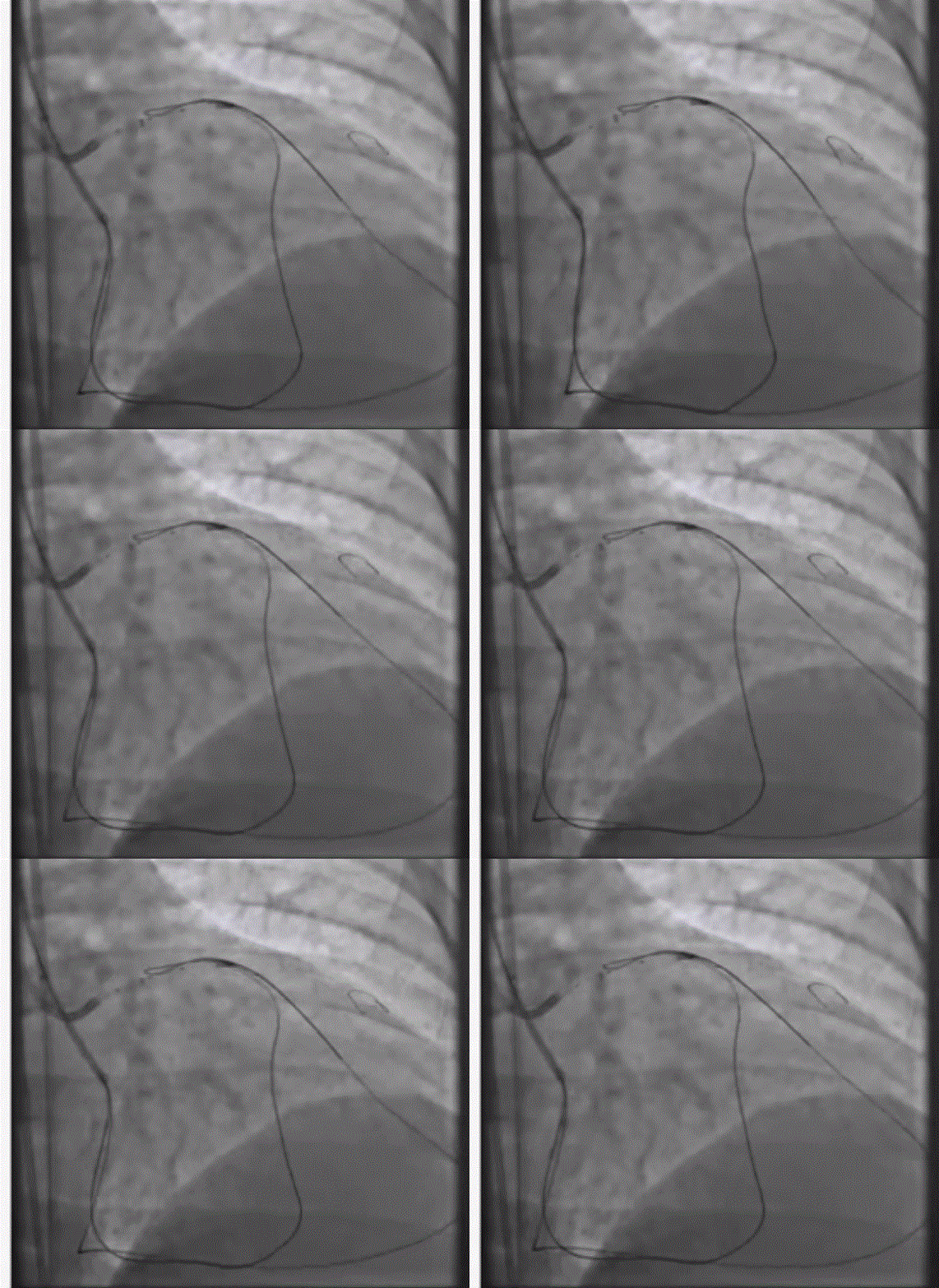
lv apex radiological clinical anatomicallv apex radiological clinical anatomical 002


Read a related article

How do you define apical impulse ?

How do you define apical impulse ?

Its a funny world out there in medical science, more so in the field of cardiology ! A new treatment comes as a revolutionary breakthrough , lives merrily for a while . . . only to blink , few years down the lane . . . and  make a sheepish exit !

Here comes some important knowledge from Rome , European society of cardiology conference 2016 .Its the much expected NORSTENT study from Norway,with a largest number (9013 patients comparing one to one BMS vs DES ) with up to  6 year follow up data ,exposing the limitations and the possible false superiority of DES over bare metal stents .It almost concludes there is no meaningful preference for DES over BMS in obstructive CAD in terms of survival .(ACS included)

medical-ehics-research-inappropriate-interventions-logics-in-medicine-dr-s-venkatesan-einstein-quotes

For over a decade  billions of dollars were drained with a hyped scientific concept of coating the stent with drugs to prevent restenosis . DES , was able to  effectively pull the BMS down and out by statistics. This, in spite of the strong concern of DES, interfering with normal healthy endothelisation of the stented segment which resulted in unexpected sudden DES related thrombosis. The power of commerce is huge , it can  finish of a useful modality,if available cheap.This happens even in a lesser developed country like India.

I guess,the obituary for BMS is already written in most part of the world. (I can vouch for it my city Chennai !) Now that NORSTENT  has come out, though belatedly, I  wonder any company  wants to manufacture BMS in a big way ! Can it infuse a fresh life into BMS which I believe is  surprisingly  sitting alive in it’s  graveyard .

     Baremetal stents where are you ? My patients need you !

Counter  thought and a rebuttal !

Many will say my interpretation of the NORSTENT study is wrong and its a indecent attack on a proven scientific concept of DES which is the only way to reduce restenosis rate.

But , what is the big deal in preventing restenosis,if DES  doesn’t save significant lives ?

The argument that DES reduces repeat revascularisation is largely irrelevant as it amount to only  angiographic gratification and  reduced threshold  for intervention  and ultimately imply inappropriate re-intervention in the BMS group.(Only Clinical restenosis ie symptomatic, flow limiting stenosis   require attention .We need that specific data from  NORSTENT . )

Don’t believe blindly in  whatever is written here .Read for yourself and decide ! The NORSTENT from Norway published in NEJM August 2016 http://www.nejm.org/doi/full/10.1056/NEJMoa1607991

Interventional Cardiologist’s favourite play time is to get rid of of obstructions across any  blood vessel , valve or a conduit . This has been well practiced  for over 2 decades in both coronary and valvular obstruction.Now they wanted more and have since started implanting valves percutaneously. (Aortic valve -TAVR in particular )

Why do balloons work in Mitral stenosis but not in Aortic stenosis ?

It remains a mystery at-least to me ,how  PTMC (Percutaneous mitral commissurotomy ) became a default strategy  for relieving  mitral valve stenosis,  while  BAV (Balloon Aortic valvotomy)  was  never considered good enough for opening  Aortic stenosis.

The reason is,  mitral stenosis(Rheumatic)  primarily involve the commissures, while degenerative aortic stenosis involve leaflets more and calcification is much extensive and hence balloons are less effective .Since the initial reports of BAV had more complication like stroke , AR, the interest has waned (except in children with BCAV ).

The arrival of TAVR in big way has made  things difficult for BAV to prove its real worth   and at best it was considered a bridge therapy.Curiously , BAV is often used as an  integral  part of TAVR as  pre-dilatation with various wires across the valve.Hence , every procedure of TAVR,whether you like it or not carries the  huge risk of BAV (please note,these are the same risk which made it unpopular earlier !)

Now , with accumulating data(Funny we got trained in BAV during TAVR   we have double confirmed BAV is not that risky after all,  even in calcific aortic valve. We also learnt BAV does open up the valve significantly (exact gain contributed by BAV during the TAVR is not quantified as yet).Hence  many believe BAV is grossly underutilized modality .

Final message (As usual , without evidence )

BAV, considered just a  bridge therapy  to TAVR/SVR , (mind you,it may not be flimsy bridge , but a  near permanent  steel bridge that can outsmart the much hyped TAVR!) Let us recall again the mitral valve logic where  you just require dilatation for stenosis .Some  degree of AR during BAV  is acceptable as do we accept MR in PTMC.As I said earlier the perceived complications of BAV has rapidly declined. For those who are interested in health economics , a single patient’s cost of  TAVR  can be shared and  could  confer a fresh bout of life to 20 patients with severe aortic stenosis who can be  tackled well with BAV.

I agree , BAV can not reach the glory of PTMC, but definitely  its going to come back and  expected to give a tough fight to TAVR in atleast high risk patients.BAV has a potential to become a therapy of choice in patients  with critical aortic stenosis with severe LV dysfunction as even a small gain in orifice with a balloon can provide a big  booster effect on LV function.

 A thought and a counter

 BAV is retro technique with  low efficiency and with high complication rate .

However,  isn’t  ironical ,  complications with TAVR  ,which includes 25 % of permanent pacemaker assistance  is accepted .(with a pride ?)  while that of  BAV is magnified and made to look unacceptable.Of course , many have mastered BAV and complications has come down recently .I have heard few anecdotal examples where  TAVR was abandonded for some reason after  pre-dilating the aortic valve and patient doing fine with BAV in the long term.Its  being predicted BAV is going to reemerge (already is !) as a useful strategy in critical calcific Aortic stenosis

The  emprical  utterrings in this discussion  are  dangerous and  unethical  and not evidence based !

It would appear  “not doing” a large  randomised trial comparing one to one  (BAV vs TAVR) in  a real “high risk” setting of AS amounts to ” unethical”  act  as complication with BAV has grossly reduced in recent times ! Its our duty to provide  best or near best to our patients.Let us  ensure reasonable inferiority/Non inferiority  is accepted that  can  prevail over a perceived superior modality , if it comes at low cost !

Further reading

1.

balloon aortic valvuloplasty bav