Timing of AVR and MVR in AR and MR has always elicited huge discussion in cardiology literature. Mind you, if the patient is symptomatic and there is LV dysfunction, it is absolutely easy to make a decision.Here, the question of timing doesn’t arise at all. (Of course, the symptoms and LV dysfunction should be confirmed to arise because of valve disease, not because of any other systemic disease, or LV dysfunction might be due to associated CAD. *I know a women who got her leakinging mitral valve replaced because she developed symptoms of dyspnea due to anemia .
Timing becomes a big issue only in patients with no symptoms at all. Some cardiologists put them on a treadmill. It is controversial, as anyone will develop symptoms. But , somehow, we should make it sure, patients are truly asymptomatic.
For long, we relying on some gospel echo parameters. I don’t how good they are. But , no one really knows,how and when the onset of LV dysfunction would be , and how it will progress. But, we are bound by the guidelines , as on today. There is some critical difference between the echo parameters , based on we intervene.
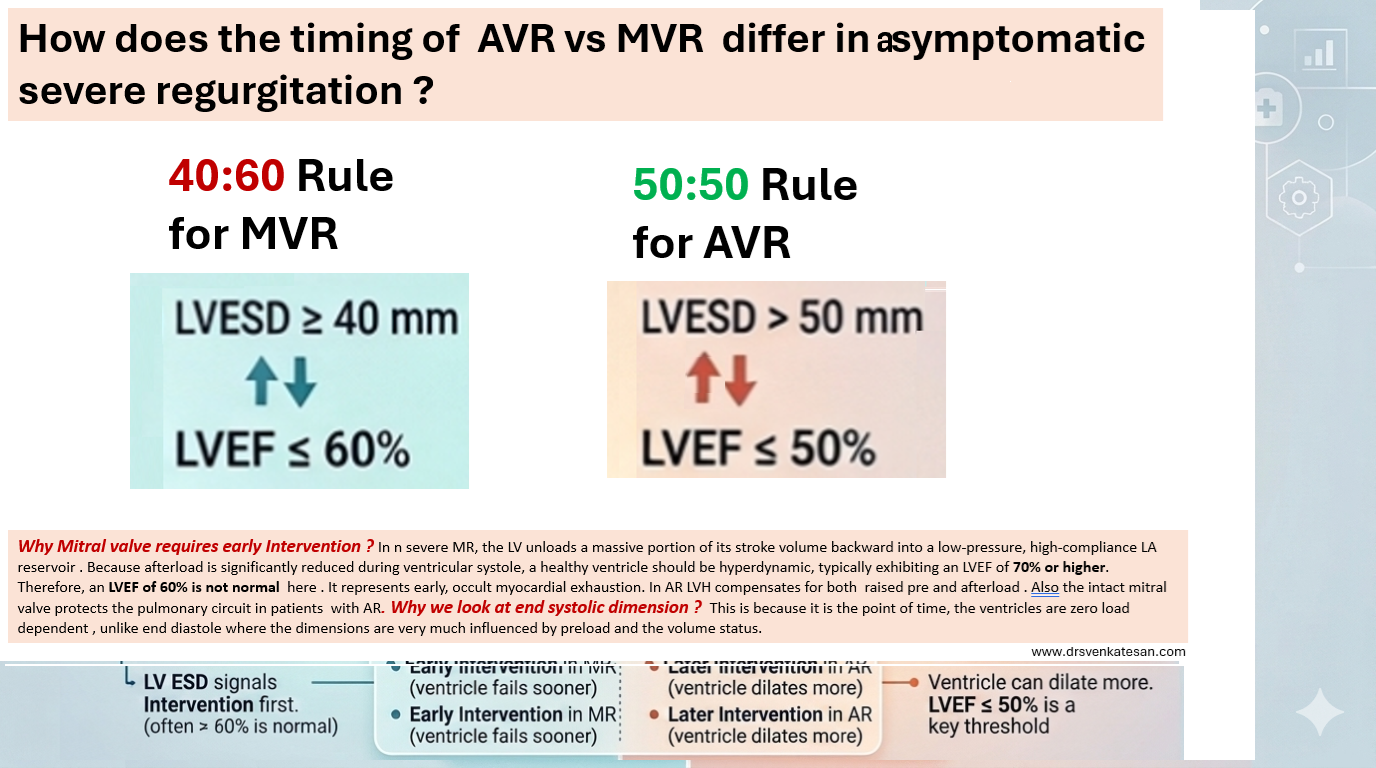
For mitral valve the threshold is lower. It needs early MVR for same degree of regurgitation as AR. It is proposed by the author for the benefit of fellows to easily remember the cut offs. It may be called as the 40:60 rule for MVR and 50:50 rule for AVR. The former denoting LVESD and later referring to LV EF %. The difference in echocardiographic thresholds arises because the two lesions cause fundamentally different hemodynamic loads on the left atrium and ventricle .(Read the legend in Image)
Final message
With mortality and morbidity for valve replacement steadily falling, it is likely more and more patients will be taken for surgery early. Of course, intervention guys are raring to go with percutaneous TAVR and TMVR, so the thresholds are expected to fall.




