Feeds:
Posts
Comments

Posts Tagged ‘acc aha stemi guidelines’

Localising the infarct-related artery (IRA) In NSTEMI , when there is multi-vessel coronary artery disease (CAD) is a classic clinical dilemma. Because NSTEMI lacks the clear, localising markers as in STEMI, identifying the “culprit” among multiple chronic blockages requires a more careful approach. It requires combined analysis of electrocardiographic clues , Echocardiographic WMA, angiographic analysis, and finally as a last resort intracoronary Imaging. Note : In UA,without NSTEMI it can be called as ARA-Angina related artery.
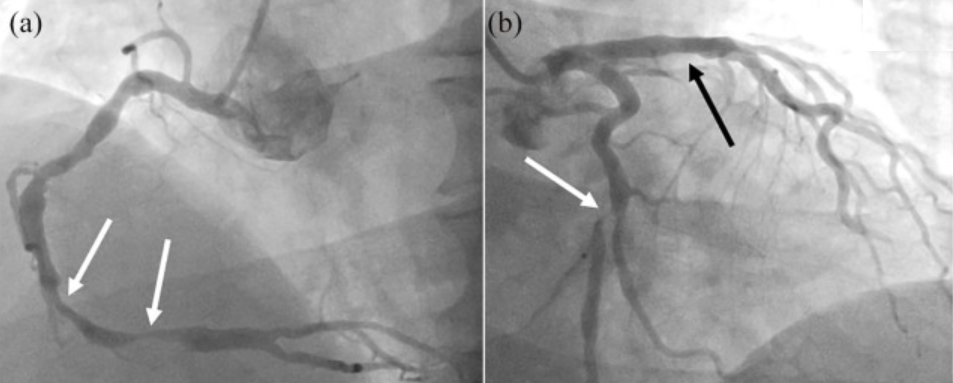
Image source : Baumann et al. Ther Adv Chronic Dis. 2020 Jul 1;11:2040622320938527

A meticulous review of the invasive coronary angiogram (ICA) will identify the culprit lesion in the majority of cases. Look for these specific features

  • Plaque Morphology: Eccentric , hazy lesions, irregular borders, or filling defects indicative of an intraluminal thrombus
  • Lesion Ulceration: Look for ulcerated edges, aneurysmal segments, or evidence of a dissection flap. Any vessel showing TIMI-1 or TIMI-2 flow, or prolonged contrast stasis during washout suggest microvascular plugging downstream from a fresh rupture.

ECG -ECHO correlation of WMA is the key

  • Wall motion defect correlation: Matching the distribution territory of the suspected culprit vessel LADcs LCX or RCA can be most useful . Still extensive collaterals can prevents us, to make a rule of thumb
  • Typical patterns like Wellens can help localise the IRA. Transient ST-depressions or deep T-wave inversions
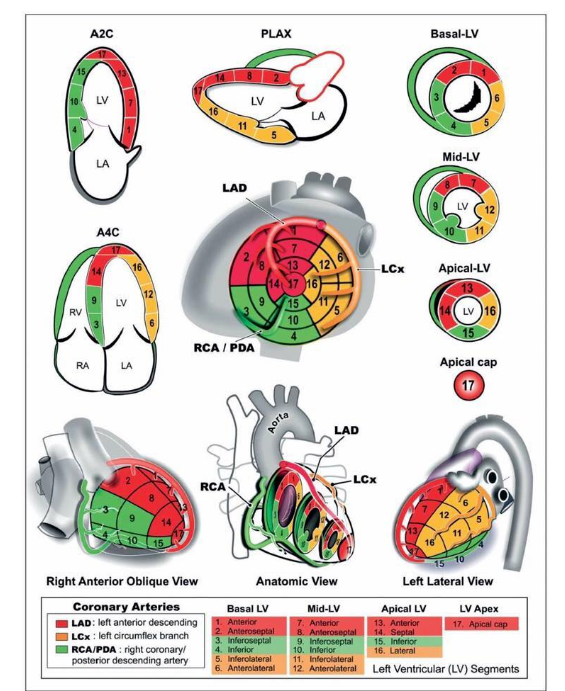
The most important illustration in coronary artery disease

Note* WMA can be deceptive as well, due to old MI, remote ischemia , or either due to collateral support or lack of it

Intra coronary Imaging

When angiography shows multiple severe lesions with no obvious acute features, coronary imaging like OCT/IVUS can be helpful. It visualises plaque rupture, thin-capped fibroatheromas (TCFA), red/white thrombi, and superficial plaque erosions. IVUS can help identify ruptured fibrous caps, and intramural haematomas.However, the temptation to do imaging should be resisited as performing this in ACS adds its own risk.
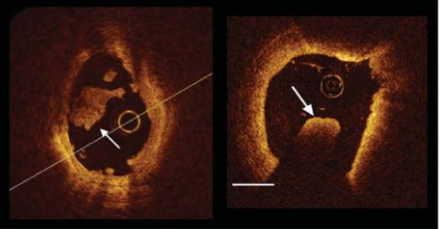
Thromotic lesion in ACS revealed by OCT . Image source Francesco Prati et al European Heart Journal 31(4):401-415

What about FFR & iFR ?

Physiological tools like FFR / iFR / iFR are less useful to identify culprit lesion rather it tell us about the flow across the lesion.

Final messsage

Identifying IRA in NSTEMI/UA is more challenging than in STEMI, relying on basic ECG and ECHO tests. It is good to realise, this effort may be redundant if we are considering only medical management.(Which is often the case in many low risk patients)

Reference

1.Baumann AAW, Mishra A, Worthley MI, Nelson AJ, Psaltis PJ. Management of multivessel coronary artery disease in patients with non-ST-elevation myocardial infarction: a complex path to precision medicine. Ther Adv Chronic Dis. 2020 Jul 1;11:2040622320938527. doi: 10.1177/2040622320938527. PMID: 32655848; PMCID: PMC7331770.

Read Full Post »

One popular definition of Intelligence goes something like this  “It’s a global capacity  of a living organism  to deal effectively with environment and live peacefully”

When myocytes are confronted with acute ischemia , they  don’t always  jitter . It expresses many behavioral pattern.The damage inflicted is variable as  the molecular mechanism of ischemic tolerance appears to be a virtue ! This might make  much revered time window of myocyte ischemia irrelevant .Each cell has got a unique capacity to survive or die . In chronic ischemia this myocyte intelligence and intention to survive is glaringly evident. How about this phenomenon in ACS ?

myocardial intelligence myocyte memory

Art of  survival 

Why some cells die instantly , some fully recover and few go for hibernation  and others  are just stunned . While apoptosis is programmed cell death with intact cell membrane , hibernation can be termed as programmed cell survival .We don’t know how many intermediate forms of cell surviving mechanisms exists.

One of the famous questions is does the myocyte need blood or fuel for survival* ?

It is a fine balance of various cell  surviving (Anti ) mechanism.How energy is utilised with available ATP molecules is a different  science altogether .It’s  possible like brain,  heart too has  myocardial intelligence  , which does  some independent thinking aided by  fuzzy logic and problem solving algorithms  built within.

Ignorance based ACS care 

While we slog with metals inside the large coronary arteries , the response of the micro vascular territory is at the mercy of God . mRNA instructed DNA codes determine acute mitochondrial  respiratory sensitization.Finally ,the successful reversal of ischemic injury depends upon the cell repair molecule’s crisis management skills !

How else one can explain , some broken hearts recover so well from a major ischemic injury others sink with first insult !

The concepts of pre and post ischemic conditioning  are related phenomenon which can be pharmacologically  mimicked .They  are the major areas of research in myocyte  revascularisation.

Final message 

What is written above  is pure non academic fantasy . Now, read the following article by Dr Kloner which describe the molecular mechanism of  ischemia modification and its impact on clinical cardiology.

Reference 

1.Robert A. Kloner, Shereif H. Rezkalla; Preconditioning, postconditioning and their application to clinical cardiology, Cardiovascular Research, Volume 70, Issue 2, 1 May 2006, Pages 297–307,

Read Full Post »
