Feeds:
Posts
Comments

Posts Tagged ‘hocm’

The commonest symptom that brings a HCM patient to a physician is exertional dyspnea, followed by syncope and, of course, the unpredictable fatality.

Video courtesy Minneapolis Heart Institute Foundation

What is the mechanism of exertional dyspnea in HOCM?

Is it the obstruction or the restrictive diastolic function? It is easier to say both are equally responsible. Of course, that could be the correct answer, but a true academician need to go further. Among the two ,which is the dominant mechanism ?

As we are wondering what exactly causes dyspnea in HOCM … If we think for a minute, a simple fact seems to clarify everything. Try answering this question. Is dyspnea more common in obstructive HCM or  non-obstructive HCM? The answer is not an unequivocal yes .There is definitely no linear correlation between dyspnea and degree of obstruction. This clearly tells us obstruction is not the primary culprit. We got the answer already. (Ref 3)

Other mechanisms: Dyspnea due to reduced forward output is rarely an issue. Associated MR can be a significant factor as MR – v wave pulses can directly trigger the pulmonary venous receptors. High intraventricular pressure stretching the LV mechanoceptors is also a reason. (Its more important in syncope though) In elderly, associated ischemia and CAD can contribute to dyspnea.

Clinical implication of this question

HOCM is a mystery genetic disease, with total myocardial disarray. Still, patients are blessed with hyper-contractile ventricles. No one understands how this is possible. What we need to do is  pacify these aggressive contractions. That’s why beta blockers and calcium blockers have been used for decades. Now Mavacamten is introduced to correct the basic defect.

Mavacamten is a new class of drug that targets and corrects the underlying molecular defects of HCM .It is a Selective cardiac myosin inhibition , Reduces active myosin heads by reducing the number of myosin heads that can enter the active, force-generating state.  Mavacamten stabilizes myosin in an inactive, energy-sparing conformation known as the “super-relaxed state.” This results in decreases contractility . Relieves LVOT obstruction and indirectley improves diastolic fucntion. lower filling pressures. 

Is Mavamten really worthy ? What is the indication ?

Basically, it is a negative inotropic agent. Mind you, beta blockers are a great class of Nobel Prize-winning wonder drugs for this purpose. Calcium blockers too play an important role. But,we are living in a new age, a new era. We have to move on in life,  hence we are forced to switch to different agents whether we like it or not, whether it works or not.

What does the evidence say?

Mavacamten is proven to be useful in HOCM in the VALOR-HCM trial published in JACC 2022. Though the MAVERICK trial showed some promise in non-obstructive HCM, the recent 2025 [ODYSSEY-HCM trial](DOI: 10.1056/NEJMoa2505927) did not provide any positive benefits.

Final message

Every patient of HOCM turns out to be clinically, and hemodynamically a full-blown HFpEF and even technically an RCM-plus. In this context, drug research must be directed at more positive lusiotropic agents (Than negative Inotropics) and anti-fibrotic drugs.

Coming to the title question, if I can manipulate the cardiology linguistics , it can be concluded like this. In HCM/HOCM, the primary symptom is diastolic dyspnea due to restriction and the systolic dyspnea due LVOT obstruction contributes a lesser degree. ( Then why all this Septal reduction stuff ? Please don’t ask this question)

Reference

1.Banthiya S, Check L, Atkins J. Hypertrophic Cardiomyopathy as a Form of Heart Failure with Preserved Ejection Fraction: Diagnosis, Drugs, and Procedures. US Cardiol. 2024 Oct 14;18:e17. doi: 10.15420/usc.2023.21. PMID: 39508003; PMCID: PMC11539043.

2.Desai MY, Owens A, Geske JB, Wolski K, Naidu SS, Smedira NG, Cremer PC, Schaff H, McErlean E, Sewell C, Li W, Sterling L, Lampl K, Edelberg JM, Sehnert AJ, Nissen SE. Myosin Inhibition in Patients With Obstructive Hypertrophic Cardiomyopathy Referred for Septal Reduction Therapy. J Am Coll Cardiol. 2022 Jul 12;80(2):95-108. doi: 10.1016/j.jacc.2022.04.048. PMID: 35798455.

The dyspnea paradox : HCM might be more symptomatic than HOCM , especially in the early stages

3.M Lowe, J Jackson, Y Zhong, M Contente, L Le Brocq, S Barlow, T Krause, Clinical characteristics and burden of non-obstructive hypertrophic cardiomyopathy: a real-world survey in Italy and Spain, European Heart Journal, Volume 45, Issue Supplement_1, October 2024, ehae666.2021, https://doi.org/10.1093/eurheartj/ehae666.2021
Next question: Is Incidence of syncope linearly related to the severity of LVOT obstruction?

Let us take more time to find the correct answer.

Read Full Post »

In HCM every myocyte is  genetically made  defective . Myofibrils are in disarray every where . Still , can we identify some vulnerable zones that acts as arrhythmic  focus ? If that is possible , we  have a opportunity to abate that focus .

In HOCM  , which is the most stressed area ? LVOT ?  Septum, ? When we say stress , it can mean either mechanical or electrical .

VENTRICULAR TACHYCARDIA 002

Does electrical instability involve the same zone as mechanical stress ?

How often VT originate from LVOT in HCM ?  For this we have good clinical model _, the patients who underwent alcohol septal ablation.

What happens to the incidence of VT  post septal  ablation  ?

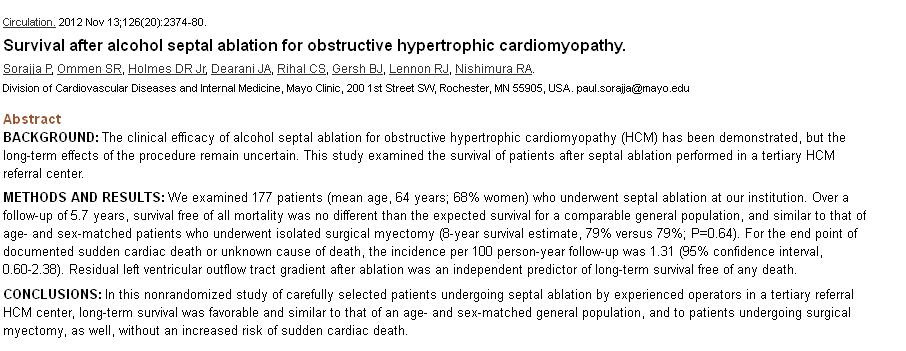
“It is reported  post septal ablation the incidence of SCD  becomes  equal to general population” (Read the paper below )

If that is true , it is obvious the  arrhythmic  focus is also ablated along with LVOT myocardium .

Outcome of HOCM after alcohol septal ablation

Though many studies claim  so !  It  fails to convince us  .  HOCM is a diffuse disease of  myocardium.  Even a cluster of myocyte disarray  with fibrosis   can be a future focus  irrespective of it’s location .

However ,  it is always possible relieving the mechanical stress of the LV can definitely reduce the likelihood of an electrical event .(Even if the arrhythmic focus is intact elsewhere !)

* We know RVOT is  developmentally arrhythmia prone zone . We also know HCM involves RVOT (After all ,  IVS  is legally shared by both ventricles !  ) . Some of  the monomorphic  VTs with LBBB morphology may originate from RVOT in HCM .

Management of recurrent VT in HOCM

  • Drugs (Amiodarone/ Calclum blockers/ Beta blockers/Disopyramide)
  • ICD- (Probably mainstay  )
  • Very rarely ablation (If localised focus is well documented )

Reference

1.A case report for successful ablation of  VT in HOCM   http://www.ncbi.nlm.nih.gov/pubmed/9255687

2.http://www.ncbi.nlm.nih.gov/pubmed/23076968

//

Read Full Post »

HCM is due to  hereditary mutation of myocyte sarcomere .The molecular defects are  located  in  myosin, tropomyosin, titin .Depending upon the protein  involved the hypertrophy can be regional or localised.

Non obstructive types most often involve tropomyocin mutations. Obstructive types predominate with myosin mutations.

HCM types

Non obstructive

  • Simple ASH
  • Apical HCM

Obstructive

  • LVOT
  • Mid ventricular

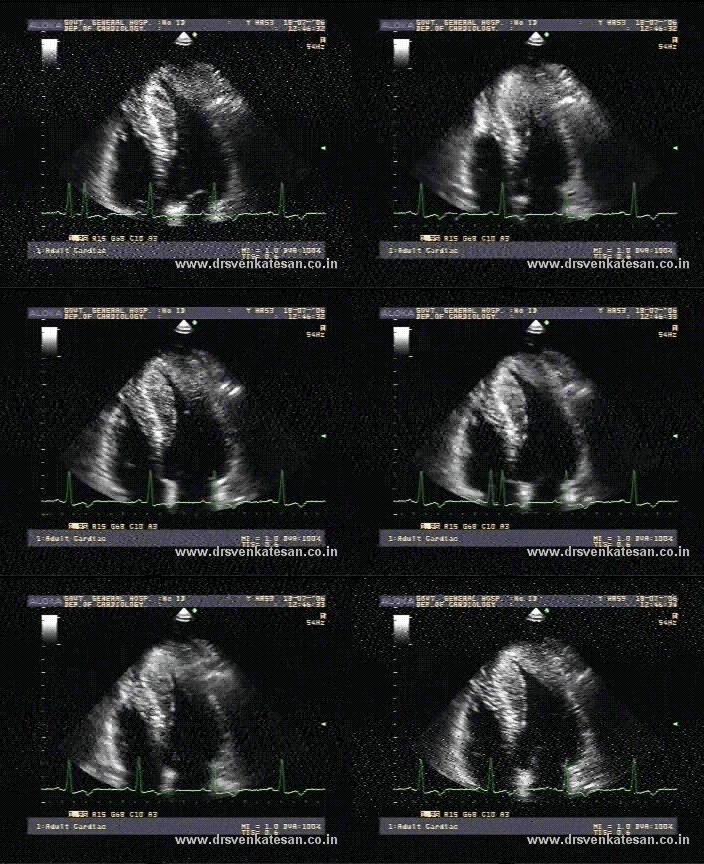
When the hypertrophy is in the LV apex there is little hemodynamic consequence

Apical HCM can still be prognostically and practically  important even though there is no  hemodynamic impact.

  • Arrhythmic risk persist(Any focal hypertrophy can be substrate for reentry due to slow conduction)
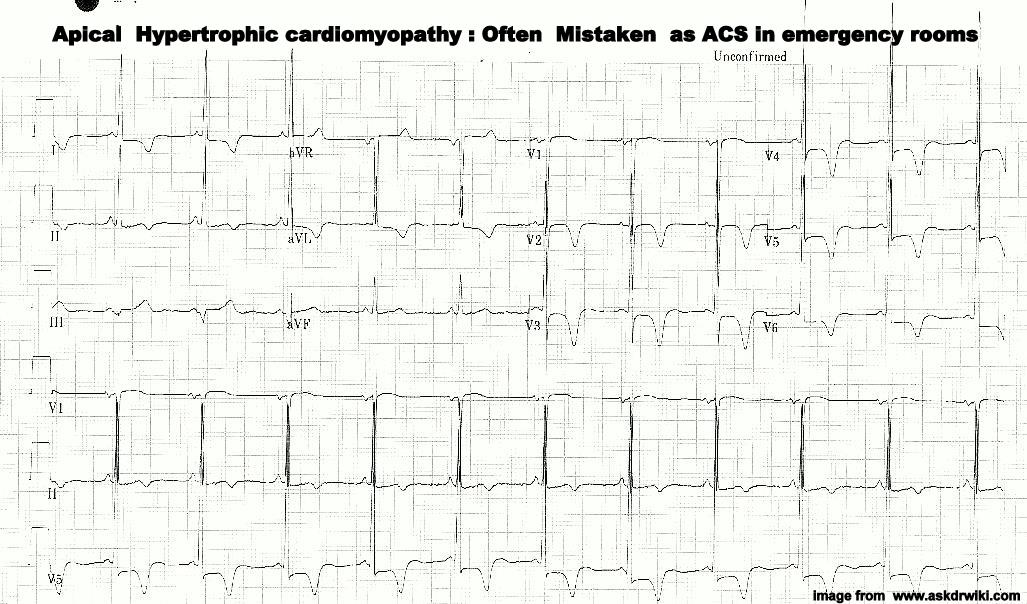
  • More  importantly  apical HCM is the commonest myocardial condition mistaken  for unstable angina  and they wrongly enter the ACS protocol and might land up in cath lab tables as well !

Always remember  high voltage qrs with deep T wave inversion (90 out of 100 times)  is due to  myocardial pathology not ischemic.

Management

  • Reassurance (First advice is,  not to search for more information from the internet ! It may confuse them !  )
  • Just follow up with yearly echocardiogram .Follow up the siblings too.
  • Marriage counseling . (Not contraindicated )
  • Holter monitoring or  extended loop recording may be done to  detect any sub-clinical of arrhythmias.
  • Beta blockers are generally not indicated  routinely  may be given if family history of sudden death .

Reference

http://emedicine.medscape.com/article/152913-overview

Read Full Post »

Hypertrophic cardiomyopathy (HCM) manifests   with or without obstruction. Obstructive HCM ,  (ie HOCM)  is more often symptomatic .However , the risk of arrhythmias, sudden death, and some degree of diastolic dysfunction are common in both.

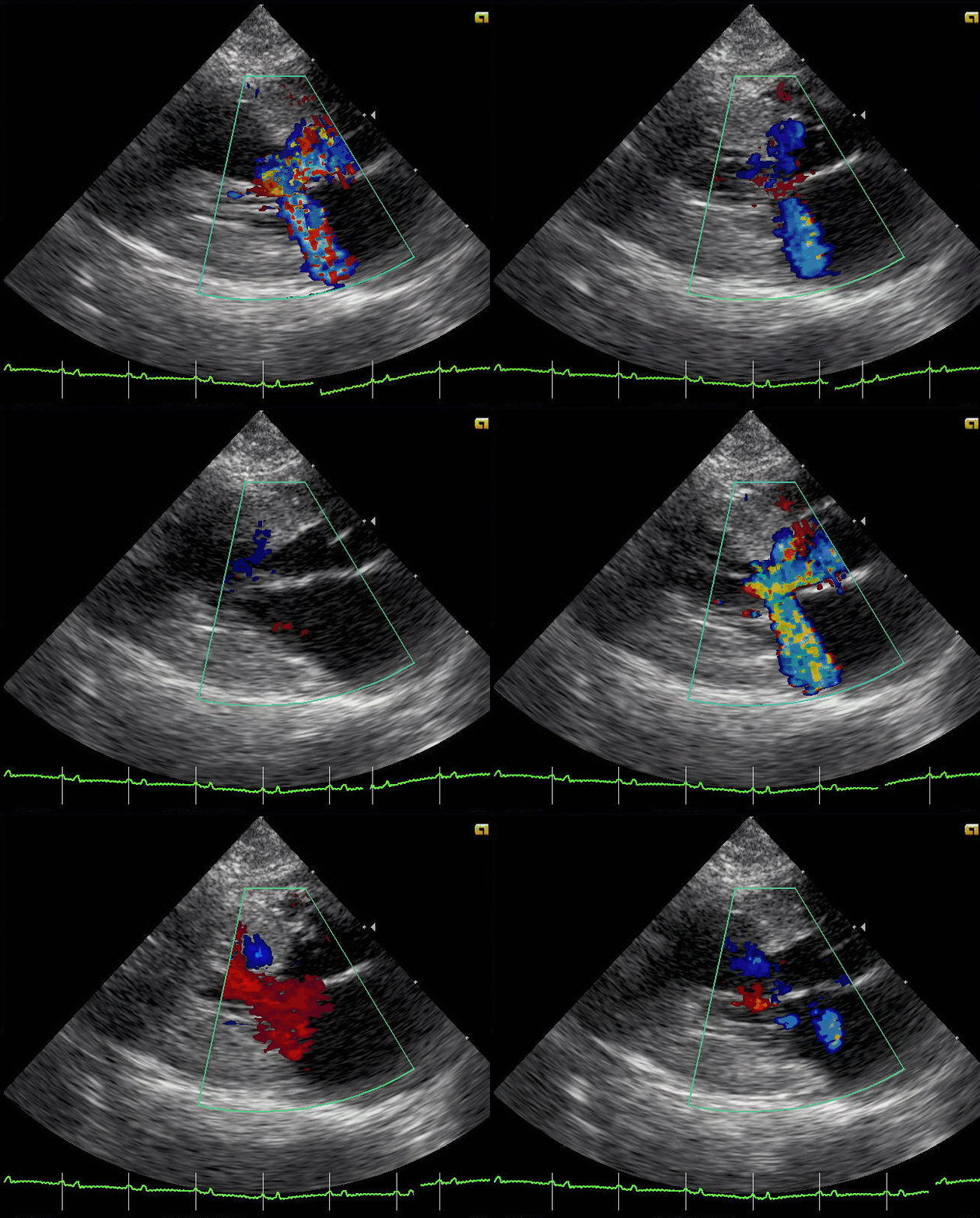
ECG, clinical examination are generally  not sensitive to identify obstruction in HCM  .Echocardiogram is the easiest  way to identify  the obstruction (gradients> 3o mmhg across LVOT are considered significant ).LV angiogram ,MRI, CT scans are rarely necessary today.

However , the following clinical clues will help us  to suspect significant obstruction in HCM

History

  • Class  2 or  3 dyspnea.
  • Exertional syncope
  • Exertional angina

Pulse

  • Pulsus bisferiens (Two peaks in systole )

LV apex

  • Sustained , double apical impulse  often indicate obstruction.
  • Presence of Mitral regurgitation ( 20% can have  MR without obstruction due to intrinsic abnormalities of  mitral valve )

* It should  be realised , valsalva induced MR /LVOTO  may occur in many of the non obstructive HCM.

What happens to  clinical signs of obstruction with medical therapy(Beta blockers etc)

One would expect these signs to regress or disappear, but it rarely happens. The pulse , the  murmur show  little change .  This implies , the main mechanism of beneficial effect could be in  heart rate  reduction , and  improvement in the   diastolic properties of left ventricle.

Read Full Post »

Hypotension is one of the dreaded complication of acute STEMI.

  • It can be due to either a  mechanical complication or hypovolemia.
  • The hypotension in inferoposterior MI is  often related to enhanced vagal tone and easily correctable with atropine  and fluid  administration.
  • RVMI is the classical example of hypotension that may improve with fluid resuscitation
  • Hypotension,  if  not reversible within 12  hours  ,  is more likely to  represent a more sinister mechanism like pump failure, MR or ventricular  septal tear etc .

A new mechanism for persistent  hypotension is increasingly recognised.

This is due to the

1.Loss of LVOT dynamic activity.

2.Excessive  dynamism of LVOT.

LVOT contractile and ejectile falure

Even though LV  outflow tract  contain  less  contractile myocytes  , it has an important mechanical  job to do. We know , it’s  primary job is that of a  conduit  but  it also  has to  eject the blood into aorta with sufficient force.  In fact, it is thought much of the acceleration of blood velocity occur in LVOT . So, LVOT  plays a key role in maintaining the cardiac index.  An excessively dynamic LVOT will impede the forward blood flow as in HCOM.  Similarly  less dynamic contraction  of LVOT  results in  low velocity propulsion , that interferes with   proper delivery of blood from LV cavity into the aorta .

These factors get amplified in  acute MI , as it is a compromised situation with fluctuating HR and contractility. So a properly functioning  LVOT conduit is  absolutely mandatory.

STEMI due to a proximal LAD obstruction   located can involve the septal .If the first septal branch  happens to be a major one,  there will be  definite impact on the LVOT function.

Excessive dynamism  , LVOT   desynchrony  LVOT collapse .

LVOT has a medial border formed  by IVS , an  anterior surface and  a posterior surface .The lateral border is relatively boundary less , except it is guarded by  the anterior mitral leaflet.

But one should recall , the AML comes towards the LVOT only in diastole . When it comes in systole it becomes a pathological event  called  SAM  (Systolic anterior motion )

The LVOT wall desynchrony can occur in both anterior and posterior MI.In a mulivessel CAD  this can happen when there is disproportionate inferior to anterior wall motion defect.

Management.

  • There is no specific management strategies aimed at restoring LVOT function.
  • Emergency revascularisation will attenuate the mechanical dysfunction
  • Dosage of powerful inotropic agents should be moderated in dynamic LVOT obstruction.
  • Spontaneous recovery  may occur in few

http://circ.ahajournals.org/cgi/reprint/116/5/e110.pdf

Haley et all Mayoclinciproceedings 1999

Read Full Post »