Dyspnea
Dyspnea is probably most common symptom encountered in the practice of clinical medicine. Although cardiac and pulmonary causes typically come to our mind first, the top two etiologies are actually neither of these. Skeletal muscle deconditioning is the leading cause, followed closely by anemia.The mechanism of dyspnea will remain complex , for the simple reason, it is perception of normal sensory stimulus.
Origin and mechanisim of dyspnea
The Initial trigger can be either mechanical or bio- chemical(Chemo receptors) .Mechanical receptors are spread all over the body in muscle tendons and Golgi organs in every skeletal muscle. Contrary to the popular belief, signals from muscular triggers can exceed the J-receptors and cardiac stretch receptors even in cardiac failure. Whatever the initial trigger, dyspnea is a sensation ultimately perceived in the insular area of the limbic cortex. Note: Dyspnea can occur with a pure cortical trigger (Cortical emotional dyspnea).
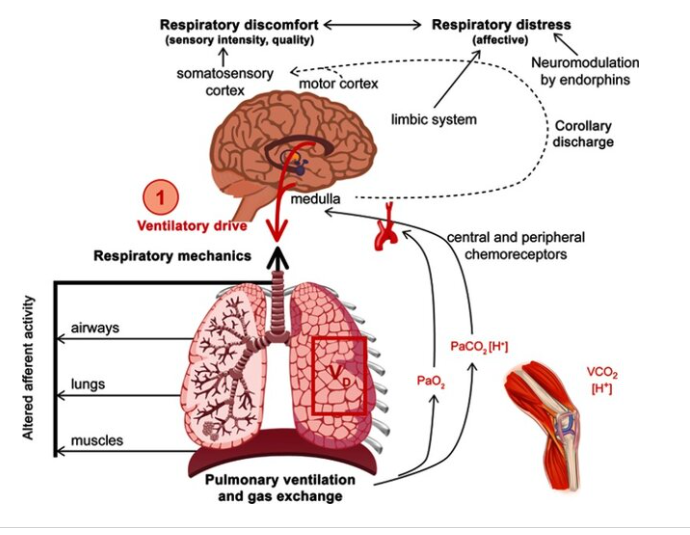
Image source : Hanania NA, O’Donnell DE Int J Chron Obstruct Pulmon Dis 2019 24:14:1127-1138.
*The fact that a complete quadriplegic individual can still experience dyspnea demonstrates that the trigger can be entirely biochemical, mediated through chemoreceptors. Further, vagal afferents and efferents likely play a role, as this pathway completely bypasses the spinal cord.
Welcome a new class : Drug Induced dyspnea
Now we recognise some of the important drugs , we use can cause a sensation of dyspnea independent of cardiac ,or pulmonary pathology . Four commonly used drugs are discussed here. They can be called as dypneogenic drugs.
Adenosine: Two ways it cause dyspnea. Through A1 receptors (Gi-coupled) on pulmonary vagal afferents which lowers cAMP and through A-2 receptors (Gs-coupled) on arterial chemoreceptors, that raises cAMP . This dual activation stimulates localized nerve terminals result in dyspnea sensation without any truemetabolic alteration.(Note : Aminophylline can block this)
Ticagrelor: This again is related to Adenosine , but in an Indirect manner. It reversibly inhibits the ENT 1 (Equilibrative Nucleoside Transporter) By blocking cellular reuptake and clearance It also elevates endogenous adenosine in blood and lung tissues, activating vagal receptors to mimic a true suffocation state despite normal blood gas levels. Is Aminophylline useful here ?
Beta-Blockers ( Non selective like Propranolol etc ) : The adverse effect on airway is well known. It is due to Beta 2 -adrenergic receptor blockade on airway smooth muscle cells
NSAIDs (Aspirin) In susceptible individuals, NSAIDs inhibit the Cyclooxygenase-1 (COX-1) enzyme, that blocks prostaglandin (PGE-2) synthesis. This shunts arachidonic acid exclusively to lipoxygenase pathway, causing an imblance with Leukotrienes that result in both bronchoconstriction as well as inflamatory mucosal edema.
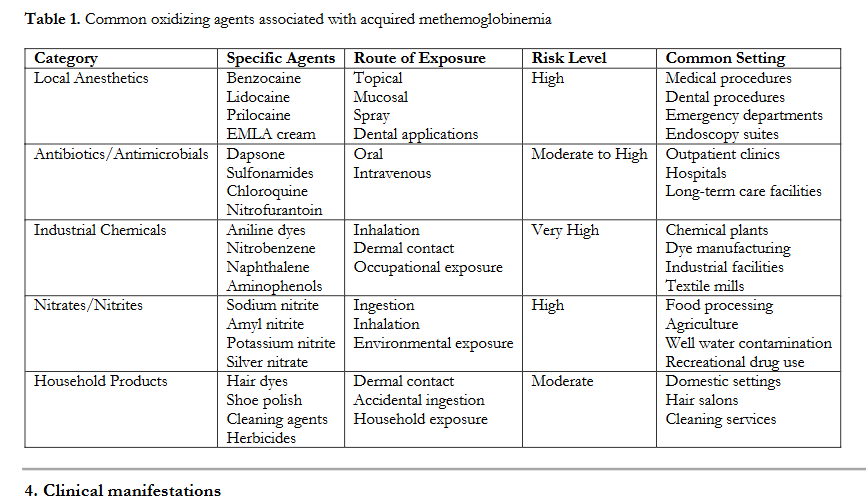
Note :Drugs that cause met-hemoglobinemia (A big list : Ref : Ramya Sri Bura et al Journal of Pharma Insights and Research, 2025, 03(01), 112-120) can be responsible for dyspnea,. It can be easily missed by routine pulse oximetry which shows normal saturation. Co-oximetry using multi wave length spectro photometry is required to confirm. Further , drugs like Amiodarone , Bleomycin Nitrofurantoin and Methotrexate can cause true pulmonary pathology like alveolar endothelial necrosis or pulmonary fibrosis. (They also qualify for dyspneogenic drugs technically)
Final message : Why learning about these drugs are important ?
It is important for two reasons.
1.When encountering patients with unexplained dyspnea please check the prescription drugs. There is a list of drugs , where the culprit could be hiding.
2.The fact that both pleasant and unpleasant emotions can evoke dyspnea , it is clear that some unknown neurotransmitters are clearly responsible for its modulation. This is important for further research , because the it gives us an pharmacological way to get it blocked.
Reference
Further queries
Do we have drugs to block the sensatin of dyspnea ?
Opiods can do this .Curiously,it has been found Frusemide inhalation that sensitises pulmonary receptors