Link to a related post , that might add some sense to the above quote
Posted in Uncategorized, tagged acc aha, best medcial quotes on ethcis, esc, medical ethics, medical guidelines, patient empowerment on March 9, 2026|
Posted in Uncategorized, tagged best medical quotes, bmj, hippocrates, jama dr s venkatesan sangareddi, lancet, medical ethics, nejm, osler willam, pateint care vs science, practical bio ethcis, primum non nocere, science and ethics on January 14, 2026|
Posted in Uncategorized, tagged bmj, dr s venkatesan, expressions in cardiology, fake vs fact in medical science, jama network, lancet, madras medical college, medical education, medical ethics, nejm, quotes in medical ethics, venkatesan sangareddi on November 18, 2025|
Posted in Uncategorized, tagged bmj, conflict of interest, jacc, jama network, lancet, medical ethics, nejm on July 25, 2025|
Dr. Venkatesan Sangareddi MD, Former professor of cardiology, Madras medical college,Chennai .India
Medical science remains a cornerstone of human progress, and what we have achieved in the last 100 years is unprecedented. Every one of us is aware that the trust placed in medical research is sacred. Also, the medical profession is expected to remain noble as long as human beings exist. However, as in all walks of life, there must be trade-offs to any positives. Yes, this trust has increasingly become vulnerable, threatened by the pervasive and often subtle influence of conflicts of interest (COI). This is especially explicit in the current medical research landscape.

While the scientific community has made strides in acknowledging and requiring disclosure of COIs, particularly from authors , the measures are proving insufficient. There is a big irony sitting right across us. It is made to look, as if conflicts of Interest (COI) exist only with the authors.
The following article written by the author (Ref 1) calls for an awakening to every medical journal publishers, regardless of their prestige or impact factor, to recognize their vulnerability . We are expected to adopt a new paradigm of transparency in declaring COI, that extends to every participant in the publication process, including the scientific or ethical committies that approve the study ,the peer reviewers, the publishers and finally to the industries that fund the research.
Reference
1,Click here to download the full paper: A caution: It is a fairly lengthy article. (15 minutes read) Hope the suggestions made in the article are not labeled as unrealistic and possibly crazy as well.
Posted in acute coroanry syndrome, acute coronary syndrome, Medcal research, Medical education, Medical ethics, Primary -PCI, Primary PCI, Thrombolysis, tagged acc aha esc scai criteria, captim trial, cardiology, danam 2, defining success in pci, drsvenkatesan, ethics in medicine, golden hour, medical ethics, nejm, nstemi, pharmaco Invasive strategy, prague 2, pre hospital lysis, ptca, stemi, stream trial, successful primary PCI, symptom to balloon vs symptom to needle time, symptom to door vs door to needle time, time windows in STEMI on June 8, 2025|
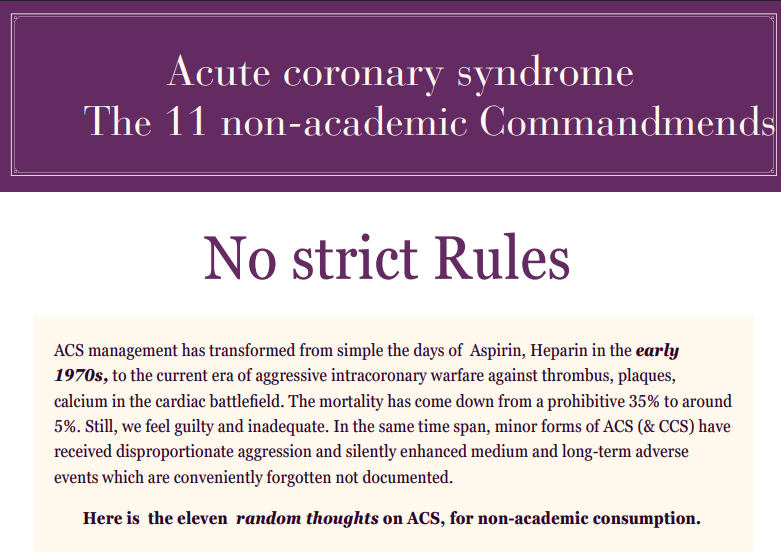


How can we use AI as a tool of knowledge distillation ?
Here is a deep discussion with Grok 3, on the merits, limitations & validity of DANAMI 2 and PRAGUE 2 , the two old studies on pPCI. Curiously , we don’t have any other studies to quote. As on 2025 , superiority of pPCI hangs precariously on these two decade old studies, which has some serious omissions in the primary end point and its Interpretation. To get into the facts , please go through the following link.
https://grok.com/Is primary PCI really superior to lysis in a global perspective /
It is a long chat, I am sure most of you can’t spare your vital time. But, the truth comes out only at the fag end of the conversation.
Posted in Uncategorized, tagged dr venkatesan sangaredddi, ethics in cardiology, medical ethics, venkat quotes, who is an Interventional cardiologsist ? on March 27, 2025|
Yes, It’s not a humiliation, to get branded as a new generation cardiologist. In fact, the opposite is true. Sorry, no-blaming any one. We can’t avoid it as well. It is the wages, we are foreced to pay for sensationalised technological sins , that is Imploding in the world of medical science.
Posted in Uncategorized, tagged aim of the study, bmj, cite score, H index, i 10 index, Impact factor, junk articles and papers, lancet, medical education, medical ethics, nejm on December 18, 2024|
Absolutely yes. The number of studies with such wrong aims is staggeringly higher than we could imagine. “Wrong aim” is probably not the right word to describe them. Rather, we can call them obsolete, duplicate, illogical, unproductive, intentionally fraudulent studies, or studies with a prefixed conclusion.
There is an estimate, that says 95% of papers in nearly 5,000 medical journals, is either junk or written for the sake of publication related to mandatory academic positions or promotions as a budding scholar or faculty. Science has to survive on the shoulders of those rare & genuine 5% souls.
Final message
What is the true “Aim for your study” , I want a very honest answer ?
Yes sir, I agree ,the primary aim is to publish my damn paper and get that promotion !
A related post
There was a brief post about this in the year 2008, 15 years ago. Is it still relevant? Find out for yourself.
Posted in Uncategorized, tagged class 1 class 2a class 2b, guidelines in cardiology, medical ethics on November 14, 2024|
A right answer to this MCQ will check , how realistically we have understood modern medical decision making .It could change the way we practice cardiology, provided you choose the right response.

Which of the following correctly describe about the disease specific popular guidelines by various scientific committees like AHA, ESC, and other by global expert forums ?
A. They are absolutely scientific and evidence based. Tremendously helping us and our patients. We must follow it strictly day in and day out.
B. These guidelines are very tricky , but still useful .However , if strictly followed, it may not be in the interest of patients. Still, I am compelled to follow it because of peer pressure and perceived sanctity of science.
C. I know ,most guidelines are too elaborate and complex and trying to confuse me, but glad to say I am able to tackle it.
D. Read, understand and use them as an adjunct, but always form your own guidelines in the best interest and care for our patients.
Answer
Did you find the correct(rather pragmatic) answer? I am not going to reveal mine , instead will tell the response which could be explicitly wrong . (Yes, it is the first letter of the English alphabet)
Posted in Uncategorized, tagged evidence based medicine, fisher, jama network, journalof statistics, kaplan meir, lancet, levels of evidence, medical ethics, medical statistics, MEDICALEDUCATION, meta-analyses, meta-analysis, nejm, pearson, pvalue, randomised control trial, rct vs metaanalyses, why two meta analysis difer ? on October 10, 2024|
“In one sense, meta-analysis would come closer to a milder form of ethical plagiarism”
Can meta-analysis really be called as original scientific research ?
No it is not, but some may say yes. It is very difficult to dispute either. But, the fact of the matter is, meta-analyses are not a true science of innovation. It is using some others’ work( sort of intellectual steal ?) done by a group of scientists interested in the same research topic, trying to squeeze more info from these studies. It is a glorified group journal club activity.
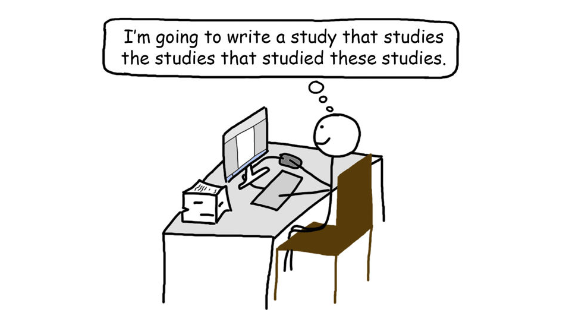
Image source & Courtesy http://www.inquasar.com
At best, meta-analysis can be referred to as knowledge and evidence aggregation. Surprisingly, mostof the academia seems to give more weight to meta-analysis, disproportionately more than the original researchers. This is because meta-analytic scientists backed by big journals claim, they can bring out more info out of the original. The assumed scientific superiority of meta-analysis is expected to be downgraded soon, as these sort of evidence aggregation can be done easily by any AI-powered engines. Network meta analysis, by dedicated medical scholastic AI networks can do this in a fraction of a second.
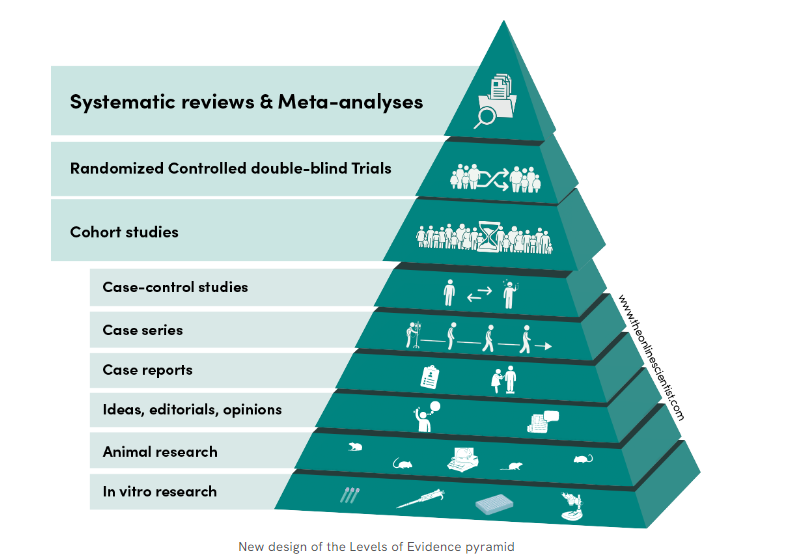
Meta analyses as of now is sitting proudly as crowning glory at the top of evidence pyramid. This is one of the reasons for the false glory surrounding anyone (or anything ) associated with meta-analyses. I doubt whether it really deserve the top slot. (An excellent debate between RCT vs metanalysis) Wish, the meta-analysis taste its own medicine at least once. We need to have a meta-analysis to show it is really superior to other forms of evidence. I cant find one as yet.
What about systematic review ? This looks better, as it has less statistical content , and the researcher is at least compelled to go deep and get enlightened on the topic as they spend months together on the topic.
How is meta analysis different from original research?
There is no new data collection ,no primary hypothesis testing . It primarily focus on summarizing existing evidence. To do it properly, there are certain standards.
Positive side of metanalysis
While meta-analyses aren’t original research, it’s a crucial tool for evidence synthesis, research translation informed decision-making.
Flaws of metanalysis
It is a academic business with done studies. So it is 100% retrospective. It might come with irreversible errors. Unless every error in the past studies is accounted for and curated the result of meta-analysis, it can never be foolproof.
Should we get permission from all the authors who did their original studies before doing a meta-analysis?
As long as fair use criteria applies there is no need , but a moral obligation is definitely there . Other wise metanalyses will come closer to a milder form of academic plagiarism of others’ work. (Of course legally and scientifically approved)
Final message
In the world of true scientific research, meta-analyses can not be considered as great scientific work. It is just evidence aggregation, which of course could be meaningful if and only if the studies taken were done properly.
However, meta-analysis has undisputed value in aggregating rare cases, scenarios, diseases, and problems where there are very few published studies. Collecting them together in an organized fashion serves a real good purpose.
Reference
1.Pearson K. Report on certain enteric fever inoculation statistics. Br Med J. 1904;3:1243–6.
Posted in Uncategorized, tagged doctor patient relationship, medical ethics, patient demands, patient democracy, patient empowerment, patient rights and duties on July 28, 2024|



 Dr.S.Venkatesan MD