Posts Tagged ‘nobel prize in medicine’
Welcome to the exciting new era in scientific Medicine
Posted in Uncategorized, tagged ai in medicine, ethics in medicine, future of medicine, Lown Institute, medical education, nobel prize in medicine on October 11, 2025|
A potential new face of “Ethical dysfunction” is waiting to unfold !
Posted in bio ethics, Medical education, Medical ethics, medical satistics, tagged best medical quotes, bmj, dr venkatesan sangareddi, first do no harm primum nocere, hippocrates, Hippocratic oath, inappropriate medcial care, jamanetwrok, lancet, madras medical college, medcial ethics, medical science future, nejm, nobel prize in medicine, over treatment, principles of practice of medicine, william osler on September 8, 2023|

Postamble
This quote is being sent for the annual meet of “Right care movement” I know ,this can sound outrageous, permissble limits of abuse ? Up to 2% or 5% ? Let it be anything . Meanwhile try to enlighten yourself , the key differences between misuse & abuse.
What is the true success for a scientist ?
Posted in bio ethics, Histroy of medicine, Medcal research, Medical education, Medical ethics, medical quotes, tagged ethics in medical research, ethics in medicine, greatest award in medicine, medical quote, nobel prize in medicine, publish or perish, what is success in scientific world on November 26, 2021|
What is the true success in a scientific career?
It is not the number of publications in journals or getting those big awards or memberships in prestigious scientific societies. True success is “something else,” says the Nobel Medical Laureate Dr Willam Kaelin
Great thoughts. Just wondering, what are those elements beyond our controls he was alluding to?
Video courtesy and thanks : http://www.nobel.org
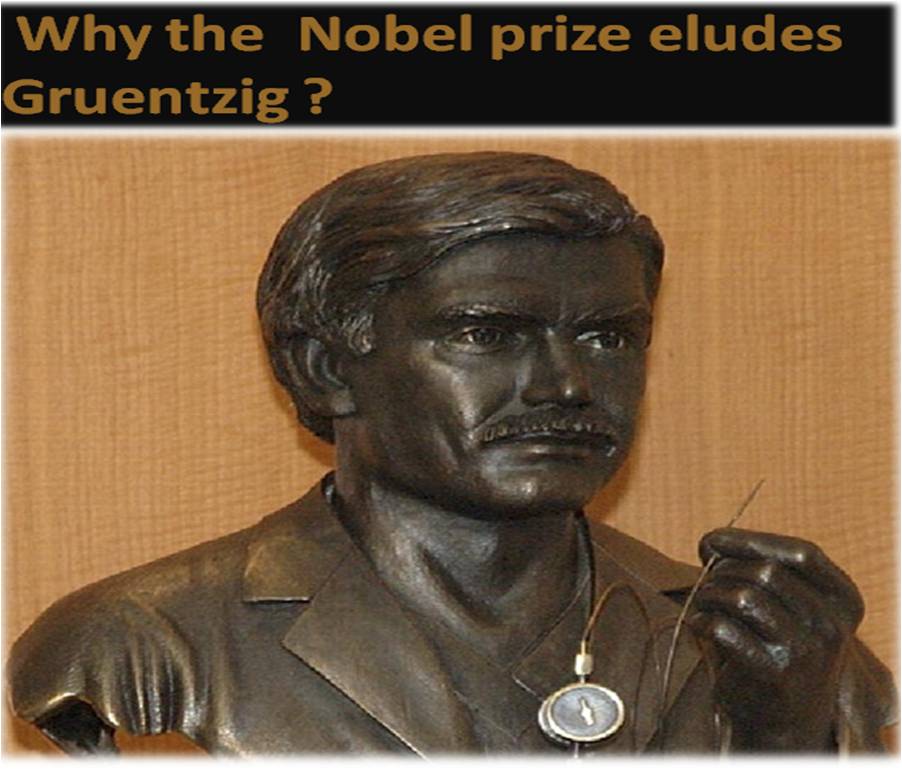
Why Gruentzig is not considered yet for Nobel prize in Medicine ?
Posted in history of cardiology, tagged andreas gruentzig, nobel prize for cardiac catheterisation, nobel prize in medicine, pci, ptca on January 5, 2012| Leave a Comment »
Medical science has grown ( and growing ) in an astonishing pace. Many of the inventions which were considered as major break throughs have fallen on the wayside over the years . Of course , quite a few withstood the test of time .
One of the great inventions of last century is per-cutaneous interventions inside the human coronary artery .
The concept was first conceived and executed by Andreas Gruentzig of Germany in year 1977. Now , at-least a million PCIs are done every year to tackle CAD with greatly improved knowledge base, evidence , hardware, techniques and expertise .
PTCA is an invention worth a Nobel prize . . .well , that’s what we cardiologists feel. The Nobel committee seems to think otherwise .
 What could be the reasons ?
- PTCA is simply an extension of an old invention. Already the inventors of the cadiac catheterization were conferred with Nobel prize (Forssman, Cournand,Richards) . Hence , it is a sort of duplication of invention . If Gruentzig is conferred a Nobel prize the man who discovered the coronary stent (A plaque scaffolding device) will argue he too deserve a Nobel !
- What Gruentzig did was in-fact a fundamental human response by Instinct ! .When you encounter a mechanical obstruction on the road just try to overcome it . “Here is an obstruction impeding the blood flow , let me remove it” . He did this with a wire and balloon . There is not much intellectual innovation . It was delivery of a mechanical force through a wire . But what the Nobel committee should take it to account is , he did this in live human beating heart and cured of his illness most dramatically avoiding a need for surgery.
- Finally comes the vital question. What is the impact of this invention in the health of mankind. ? How many lives have been saved when compared to other modalities to treat the coronary artery disease ? *.This again is not convincingly answered especially in stable angina , for which Geuentzig originally developed this modality . One popular argument is , in terms of life saved and sufferings relived oral rehydration fluid or penicillin would beat PTCA most convincingly !
* Another possible reason is , the Nobel medical committee is probably well aware of the perennial controversy about role of Medicine vs Surgery vs PCI on the outcome CAD and the superiority of one over the other !
Final message
Whatever be the reasoning , Nobel committee has to rethink . Cardiologists all over the world would definitely agree if one man who have made a huge difference in their patient’s life , it must be Gruentzig .
It is well-known Nobel prize is given for path breaking research that break new grounds like decoding cosmic mysteries , expansion of universe , cell signalling , molecular mimicry and the stuff like that .
Still , Gruentzig definitely deserves a Nobel solely for the novelty in his procedure and in the process it helped avoid surgery in vast majority of heart patients.
Reference

http://www.nobelprizemedicine.org/
http://circ.ahajournals.org/content/93/9/1621.full
Video
http://www.angioplasty.org/video/aghero.ram
One small mistake in cath lab . . . A giant leap for man kind !
Posted in Cardiology -Interventional -PCI, history of cardiology, tagged accidental inventions in medicine, cag, cardiac cathetrisation, coroanry angiogram, errors as science, forsmann cournand richards, great inventions, great medcial discoveries, henry ford detriot, nobel prize in medicine, scientiifc errors, Sones mason, what is coroanry angiogram on November 21, 2010| 1 Comment »
In any field , errors and mistakes transform into experience in retrospect. (Of course only if we realize our mistakes !) . Many would argue prevention of such errors is the only way to move forward in science , but ,the opposite could also be true.
In Medicine ,
- Most errors are mild ,
- Some errors can be fatal but it helps us prevent further fatalities.
- Some errors create history and re-define the science.
That’s what happened on 1958 , to be precise on October 3oth , 1958 in a lonely laboratory of Henry Ford hospital/Cleveland clinic *
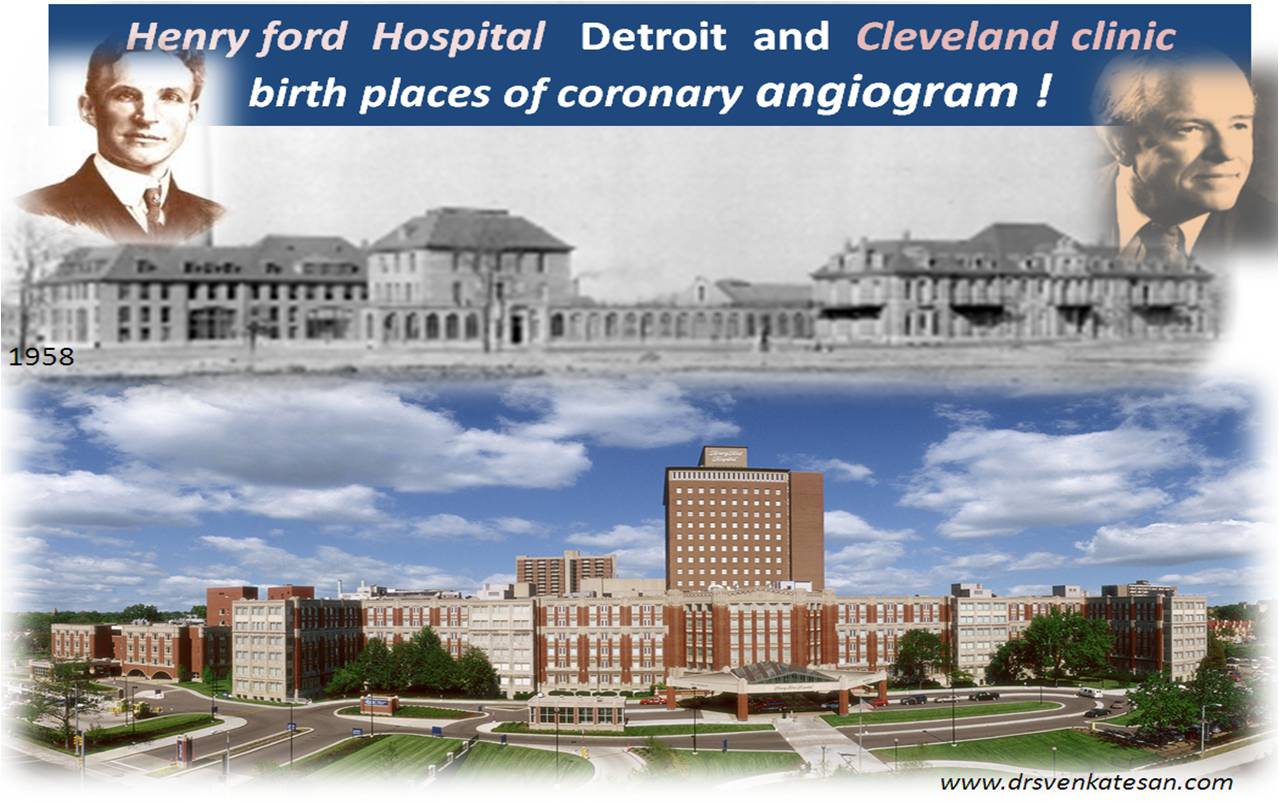
*A correction -This invention actually happened in Cleveland. ( Sones learnt all his techniques in Henry ford)
When Sones along with his assistant were trying to do an Aortogram in a patient with RHD, the entire dye meant for aorta went straight into the right coronary artery.When every one was stunned ,the patient happily survived the injection with a few skipped beats.
The man behind this horrendous medical mistake was Mr . Sones . He was guilty for many days , spent many sleepless nights ( In spite of the patient surviving the episode ). In fact , he was much amused about the patient’s survival . At that point of time, even a spill over of dye into coronary artery was considered forbidden. He pondered over the incident for months .
Had two queries lingering in his mind .
- How the right coronary artery was able to withstand the 40cc dye injected with force .
- If 40 m l was tolerated , well what about routinely injecting 3-5 ml for visualizing the coronary tree by intentionally seeking the coronary ostium .
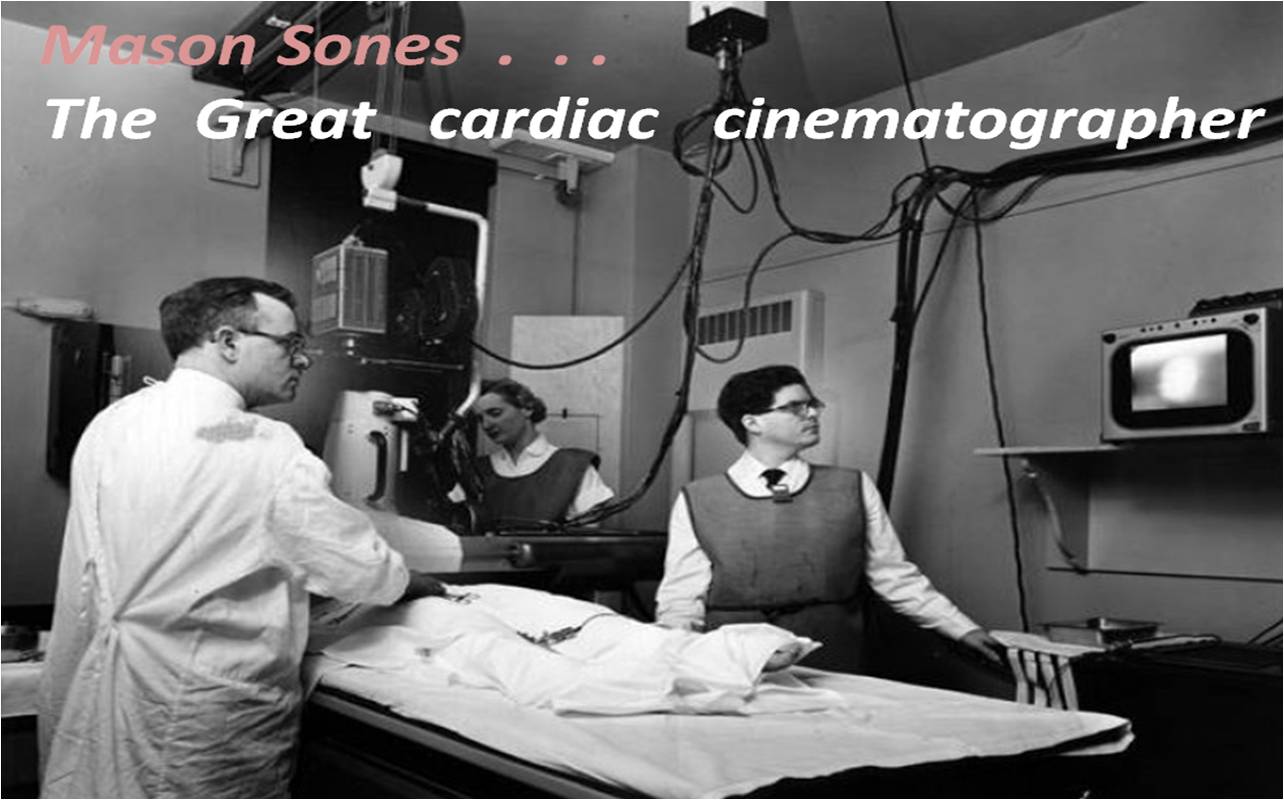
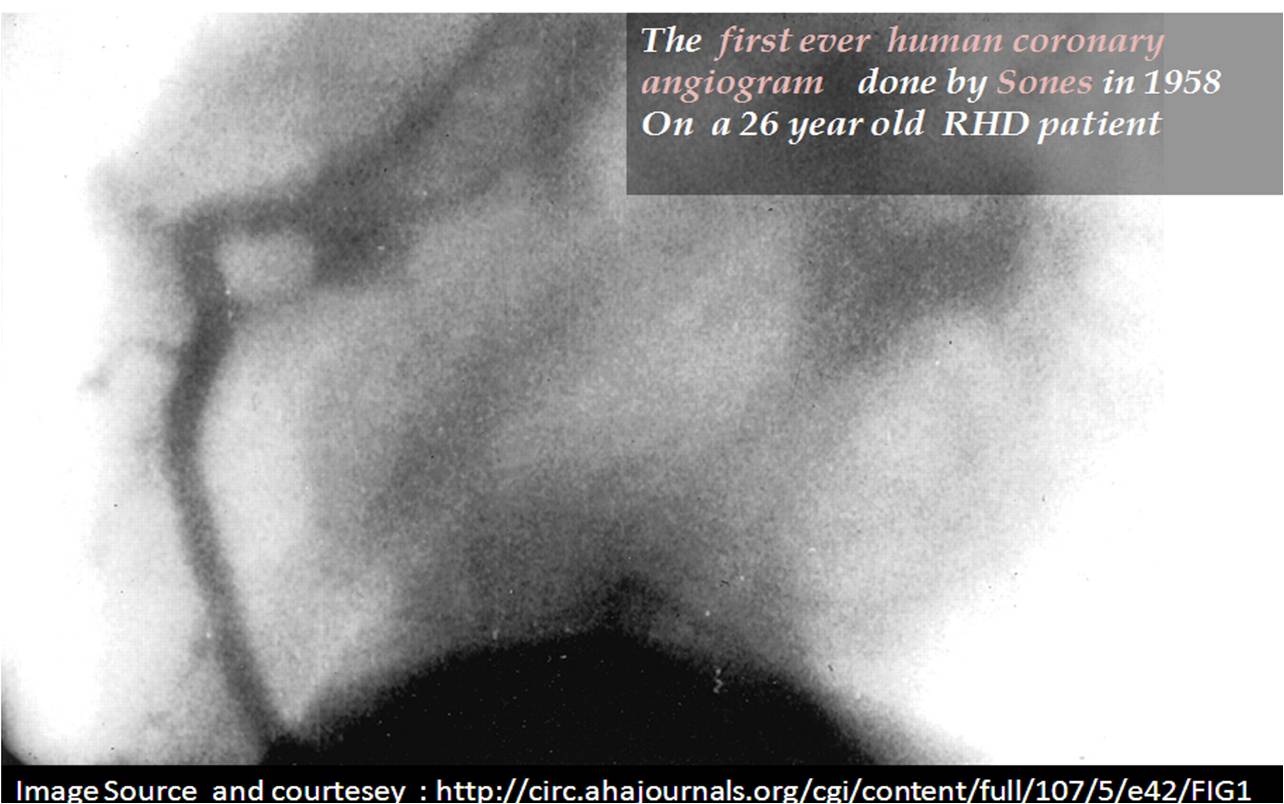
That was the moment , the concept of diagnostic coronary angiogram was born . He published his observation as an abstract in Circulation journal. Later he did many experiments with video engineering at Kodak labs , X ray technology to improve the cine imaging .By 1964 , he devised a perfect protocol for doing selective coronary angiogram. Then along with Rene Favaloro he pioneered CABG surgery in USA.
Final message
Cardiac catheterisation was invented by Forssman , Cournand , and Richards ,(Nobel prize 1956 ). It was Sones who took it into the coronary arteries and thus it was made possible for a whole new specialty of coronary diagnostics and therapeutic PCI which was conceptualized by another extraordinary human life called Gruentzig. Sones along with Gruentzig definitely deserve a Nobel in medicine which i think will happen soon ! They lived a great life constantly thinking, innovating putting patients interest in the fore front .
Mean while , I argue our youngsters to portray the images of these giants in every cath lab they work .You may get their blessings from heaven , provided you do your interventions with integrity and honesty without any conflict of interest in the patient care.
Do not cry foul when some genuine errors happen in cath lab.Few among us (like Sones ) may innovate those mistakes into glory !
Reference
http://en.wikipedia.org/wiki/F._Mason_Sones#cite_note-3
http://www.wired.com/thisdayintech/2009/10/1030first-coronary-angiogram/
Categories
-

-
The contents of the this blog is being published as Kindle E book , as per the request of many of the readers. Every article will continue to be open source in this site. Again I shall reiterate the book format is not aimed at any commercial intent. It is only to facilitate learning in a single book format Here is the link to book
https://amzn.in/d/euhL5vu Archives
- March 2026 (5)
- February 2026 (8)
- January 2026 (8)
- December 2025 (11)
- November 2025 (7)
- October 2025 (8)
- September 2025 (7)
- August 2025 (9)
- July 2025 (10)
- June 2025 (8)
- May 2025 (9)
- April 2025 (7)
- March 2025 (10)
- February 2025 (4)
- January 2025 (9)
- December 2024 (11)
- November 2024 (8)
- October 2024 (10)
- September 2024 (5)
- August 2024 (5)
- July 2024 (6)
- June 2024 (5)
- May 2024 (4)
- April 2024 (7)
- March 2024 (4)
- February 2024 (8)
- January 2024 (6)
- December 2023 (8)
- November 2023 (13)
- October 2023 (14)
- September 2023 (5)
- August 2023 (6)
- July 2023 (10)
- June 2023 (5)
- May 2023 (5)
- April 2023 (4)
- March 2023 (5)
- February 2023 (2)
- January 2023 (7)
- December 2022 (3)
- November 2022 (5)
- October 2022 (5)
- September 2022 (4)
- August 2022 (3)
- July 2022 (9)
- June 2022 (2)
- May 2022 (1)
- April 2022 (2)
- March 2022 (1)
- February 2022 (3)
- January 2022 (7)
- December 2021 (3)
- November 2021 (5)
- October 2021 (8)
- September 2021 (4)
- August 2021 (6)
- July 2021 (6)
- June 2021 (7)
- May 2021 (5)
- April 2021 (4)
- March 2021 (3)
- February 2021 (6)
- January 2021 (8)
- December 2020 (4)
- November 2020 (5)
- October 2020 (7)
- September 2020 (7)
- August 2020 (10)
- July 2020 (6)
- June 2020 (9)
- May 2020 (9)
- April 2020 (5)
- March 2020 (7)
- February 2020 (3)
- January 2020 (4)
- December 2019 (4)
- November 2019 (6)
- October 2019 (3)
- September 2019 (6)
- August 2019 (3)
- July 2019 (1)
- June 2019 (3)
- May 2019 (2)
- April 2019 (2)
- March 2019 (2)
- February 2019 (4)
- January 2019 (2)
- December 2018 (2)
- November 2018 (2)
- October 2018 (2)
- September 2018 (1)
- August 2018 (2)
- July 2018 (3)
- June 2018 (1)
- May 2018 (3)
- April 2018 (1)
- March 2018 (3)
- February 2018 (3)
- January 2018 (1)
- December 2017 (3)
- November 2017 (3)
- October 2017 (3)
- September 2017 (2)
- August 2017 (2)
- July 2017 (2)
- June 2017 (2)
- May 2017 (4)
- April 2017 (3)
- March 2017 (3)
- February 2017 (5)
- January 2017 (3)
- December 2016 (2)
- November 2016 (5)
- October 2016 (4)
- September 2016 (3)
- August 2016 (5)
- July 2016 (3)
- June 2016 (4)
- May 2016 (3)
- April 2016 (6)
- March 2016 (4)
- February 2016 (3)
- January 2016 (5)
- December 2015 (6)
- November 2015 (5)
- October 2015 (8)
- September 2015 (2)
- August 2015 (5)
- July 2015 (7)
- June 2015 (4)
- May 2015 (6)
- April 2015 (5)
- March 2015 (7)
- February 2015 (15)
- January 2015 (8)
- December 2014 (5)
- November 2014 (9)
- October 2014 (7)
- September 2014 (9)
- August 2014 (5)
- July 2014 (11)
- June 2014 (5)
- May 2014 (4)
- April 2014 (5)
- March 2014 (8)
- February 2014 (8)
- January 2014 (5)
- December 2013 (7)
- November 2013 (7)
- October 2013 (14)
- September 2013 (12)
- August 2013 (15)
- July 2013 (15)
- June 2013 (15)
- May 2013 (15)
- April 2013 (15)
- March 2013 (15)
- February 2013 (15)
- January 2013 (15)
- December 2012 (15)
- November 2012 (15)
- October 2012 (15)
- September 2012 (15)
- August 2012 (15)
- July 2012 (15)
- June 2012 (15)
- May 2012 (15)
- April 2012 (15)
- March 2012 (15)
- February 2012 (15)
- January 2012 (15)
- December 2011 (15)
- November 2011 (17)
- October 2011 (17)
- September 2011 (17)
- August 2011 (21)
- July 2011 (20)
- June 2011 (17)
- May 2011 (15)
- April 2011 (17)
- March 2011 (25)
- February 2011 (20)
- January 2011 (20)
- December 2010 (18)
- November 2010 (21)
- October 2010 (21)
- September 2010 (25)
- August 2010 (20)
- July 2010 (10)
- June 2010 (11)
- May 2010 (19)
- April 2010 (16)
- March 2010 (14)
- February 2010 (22)
- January 2010 (18)
- December 2009 (20)
- November 2009 (20)
- October 2009 (3)
- September 2009 (21)
- August 2009 (19)
- July 2009 (12)
- June 2009 (12)
- May 2009 (11)
- April 2009 (15)
- March 2009 (21)
- February 2009 (4)
- January 2009 (12)
- December 2008 (13)
- November 2008 (9)
- October 2008 (22)
- September 2008 (20)
- August 2008 (16)
- July 2008 (14)
- June 2008 (7)
Blog Stats
- 6,630,670 hits
Please give your feed back .
Click below to see who is watching this website live !

- This site will never aim for profit. Still ,this donation link is added at the request of few visitors who wanted to contribute and of-course that will help make it sustainable .

Please Note

 Dr.S.Venkatesan MD